Why Your Body Syncs to a Beat
Jordan MillsJune 2, 2026 · 12 min read

Music can measurably push you harder. In one study, time to exhaustion was significantly longer with music, and total exercise duration rose from 22.48 minutes without music to 37.12 minutes with music in young adults. That is not just mood. It is your brain and body getting pulled into a shared timing system that makes movement feel more automatic. Researchers call that process auditory-motor synchronization (AMS).
Research-backed overview, not medical advice. If you have a heart, lung, hearing, or neurological condition, check with a clinician before changing training intensity or headphone use.
Why the body locks in
Auditory-motor synchronization is the brain’s ability to line up movement with sound: stepping, pedaling, or tapping on the beat. Think of it as a timing handshake between hearing and movement. The beat gives your motor system a schedule, and your body starts predicting the next moment instead of reacting late. If BPM basics are new to you, start there; this piece goes one layer deeper into the mechanism.
A useful analogy is a metronome and pendulum. The metronome sets a steady pulse while the pendulum swings in a predictable rhythm; when they interact, each one can stabilize the other until they move in sync. Your brain works similarly: external rhythm nudges internal neural oscillations, and those oscillations help movement land on time. Brown University research on metronome timing describes the same coupling idea in motor control labs.
How your brain anticipates the beat
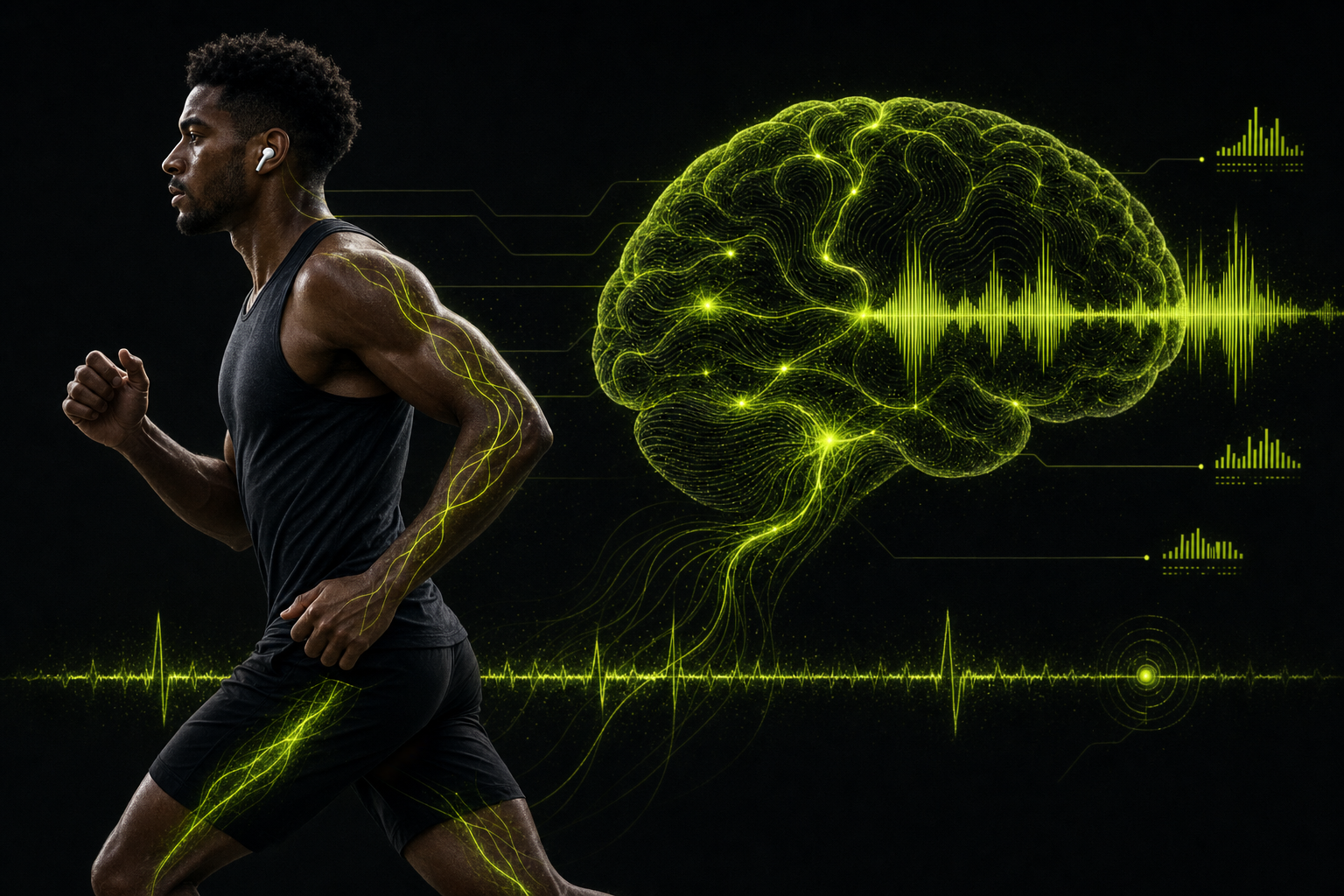
Neural entrainment means brain activity begins to line up with a repeating external rhythm. Instead of waiting for sound to arrive, the brain starts leaning toward the next beat, which helps it prepare the next step, pedal stroke, or stroke more efficiently.
That is why people often tap slightly ahead of the click in synchronization tasks: the brain is predicting the beat rather than merely chasing it. Prediction is the core of rhythmic movement, and it is one reason music can make exercise feel smoother and less effortful. For the dopamine and performance layer on top of timing, see your brain on music during a workout.
Brain regions involved
The motor cortex is part of the execution team. Studies of rhythm and timing show motor areas stay active even when people only listen to rhythm, which suggests the brain is simulating movement before it happens. In beat-based tasks, the premotor cortex and supplementary motor area help encode timing and prepare actions in advance. PLOS Biology work on passive rhythm listening supports that simulation idea.
- Your brain locks your steps to the beat
- It keeps your rhythm steady, like a metronome
- Movement gets more efficient-less wasted energy
- Music you love releases dopamine (a feel-good chemical)
- You get the same buzz as a favorite treat
- You feel more driven to push
- Fast, loud music revs you up
- Adrenaline and heart rate tick upward
- Muscles feel "psyched up" and ready
- Your attention shifts to the music
- It pulls your mind off the burn
- The effort starts to feel easier
The basal ganglia act as a beat-keeping hub in the subcortical network. Research on rhythmic priming and rhythm-based language effects points to the basal ganglia as a key structure for both beat perception and timing-related processing. In practical terms, they help the brain hold a stable pulse so movement does not drift off tempo. PMC reviews on rhythmic priming summarize that role.
A 2024 scoping review found converging evidence that auditory-motor synchronization engages bilateral cortical and subcortical networks, including the supplementary motor area, premotor cortex, ventrolateral prefrontal cortex, basal ganglia, and cerebellum. The supplementary motor area and basal ganglia are especially important for beat-based timing and internally guided rhythmic movement.
Rhythmic priming explained
Rhythmic priming is the idea that hearing a regular beat can warm up the brain for later timing tasks. In language research, regular rhythmic primes improved grammaticality judgments in children, while non-linguistic control tasks did not show the same effect, which suggests a rhythm-specific boost rather than general arousal alone.
That matters for exercise because the same timing systems that support speech and grammar are also tied to movement timing. When your brain gets a steady beat first, it may become better at anticipating upcoming actions, which can make repetitive movement feel more natural. Recent AMS trend reviews tie that priming logic directly to motor learning.
Key research findings
Music extended exercise time in one study
What your brain is doing
Think of a workout beat as a scaffold. The auditory system hears the pulse, premotor and motor regions prepare the movement, and the basal ganglia help maintain rhythm so the body can keep matching the pattern without constant conscious correction. Recent PMC work on auditory-motor coupling frames that scaffold as reduced timing friction: the beat has already done part of the prediction work.
Research also suggests the effects depend on tempo and context. In exercise studies, music improved performance and endurance, and authors noted it can delay fatigue and increase exercise capacity. Rhythmic auditory stimulation has also improved tapping performance and reduced timing variability, showing that external rhythm can sharpen motor regularity.
What this means for your workout
If you want music to help, the biggest benefit is usually not hype alone; it is better timing. A steady rhythm can reduce moment-to-moment decision-making your brain has to do, which may help you sustain effort longer and keep cadence more consistent.
- Use a clear, regular beat for steady-state cardio, runs, rides, or rowing.
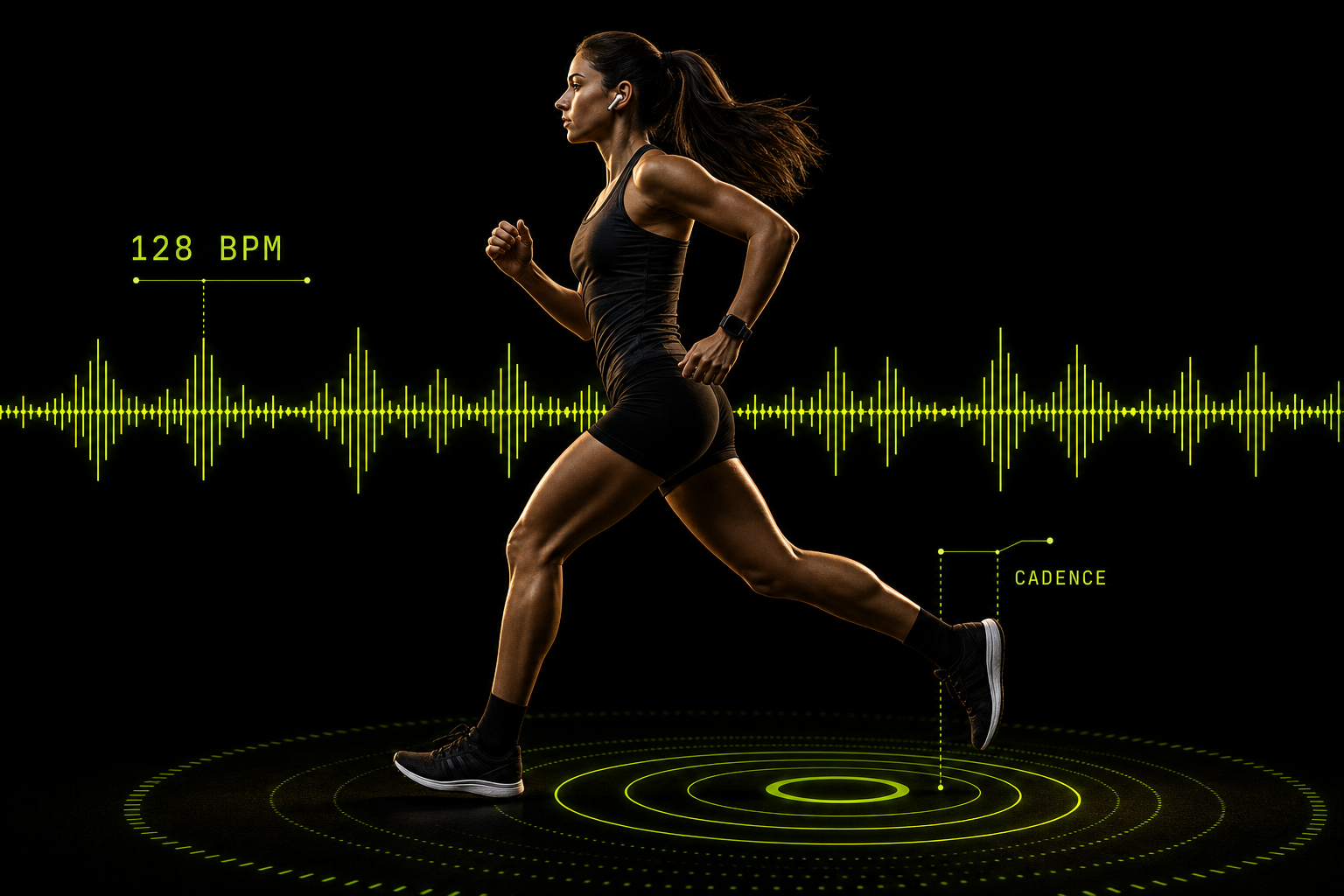
- Match the beat to target cadence so stride or stroke can lock in more easily.
- Lean on rhythm under fatigue, when timing support matters most.
- Save irregular playlists for sessions where mood matters more than cadence.
The evidence does not mean every song helps every workout equally. But rhythm is more than background entertainment: it can function like a timing aid for the nervous system. For EEG-level vocabulary around the same idea, music, brain rhythms, and exercise picks up the thread.
Why Repbeats fits
Repbeats automates the timing support your brain is already looking for. Instead of forcing you to mentally count reps or chase cadence, the system turns rhythm into a built-in guide that helps your body stay synchronized with the work.
Sources
- Scoping reviews and trend papers on auditory-motor synchronization (AMS) in exercise and motor learning.
- Studies of exercise duration and time to exhaustion with versus without music in young adults.
- Beat-based timing research on premotor cortex, supplementary motor area, and basal ganglia during rhythm listening and movement.
- Work on rhythmic priming and grammaticality judgments in children versus non-linguistic controls.
- Reviews of rhythmic auditory stimulation, tapping variability, and fatigue during sustained effort.