Your Brain on Music During a Workout
Jordan MillsMay 31, 2026 · 14 min read
Hit play and your body changes gears. The right song does not just keep you company-it quietly flips switches in your brain that help you move better, push harder, and feel like the work is easier. Scientists have studied this for years, and the takeaway is simple: good workout music is one of the cheapest, most reliable ways to get more out of a session.
Quick note: this summarizes published research, not medical advice. If you have a health condition, take medication, or have any pain or hearing concerns, check with a doctor first.
What music does inside your head
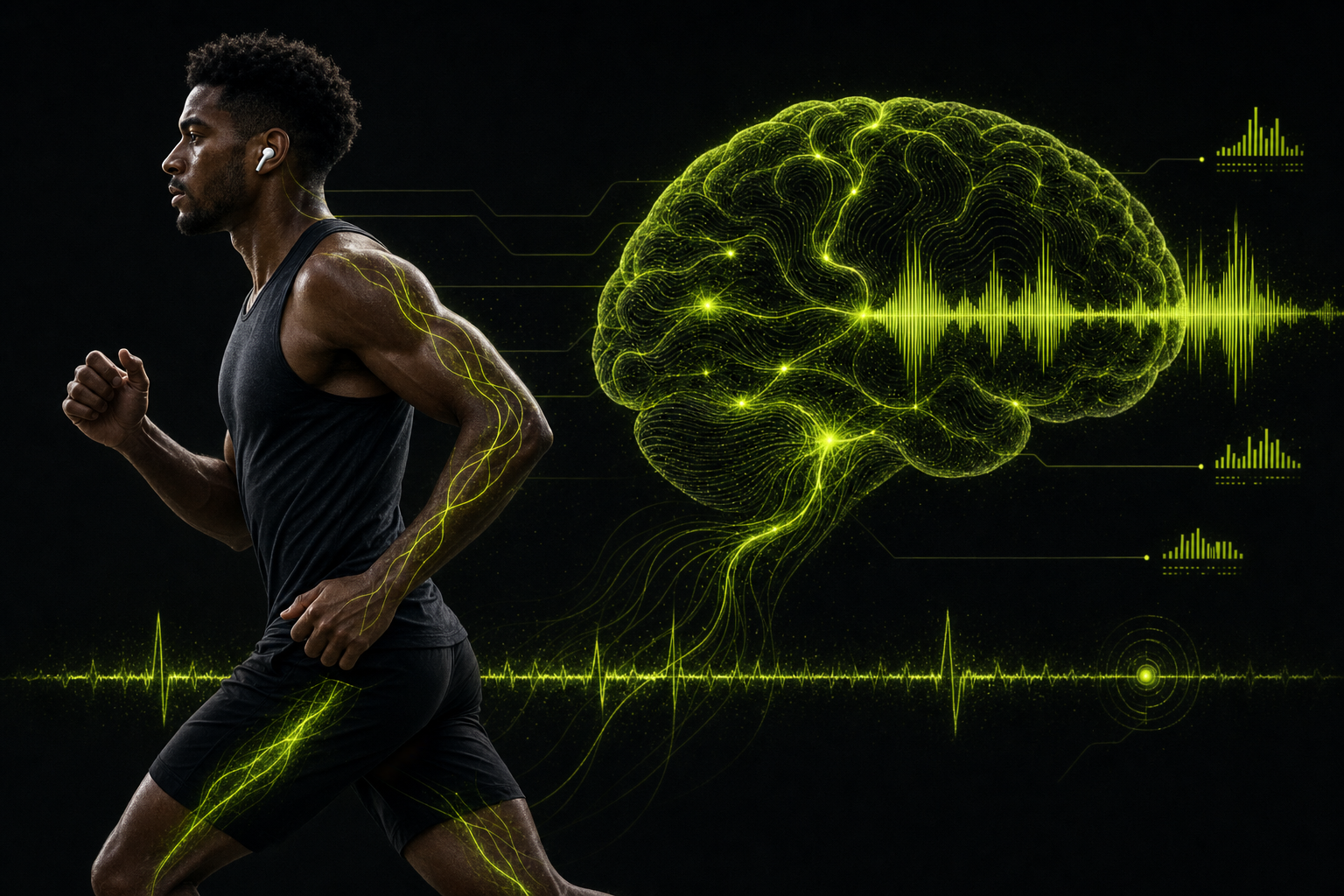
Music comes in through your ears, but it does not stop there. It spreads to four other parts of the brain-the parts that handle movement, motivation, energy, and focus. They all light up at once, which is why a great song seems to help in several ways at the same time. Here is the simple version.
- Your brain locks your steps to the beat
- It keeps your rhythm steady, like a metronome
- Movement gets more efficient-less wasted energy
- Music you love releases dopamine (a feel-good chemical)
- You get the same buzz as a favorite treat
- You feel more driven to push
- Fast, loud music revs you up
- Adrenaline and heart rate tick upward
- Muscles feel "psyched up" and ready
- Your attention shifts to the music
- It pulls your mind off the burn
- The effort starts to feel easier
It helps you move in time
When a beat plays, your brain starts syncing your steps or pedal strokes to it-almost like an internal metronome you do not have to think about. Moving in time with the music is more efficient: in one study, cyclists who pedaled to the beat used less oxygen to do the same amount of work. Same effort, less wasted energy. This locking-on has a name-if you want the deeper dive, here is the science of neural entrainment and brain rhythms.
It makes you want to keep going
Music you enjoy releases dopamine, a feel-good brain chemical-the same one tied to things like a favorite meal. Researchers (Ferreri and colleagues, 2019) proved the link: boosting dopamine made music feel more pleasurable, and blocking it took the joy away. During a workout, that little hit of dopamine turns into extra motivation to push.
It revs you up and takes your mind off the pain
Fast, upbeat music works like a friendly distraction. It pulls your attention away from how tired you feel and toward the beat, so the same effort feels easier. At the same time it gives you a small jolt of adrenaline-your heart rate ticks up, your muscles feel "psyched up," and you are ready to go harder.
Does it actually improve performance? Yes.
When researchers gathered all the studies together, the pattern was clear: music people choose for themselves usually helps. In one big review (Ballmann and colleagues, 2023), most endurance studies and the large majority of sprint and power studies found better results with music.
How often music improved performance
The real-world numbers are impressive. Runners covered about 10% more ground in a 6-minute test when they listened to music they liked-and they did not even feel like they were working harder (Jebabli et al., 2020). Swimmers went farther with faster music than with slower music, again without their heart rate or effort feeling any higher (Aburto-Corona et al., 2023).
Swimmers went farther with faster music
Lifting gets a boost too. When trained men listened to a few minutes of pump-up music before bench pressing, they moved the bar faster, produced more power, and squeezed out more reps (Ballmann et al., 2021)-a big improvement for such a simple, free trick.
Pump-up music improved every part of the lift
One exception: music is great for powering through effort, but it can slightly slow your reactions on tasks that need split-second timing. So use it to push hard and go long-not for drills where precise timing matters most.
| Study | Who & what | Music | What happened |
|---|---|---|---|
| Aburto-Corona 2023 | 16 swimmers, 12-min swim | Fast vs slower beat | Swam farther with faster music; effort and heart rate stayed the same |
| Jebabli 2020 | 20 runners, 6-min run | Own pick vs no music | Ran about 10% farther; less muscle burn; did not feel any harder |
| Ballmann 2021 | 10 lifters, bench press | Pump-up music first | More power, faster bar speed, and more reps |
| Nakamura 2010 | 15 cyclists, 20-min ride | Preferred vs not | Rode farther and it felt easier; heart rate unchanged |
What happens in your body
Music’s effect on your body is gentle but real. At the same pace, it does not change your heart rate much. Where it helps is efficiency-syncing to a beat can mean using less oxygen for the same work. Several studies also found less lactate (the stuff linked to that muscle "burn") left in the blood afterward, which may help you recover a little faster.
The hormone side is less certain. One small study hinted that music might lower the stress hormone cortisol and raise feel-good chemicals after exercise, but the effect was not strong enough to be sure. Promising, but not proven.
How it makes you feel
This is where music wins most clearly. Songs you like lift your mood, boost your motivation, and take the edge off discomfort. In sprint studies, almost everyone felt more motivated with their own music. People often say the workout "flew by"-even though the physical effort was exactly the same.
- Motivation jumps. In about 9 out of 10 sprint studies, people felt more driven with music they picked.
- You can hit "the zone" more easily. A steady beat gives a sense of control and flow.
- The burn feels smaller. Music distracts you from discomfort, so hard efforts feel easier.
- Lyrics can help-or distract. Uplifting words add fuel, but busy lyrics can break your focus during tricky movements.
How to use music in your workouts
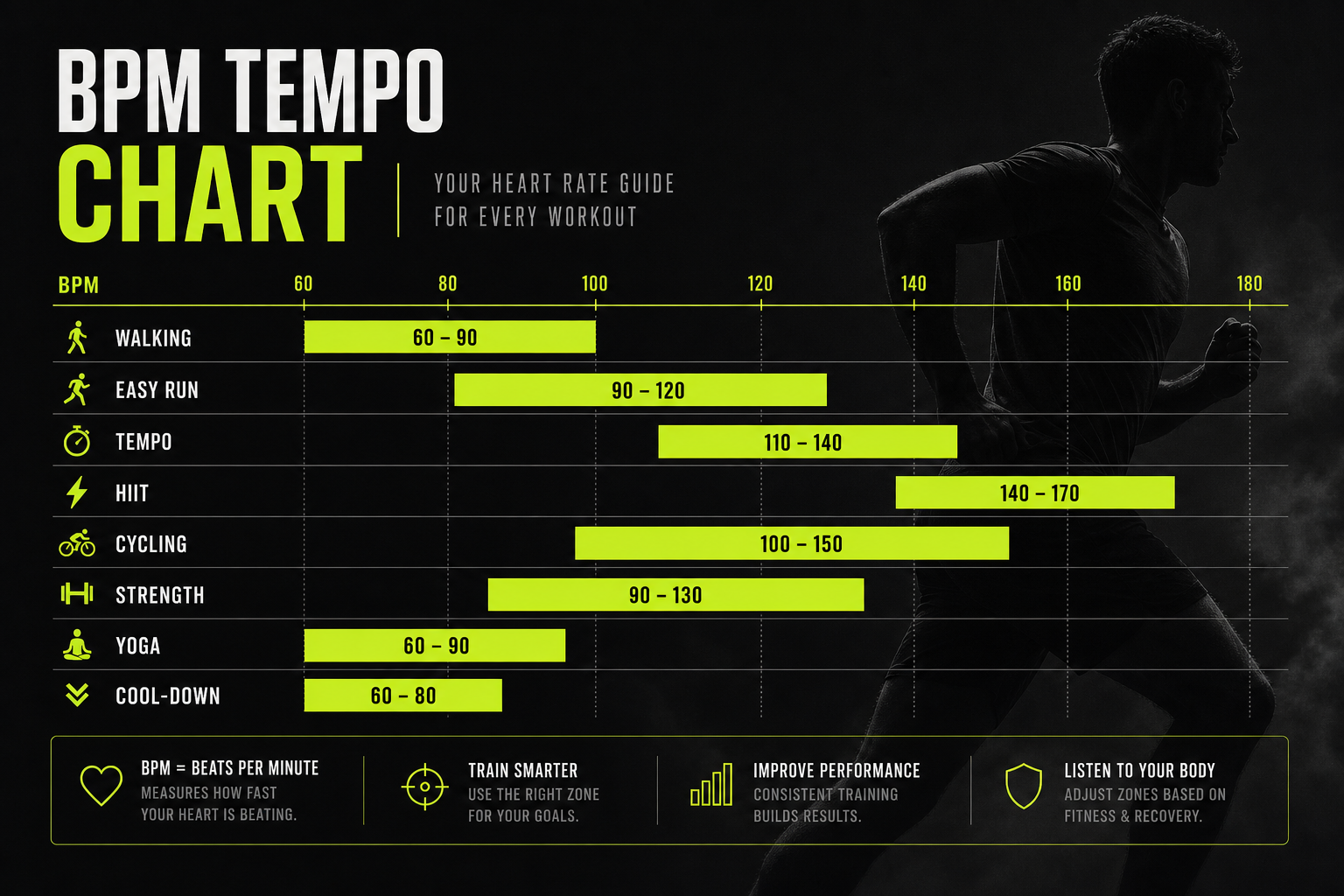
Tempo-how fast the beat is-matters most, and faster usually wins. A 2024 study found fast songs (around 150 BPM) felt the best and made effort feel easiest, while slow songs (around 90 BPM) were the least enjoyable. If you want the deeper picture of how song tempo changes your effort and pace, we cover it on its own. Here is a simple guide that lines up with expert (ACSM) recommendations.
- Match the beat to your steps. Pick songs with a steady beat and, for running or cycling, try to step or pedal in time. Skip choppy, unpredictable rhythms when you need to focus on form.
- Keep the volume sensible. Loud enough to energize (around 70–80 dB), not blasting. Too loud can actually hurt your focus and reactions; too quiet does nothing. Stay aware of your form and your surroundings.
- Always pick your own music. Songs you choose work far better than someone else’s playlist.
- Lyrics are your call. Use them if they fire you up; switch to instrumentals (like EDM or rock) when you really need to concentrate.
| When | Beat (BPM) | What to play |
|---|---|---|
| Warm-up | 100–120 | Upbeat but easy-light pop or chill tracks |
| Hard / fast work | 130–160 | High-energy rock, EDM, or hip-hop |
| Cool-down | Under 100 | Calm music-ambient, classical, easy jazz |
What we still don’t know
The evidence strongly says music helps, but it is not perfect. A few honest caveats.
- Small groups. Many studies used just a handful of people, often young men, so we cannot be sure the numbers fit everyone.
- Different setups. "Music you like" and the things it was compared against vary from study to study, which makes them hard to combine.
- Limited brain data. Most brain explanations are educated guesses; few studies measure the brain and performance at the same time during exercise.
- Open questions. Which matters more-the tempo, the melody, or the lyrics? Does training with music for months change the brain? We do not fully know yet.
For Repbeats listeners, the lesson is simple: the beat should follow your body. Music that drifts away from your pace-or peaks when you are trying to recover-works against the very results you are chasing.
References
- Pranjic, M., et al. (2024). From Sound to Movement: Mapping the Neural Mechanisms of Auditory–Motor Entrainment and Synchronization. *Brain Sciences, 14*(11), 1063.
- Ferreri, L., Mas-Herrero, E., et al. (2019). Dopamine modulates the reward experiences elicited by music. *PNAS, 116*(9), 3793–3798.
- Ballmann, C. G., Parker, M. G., & Post, E. S. (2023). Effects of Music Choice on Performance and Psychophysiological Responses to Exercise-A Scoping Review. *J. Functional Morphology and Kinesiology.*
- Jones, L., Karageorghis, C. I., et al. (2024). The exercise intensity–music-tempo preference relationship: A decennial revisit. *Psychology of Sport and Exercise, 74*, 102644.
- Bacon, C. J., Myers, T. R., & Karageorghis, C. I. (2012). Effect of music-movement synchrony on exercise oxygen consumption. *J. Sports Medicine and Physical Fitness, 52*(4), 359–365.
- Ballmann, C. G., et al. (2021). Effect of pre-exercise music on bench press power, velocity, and repetition volume. *Perceptual and Motor Skills, 128*(3), 1183–1196.
- Aburto-Corona, J. A., et al. (2023). Listening to fast-tempo music improves physical performance in recreational swimmers. *Research Quarterly for Exercise and Sport, 94*(2), 578–585.
- Jebabli, N., et al. (2020). Listening to preferred music improved running performance without changing the pacing pattern during a 6-minute run test. *Sports (Basel), 8*(5), 61.
- Nakamura, P. M., et al. (2010). Effects of preferred and nonpreferred music on continuous cycling exercise performance. *Perceptual and Motor Skills, 110*, 257–264.
- American College of Sports Medicine (2022). ACSM’s Resources for the Group Exercise Instructor (2nd ed.). Music tempo guidelines.