Best BPM for Every Workout Type: A Complete Tempo Chart
Jordan MillsJune 5, 2026 · 14 min read
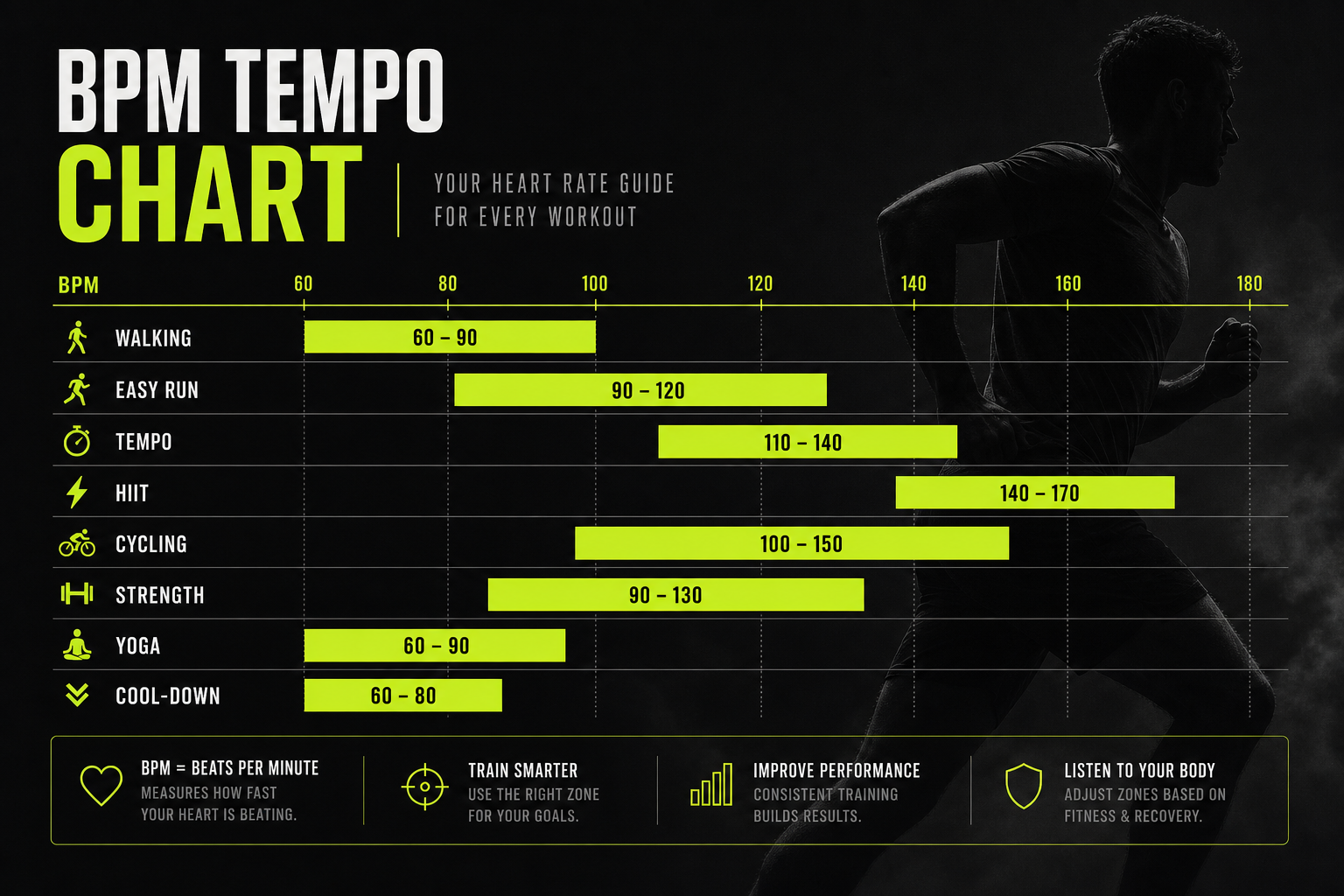
Bookmark this page. Beats per minute (BPM) is the simplest performance variable most athletes ignore: song tempo either matches your movement rhythm or fights it. Match it and perceived effort drops, cadence stabilizes, and sessions feel coherent. Fight it and every mile or rep costs more than it should. This is the complete Repbeats tempo chart—ranges by workout type, the physiology behind each band, and a method to find your numbers instead of copying a generic playlist.
New to BPM? Start with what beats per minute means for your workout. Ready for depth on entrainment and RPE? See auditory-motor synchronization and how tempo lowers perceived exertion. This guide is the reference layer between those pieces.
Ranges below follow widely cited exercise-music guidelines (including ACSM group-exercise tempo bands) and running-cadence research. They are starting points. Limb length, fitness, terrain, and music genre all shift the sweet spot—which is why the chart ends with a personal calibration protocol.
Master BPM Reference Chart
The table below is designed to be screenshotted and shared. Each row links workout intent to a tempo band, typical perceived effort, and the physiological job that band does.
| Workout type | BPM range | Typical RPE | Cadence / rhythm target | Why this tempo works |
|---|---|---|---|---|
| Walking | 100–120 | 3–4 | 90–120 steps/min | Supports brisk gait without over-striding; parasympathetic-friendly pace |
| Easy run | 140–155 | 5–6 | 140–155 spm (1 step per beat) | Locks aerobic cadence; lowers bounce and braking at conversational effort |
| Tempo run | 155–170 | 7–8 | 155–170 spm or half-beat stride | Raises turnover and sympathetic drive for sustained threshold work |
| HIIT | 165–180 | 8–9+ | 165–180+ spm on work intervals | Maximizes arousal and step rate for short, high-output bursts |
| Cycling | 110–140 | 4–7 | 60–100 rpm (often half- or quarter-beat) | Matches pedal cadence bands for endurance without spastic revving |
| Strength | 100–130 | 6–8 | Rep tempo: ~2–4 s eccentric + concentric | Steadies bar speed and breathing; avoids rushed reps under load |
| Yoga / mobility | 60–90 | 1–3 | Slow breath cycles (4–6 s inhale/exhale) | Down-regulates HR and HRV; supports parasympathetic recovery |
| Cool-down | 70–90 | 2–4 | Slow walk or nasal breathing | Accelerates sympathetic off-ramp after hard sessions |
How to Read the Chart
| Symbol / term | Meaning |
|---|---|
| BPM | Beats per minute in the song—the metronome your brain entrainment system locks onto |
| spm | Steps per minute (running). Often matches BPM when you strike once per beat |
| rpm | Revolutions per minute (cycling). Frequently synced at half-beat (divide BPM by 2) |
| RPE | Rate of perceived exertion on a 0–10 scale; see RPE and music |
| ±5–10 BPM | Normal individual variance—tune by feel, not dogma |
Walking: 100–120 BPM
Brisk walking sits in a narrow mechanical window. Below ~100 BPM, the beat feels sluggish relative to a purposeful walk; above ~120 BPM, you are tempted to jog to stay on rhythm. The 100–120 band supports a 90–120 steps-per-minute gait—fast enough for heart-health benefits, slow enough to keep nasal breathing and low impact.
Physiologically, this range keeps you in parasympathetic-dominant territory: heart rate modest, cortisol low, movement automatic. Music here acts as a pacing governor for recovery walks, treadmill warm-ups, and active-rest days. LISS and recovery programming often lives in this lane.
| Walking context | Suggested BPM | Notes |
|---|---|---|
| Recovery stroll | 95–105 | Emphasis on relaxation, not speed |
| Brisk health walk | 105–115 | ACSM-aligned brisk walking cadence |
| Incline / power walk | 115–120 | Short strides; do not chase jog tempo |
Easy Run: 140–155 BPM
Easy running is aerobic base building—conversation pace, nasal breathing if possible, RPE 5–6. Cadence research consistently clusters recreational runners around 150–180 spm, with many finding 140–155 comfortable when syncing one footstrike per beat. That 1:1 coupling is the sweet spot for auditory-motor synchronization: the beat externalizes turnover without forcing a sprint stride.
Why it works: at easy intensity, elastic energy return in tendons favors quicker, lighter steps. A 140–155 BPM track reduces over-striding and vertical bounce—common inefficiencies when runners self-select a slow playlist. Heart rate stays in zone 2; music lowers RPE so you accumulate more minutes at the same physiological load.
| Runner profile | Start BPM | Sync pattern |
|---|---|---|
| Newer runner, shorter stride | 140–145 | 1 step per beat |
| Average recreational | 145–150 | 1 step per beat |
| Taller / naturally higher cadence | 150–155 | 1 step per beat or every other beat at 75–78 spm feel |
Tempo Run: 155–170 BPM
Tempo work is sustained discomfort—threshold pace, RPE 7–8, lactate steady-state. You need higher sympathetic tone without tipping into an all-out sprint. 155–170 BPM raises step rate and arousal while remaining rhythmically stable for 20–40 minute blocks.
Mechanism: faster periodic input increases central motor drive and reduces ground-contact variability. Runners often use one step per beat at the low end (155–160) or half-beat sync (feel 78–85 spm against a 160–170 track) if turnover already runs high. Wrong tempo here—a 130 BPM ballad on a tempo day—raises perceived strain because movement and music diverge.
| Tempo session | BPM | RPE target |
|---|---|---|
| Cruise intervals (3–8 min) | 158–165 | 7 |
| Continuous tempo (20–30 min) | 155–162 | 7–8 |
| Progression finish | 165–170 | 8 |
HIIT: 165–180 BPM
High-intensity intervals demand maximum turnover and arousal in short windows. 165–180 BPM aligns with work-phase step rates for sprints, hill repeats, and bike erg bursts. This is where music’s ergogenic effect is most motivational and least about lowering RPE—near-max efforts still hurt, but the beat keeps you on cadence when glycogen and willpower dip.
Physiology: fast-tempo auditory cues increase beta-band motor engagement and blunt attention to fatigue signals early in the interval. Use this band only on work phases; pair with cool-down tempos (70–90 BPM) or walking (100–120) on recovery intervals so autonomic load can drop. See HIIT vs MISS vs LISS for how intervals fit the weekly mix.
| HIIT format | Work-phase BPM | Recovery-phase BPM |
|---|---|---|
| 30 s on / 90 s off | 170–180 | 100–120 walk or silence |
| 1 min on / 1 min off | 165–175 | 90–110 |
| Tabata (20 s / 10 s) | 175–180+ | Silence or 80–90 on micro-rest |
Cycling: 110–140 BPM
Cycling cadence and running cadence are different animals. Most endurance riding lives at 60–100 rpm. Because one pedal stroke is a half-cycle relative to a full beat, cyclists often sync at half-beat (BPM ≈ 2× rpm) or quarter-beat for high-cadence drills.
The 110–140 BPM band maps cleanly to 55–70 rpm (half-beat) through 110–140 rpm (1:1 for spin-class standing climbs). It supports steady aerobic work without the metronome feeling frantic. Above 140 BPM on seated endurance rides, riders often bounce in the saddle—a sign to drop tempo or switch sync ratio.
| Ride type | BPM | Typical rpm (half-beat sync) |
|---|---|---|
| Recovery spin | 110–120 | 55–60 |
| Endurance / zone 2 | 120–130 | 60–65 |
| Tempo / sweet spot | 130–140 | 65–70 |
| High-cadence drills | 140–160 | 70–80 (or quarter-beat at lower BPM) |
Strength Training: 100–130 BPM
Lifting is rep-tempo work, not footstrike cadence. A controlled squat or press often runs 2–4 seconds per rep (eccentric + concentric), which translates to roughly 15–30 reps per minute per set—or 30–60 BPM if you synced every rep. In practice, athletes feel better with 100–130 BPM background tempo: the beat structures rest periods and keeps bar velocity honest without rushing load.
Why 100–130 works: it maintains moderate sympathetic arousal for focus and bracing, avoids the panic of 170 BPM on a heavy deadlift, and leaves room for breathing between reps. Pre-lift music in this band has been associated with higher power and rep volume in some trials—see can a playlist make you stronger?. For technical lifts, drop toward 100 BPM or switch instrumental tracks with minimal lyrical distraction.
| Lift style | BPM | Sync tip |
|---|---|---|
| Heavy singles / doubles | 95–110 | Breath on bar, not on every beat |
| Hypertrophy sets (8–12) | 110–120 | Downbeat on eccentric start |
| Metabolic circuits | 120–130 | Rep or station change each 4–8 beats |
Yoga & Mobility: 60–90 BPM
Yoga, stretching, and breath-led mobility target parasympathetic recovery: slow heart rate, long exhales, stable HRV. 60–90 BPM mirrors 4–6 second breath cycles and avoids cortisol-spiking tempos that belong on a tempo run.
Neurologically, sub-90 BPM material reduces sensory load and supports interoceptive attention (feeling position and breath). Fast lyrics fight holds and nasal breathing. If you use music at all here, favor ambient, classical, or downtempo instrumentals without sharp transients.
| Practice | BPM | Breath anchor |
|---|---|---|
| Yin / restorative | 60–75 | 6 s inhale / 6 s exhale |
| Vinyasa flow | 75–90 | Movement on 4-count breath |
| Foam rolling | 65–80 | Exhale on tender spots |
Cool-Down: 70–90 BPM
The cool-down job is sympathetic off-ramping: clear lactate, lower core temperature, restore HR toward baseline. 70–90 BPM signals the nervous system that work ended. It pairs with slow walking (overlap with 100–120 if you walk; stay at the low end if you stay stationary).
Skipping tempo decay—jumping from HIIT tracks straight to silence—can leave HR elevated and delay recovery. Rest and recovery timing matters as much as the main set; the playlist should reflect that arc.
| Prior session | Cool-down BPM | Duration |
|---|---|---|
| Hard run or HIIT | 70–80 | 8–15 min easy move + stretch |
| Strength | 75–85 | 5–10 min walk + breathing |
| Easy cardio | 80–90 | 5 min gradual fade |
Find Your Personal BPM
Charts are population averages. Your sweet spot depends on height, leg length, training history, and music taste. Use this four-step calibration instead of guessing from Spotify’s “workout” label.
- Measure natural cadence. On an easy run, count steps for 30 s and double (or use a watch). That spm is your easy-run anchor.
- Bracket ±5 BPM. Test tracks at spm−5, spm, and spm+5. The right song feels like it pulls you forward without sprinting you.
- Log RPE at fixed pace. Same route or treadmill speed; note RPE with each BPM bracket. Lowest RPE at matched pace wins.
- Re-test monthly. Fitness and fatigue shift cadence. Revisit after injury, deload, or pace breakthroughs.
| If you feel… | Adjustment |
|---|---|
| Behind the beat, dragging | Raise BPM by 3–5 |
| Choppy, over-striding, or anxious | Lower BPM by 3–5 or switch to half-beat sync |
| Fine on flats, wrong on hills | Let tempo rise with HR (manual phase change or adaptive playback) |
| Strong in gym, lost on runs | Separate lifting and running playlists—do not reuse HIIT BPM for easy days |
How Repbeats Auto-Detects Your Zone
Manual BPM matching breaks the moment pace, terrain, or interval phase changes. You know the right band for an easy run—until a hill pushes heart rate into tempo territory while your playlist stays at 145 BPM. Entrainment fractures; RPE climbs for no training benefit.
Repbeats reads wearable biometrics (heart rate, pace, workout phase) and shifts music tempo to keep you inside the zone you are actually training—not the zone you were in five minutes ago. Easy aerobic work holds 140–155; threshold blocks creep toward 155–170; HIIT spikes 165–180; recovery and cool-down pull 70–120 without you hunting for the next track.
- Zone-aware tempo replaces static playlists that lag behind your body.
- Phase transitions (warm-up → work → cool-down) follow session structure automatically.
- Personal calibration compounds over time as the system learns your cadence and HR response.
References
- American College of Sports Medicine (2022). ACSM’s Resources for the Group Exercise Instructor (2nd ed.). Music tempo guidelines by activity mode.
- Jones, L., Karageorghis, C. I., et al. (2024). The exercise intensity–music-tempo preference relationship: A decennial revisit. *Psychology of Sport and Exercise, 74*, 102644.
- Karageorghis, C. I., & Priest, D.-L. (2012). Music in the exercise domain: a review and synthesis (Part I & II). *International Review of Sport and Exercise Psychology, 5*(1), 44–66; 67–84.
- Heiderscheit, B. C., et al. (2011). Effects of step rate manipulation on joint mechanics during running. *Medicine & Science in Sports & Exercise, 43*(2), 296–302.
- Bacon, C. J., Myers, T. R., & Karageorghis, C. I. (2012). Effect of music-movement synchrony on exercise oxygen consumption. *Journal of Sports Medicine and Physical Fitness, 52*(4), 359–365.
- Terry, P. C., et al. (2012). Effects of synchronous music on treadmill running among elite triathletes. *Journal of Science and Medicine in Sport, 15*(1), 52–57.