HIIT vs LISS vs MISS Compared
Jordan MillsMay 24, 2026 · 15 min read

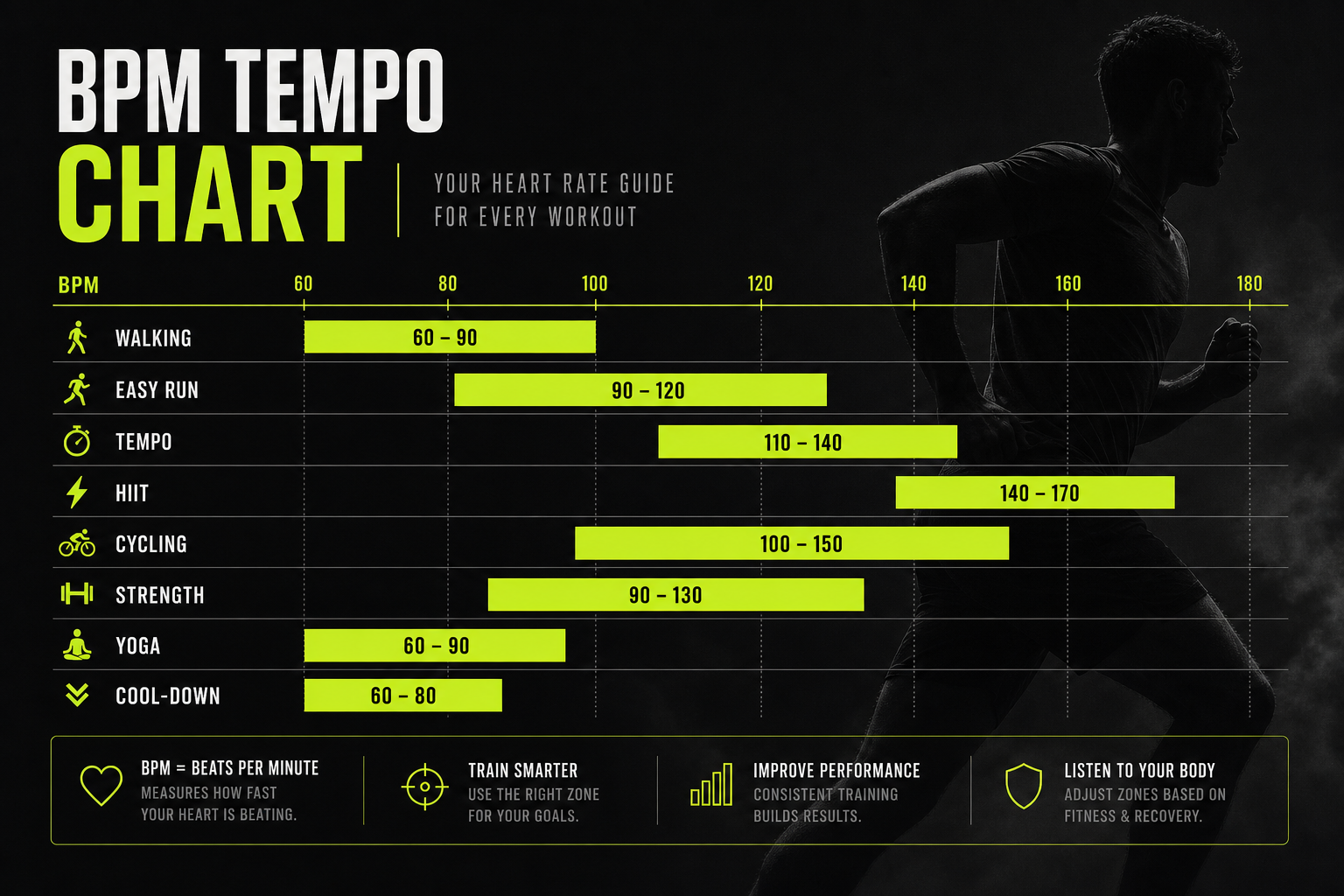
Few fitness debates are louder than HIIT vs MISS vs LISS. The good news: research says all three improve your fitness and health. They just get there by different routes-and each has a job it does best. Here is a clear, no-hype comparison, with the data and a simple weekly plan that uses all three. Unfamiliar with BPM and tempo bands? Read what beats per minute means for your workout first.
Quick note: this is a general summary of the research, not medical advice. If you have a heart, lung, or metabolic condition-or you are new to hard exercise-talk to a doctor before starting high-intensity work.
The three, defined
The simplest way to tell them apart is intensity-how hard you are working as a share of your maximum heart rate (HRmax).
- HIIT (high-intensity interval training): short bursts of near-maximal effort (about 80–95% HRmax) with rest in between. Think 4×4-minute hard intervals or 20s-on/10s-off. Sessions are short-often 10–30 minutes of work.
- MISS (moderate-intensity steady state): continuous effort at about 64–76% HRmax for 20–60 minutes. A steady jog, ride, or brisk elliptical-the workhorse of general fitness.
- LISS (low-intensity steady state): gentle, continuous effort (about 40–60% HRmax) for 30–60+ minutes, easy enough to hold a conversation. Walking, easy cycling, slow rowing.
What's happening inside
Heart and blood vessels
All three improve heart and vascular health, but HIIT pushes your heart’s stroke volume and peak output hardest, so it tends to drive bigger central gains-and better artery flexibility-per unit of time. Steady work (MISS and LISS) builds endurance by raising blood volume and capillary density; it just usually needs more total minutes to match HIIT’s heart remodeling.
Metabolism and the afterburn
During exercise, easy work (LISS/MISS) burns a higher share of fat, while HIIT leans on carbohydrate. But HIIT creates a bigger disturbance-glycogen depletion, lactate-that ramps up fat burning *after* you stop. That post-workout "afterburn" is called EPOC (excess post-exercise oxygen consumption), and HIIT produces more of it than an equal-calorie moderate session.
Mitochondria-your aerobic engine
Mitochondria are the cellular power plants that set your aerobic capacity. Both HIIT and steady work grow them, but HIIT’s intense stress appears to spark a stronger response (more biogenesis and network "fusion") per unit time. LISS reaches similar gains-it just takes a lot more volume to get there.
Head-to-head: the outcomes
For raw aerobic capacity (VO₂max), HIIT is the clear leader minute-for-minute. A recent review found HIIT improved VO₂max by about 3.24 mL·kg⁻¹·min⁻¹ versus about 2.23 for moderate training over comparable time.
VO₂max improvement: HIIT vs moderate training
Fat loss is a different story. When you match total work or calories burned, HIIT and steady cardio produce similar fat loss and body-composition change-a DXA-based meta-analysis in overweight adults found no significant difference. HIIT’s edge, where it exists, comes from a bit more muscle preservation and that post-workout afterburn.
Afterburn (EPOC) after an equal-calorie session
| Feature | HIIT | MISS | LISS |
|---|---|---|---|
| Intensity (% HRmax) | 80–95% | 64–76% | 40–60% |
| Typical session | 10–30 min | 20–60 min | 30–60+ min |
| VO₂max gain per hour | Highest | Moderate | Lowest |
| Fat loss (volume matched) | Similar | Similar | Similar |
| Afterburn (EPOC) | High | Moderate | Low |
| Time efficiency | Best | Moderate | Needs long sessions |
| Injury risk | Higher | Moderate | Lowest |
| Best for | Time-poor, fast fitness gains | General fitness, aerobic base | Beginners, recovery, easy on joints |
Match the method to your goal
You do not have to choose just one. The smartest plans blend modalities and weight them toward your goal.
- Pair short intervals with longer easy sessions
- Keep strength work 2–3×/week to protect muscle
- Diet and total volume drive the result
- Build an aerobic base with steady work
- Add intervals for speed and VO₂max
- Go polarized: ~80% easy, ~20% hard
- Meet the weekly activity guidelines
- Add 1–2 short HIIT sessions if you like
- Strength train twice a week
A sample training week
| Day | Fat loss | Endurance | Health |
|---|---|---|---|
| Mon | HIIT 20–30 min | Moderate run 40 min | Brisk walk 30–40 min |
| Tue | Rest / easy walk | HIIT 20 min | Strength (optional) |
| Wed | LISS 45 min | Easy swim or bike 30 min | Rest or LISS 30 min |
| Thu | HIIT 20 min | Moderate run 50 min | Moderate run 30 min |
| Fri | Rest / yoga | Cross-train or rest | Strength (2nd day) |
| Sat | LISS 60–90 min | Long easy ride 90 min | Leisure cycling 45 min |
| Sun | LISS or MISS (optional) | Rest or light jog | Rest or gentle yoga |
- Always warm up and cool down-5–10 minutes, especially before HIIT.
- Progress gradually. Add intervals or duration over weeks; do not jump straight to all-out efforts.
- Space your hard days. Give similar patterns ~48 hours and balance HIIT with easy or rest days-see how to time your rest days around training load.
- Vary the modality. Rotating HIIT, MISS, and LISS supports both performance and long-term adherence.
Who should do what
- New or sedentary: start with LISS/MISS to build a base, then add one short 10–15 min HIIT as fitness improves. Screen with a doctor if you have heart-risk factors.
- Recreationally active: 1–3 HIIT sessions a week on top of steady work breaks plateaus and saves time.
- Athletes: go polarized-roughly 80% easy (LISS/MISS) and 20% hard (HIIT race-pace intervals or sprints).
- Older adults: well-supervised HIIT is safe and effective-use shorter intervals with ample rest, and combine with moderate work.
- Clinical (obesity, type-2 diabetes, heart disease): both help, and HIIT is often a bit faster per minute, but start low, progress slowly, and follow medical advice. Supervised HIIT is used safely in cardiac rehab.
For Repbeats listeners: let the beat track the zone. HIIT wants sharp tempo jumps between work and recovery, MISS holds a steady groove, and LISS stays mellow-so your music should shift with the effort, not fight it. Dialing in the right music tempo for each cardio zone is half the work, and Repbeats automatically matches BPM to each phase so you do not have to think about it.
The evidence base
- Meta-analyses comparing HIIT vs moderate-intensity continuous training (MICT) for VO₂max in healthy adults and clinical populations.
- DXA-based body-composition meta-analysis: HIIT vs continuous training in overweight/obese adults (no significant difference when training volume is matched).
- Studies of excess post-exercise oxygen consumption (EPOC) comparing isocaloric HIIT and moderate exercise.
- Type-2 diabetes trials and reviews on HIIT vs MICT for HbA1c, fasting glucose, and insulin sensitivity.
- Reviews of HIIT safety and efficacy in older adults and supervised cardiac rehabilitation.
- Comparisons of adherence and enjoyment between supervised HIIT and moderate continuous training.