Can a Playlist Make You 15% Stronger?
Jordan MillsJune 4, 2026 · 11 min read
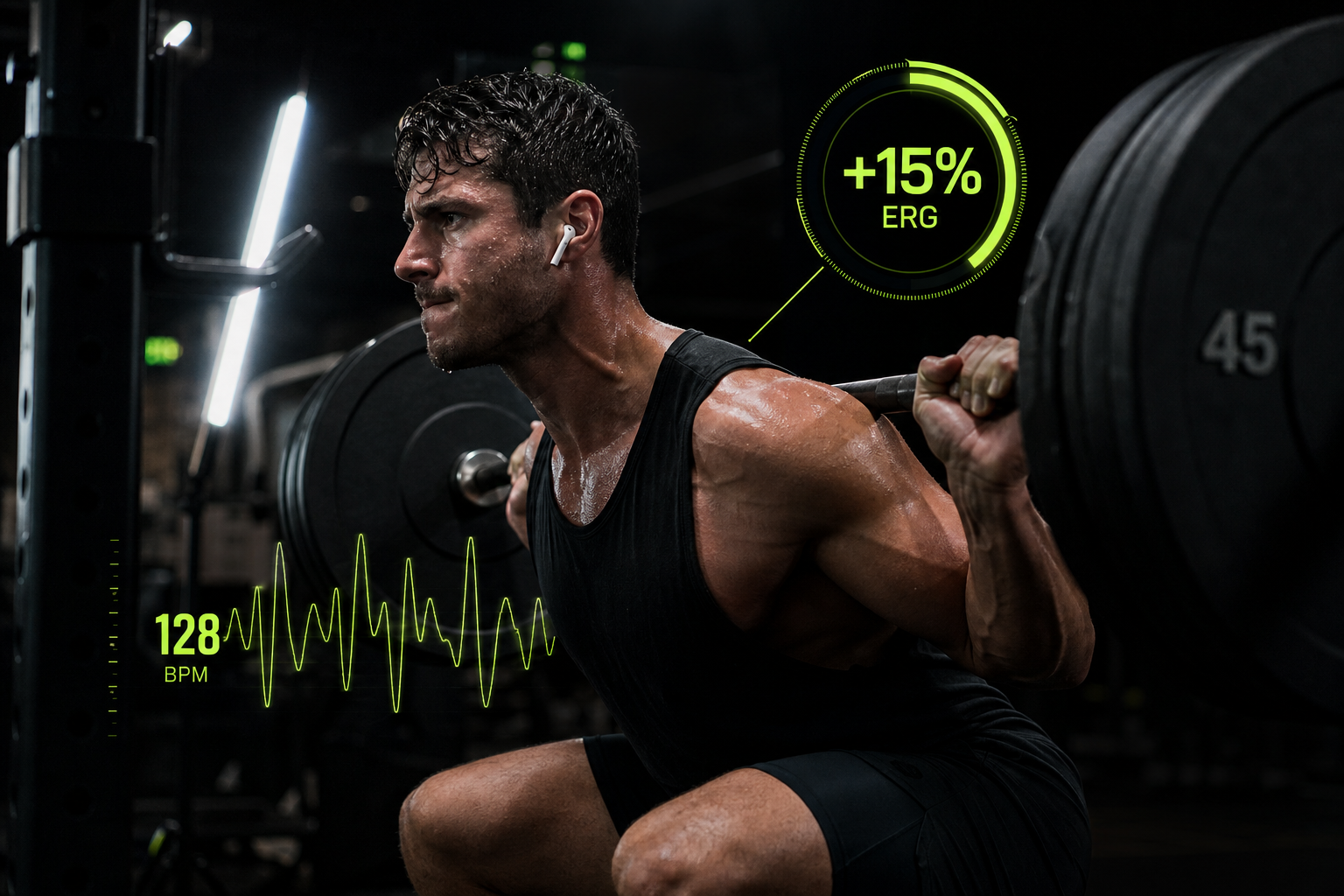
Yes—with an asterisk the size of a stadium speaker. In 2009, Costas Karageorghis showed that motivational, tempo-matched music could increase time to exhaustion by about 15% compared with no music during inclined treadmill walking. That is one of the most cited ergogenic numbers in exercise psychology. It is also one of the most misquoted.
The 15% is not a promise that your one-rep max jumps tomorrow. It is not a legal supplement label. It is a measured boost in how long you can sustain work before voluntary exhaustion, with better in-task mood layered on top. Still provocative. Still real. And still worth engineering your playlist around—if you know what you are actually buying.
This is a research summary, not medical advice. If you take stimulants, have cardiovascular concerns, or train with hearing issues, talk to a clinician before stacking ergogenic strategies.
What “ergogenic” Actually Means
An ergogenic aid is anything that improves work capacity, output, or efficiency: legal supplements, equipment, heat protocols, coaching cues, and yes, a well-built playlist. The bar is performance, not vibes alone. A song that feels good but slows your cadence is anti-ergogenic. A song that locks your stride to a sustainable beat and keeps you in the set longer is fair game.
Sports scientists usually sort ergogenic tools by how they work: metabolic (caffeine), mechanical (compression, shoes), psychological (music, imagery), or environmental (temperature, altitude). Music is mostly psychophysical—it changes perception, arousal, and motor timing more than it rewrites your VO₂ max. That is why it pairs so well with submaximal volume work and steady pacing, and why it hits a ceiling when internal fatigue screams louder than any chorus.
The 15% Headline—and What It Is Not
Karageorghis et al. (2009) had participants walk on a treadmill at 75% heart-rate reserve until they quit. Three conditions: no music, neutral synchronous music, and motivational synchronous music (self-selected pop/rock, stepping in time with the beat). Motivational music won. Endurance rose ~15% vs silence and ~6% vs neutral tracks at matched tempo.
Read that carefully. Synchronous mattered—movement matched the beat. Motivational mattered—tempo alone was not enough; emotional pull separated a 6% gain from a 15% gain. Task-specific mattered—walking endurance, not a powerlifting total. Later work on elite triathletes still found ergogenic effects, but effect sizes shrink as training status rises. The honest headline: music can buy you more reps, more minutes, or more distance before you tap out. Sometimes that looks like strength endurance. It rarely looks like a magic PR on a single heavy single.
Karageorghis 2009: relative time to exhaustion
Music vs Caffeine vs Compression Socks
If music is an ergogenic aid, it deserves to sit in the same conversation as the stuff athletes already stash in gym bags. Not as a replacement—as a stack. Here is how the evidence roughly compares for recreational and competitive trainees.
| Ergogenic aid | Typical performance effect | Primary mechanism | Honest caveats |
|---|---|---|---|
| Motivational sync music | Up to ~15% longer endurance (walking/running tasks); lower RPE; modest power/rep-volume gains in some lifting studies | Distraction, arousal, rhythmic entrainment, dopamine | Needs tempo match + songs you care about; weaker near max effort; highly trained athletes see smaller jumps |
| Caffeine (~3–6 mg/kg) | ~2–4% endurance/time-trial improvement; small power benefits in meta-analyses | Adenosine blockade, central drive, reduced perceived effort | Sleep disruption, anxiety, GI issues; habituation; banned thresholds in some federations |
| Compression socks / garments | ~1–2% running economy in select studies; recovery comfort more consistent than live performance | Mechanical support, venous return, proprioceptive cues | Fit and fabric matter; effects inconsistent across modes; not a substitute for training |
Music’s superpower is frictionless dosing. No jitters. No laundry of compression layers. No tapering protocol. The failure mode is also human: wrong BPM, random shuffle, and tracks that fight your movement instead of pacing it. That is where most playlists leave performance on the table.
The Mechanism: Why a Beat Changes Output
Music is not one lever. It is four levers pulled at once—and tempo is the knob that ties them together.
- Attentional dissociation. Rhythm competes with discomfort signals. Less bandwidth for “this burns.” See how tempo lowers RPE for the perceptual math.
- Rhythmic entrainment. Steps, strokes, and reps lock to periodic sound. More stable cycles, less wasted motion. Auditory-motor synchronization is the mechanism name.
- Arousal regulation. Fast, bright tracks raise drive; the right track at the wrong phase over-cooks you. Music and the exercising brain covers dopamine and mood.
- Efficiency, not fantasy. Bacon et al. (2012) found synchrony can reduce oxygen cost at matched output—you are not cheating physics; you are organizing movement better.
Put simply: caffeine mostly pushes the central nervous system. Compression mostly pushes mechanics. Music mostly pushes perception and timing—which, over a long set or a grinding interval block, still shows up on the scoreboard as more work done.
Does It Work for Everyone?
No—and any article that implies universal gains is selling headphones, not science. Karageorghis’s own reviews note that recreational exercisers tend to benefit more than elite performers, likely because elites already tolerate high internal load and external distraction buys less headroom.
- Near-max efforts. At RPE 9–10, physiological feedback dominates. Music still hypes you; it rarely erases the pain. The ceiling effect is real.
- Wrong tempo. Async or mismatched BPM breaks entrainment and can increase perceived strain. A ballad on a tempo run is not ergogenic—it is sabotage.
- Neutral vs motivational. Matching the beat without emotional pull captured about half the endurance gain in 2009. Vibe is data.
- Task type. Endurance and rep-volume tasks show clearer effects than single all-out strength attempts, though pre-lift music can still boost bar speed and total reps in some trials (Ballmann et al., 2021).
- Hearing, safety, and rules. Outdoor traffic, gym etiquette, and race regulations matter. Ergogenic only if you can use it responsibly.
If you are highly trained and skeptical, run your own trial: same workout twice, matched load, music vs silence, log time, reps, or distance and RPE. Most skeptics convert when the data is their data.
Build Your Ergogenic Playlist
Treat the playlist like equipment: selected, maintained, and phased for the session. Not a mood board you shuffle on autopilot.
- Pick motivational tracks you actually like. Karageorghis’s 15% gap vs neutral music is your reminder: tempo match is necessary; emotional buy-in is the multiplier.
- Sync movement to the beat. Walk, run, pedal, or rep on the downbeat. Async listening leaves endurance gains on the table.
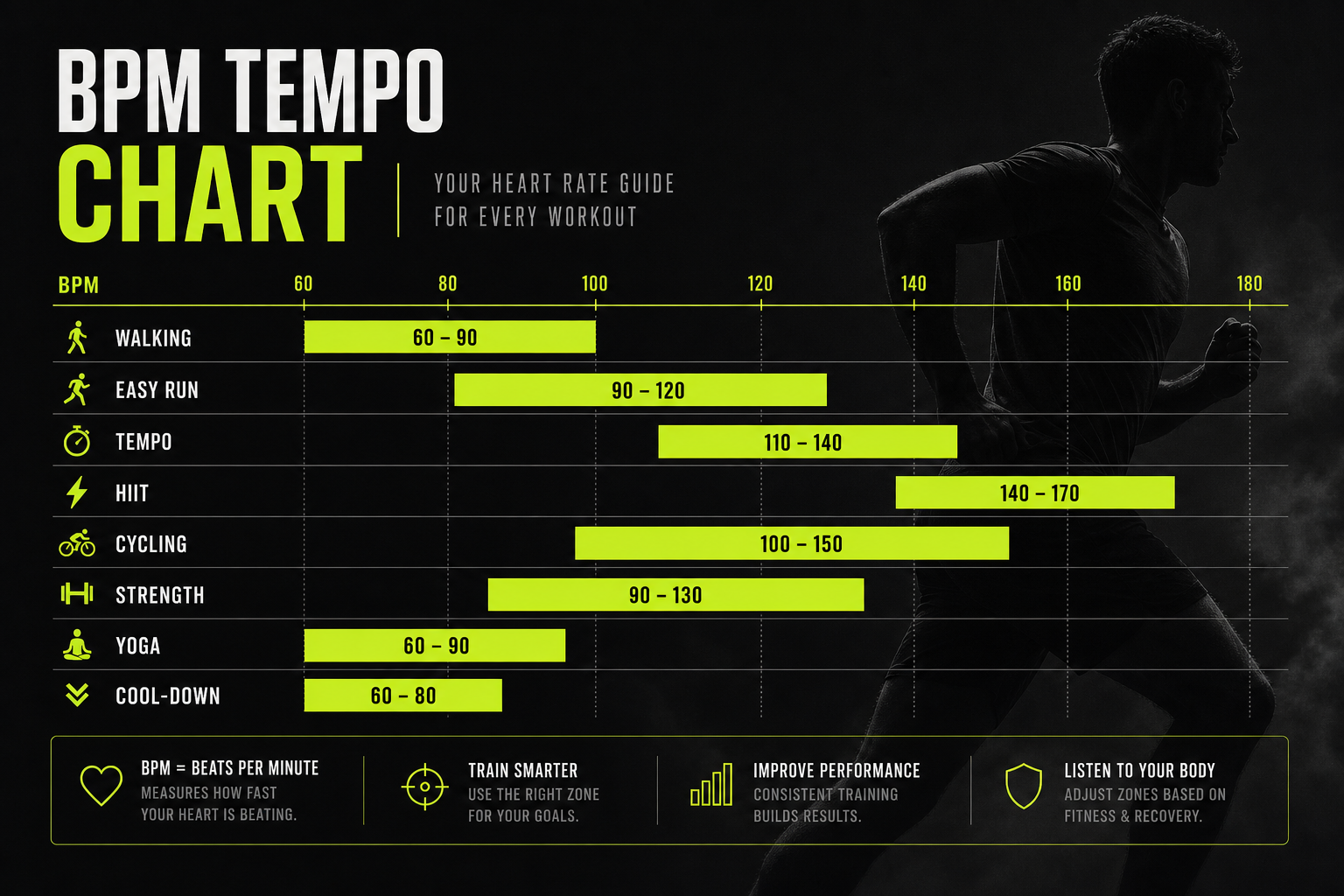
- Match BPM to the activity. Start from BPM basics for workouts: roughly 120–140 for easy cardio, 140–180 for running (pace-dependent), 100–130 for controlled lifting tempos.
- Phase by block. Warm-up slower, main work steady, intervals faster, recovery downshifted. One BPM for the whole hour is amateur hour.
- Keep volume sane. Loud enough to entrain (~70–80 dB), not so loud you lose form cues or situational awareness.
- Kill shuffle on hard days. Random BPM jumps break synchrony mid-set. Sequence tracks or use adaptive tempo.
- Log one metric. Time to failure, total reps, distance, or RPE at a fixed split. Ergogenic claims should show up in your notebook.
- Stack, don’t substitute. Music complements sleep, protein, caffeine if you use it, and a real program—it does not replace them.
Where Repbeats Fits
The ergogenic effect in the lab required synchronous, motivational music. In the wild, pace drifts, heart rate climbs, and intervals demand different tempos than recovery jogs. A static playlist cannot keep synchrony for an entire session—so the 15% headline becomes a three-song spike instead of a training advantage.
Repbeats adjusts tempo from wearable biometrics and workout phase so entrainment holds from warm-up through the last rep. Less manual BPM hunting. Less shuffle roulette. More of the performance buffer Karageorghis measured, spread across the whole session instead of one lucky track.
References
- Karageorghis, C. I., Mouzourides, K. A., Priest, D.-L., Sasso, T. A., Morrish, D. J., & Walley, C. J. (2009). Psychophysical and ergogenic effects of synchronous music during treadmill walking. *Journal of Sport & Exercise Psychology, 31*(1), 18–36.
- Karageorghis, C. I., & Priest, D.-L. (2012). Music in the exercise domain: a review and synthesis (Part I & II). *International Review of Sport and Exercise Psychology, 5*(1), 44–66; 67–84.
- Karageorghis, C. I., et al. (2011). Effects of synchronous music on treadmill running among elite triathletes. *Journal of Science and Medicine in Sport, 14*(6), 513–518.
- Bacon, C. J., Myers, T. R., & Karageorghis, C. I. (2012). Effect of music-movement synchrony on exercise oxygen consumption. *Journal of Sports Medicine and Physical Fitness, 52*(4), 359–365.
- Ballmann, C. G., et al. (2021). Effect of pre-exercise music on bench press power, velocity, and repetition volume. *Perceptual and Motor Skills, 128*(3), 1183–1196.
- Southward, D. J., Firth, E. C., & Morris, J. G. (2012). Caffeine as an ergogenic aid. *Journal of Human Sport and Exercise, 7*(3), 650–661.
- Engel, F. A., Holmberg, H.-C., & Sperlich, B. (2016). Is there evidence that runners can benefit from wearing compression clothing? *Sports Medicine, 46*(12), 1939–1952.
- Ballmann, C. G., Parker, M. G., & Post, E. S. (2023). Effects of Music Choice on Performance and Psychophysiological Responses to Exercise: A Scoping Review. *Journal of Functional Morphology and Kinesiology.*