How Music Tempo Lowers Perceived Exertion (RPE), Backed by Research
Jordan MillsJune 3, 2026 · 12 min read
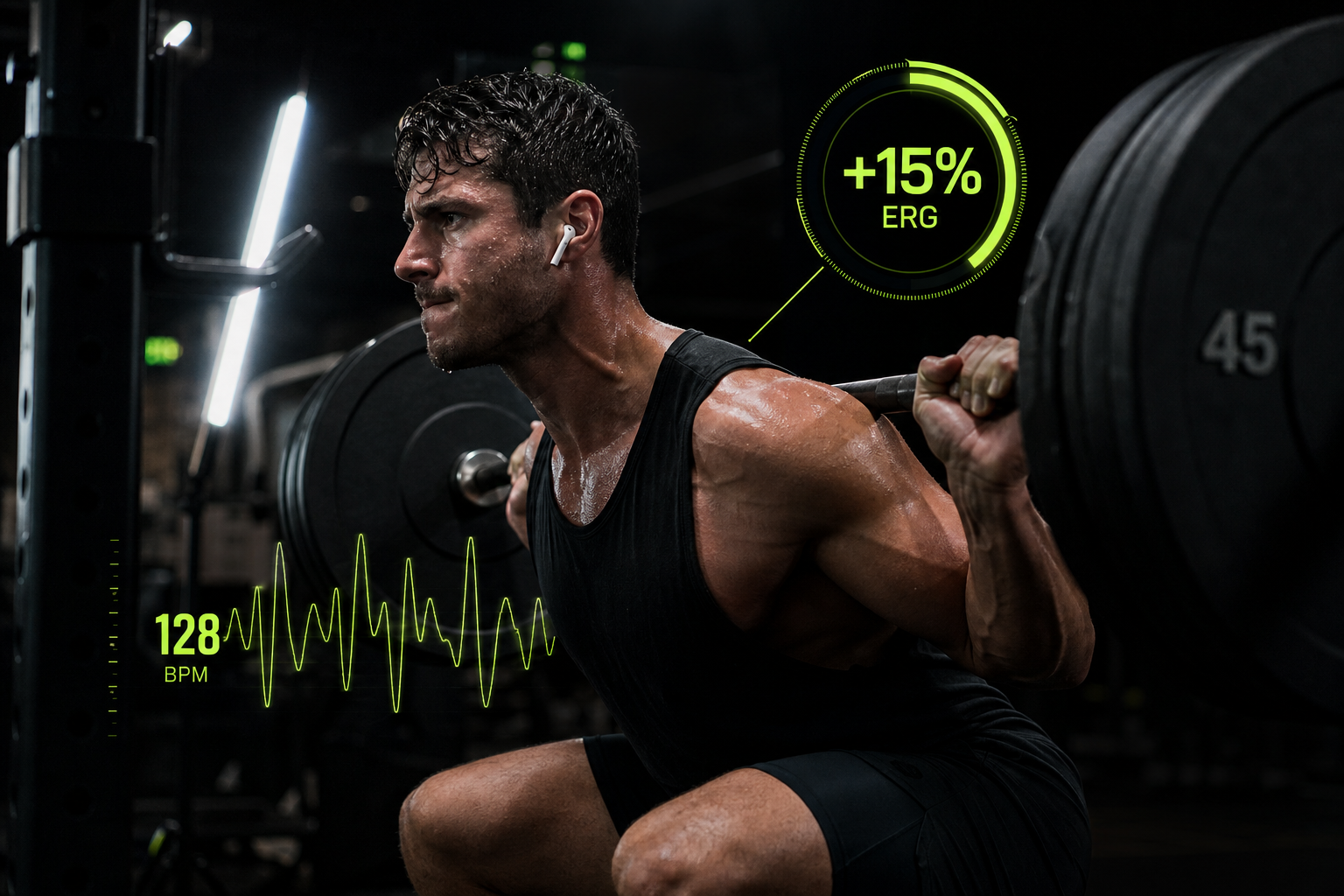
What if your playlist could make a 7/10 effort feel like a 6? That is not motivational fluff. It is a measurable, repeatable effect in sport psychology and exercise science. Song tempo does not only change mood; it can change how hard the work feels. If what BPM means for your workout is new to you, start there. This piece focuses on rate of perceived exertion (RPE) and the research behind tempo-matched music.
This is a research summary, not medical advice. If you have a heart, lung, or hearing condition, take medications that affect exercise tolerance, or feel pain during training, check with a clinician before changing intensity.
What RPE actually measures
Rate of perceived exertion is a subjective scale for how hard your body feels like it is working. The classic Borg 6–20 scale was designed to track roughly with heart rate. Many athletes use a simplified 0–10 version in the gym or on the road.
| RPE (0–10) | What it tends to feel like |
|---|---|
| 1–2 | Very easy: sitting, slow walking |
| 3–4 | Light: easy warm-up, full conversation |
| 5–6 | Moderate: working, still talking in phrases |
| 7–8 | Hard: heavy breathing, focus required |
| 9 | Very hard: near max, few words |
| 10 | Maximal: all-out, unsustainable |
On the original Borg 6–20 scale, multiplying by ten approximates heart rate in healthy adults (RPE 12 ≈ 120 bpm). Lab studies often report Borg scores; apps and coaches often use 0–10. The scales measure the same construct: subjective strain. When Karageorghis reports a ~10% RPE reduction, that percentage applies whether you log 14/20 or 7/10. What changes is the label, not the underlying effect.
RPE is not a vanity metric. It tracks how your nervous system integrates breathing, muscle burn, temperature, and motivation into one number. Two athletes at identical pace can report different RPE depending on sleep, stress, heat, and yes, what is playing in their ears. That is why tempo research matters: it targets the perceptual layer coaches already use to prescribe effort.
How music changes perceived effort
Music hits exercise through several channels at once. Your brain on music during a workout covers dopamine, arousal, and distraction. Here is the short list, with tempo at the center.
- Distraction. Rhythm competes with fatigue signals for attention.
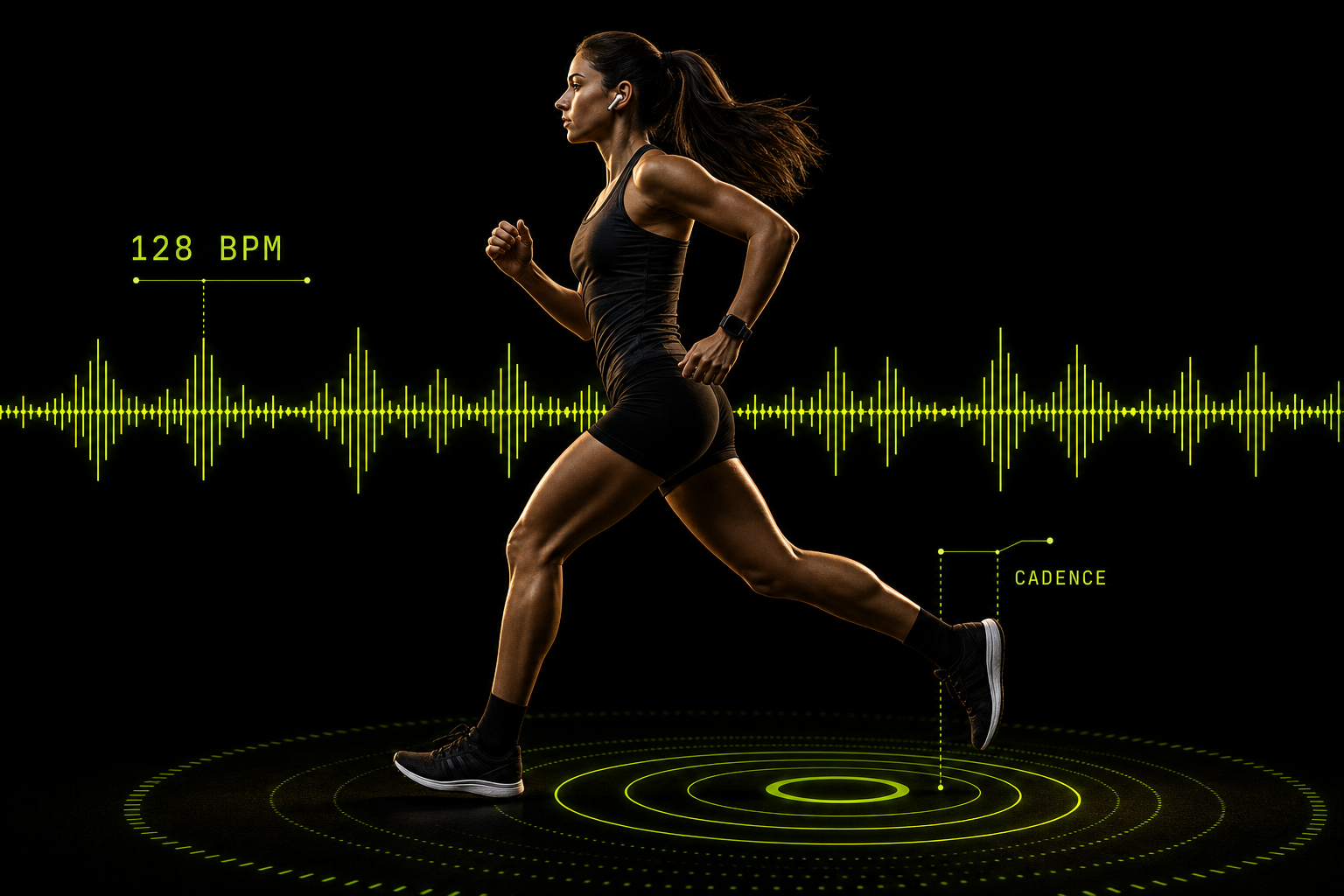
- Rhythmic entrainment. Movement locks to the beat; see auditory-motor synchronization for the timing mechanism.
- Emotional arousal. Tempo and timbre shift energy and mood.
- Motor efficiency. Steadier cycles mean less wasted motion.
Why tempo (BPM) stands out
Faster music, up to a point, tends to raise cadence, improve synchronization, lift mood, and lower perceived effort. Slow music calms; mid-tempo steadies; fast tempo drives. The wrong tempo fights your stride or rep rhythm and can raise RPE instead of lowering it.
Karageorghis and the ~10% RPE drop
Professor Costas Karageorghis is among the most cited researchers in music and exercise. His 2012 two-part review in *International Review of Sport and Exercise Psychology* synthesized decades of trials and meta-analyses. The headline finding for athletes: synchronous music (beats aligned with step or pedal rate) consistently lowers perceived exertion during submaximal work by roughly 10% compared with no music or asynchronous tracks that do not match movement tempo.
Follow-up work from his group, including studies on music-movement synchrony and oxygen cost, showed that entrainment is not just psychological. When movement locks to the beat, metabolic efficiency can improve slightly because stride or pedal cycles become more regular. You are not magically burning less energy; you are experiencing the same output as less costly. That distinction is crucial: RPE drops without necessarily changing speed or watts on your watch.
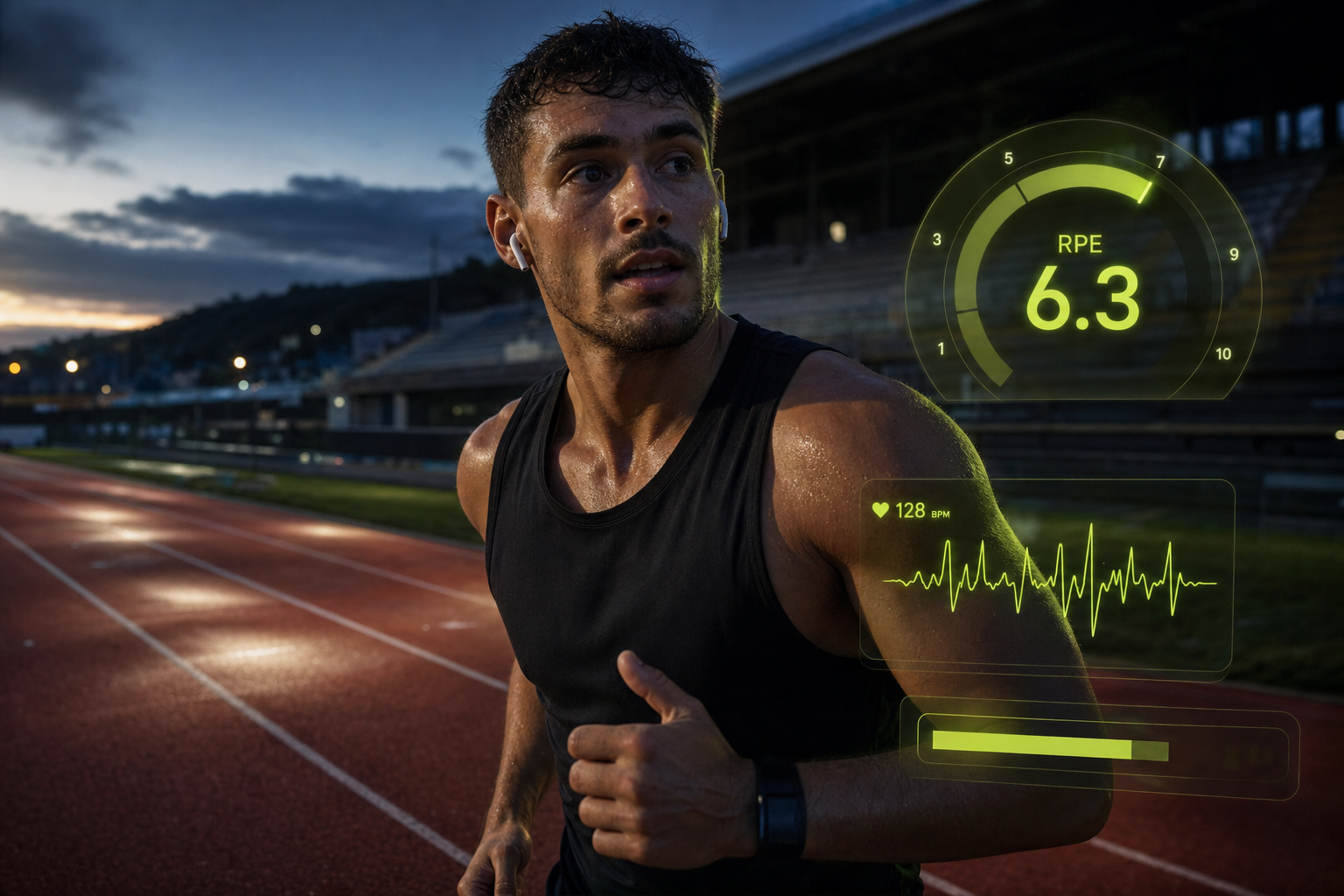
On a 10-point scale, a 10% reduction is the difference between 7/10 and about 6.3/10 at the same pace. Small on paper, large in behavior: you stay longer, push slightly harder, and come back tomorrow. Over weeks that compounds into more volume and better adaptation. Recent decennial revisit data (Jones et al., 2024) confirms that preferred tempo still tracks intensity, but matching beats to movement remains the lever with the clearest RPE benefit. The performance data behind distraction and entrainment is summarized in your brain on music during a workout.
- Synchronous music = tempo matched to cadence or rep rate. Strongest RPE effects in the literature.
- Asynchronous music = background tracks with no cadence match. Mood lift, smaller perceptual benefit.
- No music = baseline internal focus. Fatigue signals dominate sooner at matched workloads.
Illustrative RPE shift with tempo-matched music
| Factor | Without tempo-matched music | With tempo-matched music |
|---|---|---|
| Perceived effort (RPE) | Higher (e.g. 7/10) | Lower (e.g. ~6–6.3/10) |
| Time to fatigue | Baseline | Often extended |
| Movement consistency | More variable | More rhythmic, stable |
| Motivation | Moderate | Elevated |
| Focus on discomfort | Higher | Reduced |
Four mechanisms under the hood
1. Attentional dissociation
Attention is finite. An engaging beat captures bandwidth that would otherwise go to muscle burn, breathlessness, and discomfort. That is why lyrics and tempo both matter: boring or mismatched tracks leave room for fatigue to dominate.
2. Rhythmic entrainment
Humans synchronize steps, strokes, and reps to periodic sound. When movement and beat align, coordination improves and energy waste drops. Auditory-motor synchronization is the applied name for this timing handshake; music and brain rhythms covers the neural layer without hype.
3. Arousal regulation
Tempo shifts autonomic tone: slow tracks down-regulate, moderate tempos hold focus, fast tempos raise drive. The goal is a band that matches the phase of the session, not a single BPM for the whole hour.
4. Motor pattern stability
Predictable cycles lower cognitive load. You spend less energy micromanaging each step or rep and more time running on rhythm. That stability is part of why matched tempo feels easier even when heart rate is unchanged.
How to Use This in Your Next Workout
Theory only helps if you can run it on a Tuesday. You do not need a lab coat or a perfect playlist library. Start with one session where you control tempo on purpose, log RPE every five minutes, and compare how the same route or set feels with and without a matched beat. Most athletes feel the shift within the first ten minutes of steady work.
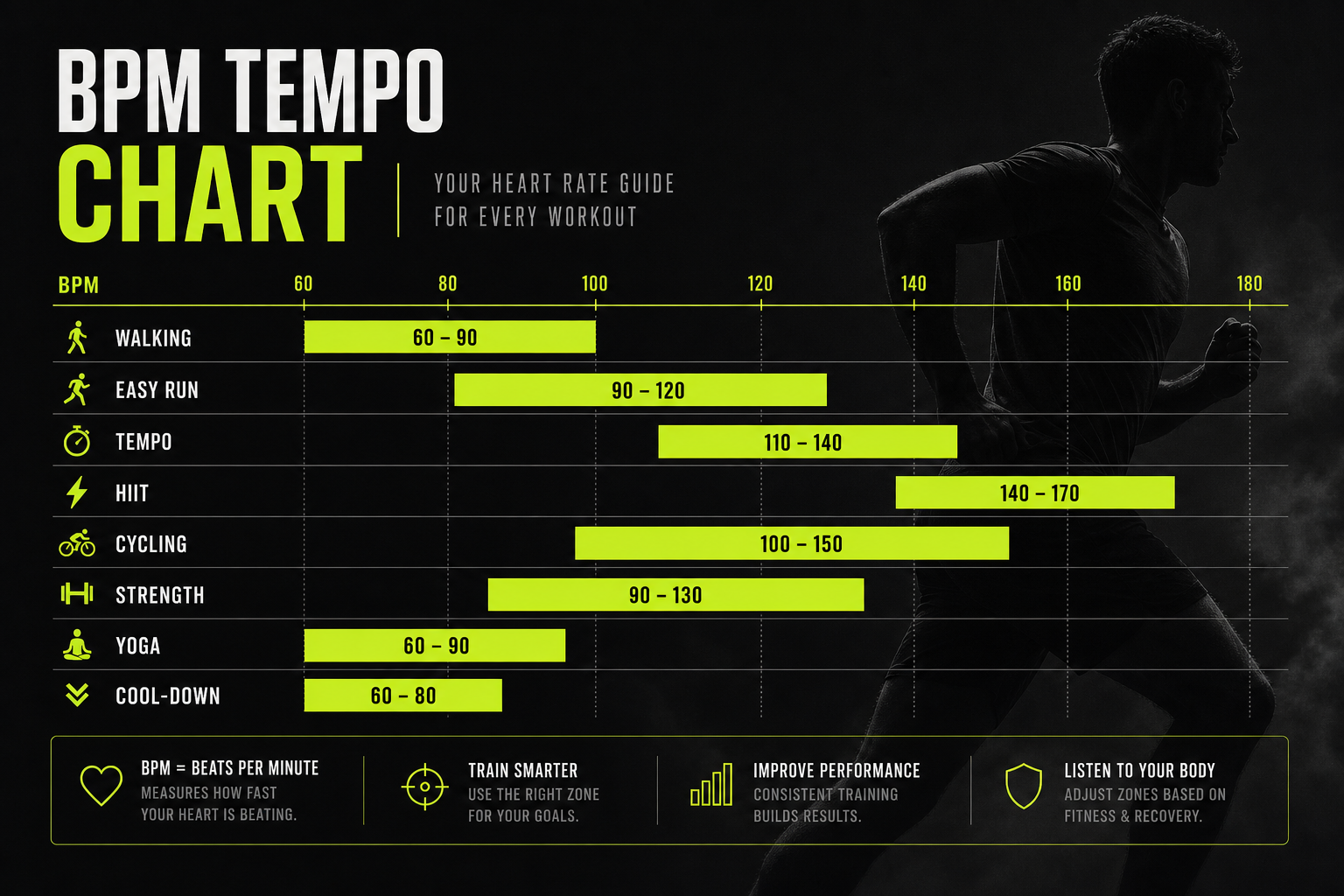
Match tempo to activity and phase, sync movement to the beat, progress BPM gradually, and stop treating shuffle as a training plan. The table below is a starting band, not a prescription. Your height, limb length, and training history all shift the sweet spot.
| Activity | Starting BPM band |
|---|---|
| Walking | 90–115 |
| Easy jog / brisk cardio | 120–140 |
| Running | 140–180 (pace-dependent) |
| Strength (rep tempo) | 100–130 (depends on lift speed) |
- Match tempo to the activity using the table above as a starting point, not a rulebook.
- Move with the beat. Steps, strokes, or reps on the downbeat; entrainment is where RPE drops show up most reliably.
- Progress tempo over time instead of jumping effort and music at once. Let BPM creep up and let your body follow.
- Phase your playlist. Warm-up, main set, push, cool-down each deserve different tempos. Recovery blocks want sympathetic load to step down; see rest and recovery timing for how easy days fit the week.
- Avoid random shuffle. BPM jumps break entrainment and waste the effect. How music tempo affects pacing and stress response explains why fixed playlists drift from your body mid-session.
- Run a simple A/B test. Same workout twice: once with tempo-matched tracks, once in silence or with mismatched BPM. Note RPE at identical splits. Most people see the gap in the 5–8 band first.
The ceiling effect: where music stops helping
Music is not anesthesia. At very high intensities (RPE 17+ on Borg, or 9–10/10), internal signals dominate: lactate, oxygen debt, neuromuscular fatigue. Attention turns inward; distraction weakens; RPE reduction shrinks. This is the ceiling effect. Think of a VO₂ max interval or a final sprint: the beat might still fire you up emotionally, but it cannot override the scream from your legs.
Karageorghis’s own reviews are explicit about this boundary. Music is an ergogenic aid for submaximal and moderate-to-hard steady work, not a substitute for suffering at the true ceiling. That is good news for programming: you can lean on tempo for the bulk of a session where volume accumulates, then accept that all-out blocks will still feel all-out.
That is one reason HIIT vs LISS vs MISS matters for playlist design: sharp tempo jumps for intervals, steady grooves for MISS, mellow BPM for LISS and recovery.
Why a small RPE drop changes training
A ~10% lower perceived effort changes behavior: longer sessions, better adherence, willingness to repeat hard blocks, faster mental recovery between sets. Over months that means more cardiovascular adaptation, more endurance volume, and more sustainable output. Lower perceived strain at the same load is a real performance lever, not a comfort trick.
The practical gap: static playlists
Even when you understand RPE and tempo, manual BPM matching is tedious. Pace changes mid-run; heart rate climbs on hills; intervals need different tempos than recovery. A fixed playlist cannot follow those shifts, so the benefit stays inconsistent. That is the problem adaptive tempo and pacing science keeps circling back to.
How Repbeats compounds the effect
A single well-chosen track can shave a point off RPE for three minutes. A whole session of matched tempo is where the science turns into training advantage. Warm-up at 110 BPM, steady block at 155, hill surge at 168, recovery jog at 130: each phase has its own perceptual load. Static playlists force you to either change songs manually or accept drift. Both break entrainment and leave RPE savings on the table.
Repbeats adjusts music tempo in real time from wearable biometrics and workout phase instead of a static queue. When your heart rate climbs on a hill, tempo can rise with it. When you ease into recovery, the beat downshifts so sympathetic load drops faster. The Karageorghis effect is not a one-song spike; entrainment holds across warm-up, main work, transitions, and finishers. Small reductions stack: minute ten feels like minute five used to, and you finish the session with more quality volume than you would have tolerated in silence.
- Phase-aware tempo keeps RPE benefits active through the full session arc, not just the first playlist track.
- Biometric sync reduces manual BPM guessing when pace or terrain changes mid-workout.
- Compounding adherence — lower perceived strain across weeks means more completed sessions and faster adaptation.
References
- Karageorghis, C. I., & Priest, D.-L. (2012). Music in the exercise domain: a review and synthesis (Part I & II). *International Review of Sport and Exercise Psychology, 5*(1), 44–66; 67–84.
- Bacon, C. J., Myers, T. R., & Karageorghis, C. I. (2012). Effect of music-movement synchrony on exercise oxygen consumption. *Journal of Sports Medicine and Physical Fitness, 52*(4), 359–365.
- Jones, L., Karageorghis, C. I., et al. (2024). The exercise intensity–music-tempo preference relationship: A decennial revisit. *Psychology of Sport and Exercise, 74*, 102644.
- Ballmann, C. G., Parker, M. G., & Post, E. S. (2023). Effects of Music Choice on Performance and Psychophysiological Responses to Exercise: A Scoping Review. *Journal of Functional Morphology and Kinesiology.*
- Jebabli, N., et al. (2020). Listening to preferred music improved running performance without changing the pacing pattern during a 6-minute run test. *Sports (Basel), 8*(5), 61.
- American College of Sports Medicine (2022). ACSM’s Resources for the Group Exercise Instructor (2nd ed.). Music tempo guidelines.