Run Faster: 160–185/100–130 BPM for 400m Interval Music
Jordan MillsSeptember 13, 2026 · 9 min read

Run Faster: 160–185/100–130 BPM for 400m Interval Music
Use fast-tempo music during the 400m work rep, and drop to medium-tempo music during recovery, matching the BPM to your running cadence for best effect. Match the BPM to your running cadence rather than the reverse, or let an adaptive tool like Repbeats shift tempo for you automatically. That single switch, backed by research from Frontiers and coach templates from Runner’s World, does more for interval quality than any single song choice.
TL;DR:
- Matching BPM directly to your running cadence ensures synchronization, with 170 spm runners using tracks around 170 BPM for optimal effort.
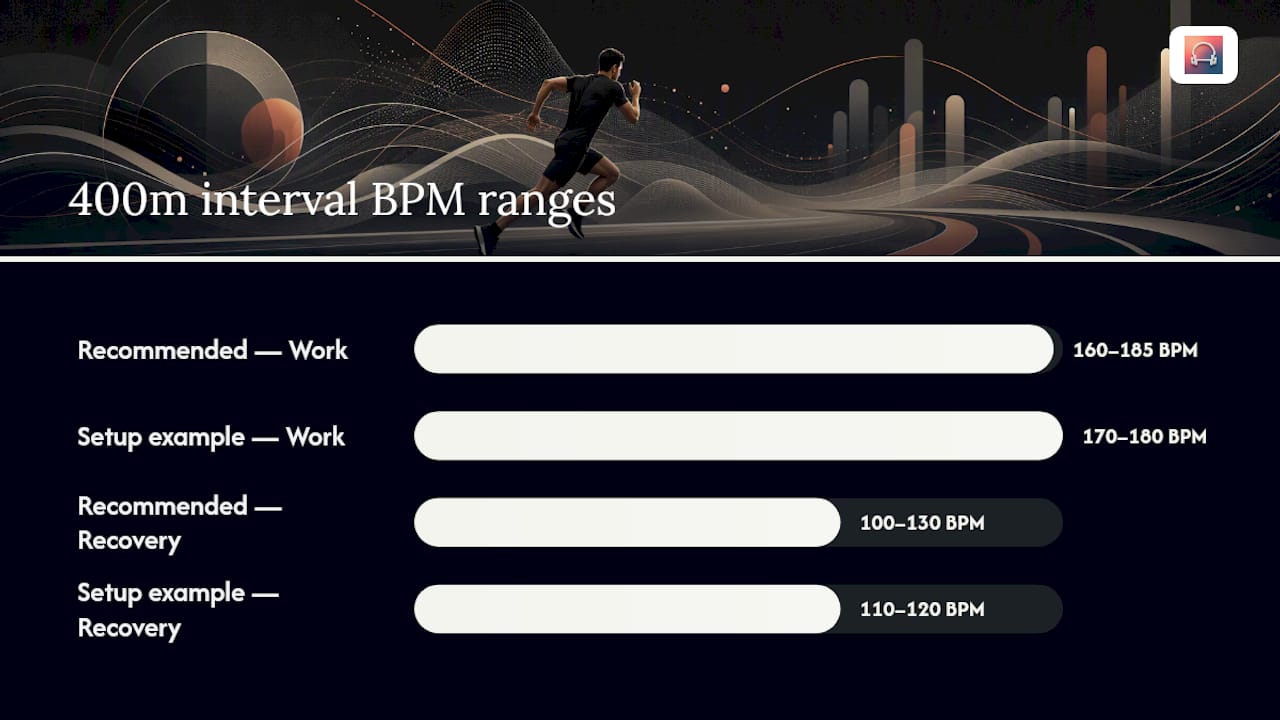
- Fast-beat music during work reps (160-185 BPM) helps improve speed without increasing perceived exertion, while medium-tempo (100-130 BPM) aids active recovery.
- Repbeats’s automatic tempo adjustment reduces the need to manually edit playlists, maintaining cadence entrainment even as fatigue sets in.
- Grouping reps into sets of four and dropping tempo during recovery preserves interval quality better than maintaining high energy throughout the session.
- Testing music with your actual workout pace beforehand helps ensure the tempo shifts feel natural and supportive during fatigue.
Table of Contents
- What BPM Should You Use for 400m Work vs. Recovery?
- How Do You Match Music Tempo to Running Cadence?
- What Are Good 400m Interval Workout Templates?
- How Does Repbeats Automate BPM Matching for Intervals?
- A Coach’s Quick Take on Music and Rep Quality
- Get Your 400m Playlist Running Itself
- Sources
- FAQ
What BPM Should You Use for 400m Work vs. Recovery?
The tempo of your music actually changes how a 400m rep feels while you’re running it. A crossover study published in Frontiers in Psychology had athletes complete high-intensity rowing intervals under fast-beat music (FBM) and slow-beat music (SBM) conditions. FBM produced significantly shorter total interval times without any increase in perceived exertion. That’s the part that matters for your 400m: you run faster and it doesn’t feel harder.
Research by Costas Karageorghis and colleagues backs this up with a more specific prescription. Their work on high-intensity interval training recommends fast-tempo music for the work interval and medium-tempo music for active recovery, a pattern that keeps motivation high during the hard part and protects your mood and heart rate during the easy part. Slap slow music onto a 90-second recovery jog and you risk the opposite effect: your arousal drops too far, and restarting the next rep feels heavier than it should.
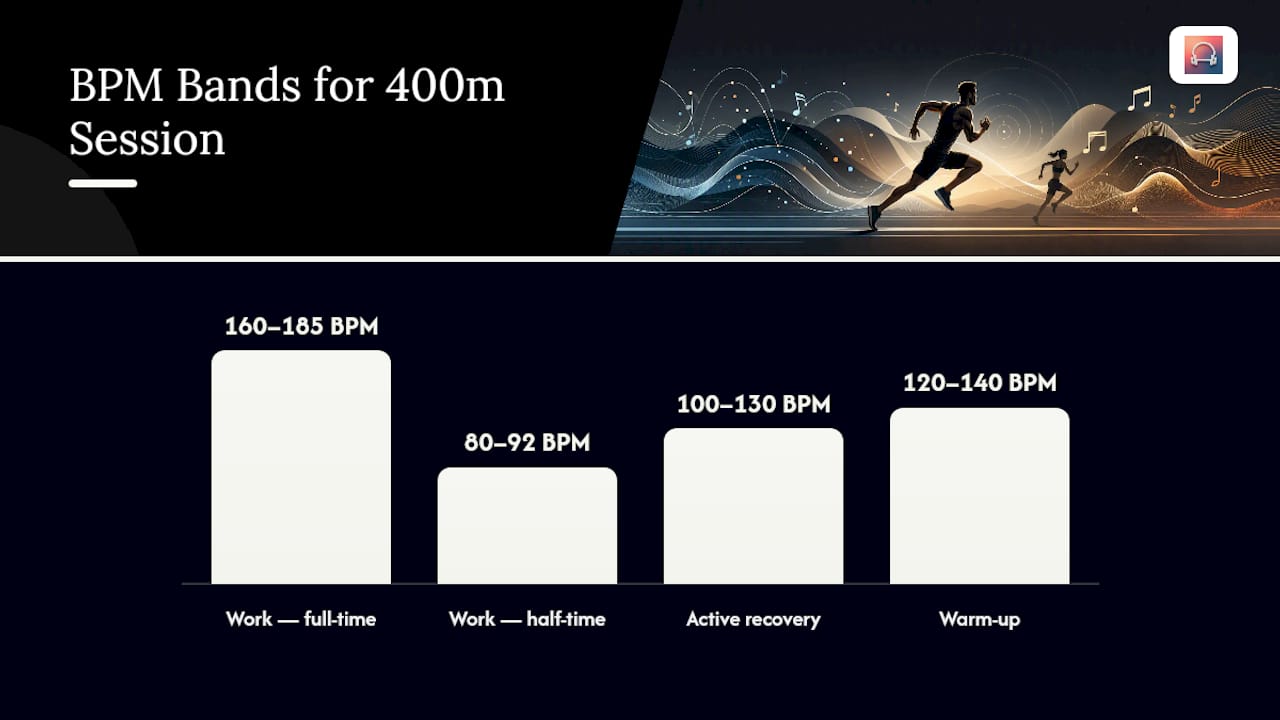
Here’s how that translates into workable BPM bands for a 400m session:
- Work interval (the 400m itself): 160-185 BPM if you want the beat to land on every footstrike, or half-time tracks around 80-92 BPM if you prefer a driving, less frantic feel.
- Active recovery (jog or walk between reps): 100-130 BPM, enough rhythm to keep you moving without spiking your arousal back up.
- Warm-up: 120-140 BPM works well to ease into cadence before the first hard rep.
One nuance worth knowing: the same Frontiers study found the biggest FBM performance boost showed up on the first interval, with a noticeable drop by the second. Front-load your best, highest-energy track for rep one, since that’s where the tempo effect seems to do the most work.
How Do You Match Music Tempo to Running Cadence?
Cadence, not vibe, should drive your BPM choice. Count your steps for 30 seconds during an easy run, double it, and you’ve got your cadence in steps per minute. Most runners have a cadence in a range that should guide your target BPM, rather than selecting arbitrary “pump-up song” tempos.
From there, the math is simple:
- Match BPM directly to cadence. If you run at 170 spm, a 170 BPM track lines a beat up with almost every footstrike.
- Use half-time for a smoother feel. A 170 spm cadence also pairs with an 85 BPM track, since your foot lands on every other beat. This works better for songs that feel too frantic at full tempo.
- Round to the nearest 5 BPM band. Nobody’s stride is metronome-perfect, so a playlist built in 5 BPM increments (165, 170, 175) gives you enough options without overthinking it.
- Re-check cadence after a few weeks. Cadence often creeps up as fitness improves, so a BPM library that worked in January might sit a touch low by March.
Pro Tip: Test your top three “work rep” songs on an actual 400m before race day. A track can feel perfect standing in your kitchen and completely wrong once your heart rate hits 170.
For timing tracks to the rep itself, trim long intros. A 400m rep for most recreational runners takes 75-110 seconds, so a four-bar instrumental opener eats into rhythm you need immediately. Front-load the strongest 20 seconds of energy, and either cut songs to rep length manually or use one continuous BPM-sorted playlist with a phone alert or a coach’s whistle to mark the transition. Sites like Tzuka’s BPM matching guide and Repbeats’s own breakdown of sprint workout music both walk through building tempo-banded libraries instead of one long mixed playlist, which saves you from scrubbing through songs mid-rep.
What Are Good 400m Interval Workout Templates?
Pick a template based on your current fitness, then map music to it before you lace up.
- Beginner: 6 x 400m at moderate effort, 400m walk/jog recovery. Work BPM: 160-170. Recovery BPM: 100-115. One song per rep at full length works fine here since rest is generous.
- Intermediate: 8 x 400m at 5K pace, 90-second jog recovery. Work BPM: 170-180. Recovery BPM: 115-125. Chunk reps into two groups of four, with a slightly longer 3-minute recovery between groups, a structure Runner’s World coach Danny Mackey uses to keep pacing honest across a bigger volume set.
- Advanced: 12 x 400m near mile pace, 60-75 second recovery. Work BPM: 175-185. Recovery BPM: 105-120. Shorter rest means less time to compose yourself, so pick fewer, punchier tracks and lean on a trimmed or looped song per rep rather than trying to time a full-length track.
Mackey’s chunking approach, grouping reps into sets of four, gives you a natural place to insert a longer recovery and a mental reset, which matters more as volume climbs. Warm up around 120-140 BPM for 10 minutes, then cool down back in that same 100-120 BPM range once the last rep is done. If your energy sags by rep 9 or 10, that’s exactly when the front-loaded strongest tracks from rep one should not have already been spent. Save at least one high-energy song for the back half of the set.
How Does Repbeats Automate BPM Matching for Intervals?
Repbeats runs an auto-DJ that updates a track’s BPM every bar, synced live to data from your Apple Watch or Fitbit. Instead of manually swapping playlists when a work rep ends, the app shifts tempo automatically based on your heart rate, cadence, and session intensity.
For 400m intervals specifically, that means:
- Fewer manual playlist edits between reps and recovery, since the app handles the tempo drop for you.
- Tighter tempo entrainment during the work rep, because BPM adjusts in real time instead of sticking to a fixed track list.
- Better adherence to cadence targets across a full set, even as fatigue changes your natural stride rhythm late in the session.
Getting set up takes a few minutes: choose an interval template, connect your wearable, set a work BPM range (say 170-180) and a recovery range (110-120), then run a short test set of two or three reps to feel how the transitions land. Repbeats’s guide on BPM-matched workout music templates covers this setup in more detail.
One honest caveat: no app accounts for wind, hills, a group run pulling you off pace, or a day when your legs just feel flat. Treat the BPM ranges as a strong starting point, not a rule that overrides how your body actually feels on the track.
A Coach’s Quick Take on Music and Rep Quality
Chunking reps into groups of four, then dropping music tempo hard during the between-group recovery, protects rep quality better than treating every rest period the same. The tendency to keep energy high the whole session usually backfires by rep 8.
Two small habits pay off. Rehearse the full set with your actual playlist before race week, not just in training, so the tempo shifts feel familiar under fatigue. And run one 4-rep mini-session purely to calibrate BPM to your current cadence, since that number shifts more than most runners assume.
— Jordan Mills
Get Your 400m Playlist Running Itself
Building a BPM-banded library rep by rep works, but it’s also the kind of task that quietly eats twenty minutes you’d rather spend running. Some apps remove that step by syncing tempo directly to wearable data, so the work-to-recovery BPM switch happens automatically instead of through a manually edited playlist.
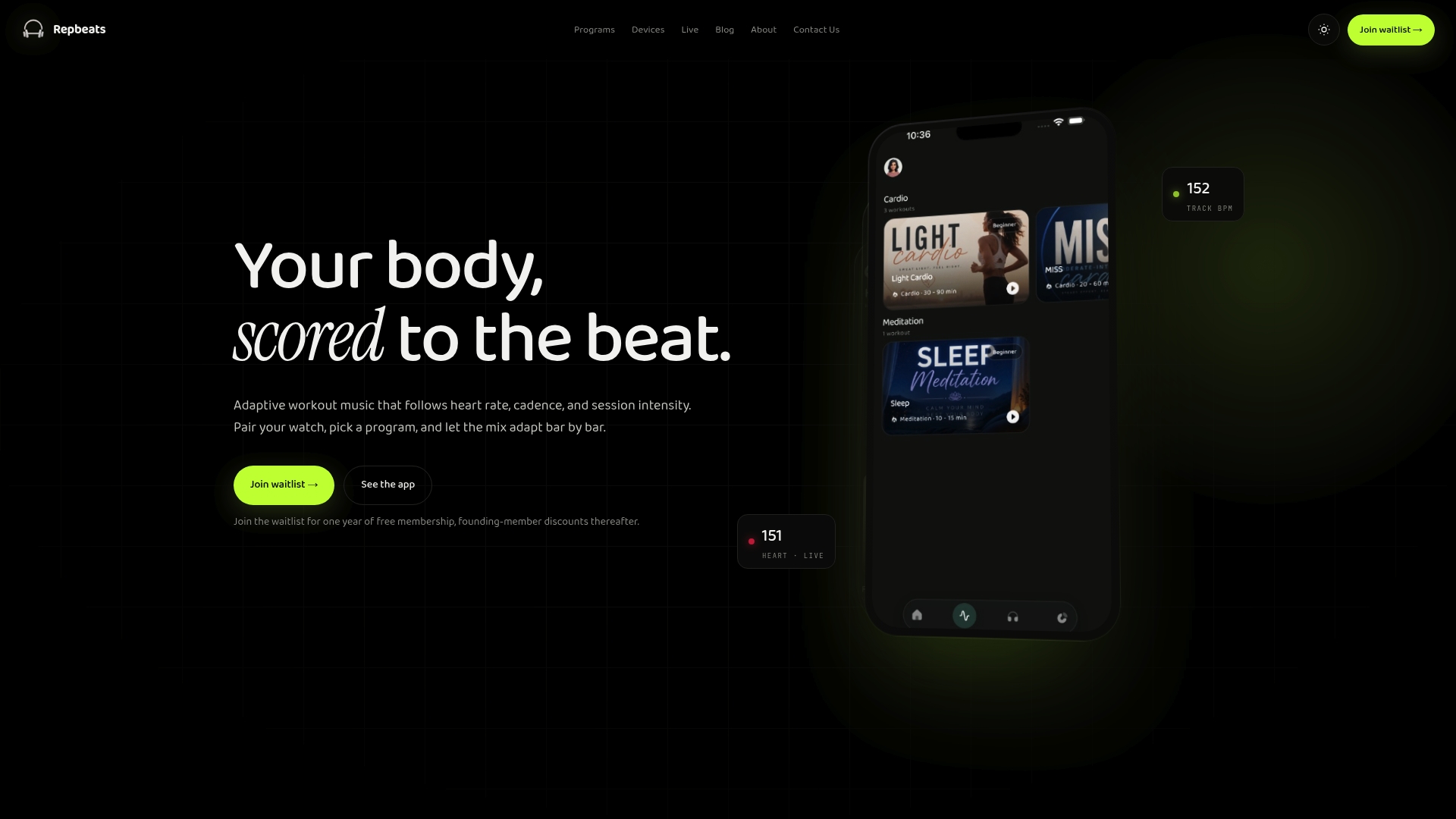
To get started, download the app, connect your wearable, and load a “400m intervals” template with your preferred work and recovery BPM ranges already set. Run a short test session first to feel how the auto-DJ transitions land before committing to a full workout. Pricing details and current trial terms are available on the Repbeats site, where you can also browse cardio and meditation programs built on the same adaptive tempo technology.
Sources
- Music influences performance without increasing perceived exertion during high-intensity rowing intervals: a cross-over design study
- One-HIIT wonder: Can music make high-intensity interval training more pleasant?
- A Pro Coach’s 400-Meter Repeat Workout for Faster Running
FAQ
What’s a good time for 400m intervals?
It depends entirely on fitness and goal race pace, but recreational runners often target 90-110 seconds per rep, while competitive runners running mile-pace repeats might hit between 75 and 110 seconds.
What are 400-meter repeats good for?
They build speed, running economy, and lactate tolerance, and they’re a core tool in Danny Mackey’s coaching templates for runners training anywhere from the mile to the marathon.
What are the intervals for a 400m workout?
A typical structure ranges from 6 x 400m with generous jog recovery for beginners to 12 x 400m with 60 to 75 second recovery for advanced runners, with work and recovery BPM adjusted accordingly.
What songs are good for interval training?
Look for tracks in the 160-185 BPM range for work intervals and 100-130 BPM for recovery, or skip the manual search entirely and let Repbeats adjust tempo automatically as your effort changes.