Six Week Stride Rate Music Plan to Raise Cadence and Cut Impact
Jordan MillsSeptember 29, 2026 · 11 min read

Six Week Stride Rate Music Plan to Raise Cadence and Cut Impact
Yes, carefully chosen, tempo matched music or auditory cues can reliably raise your running cadence.
TL;DR:
- Raising cadence by around 7% with music or auditory cues can produce lasting biomechanical benefits, including reduced impact force and knee loading.
- A consistent, salient beat in music is crucial for effective entrainment, and most runners can safely increase cadence by up to 10% without harming their running economy.
- Start by measuring your baseline cadence with a manual count or watch, then set a target between 5% and 10% higher, avoiding any increase that causes discomfort.
- Adaptive music that shifts tempo in real time offers an advantage when running on varied terrain or during fatigue, aligning with your actual stride rate.
- Regular, short cadence sessions embedded in easy runs over six weeks, with careful monitoring for pain or fatigue, can help retrain your stride rate effectively.
Table of Contents
- What the research says about music and cadence
- How to measure your cadence and calculate a safe target
- Picking and editing music that actually locks to your stride
- A six week plan to retrain your stride rate
- Wearables and adaptive music that sync to your stride
- When not to push cadence and how to avoid problems
- How runners typically respond to tempo training
- How Repbeats can help you train stride rate with adaptive music
- Primary sources and further reading
- Sources
- FAQ
What the research says about music and cadence
Runners in the music group showed a significant increase in preferred stride frequency compared with the control group, a change that held up after the program ended rather than disappearing the moment the music stopped.
Outdoor testing backs this up in real conditions rather than a lab. In one field study, runners raised cadence by 7.3% using a smartwatch metronome, and average peak impact force dropped by 5.6% during those cadence sessions. That matters because it shows the effect isn’t confined to a treadmill: a simple audio cue from a phone or watch produces a measurable change on an actual run, and GPS cadence readings tracked closely with insole sensor data, so your watch’s cadence number is a reasonably trustworthy guide.
A broader look across the research paints a more careful picture. A systematic review and meta-analysis covering 37 studies on step rate changes found consistent reductions in biomechanical loading measures such as knee flexion angle, braking impulse, and hip adduction when cadence increased. The same review found the evidence on long-term injury prevention and race performance to be limited, meaning the mechanical benefits are well documented even though nobody can yet promise fewer injuries or faster times.

A randomized six week trial found a 10% cadence increase was sustained after training ended, which suggests the change reflects a real shift in preferred stride rate rather than a temporary response to the beat, according to the study on musical feedback and stride frequency.
Two mechanisms explain why this works:
- Entrainment: your steps naturally sync to a strong, regular beat, functioning like an audio metronome.
- Motivation: music also lowers perceived effort, which is why a favorite song and a plain click track can produce different results even at the same tempo.
Beat saliency, how clearly a track’s kick and snare mark each beat, affects how well entrainment happens. A song with a buried or syncopated beat gives your feet less to lock onto, no matter how good the tempo number looks on paper.
How to measure your cadence and calculate a safe target
Before you touch a playlist, find out where you actually stand.
- Count manually first. During an easy run, count how many times your right foot hits the ground in 30 seconds, then multiply by 4 for steps per minute.
- Cross check with your watch. Most running watches display live cadence, use it during a few runs to confirm your manual count wasn’t a fluke.
- Set a relative target. Start at 5% above your baseline and treat 10% as a ceiling. Research on stride frequency and running mechanics suggests a 5% increase meaningfully reduces knee energy absorption, while going past 10% starts to erode running economy and comfort.
- Consider the 180 rule as context, not gospel. Many efficient runners land near 180 steps per minute, but this is a rough benchmark, not a target for everyone. A shorter or taller runner will have a different natural range.
- Convert steps per minute to playlist BPM. For most runners, BPM equals spm directly. Some prefer a half tempo track (BPM = spm divided by 2) with a beat every other step, which can feel less frantic at higher cadences.
- Run a baseline test. Pick a flat, quiet 10 minute stretch, run it at your normal effort, and log the resulting cadence as your true starting point before you touch a metronome or playlist.
Picking and editing music that actually locks to your stride
Not every song with the right BPM number will work. Beat saliency, how sharply defined the kick and snare are, matters more than the melody or the lyrics, because your feet are responding to a rhythmic pulse, not a chorus.
- Steady electronic tracks and four on the floor dance music tend to hold a strict beat with little tempo drift.
- Some pop and hip hop tracks work well if the drum programming stays consistent through verses and choruses.
- Ballads, songs with heavy rubato, or tracks with a shifting time feel usually fight against a fixed cadence target.
- Test a candidate song by counting the beat for 15 seconds and multiplying by 4. If your count matches the song’s listed BPM, it is likely stable enough to train with.
A metronome overlay is a simpler fix if you would rather not edit tracks at all: it layers a click on top of your existing music library.
Build a working playlist around 3 to 4 songs at your target tempo, then arrange them so the tempo ramps gradually rather than jumping straight to your ceiling. Using a song’s chorus, where the beat is usually most consistent, as your focused drill window keeps the hardest cadence work concentrated in a section you can repeat.
Pro Tip: Test any new track for a single minute before committing an entire run to it. A tempo that reads correctly on paper can still feel off if the groove doesn’t match your natural footfall.
A six week plan to retrain your stride rate

Once you know your baseline and have a target tempo, the transition from testing to training is short.
Start with a single session drill:
- Warm up for 5 minutes at your normal easy pace.
- Turn on a metronome or tempo matched playlist set to 5% above baseline.
- Run for 5 to 10 minutes, focusing on landing softly rather than reaching or overstriding.
- Note how the cadence felt: comfortable, forced, or somewhere in between.
If that felt sustainable, build it into a weekly structure over six weeks:
- Two to three cadence sessions per week, embedded in otherwise easy runs rather than run as separate workouts.
- One set of short cadence repeats, 3 to 5 minutes at your target tempo within an easy run, to reinforce the pattern without adding fatigue.
- A retention run without any music or metronome every two weeks, to check whether the higher cadence is starting to feel natural on its own.
Track cadence with your watch each session so the progression is based on data rather than feel alone. If cadence hasn’t budged during unmusicked runs by week five or six, or if the change is accompanied by new pain rather than just fatigue, that’s a signal to slow the progression or check in with a coach or clinician rather than push through it.
Wearables and adaptive music that sync to your stride
Most cadence data comes from one of three sources: your watch’s built in accelerometer, a dedicated foot pod, or a shoe insole sensor. Watch based cadence is convenient and, per the outdoor metronome study cited above, tracks closely enough with insole data for everyday training use.
There’s a meaningful difference between a static playlist built at a fixed BPM and adaptive music that changes tempo in response to your actual cadence in real time.
- A fixed playlist works well once you know your target tempo and just need consistent reinforcement.
- Adaptive music adjusts automatically as your pace shifts, which matters most on hilly routes or during fatigue when cadence naturally drifts.
- Setup is simple in either case: pair your device, choose a sync mode if the app offers one, then run a short test to confirm the tempo you hear matches your actual steps.
Repbeats is built around this second approach. Its auto-DJ updates a track’s BPM every bar using live cadence and heart rate data pulled from wearables like Apple Watch and Fitbit, so the tempo you’re running to shifts with you rather than staying fixed.
When not to push cadence and how to avoid problems
Cadence gains have a ceiling. Increases beyond roughly 10% above baseline tend to reduce running economy rather than improve it, according to the stride frequency and mechanics research cited earlier, so a bigger number is not automatically a better one.
Fatigue also works against you. Cadence naturally drifts downward late in a long run regardless of what’s playing, which is one reason short, repeated exposures tend to work better than one long forced session.
- Stop or back off if you notice new joint pain, unusual tightness, or a change in your gait that feels forced rather than natural.
- If a session feels exhausting rather than just challenging, shorten the exposure next time rather than powering through the full drill.
- When in doubt, drop the tempo back toward your baseline and reintroduce simple form cues, like shorter ground contact time, before trying the higher cadence again.
Pro Tip: A cadence change that feels effortful after several sessions, not just the first one, is a sign to dial the target back rather than push through it.
How runners typically respond to tempo training
In practice, runners who overstride or who run at a naturally low cadence tend to see the clearest gains, since they have the most room to close the gap toward a more efficient stride. Pairing the music with a simple cue, shorter ground contact time, or a lighter footfall, tends to produce better carryover than tempo alone. The honest takeaway is that music is a training aid, not a fix: it works best combined with occasional feedback from a coach or a running focused physical therapist who can watch your form directly.
— Jordan Mills
How Repbeats can help you train stride rate with adaptive music
Running the plan above manually, swapping playlists, checking BPM, adjusting for fatigue, is doable but tedious. Repbeats removes most of that friction by syncing music tempo directly to your live cadence and heart rate.
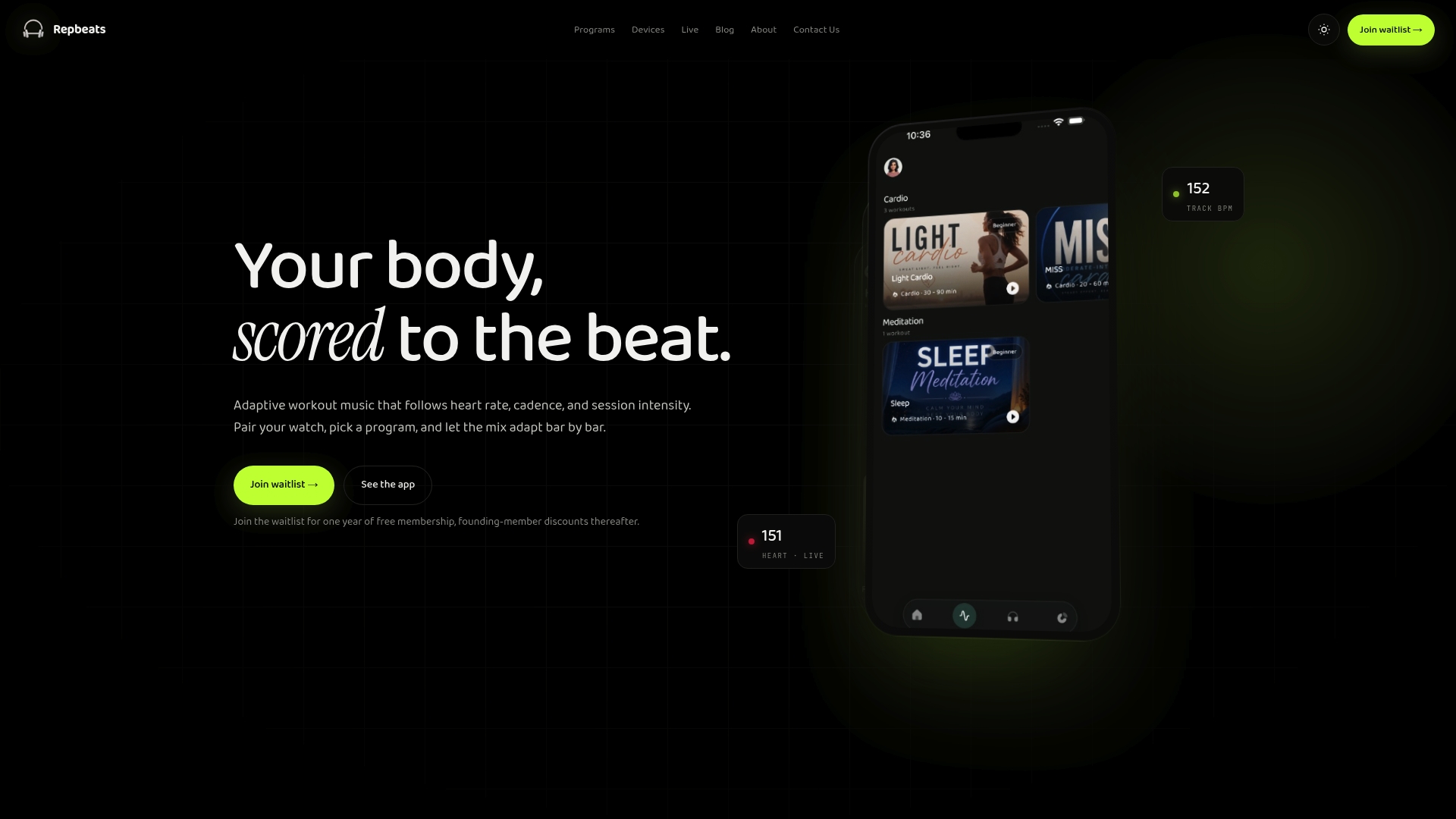
- Auto-DJ technology updates BPM every bar, so tempo shifts with you instead of staying locked to a static playlist.
- Wearable integration with devices like Apple Watch and Fitbit means your cadence and heart rate drive the music without any manual syncing.
- Playlist templates give you a structured starting tempo for sessions like the six week cadence program above.
You can see the Repbeats app and check current trial details on the Repbeats homepage.
Primary sources and further reading
- Musical feedback and stride frequency: randomized six week training study.
- Step rate systematic review and meta-analysis: biomechanical effects across 37 studies.
- Outdoor cadence and impact force study: field metronome results.
- Auditory-motor synchronization research: entrainment and beat saliency.
Sources
- Using Musical Feedback Increases Stride Frequency in Recreational Runners
- What is the effect of changing running step rate on injury, performance and biomechanics? A systematic review and meta-analysis
- Effect of Increasing Running Cadence on Peak Impact Force in an Outdoor Environment
- Auditory-motor synchronization and music-to-movement alignment strategies
FAQ
What is a good stride rate for running?
There’s no single number that fits every runner, but many efficient runners land near 180 steps per minute, a figure often cited as a rough benchmark rather than a strict target. Your ideal cadence depends on your height, leg length, and pace, so it’s more useful to measure your own baseline and adjust from there than to chase a fixed number.
What is stride rate music?
Stride rate music, sometimes called cadence music, is a playlist or audio cue set to a beats per minute value that matches or slightly exceeds your running cadence. The goal is to use the beat as a rhythmic guide your footfalls can sync to, based on research into auditory-motor synchronization showing music acts as both a metronome and a motivational stimulus with beat saliency critical for effective entrainment (auditory-motor synchronization).
Is it better to increase cadence or stride length?
Most cadence research focuses on increasing steps per minute rather than stride length, since shorter, quicker steps are linked to reduced joint loading measures like braking impulse and knee flexion angle. Lengthening stride tends to increase impact forces, so runners looking to change their mechanics generally get more consistent benefit from adjusting cadence.
How do I calculate my stride frequency?
Count how many times one foot strikes the ground over 30 seconds, then multiply by 4 to get steps per minute, or check your running watch’s live cadence display and confirm it against a manual count.