Why Rhythm Improves Exercise Output: A Science Guide
Jordan MillsJuly 5, 2026 · 10 min read

Why Rhythm Improves Exercise Output: A Science Guide
TL;DR:
- Rhythm enhances exercise performance by synchronizing movements, reducing oxygen consumption, and masking fatigue signals.
- Self-selected music with a clear beat at moderate effort levels delivers the strongest ergogenic benefits, especially when tempo matches training phases.
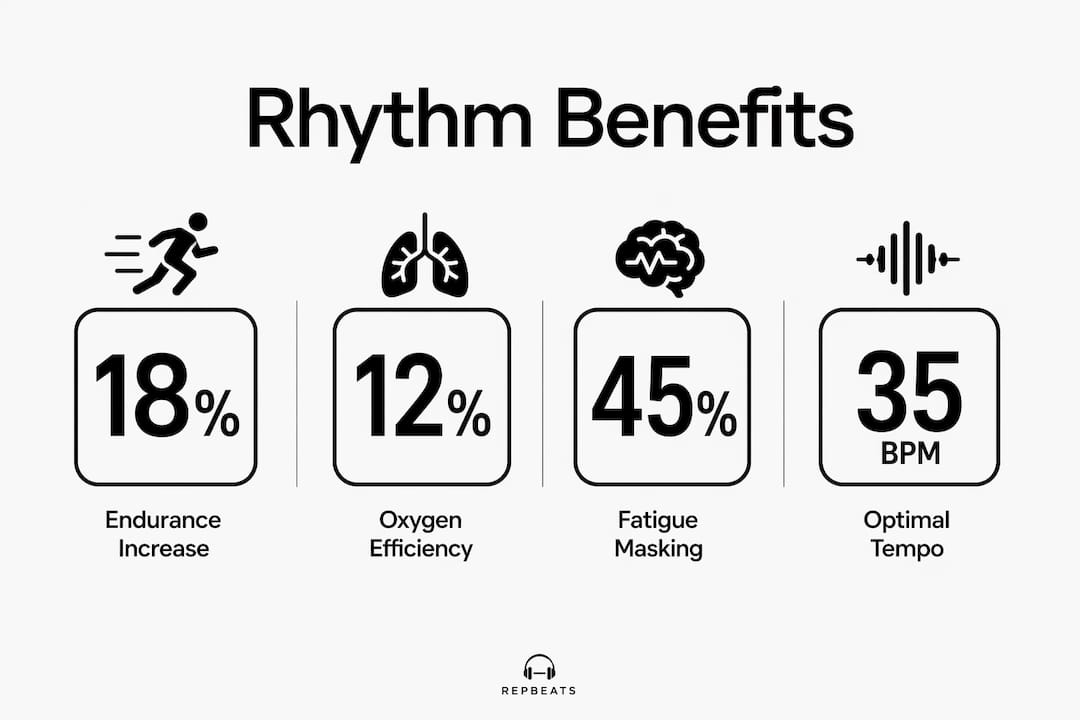
Rhythm is defined as the auditory scaffold that synchronizes your body’s movement patterns to an external beat, and it directly improves exercise output by reducing perceived effort, enhancing motor coordination, and extending endurance. The mechanism behind this is called rhythmic entrainment, where your nervous system locks onto a steady beat and uses it to regulate movement timing. A second key process, attentional dissociation, shifts your focus away from fatigue signals toward the music, letting you push harder without feeling the cost. Research confirms these are not minor effects. Cyclists listening to self-selected music improved endurance by about 20%, averaging 35.6 minutes of sustained effort compared to 29.8 minutes in silence. That gap represents a meaningful performance gain from a single environmental variable.
Why rhythm improves exercise output: the scientific evidence
The strongest case for rhythm’s effect on physical performance comes from controlled studies measuring real output metrics, not just mood ratings. The University of Jyväskylä study cited above is one of the clearest examples. Cyclists sustained effort significantly longer with music they chose themselves, without reporting greater exhaustion. That finding matters because it separates rhythm’s effect on actual output from its effect on how hard exercise feels.
A meta-analysis on metabolic efficiency found that rhythmically synchronous music reduces oxygen consumption for the same power output, with a moderate effect size of d=0.32. In practical terms, your body burns less oxygen to produce the same wattage when you are moving in sync with a beat. That is a measurable physiological gain, not a psychological trick.
| Metric | Without rhythm | With rhythm |
|---|---|---|
| Endurance duration | 29.8 minutes | 35.6 minutes |
| Oxygen efficiency | Baseline | Improved (d=0.32 effect size) |
| Perceived exertion | Higher | Lower at matched intensity |
| Motivation and output | Standard | Greater with self-selected music |
Self-selected music consistently outperforms researcher-assigned playlists. Personal music preference produces greater power output and total work than generic or tempo-matched tracks chosen by someone else. Genre and BPM matter, but your emotional connection to the music amplifies the ergogenic effect.
Pro Tip: Build your workout playlist yourself. Research confirms that personal preference drives stronger performance gains than any algorithmically assigned track, regardless of tempo.
How does rhythm affect the brain and body during exercise?
Rhythm works through three distinct mechanisms, each targeting a different layer of your performance system.

Attentional dissociation redirects your brain’s focus. During moderate-intensity exercise, your mind can split its attention between internal signals like burning muscles and external stimuli like music. When a strong beat captures that external channel, fatigue signals get less processing bandwidth. The result is that music masks discomfort and delays the point at which effort feels unbearable.
Rhythmic entrainment is the motor system’s response to a steady pulse. Your brain’s motor cortex synchronizes firing patterns to match the beat, which stabilizes your movement timing and reduces wasted energy from inconsistent cadence. This is why runners naturally adjust their stride rate when a song’s tempo changes.
Arousal regulation is the third mechanism. Faster tempos elevate heart rate and breathing rate before exercise even begins, priming your body for effort. Slower tempos during cooldowns bring those systems back down. Your nervous system uses the beat as a pacemaker for the whole session.
“Music supports exercise by diverting focus from fatigue, activating reward systems, and synchronizing movements to improve motor control. These three pathways work simultaneously, which explains why the effect on output is larger than any single mechanism would predict.”
One critical nuance: rhythm’s ergogenic effect is intensity-dependent. At low to moderate aerobic intensity, attentional dissociation is fully available because your brain has spare cognitive capacity. At near-maximal efforts, internal physiological signals take over and the music’s influence shrinks. Understanding this ceiling helps you use rhythm where it actually works.
Research in neuroscience-based athletic training also shows that rhythmic auditory cues activate dopamine pathways, improving mood and reducing the emotional weight of sustained effort. That neurotransmitter response is part of why a great song makes a hard run feel almost enjoyable.
What are the best ways to use tempo and beats in your workouts?
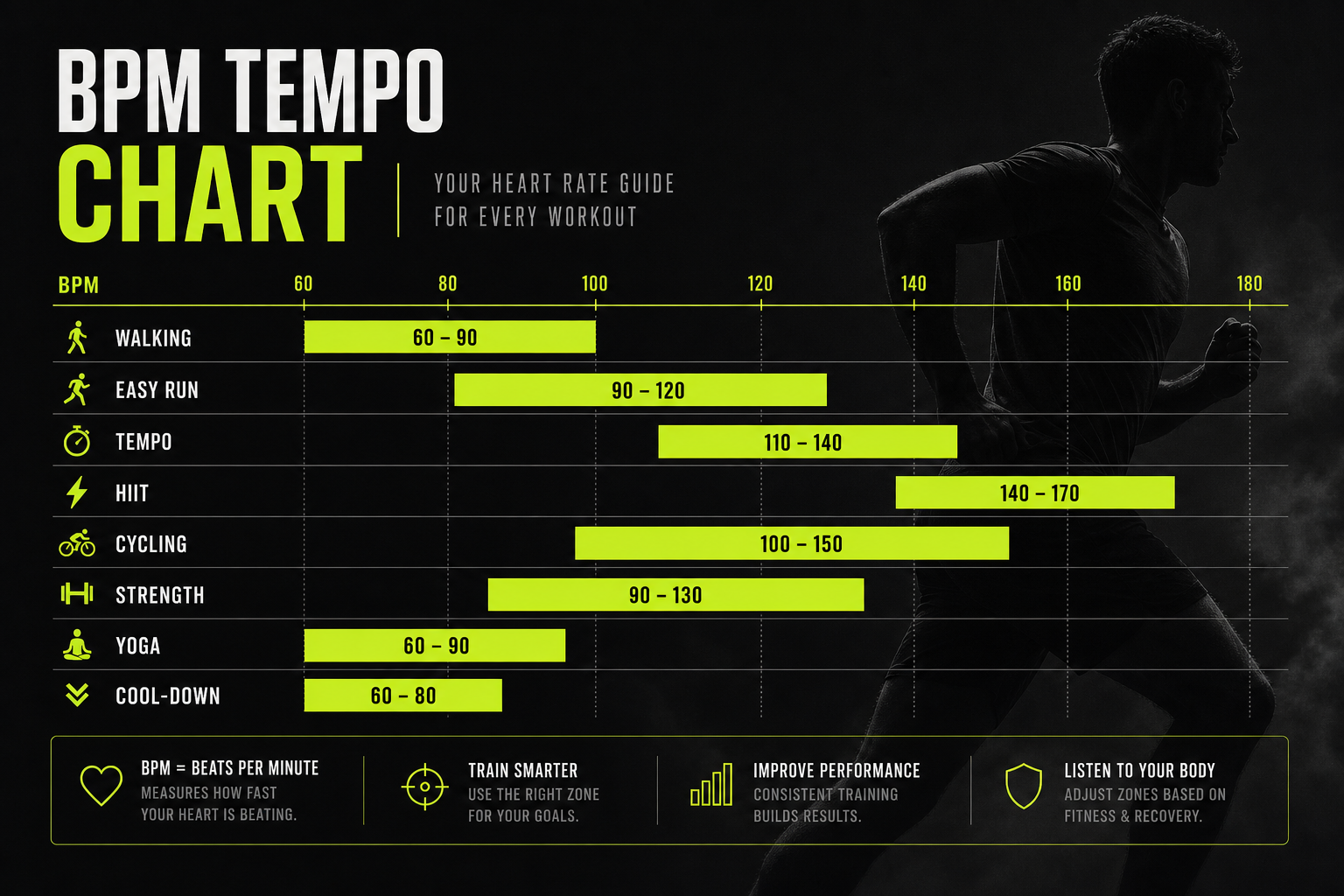
Matching music tempo to your training phase is the most direct way to apply rhythm science to real sessions. Specific BPM zones align with different effort levels, and staying within those zones keeps your movement and music synchronized.
- Warm-up and easy effort (110–130 BPM). Light cardio, mobility work, and low-intensity runs benefit from a relaxed but steady beat. The rhythm primes motor patterns without pushing arousal too high.
- Moderate intensity (130–145 BPM). Steady-state runs, cycling at threshold, and circuit training fall here. This is the zone where attentional dissociation is most effective and tempo-matched music delivers the clearest performance gains.
- High intensity (140–180 BPM). Sprint intervals, HIIT, and heavy lifting sessions need a driving, fast beat. The upper end of this range works for short maximal efforts, though the ergogenic effect weakens as intensity approaches your physiological ceiling.
- Cooldown (below 110 BPM). Slower tempos actively support parasympathetic recovery. Dropping the BPM signals your nervous system to shift gears.
For a detailed breakdown of which BPM works for each training type, the best BPM for every workout chart from Repbeats maps tempo zones across running, cycling, strength, and recovery sessions.
Beat strength matters more than genre or melody. Clear, driving beats produce stronger pacing and motivational effects than complex or syncopated rhythms at the same BPM. A track with a simple, prominent kick drum outperforms an intricate jazz rhythm at identical tempo. Choose music where the beat is unmistakable, not buried under production layers.
Combining rhythm with motivational lyrics adds another layer. Rhythm paired with lyrics reduces physical markers of fatigue and perceived effort more than either element alone. The beat handles motor synchronization while the lyrics engage emotional drive.
Pro Tip: When selecting tracks, test them by tapping your foot. If you can lock onto the beat within two seconds, it will work for pacing. If you have to concentrate to find it, skip it.
How does rhythm improve coordination and movement efficiency?
Rhythm acts as temporal scaffolding for your movement patterns. A steady beat gives your motor system a reference point for timing each repetition, stride, or pedal stroke. That reference reduces variability in your cadence, which directly lowers the energy cost of movement.
The benefits show up across multiple training modalities:
- Running: Matching stride rate to music tempo reduces overstriding and improves ground contact consistency. Runners who sync to a beat show more stable biomechanics over long distances.
- Cycling: Pedal cadence locked to a BPM target reduces torque spikes, distributing effort more evenly across the stroke cycle. This delays the onset of localized muscle fatigue.
- Functional training: Rhythmic cues during kettlebell swings, box jumps, or rowing improve rep-to-rep consistency, which matters for both safety and output.
Rhythm also supports flow states, the mental condition where effort feels automatic and sustainable. When your movement and the beat align, your brain stops micromanaging each action and lets the motor system run on autopilot. That cognitive offloading is why experienced athletes describe their best sessions as feeling effortless despite high output.
The impact of music tempo on movement economy is also visible in reduced biomechanical markers of fatigue. Athletes moving in sync with a beat show less postural collapse and more consistent joint angles late in a session compared to those training in silence. Rhythm does not just feel better. It produces measurably cleaner movement under fatigue.
Research in sports neuroscience and psychology confirms that rhythmic auditory input stabilizes motor pattern execution, particularly when fatigue begins to degrade technique. The beat becomes a corrective cue your body uses without conscious effort.
Key Takeaways
Rhythm improves exercise output by synchronizing movement to a steady beat, reducing oxygen cost, masking fatigue signals, and extending endurance across low-to-moderate intensity training.
| Point | Details |
|---|---|
| Endurance gains are real | Self-selected music extended cycling endurance by about 20% in controlled research. |
| Oxygen efficiency improves | Rhythmically synchronized movement reduces oxygen consumption at the same power output (d=0.32). |
| Tempo zones matter | Match BPM to effort: 110–130 easy, 130–145 moderate, 140–180 high intensity. |
| Beat strength beats genre | A clear, driving beat produces stronger pacing effects than complex rhythms at the same BPM. |
| Intensity sets the ceiling | Rhythm’s benefits peak at moderate aerobic effort and fade near maximal intensity. |
Rhythm is more than motivation: what I have actually observed
People treat music as a mood tool. Put on something energetic, feel pumped, train harder. That framing is not wrong, but it misses the deeper mechanism and leads to poor choices.
The athletes I have watched get the most from rhythm are not the ones with the loudest playlists. They are the ones who match tempo to phase, drop the BPM during recovery, and choose tracks where the beat is front and center. They use music the way a coach uses a metronome: as a precision tool, not background noise.
The biggest mistake I see is cranking up fast, chaotic music during near-maximal efforts and expecting a performance boost. At that intensity, your body is running on internal signals. The music becomes irrelevant at best and distracting at worst. Rhythm’s power lives in the moderate zone, and that is where most training volume should sit anyway.
Adaptive technology changes this equation. When music tempo adjusts in real time to your heart rate and cadence, you stop having to think about BPM selection at all. The scaffold builds itself around your effort. That is where I think the field is heading, and it is a meaningful step beyond static playlists.
The individual variation piece also deserves more attention. What locks one athlete into a flow state might break another’s concentration. The research on self-selected music is clear: your preference matters more than any expert’s playlist. Start there, then refine with tempo awareness.
— Jordan Mills
How Repbeats puts rhythm science to work for you
Repbeats is a fitness app built around the science covered in this article. Its auto-DJ technology reads live data from Apple Watch and Fitbit, then updates your music’s BPM every bar to match your heart rate, cadence, and session intensity. You never have to manually select a tempo zone or swap playlists mid-run. The music adapts as your effort does, keeping you in the range where rhythm’s ergogenic effects are strongest.
For athletes who want to put adaptive workout music to work immediately, Repbeats covers running, cycling, and meditation with playlists that evolve with your body in real time. Early access is available now. Join the Repbeats waitlist to get the app when it launches on iOS and Android.
FAQ
Why does rhythm improve exercise output?
Rhythm improves exercise output through rhythmic entrainment, attentional dissociation, and arousal regulation. These mechanisms synchronize movement, reduce perceived effort, and improve metabolic efficiency simultaneously.
What BPM is best for a moderate-intensity workout?
The recommended BPM range for moderate-intensity training is 130–145 BPM. This zone aligns music tempo with steady-state cardio and threshold efforts where attentional dissociation is most effective.
Does self-selected music perform better than assigned playlists?
Research confirms that self-selected music produces greater power output and total work than researcher-assigned tracks. Personal preference amplifies the ergogenic effect beyond what tempo alone can deliver.
Does rhythm help at very high exercise intensities?
Rhythm’s benefits weaken at near-maximal efforts because internal physiological signals dominate cognitive attention. The ergogenic effect of music is strongest during low-to-moderate aerobic intensity.
Is beat strength more important than genre when choosing workout music?
Beat strength is the most critical factor in workout music selection. A clear, prominent beat produces stronger pacing and motivational effects than complex rhythms, regardless of genre or melody.