Cut Joint Impact With Apple Watch Cadence: 5–10% Targets & Music
Jordan MillsSeptember 26, 2026 · 10 min read

Cut Joint Impact With Apple Watch Cadence: 5–10% Targets & Music
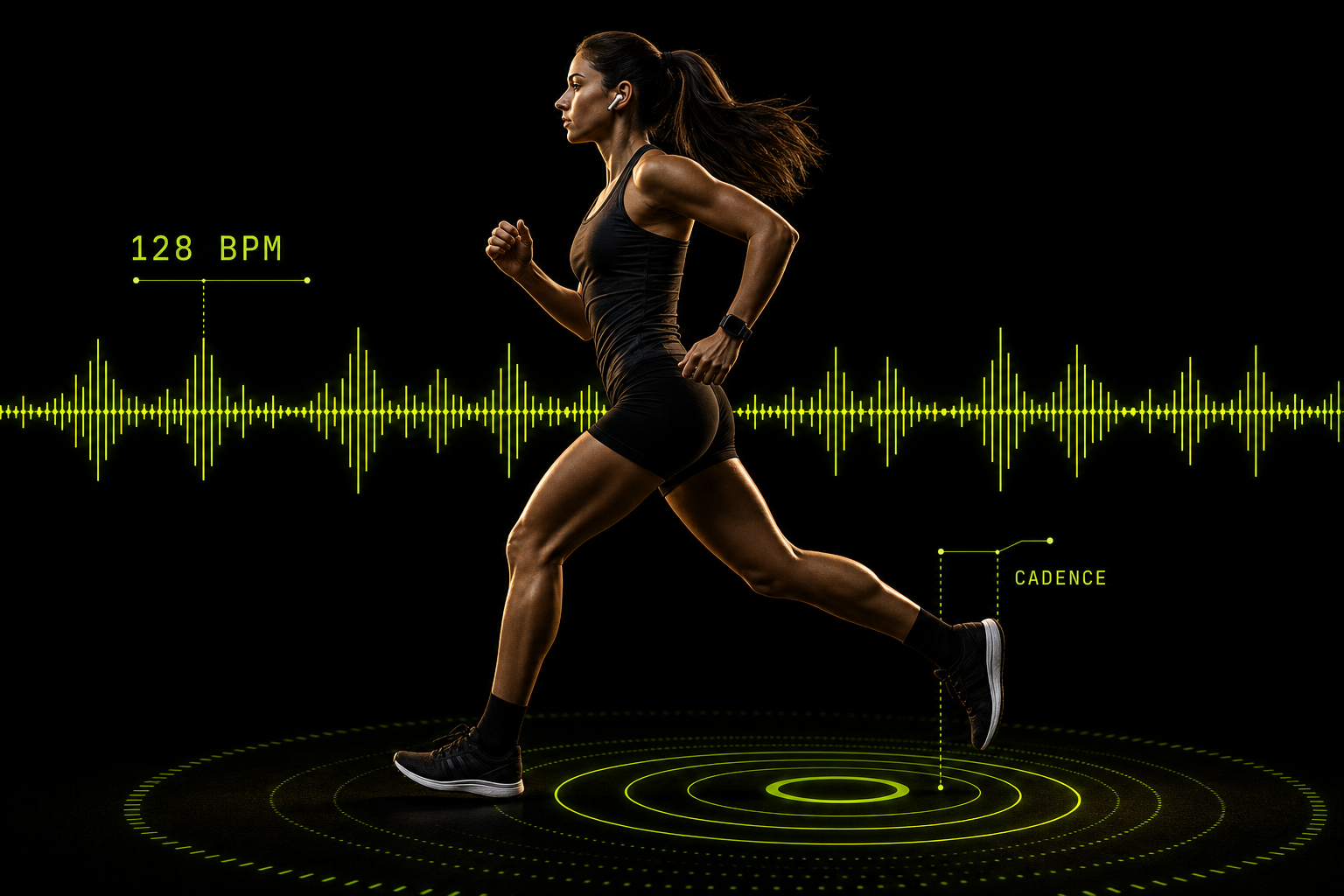
Cadence on your Apple Watch is your running steps per minute, and the Watch tracks the average reliably enough to guide real training decisions. If you want to use it well, check your typical cadence over a few runs, then nudge it up by 5 to 10 percent if you’re chasing lighter, lower-impact strides. Set an alert or a custom workout target and let the number do the coaching.
TL;DR:
- Most recreational runners’ cadence ranges from 150 to 170 steps per minute, with elite runners often exceeding 180 at faster paces.
- Apple Watch’s cadence measurement is accurate generally above a 0.90 correlation, but short runs and arm movement changes can affect reliability.
- Increasing cadence by 5 to 10 percent above your baseline can improve biomechanics and reduce impact without hindering running economy.
- Setting a live cadence alert on Apple Watch requires adding it to workout metrics and adjusting software version, with a recommended range over a fixed number.
- Adaptive music syncing with your cadence offers a hands-free, continuous cue for impact reduction or tempo work during runs.
Table of Contents
- What cadence is and why runners care
- How Apple Watch measures cadence and how accurate it is
- What your cadence numbers mean: typical ranges and realistic goals
- How to view cadence on Apple Watch and set alerts
- How to train cadence safely: a short, practical plan
- Troubleshooting common cadence and alert problems
- Repbeats perspective: adaptive music as a cadence retraining aid
- Try adaptive music that follows your cadence
- Sources
- FAQ
What cadence is and why runners care
Cadence counts your steps per minute, both feet combined. It works alongside stride length: for any given pace, a faster cadence generally means a shorter stride, and a slower cadence means a longer one. Runners watch this pairing because it shapes how hard each footstrike lands.
A shorter, quicker stride tends to keep your foot landing closer to your body’s center of mass instead of reaching out ahead of it. That reduces overstriding, one of the more common contributors to jarring impact forces at the knee and hip.
A systematic review of step rate changes found that moderate cadence increases produce consistent biomechanical improvements, including lower vertical ground reaction forces and better lower-limb alignment, without hurting running economy. That’s the case for treating cadence as more than a number on your wrist.
- Cadence and stride length trade off against each other at any fixed pace.
- A quicker cadence usually shortens stride and reduces overstriding.
- Reduced overstriding is linked to lower joint loading during impact.
How Apple Watch measures cadence and how accurate it is
Apple Watch estimates cadence using its wrist-mounted accelerometer, which picks up the rhythmic motion of your arm swing as you run. An onboard algorithm converts that motion pattern into steps per minute, then averages it across your session.

Validation studies comparing fitness watches to motion-capture systems report intraclass correlation coefficients above 0.90 for average cadence, according to research on commercial fitness watch accuracy, meaning the readings align closely with lab-grade measurement. That level of agreement means your Watch is a solid tool for tracking whether your cadence is actually changing over weeks, not just guessing at it.
Average cadence holds up better than any single-moment reading, since it smooths out the small variations that happen stride to stride. A few situations still limit reliability though:
- Very short efforts don’t give the algorithm enough data to settle on a stable average.
- Changing your arm motion, like carrying a phone or a water bottle, can distort the arm-swing signal the accelerometer relies on.
- Peak cadence spikes during a single stride are less trustworthy than the averaged figure over several minutes.
What your cadence numbers mean: typical ranges and realistic goals
Recreational runners often land somewhere in the 150 to 170 steps per minute range at easy paces, while competitive and elite runners frequently sit higher, often above 180, especially at faster paces. Those figures shift a lot based on height, leg length, and speed, so there’s no single number that fits everyone.
The often-quoted 180 steps per minute target came from observations of elite racers decades ago, not from a rule that applies universally. Treating it as gospel can push shorter or slower runners into an unnatural gait.
A more useful approach is relative: find your own spontaneous cadence over a normal easy run, then set a target 5 to 10 percent above it if you’re working on impact reduction. That keeps the goal personal instead of borrowed from someone else’s stride.
- Recreational cadence commonly falls in the 150s to 170s at easy effort.
- Elite and competitive cadence often exceeds 180, particularly at race pace.
- A percentage increase from your own baseline beats chasing a fixed number.
How to view cadence on Apple Watch and set alerts
Your average cadence for a completed run shows up automatically in the Health app and in the workout summary right after you finish. To see it live while you’re running, you need to add it to your Workout Views.
- Open the Watch app on your iPhone, go to Workout, then Workout Views, and choose the workout type you use for running.
- Tap Metrics or Metrics 2, then add Cadence to the list of stats you want visible mid-run.
- Start your run, swipe to the screen showing that metric group, and glance at your steps per minute in real time.
- To set a target instead of just watching the number, use Apple’s Workout Builder to create a custom workout with a cadence target or range for a given segment.
- Confirm your watchOS version supports Workout Builder’s cadence targeting, since this feature arrived in a recent software update and older versions won’t show the option.
Apple documents the full list of running metrics available through Workout Views and Metrics, which is worth a quick read if you want to customize beyond cadence alone.
Pro Tip: Build a cadence range instead of a single number in Workout Builder. A range gives you room to breathe without triggering constant alerts.
How to train cadence safely: a short, practical plan
Cadence changes stick best when they’re introduced gradually rather than forced all at once mid-run. The 5 to 10 percent guideline backed by biomechanics research gives you a safe ceiling to work toward.
- Start with an easy run and raise your cadence about 5% above your natural baseline for short intervals of 1 to 2 minutes.
- Repeat those intervals two or three times per easy run, resting at your normal cadence between them.
- Once 5% feels automatic over a few weeks, progress toward the full 5 to 10% range during tempo efforts.
- Reassess your baseline monthly, since your natural cadence shifts as your fitness and stride mechanics improve.
Watch for warning signs that you’re pushing too fast: a perceived effort that feels disproportionately high for your pace, or soreness that lingers past a normal recovery window. Both suggest backing off the target and giving your neuromuscular system more time to adapt.
Pro Tip: Practice cadence drills on tired legs occasionally too, not just fresh ones. Race day rarely happens at your freshest.
Troubleshooting common cadence and alert problems
Cadence alerts sometimes go quiet even when they’re configured correctly. A few checks usually solve it.
- Confirm cadence is actually added under Metrics or Metrics 2 in your Workout Views settings, since a missing metric won’t trigger an alert.
- Verify your watchOS version supports the alert type you’re trying to use, particularly if you recently updated software.
- If voice feedback has gone silent, know that user reports following watchOS 26 describe voice alerts behaving inconsistently, sometimes needing a paired phone or active connectivity to work as expected.
- As a workaround, rely on haptic taps instead of voice, or carry your phone during the run to restore consistent voice cues.
Repbeats perspective: adaptive music as a cadence retraining aid
Watching a screen for cadence numbers mid-stride isn’t always practical, especially during tempo work or races. Adaptive music that syncs its tempo to your cadence and heart rate gives you a continuous, nonvisual cue instead, similar in spirit to the auditory cueing that supports adherence to cadence drills in retraining research.
That kind of audio feedback works best as a supplement, not a replacement for actually checking your numbers and how your body feels. Pair it with the gradual, percentage-based approach outlined above rather than letting the beat alone dictate your pace.
— Jordan Mills
Try adaptive music that follows your cadence
Adaptive music can adjust its BPM to your cadence, heart rate, and workout intensity in real time, using data pulled from wearable devices. Instead of glancing down at a metrics screen, you get a soundtrack that shifts tempo as your stride does, using technology that updates the beat dynamically every bar.
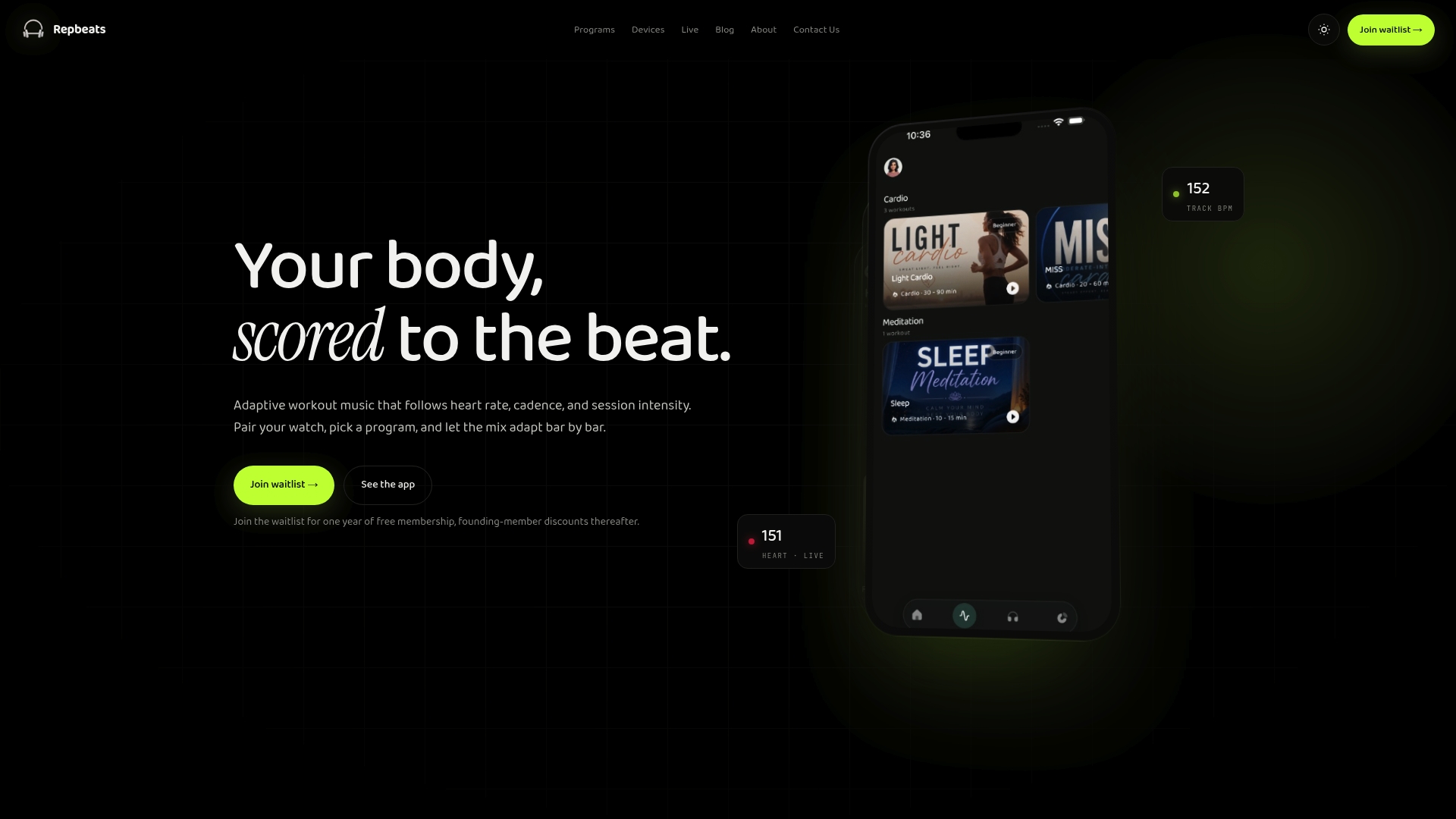
That makes it a practical companion to the cadence drills above, useful when you want a hands-free cue during a cadence-lock running setup or a tempo run without constant screen checks. Visit the Repbeats app page to see how the adaptive music works, or head to the Repbeats landing page to try it with your next run.
Sources
- Effects of changing running step rate on injury, performance and biomechanics (systematic review / meta-analysis)
- Systematic review: Cadence modification and biomechanical outcomes (PMC article)
- Workout views and running metrics on Apple Watch (Apple Support)
- Validity and reliability of a commercial fitness watch for measuring running dynamics (J Orthop Sports Phys Ther summary)
- Apple’s Secret New Custom Workout Builder in iOS26/WatchOS26: Hands-on (DCRainmaker)
- Apple Community discussion: no voice workout alerts after watchOS 26
FAQ
Is cadence on Apple Watch accurate?
Yes, for average cadence over a run, validation research comparing fitness watches to motion-capture systems reports intraclass correlation coefficients above 0.90, which counts as strong agreement. Short efforts and altered arm swing can reduce that reliability, so trust averaged readings over single-moment peaks.
Is 160 cadence too slow?
Not necessarily. Many recreational runners run comfortably in the 150s to 170s at easy pace, and cadence depends heavily on your height, leg length, and speed rather than a fixed universal number. If you’re aiming to reduce impact, a target 5 to 10 percent above your own baseline matters more than hitting any specific figure.
Is it better to have a higher or lower cadence?
Neither extreme is automatically better, since cadence has to match your stride length, pace, and body mechanics to work well. Research on step rate changes shows that a moderate increase of 5 to 10 percent above your natural cadence tends to reduce joint loading, which is why gradual, individualized increases are the usual recommendation rather than chasing a high number for its own sake.
Is 200 cadence too high?
For most runners at typical training paces, very high cadence values are unusual and likely reflect a very short, quick stride rather than an efficient one. Elite runners sometimes exceed 180 steps per minute at fast race paces, but building toward higher cadence should follow the same gradual, percentage-based progression rather than a sudden jump.