Cadence vs Heart Rate: What Really Drives the Other
Jordan MillsAugust 21, 2026 · 10 min read
Cadence vs Heart Rate: What Really Drives the Other
Yes, raising your cadence usually raises your heart rate, even when your power output or pace stays exactly the same. Spin faster or turn your legs over quicker at the same wattage or speed, and your body typically shifts work from the muscles to the cardiovascular and ventilatory systems, which shows up as a higher heart rate. That said, the size of the effect depends heavily on you: your fitness, your fatigue level, the terrain, and how far your cadence sits from what feels natural.
- Higher cadence at equal power/speed generally raises heart rate and ventilatory demand.
- Individual variability is large. Slope, fatigue, and fitness level all shift the tradeoff.
- Your move right now: run or ride a short cadence test (protocol below) to find where your own heart rate and effort level cross.
Quick fact: Controlled cycling research found that higher cadences increase ventilatory demand and heart rate response, with little change to peak V̇O2 or max heart rate across a 60 to 90 rpm range in healthy adults.
Key Takeaways
Higher cadence at equal power or pace typically raises heart rate because workload shifts from muscles to the cardiovascular system, and the exact tradeoff is different for every athlete.
| Point | Details |
|---|---|
| Cadence raises heart rate | At matched power or pace, higher cadence usually increases heart rate and ventilatory demand. |
| Wait for HR to stabilize | Hold each test cadence 3 to 5 minutes before recording heart rate to avoid a false reading. |
| Cadence effects are individual | Optimal cadence varies by rider or runner. Field data can reveal your specific number. |
| Running cadence aids injury management | A roughly 7% cadence increase can meaningfully cut peak impact force. |
| Progress cadence gradually | Limit changes to 5 to 10% per training block and watch for heart rate drift. |
Table of Contents
- Physiology: How Cadence Changes Muscular and Cardiovascular Load
- What Studies Show About Cadence and Heart Rate
- How Do You Test Cadence vs Heart Rate Yourself?
- Does Cadence Work Differently for Cycling Than Running?
- How to Program Cadence and Heart-Rate Work Into Training
- Using Adaptive Music to Hold Cadence and Heart-Rate Targets
- An Evidence-Backed Take on Cadence and Heart Rate
- Frequently Asked Questions
- Sources
Physiology: How Cadence Changes Muscular and Cardiovascular Load
Pedaling or striding faster changes where the workload lands. At a higher cadence, each muscle contraction produces less force, but you’re doing more of them per minute. That trade reduces local muscular strain but increases the frequency of contractions your heart and lungs have to fuel, which is why breathing rate and heart rate often climb even though your legs might feel less fried.
- Lower force per contraction, higher contraction frequency: less muscular strain, more cardiovascular demand.
- Ventilatory response tends to climb alongside cadence in controlled lab settings.
- Fitness level, muscular strength, and accumulated fatigue all shift where your personal balance point sits.
This isn’t universal math. A cyclist with strong quads might tolerate a lower cadence with less muscular fatigue, while someone with less strength endurance may find a higher cadence noticeably easier on the legs, even at a cardiovascular cost. Neuromuscular fatigue research suggests that riding at a cadence far outside your preferred range can reduce your maximum sustainable work rate, independent of what your heart rate is doing.
Pro Tip: Don’t judge a cadence by how your legs feel in the first two minutes. Muscular sensation changes fast; heart rate takes longer to tell you the real story.
What Studies Show About Cadence and Heart Rate
The research splits cleanly by sport, and each side answers a slightly different question.
- Cycling (CPET studies): Higher cadences increase ventilatory demand and the heart-rate response during graded testing, but peak V̇O2 and maximum achieved heart rate barely move across cadences. Sample sizes in this kind of lab work tend to be small, and protocols vary, so treat the direction of the effect as reliable and the exact magnitude as rider-specific.
- Running (cadence retraining): An outdoor trial using auditory cues found that a roughly 7% increase in cadence reduced peak impact force by about 5.6%, a meaningful signal for anyone managing overuse injuries. A separate 12-week retraining study found a 5.7% cadence increase produced measurable drops in impact peak and vertical load rates.
- Economy effects: Running economy and cycling efficiency responses to cadence changes are individual. What works for your training partner’s heart rate and joints won’t necessarily transfer to yours.
The methodological detail that matters most for your own testing: researchers typically wait 3 to 5 minutes at each cadence before recording heart rate, since it takes that long to stabilize after a workload change. Skip that wait, and you’ll draw the wrong conclusion from your own data.
How Do You Test Cadence vs Heart Rate Yourself?
You don’t need a lab. A power meter, a GPS watch, or even a treadmill with pace control gets you most of the way there. Here’s the protocol.
- Warm up for 10 to 15 minutes until your heart rate settles into a steady aerobic range.
- Pick one fixed target, either a power number on the bike or a pace on the run, and hold it constant across every interval.
- Randomize your cadence order (for example, 70, 80, 90 rpm on the bike, or your normal, plus 5%, plus 10% steps running) so fatigue doesn’t bias later intervals.
- Hold each cadence for 3 to 5 minutes, giving your heart rate time to stabilize before you record anything.
- Log heart rate, cadence, power or pace, and perceived exertion at the end of each interval.
- Control the variables you can: same gradient, same gearing, same shoes, same road or trainer.
Use a metronome or an adaptive-BPM playlist to hold your cadence steady without staring at a screen. When you analyze the results, look for the cadence that produces the lowest heart rate at your chosen power or pace, or the best tradeoff between heart rate and how hard the effort actually felt. A field-based modeling approach that tracks power, cadence, and heart rate over weeks can reveal an individual optimal cadence, and researchers using this method found examples as different as 83 rpm and 70 rpm for two separate riders.
Pro Tip: Run the same test again after a hard training week. Fatigue shifts your optimal cadence, sometimes by more than you’d expect.
Does Cadence Work Differently for Cycling Than Running?
Cycling and running share the same underlying physiology, but the practical playbook diverges.
- Cycling: Most riders land somewhere between 80 and 100 rpm as a comfortable aerobic cadence, with lower cadences (60 to 70 rpm) used deliberately for strength work and higher cadences (95 rpm plus) for high-turnover aerobic sessions.
- Running: Cadence typically falls between 150 and 190 steps per minute, and modest increases of roughly 5 to 10% can reduce impact forces, which helps with injury management more than it guarantees a faster time.
- Terrain and biomechanics change the math. Climbing usually pushes cadence down and heart rate up regardless of what you intend; downhill running often does the opposite.
Treat any specific cadence number as a starting point, not a rule. Coaching guidance from the University of Michigan makes the point directly: the popular 180 steps per minute benchmark came from observing elite racers, not from a study proving it’s optimal for everyone.
How to Program Cadence and Heart-Rate Work Into Training
Pairing cadence targets with heart rate zones gives you a training structure that’s easy to repeat and easy to progress.
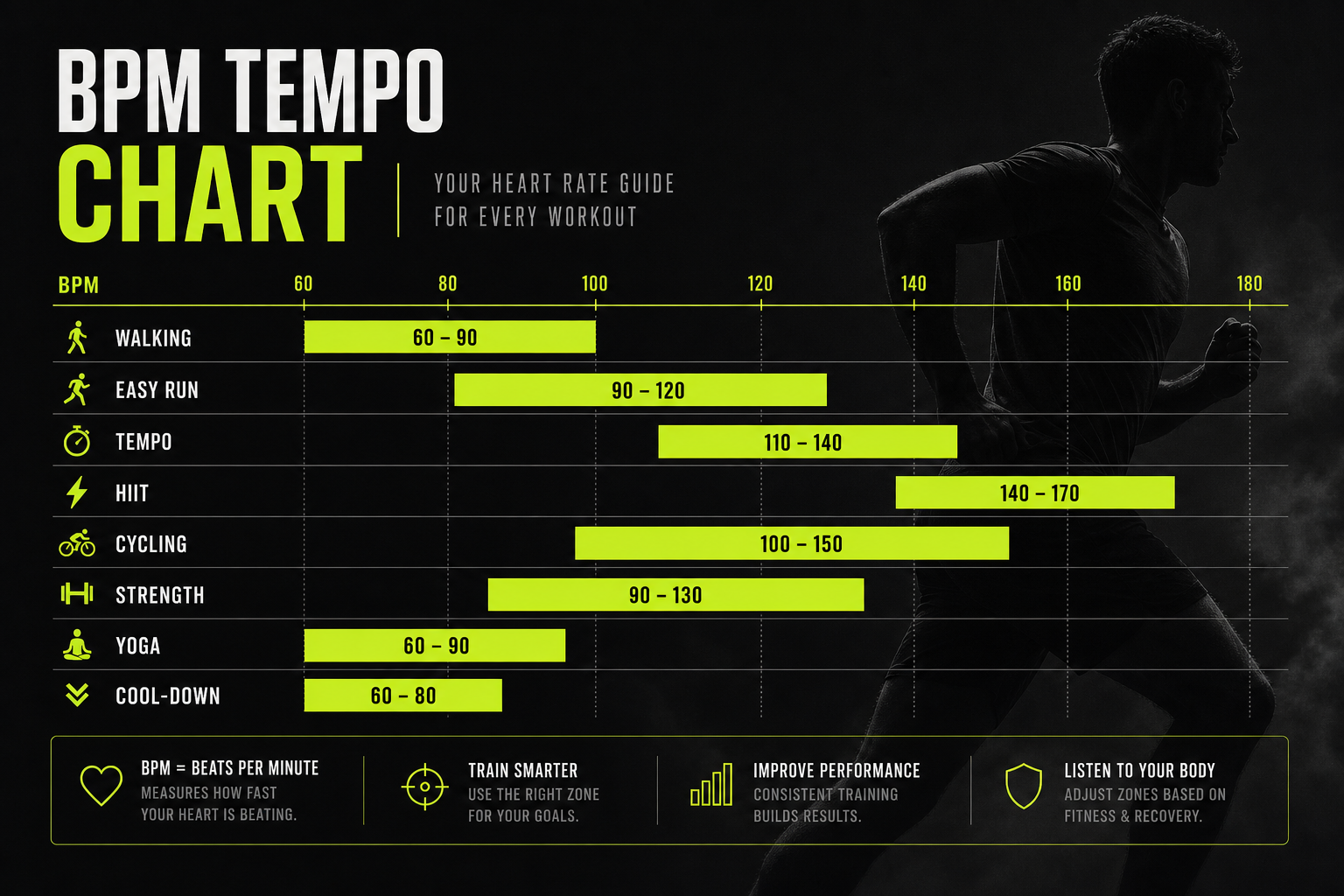
- Easy days: high cadence, Zone 1 to 2 (roughly 50 to 70% of max heart rate), used for recovery and neuromuscular efficiency.
- Tempo work: your preferred, natural cadence, held in Zone 3 (about 70 to 80%).
- Threshold intervals: preferred cadence again, pushed into Zone 4 (80 to 90%), where cadence drift under fatigue becomes a useful signal.
- Strength sessions: deliberately low cadence, moderate heart rate, focused on force production rather than cardiovascular stress.
Change cadence gradually. Prioritize cadence changes when you’re managing an overuse injury, working on neuromuscular control, or deliberately chasing a stronger cardiovascular stimulus, not just because a number sounds official. Some training platforms, including analytics tools like Fitness Flow, now track cadence and heart-rate trends over time so drift becomes visible instead of anecdotal.
Pro Tip: If your heart rate climbs at a cadence that used to feel routine, that’s fatigue talking before your legs do. Back off before it becomes an overuse problem.
Using Adaptive Music to Hold Cadence and Heart-Rate Targets
Holding a cadence steady for a 3 to 5 minute interval is harder than it sounds once your legs get tired and your attention drifts. A metronome works, but it’s monotonous and it doesn’t respond to what your body is actually doing.
- Adaptive BPM playlists can cue cadence the same way a metronome does, without the fatigue of a click track.
- Repbeats’ auto-DJ technology updates BPM every bar, syncing tempo to live heart rate and cadence data from wearables like Apple Watch and Fitbit.
- That live responsiveness means the music can hold a target during your randomized cadence intervals or nudge you gently toward a new cadence during a retraining block.
A test protocol only works if you can actually hold each cadence steady for the full interval. Music that adjusts to your live data does that job better than a static click track ever could.
Pro Tip: Set up separate playlists for each test cadence before you start your session, so you’re not fumbling with a phone mid-interval.
If you’re running the field protocol described earlier, pairing it with Repbeats turns a clipboard exercise into something you’ll actually finish.
An Evidence-Backed Take on Cadence and Heart Rate
The research supports a narrower claim than most cadence advice implies. Higher cadence tends to raise heart rate at equal output, and modest running cadence increases can reduce impact force. That’s it. It doesn’t support chasing 180 steps per minute or a specific cycling rpm because a coach or a magazine said so.
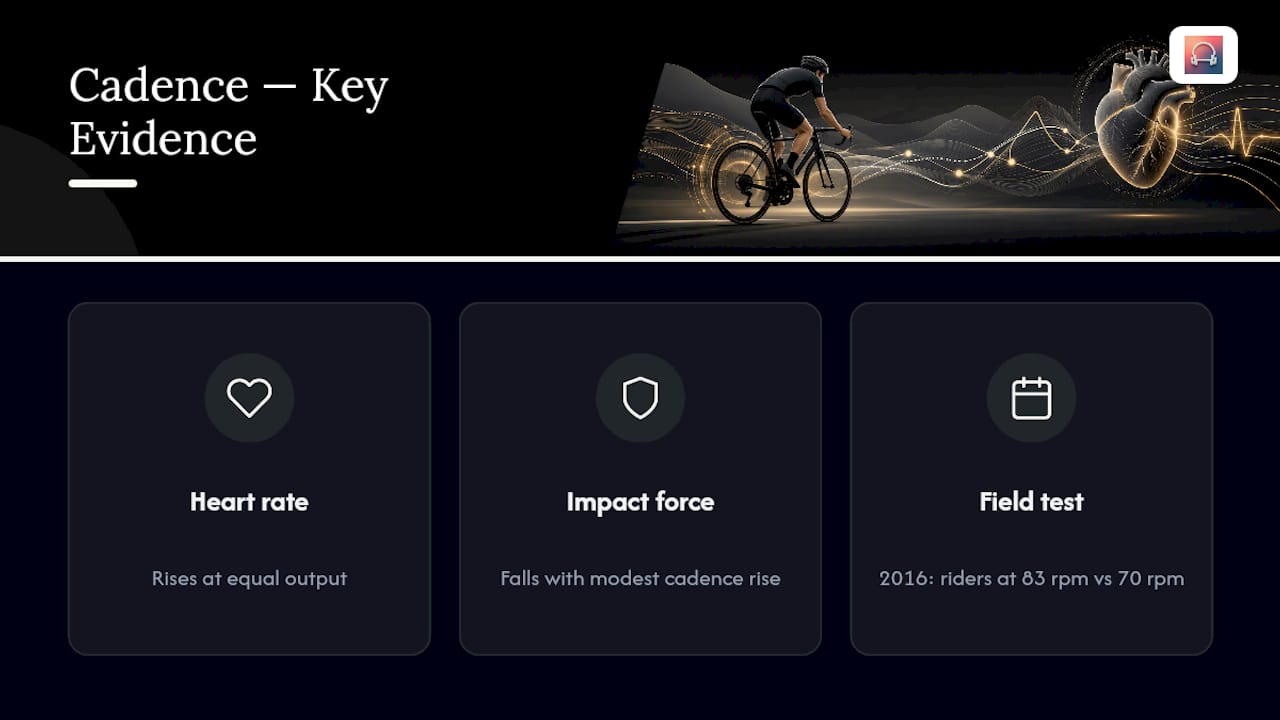
Conventional advice fails by treating cadence as a fixed target instead of a variable to test against your own data. The 2016 field methodology for estimating optimal cadence found genuinely different answers for different riders, 83 rpm for one, 70 for another, which should end any debate about universal numbers.
What should you prioritize first? Run the field test before you touch your training plan. Three or four intervals at different cadences, heart rate and perceived effort logged honestly, tells you more than another article citing a benchmark. Adaptive tools that hold cadence steady during that test, rather than a static metronome, remove the biggest source of noise: your own inconsistency mid-interval.
Frequently Asked Questions
Does higher cadence always increase heart rate? Usually, yes, at the same power or pace, but the size of the increase depends on your fitness level, fatigue, and how far the cadence sits from your natural preference.
What’s the difference between cadence and heart rate as training metrics? Cadence measures mechanical output, how fast your legs move. Heart rate measures cardiovascular input, how hard your heart is working to support that output. Neither tells the full story alone.
How long should I hold each cadence when testing? Hold each cadence for 3 to 5 minutes to let your heart rate fully stabilize before recording it. Shorter intervals give you a reading that still reflects the previous cadence.
Is there an ideal running cadence? No single number works for everyone. Modest increases of 5 to 10% above your natural cadence can reduce impact forces, but forcing a specific number like 180 steps per minute isn’t backed by strong evidence for every runner.
Can music help control cadence during a workout? Yes. Auditory cues, including metronomes and adaptive BPM playlists like those Repbeats generates from live wearable data, are an effective way to hold or shift cadence during training.
Sources
- Understanding exercise heart-rate zones — Harvard Health
- Impact of cycling cadence on physiological response during a cardiopulmonary exercise test — PMC
- Effect of Increasing Running Cadence on Peak Impact Force in an Outdoor Environment — PMC
- Methodology for estimating optimal cadence from field data — 2016 DOI article