Match Your Cadence With 125–140 BPM Focus Run Music For Runners
Jordan MillsSeptember 18, 2026 · 15 min read

Match Your Cadence With 125–140 BPM Focus Run Music For Runners
Play a playlist that stays between 125 and 140 BPM for 60 to 90 minutes and you will hold pace with less mental effort. That is what focus run music actually does. It gives your brain a rhythmic anchor so it stops narrating every ache and instead locks onto the beat, which is why steady and endurance runners lean on it more than sprinters do. Set your target BPM before you start, pick a mix built for that range, and let a tempo matching tool like Repbeats handle the rest if you don’t want to babysit a playlist mid-run.
TL;DR:
- Most runners benefit from focus run music in the 125 to 140 BPM range, which can reduce perceived exertion during steady and endurance runs.
- Curated playlists like 90-minute steady-state or Top 40 mixes are tailored for different running conditions and are available on platforms like Spotify and YouTube.
- Matching music BPM to your cadence or setting it 5 to 10 BPM above helps maintain rhythm and prevents tempo disruptions caused by shuffled or incompatible tracks.
- Adaptive apps like Repbeats and Spotify’s Running Mode sync to heart rate and cadence for real-time tempo adjustment, making playlists more responsive to changing effort levels.
- Focus music works best for easy, long runs, and warming up, but should be avoided during high-intensity intervals or race efforts where listening to your body is more effective.
Table of Contents
- Focus Run Music Playlists Ready to Play Right Now
- The Real Relationship Between BPM and Cadence
- When Focus Music Actually Helps (and When to Skip It)
- Build Your Own Focus Run Mix in Four Steps
- Apps and Tech That Handle the Tempo Matching for You
- Do Music Genres Actually Change How You Run?
- Mistakes That Quietly Wreck a Focus Run Mix
- When to Trust the Playlist and When to Trust Your Body
- Try Repbeats for Music That Adjusts to Your Run, Not the Other Way Around
- Sources
- FAQ
Focus Run Music Playlists Ready to Play Right Now
You don’t need to build anything from scratch to get the benefit of focus run music today. A handful of ready-made mixes already do the job, and each one fits a specific kind of run better than the others.
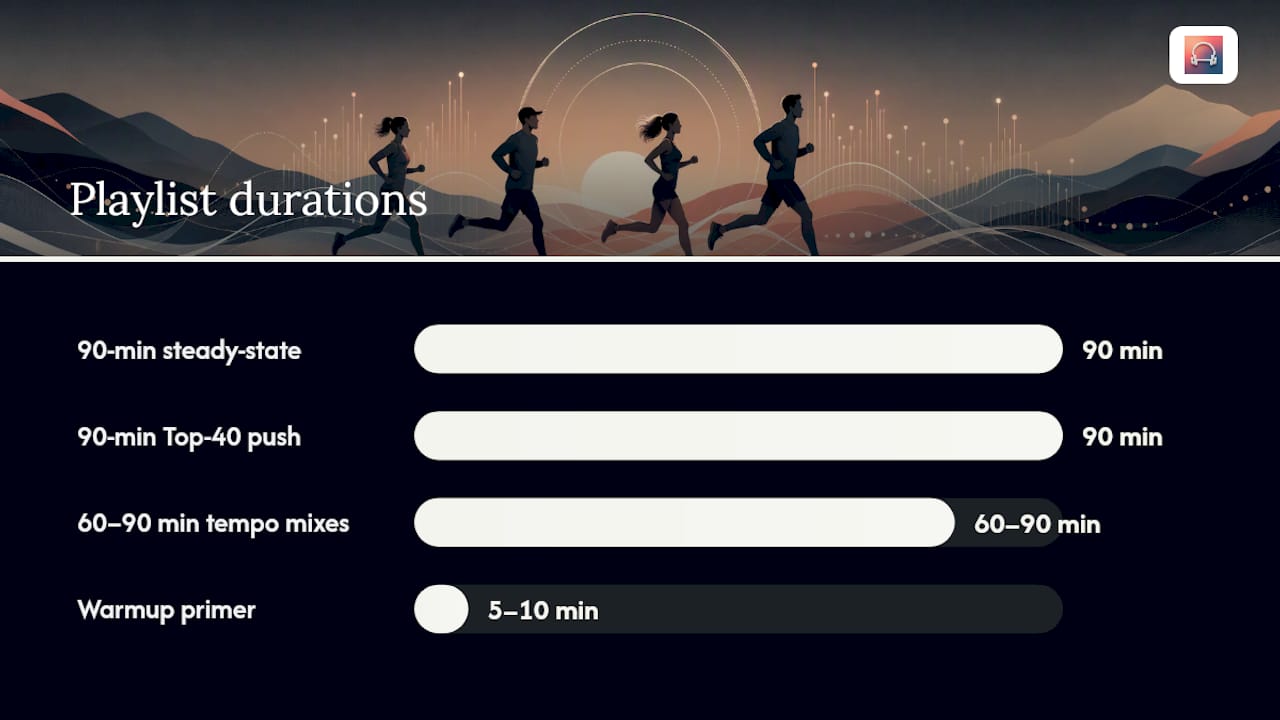
- 90-minute steady-state mix (120 to 140 BPM): Runner’s World built a 90-minute steady-state playlist specifically to help runners hold pace and momentum across a long, unbroken effort. It’s the closest thing to a default option for anyone running 10 miles or more at a conversational effort.
- 90-minute Top 40 push mix (120 to 140 BPM): For days when steady isn’t cutting it and you need a little more edge, Runner’s World also curates a Top 40 running playlist built around energetic, radio-friendly tracks in the same tempo band. It works well for the back half of a long run when motivation dips.
- 60-to-90 minute tempo mixes on Spotify: Curators like Nike publish long-format running tempo playlists that hold a consistent groove for well over an hour, which suits marathon-block long runs where you don’t want to think about your queue.
- Auto-adjusting session (any duration): Repbeats builds a session around your live cadence and heart rate rather than a fixed track list, which matters most when your pace shifts through the run and a static playlist can’t keep up.
- Warmup primer (5 to 10 minutes, 130 to 140 BPM): Short, high-energy sets built for the few minutes before a hard workout, meant to raise arousal, not sustain a full run.
- Ambient low-tempo focus sets (60 to 80 BPM): These are built for studying or deskwork concentration, not running, but worth knowing about since “focus music” search results often mix the two categories together.
- Cooldown mix (20 to 30 minutes, under 110 BPM): Slower tempo tracks that ease heart rate back down without the jarring tempo drop of a shuffled playlist.
Availability matters here. Most of these live on Spotify or YouTube, and Spotify in particular has leaned into this use case with a dedicated feature covered in a later section. None of this requires a premium account to try, though song availability and ad breaks vary by platform and region.
One insight worth flagging: playlists that hold tempo within a tight band keep you dissociated from fatigue far better than a shuffled queue with random tempo swings, according to the same reporting behind Runner’s World’s steady-state playlist. A sudden slow song mid-run breaks the spell and you feel every footstep again.
Keep one earbud out or use bone-conduction headphones on roads and trails with traffic. Volume that blocks out a car horn or another runner calling out isn’t focus, it’s a hazard. Focus music for running should sit at a level where you can still hear your surroundings, not drown them out.
The Real Relationship Between BPM and Cadence
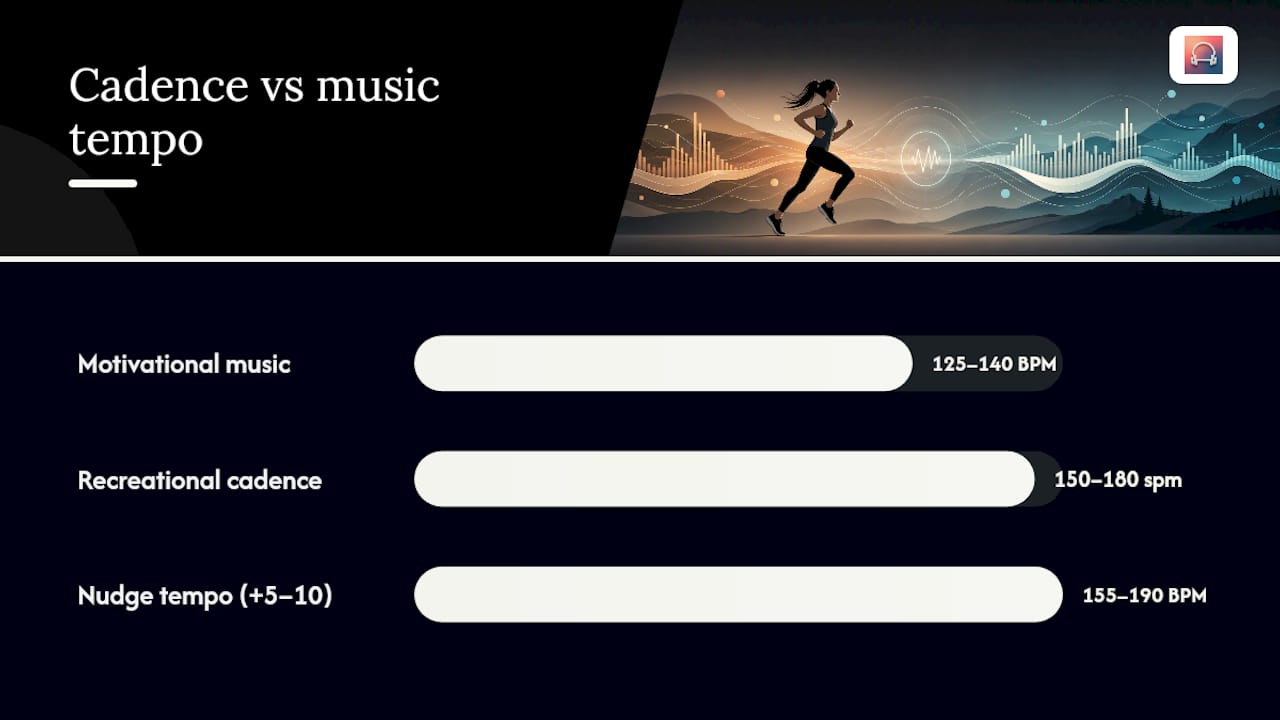
Research on exercise and music consistently points to roughly 125 to 140 BPM as the validated motivational range for running. Music in that band tends to reduce how hard a run feels without actually changing your physiology, and a broad review of exercise-music studies found perceived exertion drops by about 10% on average when the tempo is fast rather than slow.
That effect has a ceiling, though. Once you push past roughly 75% of VO2 max, the same research found the tempo effect fades. Music can make an easy or moderate run feel easier. It cannot make an all-out interval feel comfortable, and expecting it to be is where a lot of runners get frustrated with their playlists.
Cadence is the number that ties this together. Your cadence is how many steps you take per minute, and most recreational runners land somewhere between 150 and 180 steps per minute depending on height, pace, and running economy. Count your steps on one foot for 30 seconds, double it, then double that number again for total steps per minute. A watch with running dynamics will just hand you this number directly.
The practical rule: either match music BPM to your cadence exactly, or set the tempo 5 to 10 BPM above it to nudge your turnover up slightly without forcing a jarring change. Here’s how that breaks down by run type:
Pro Tip: If a song in your mix feels like it’s dragging you down mid run, check its BPM before you blame your legs. A single track running 15 BPM under the rest of your playlist will slow your cadence without you noticing.
When Focus Music Actually Helps (and When to Skip It)
Not every run benefits from a curated mix, and treating music as mandatory for every session is one of the more common mistakes runners make. Match the tool to the workout.
- Easy runs and long runs: This is where focus run music earns its keep. Steady effort, long duration, and a mental battle against boredom or fatigue are exactly the conditions where rhythmic audio helps you dissociate and hold form.
- Tempo runs and intervals: Save the playlist for the warmup and cooldown only. Once you’re deep into a threshold interval or a hard repeat, the tempo effect on perceived exertion largely disappears above that 75% VO2 max mark, and you need to be listening to your breathing and pacing cues instead.
- Race day, late miles: This is the one exception inside hard efforts. Plenty of runners save a specific high-energy track or two for the final stretch of a race, when the goal shifts from pacing discipline to pure willpower.
- Pre-run primer: A 5 to 10 minute burst of high-BPM music before a hard session reliably boosts arousal and mood heading into the work, even if you drop the music once the interval starts.
Safety guidance doesn’t change based on session type. Keep one ear open on any route with traffic, cyclists, or blind corners, and set volume low enough that you can hear your own breathing. A focus mix should support awareness, not replace it.
Build Your Own Focus Run Mix in Four Steps
A curated playlist works fine for a generic run, but a mix built around your actual cadence outperforms it for any structured session you care about.
- Set your target BPM first. Use your measured cadence, or aim for the 125 to 140 BPM band that fits most steady and endurance efforts, before you touch a single track.
- Pick two or three anchor tracks. These sit at your exact target tempo and become the backbone you build the rest of the mix around.
- Fill in with tempo-consistent tracks. Stay within about 5 BPM of your anchors in either direction. A BPM chart organized by workout type speeds this step up considerably.
- Order for a slow ramp, then sustain. Start a few BPM below target to ease in, hold steady through the middle, and save your highest-energy track for the point in the run where motivation typically dips.
- Test it on an actual run and tweak. A song that reads well on paper can still feel wrong at mile six. Swap anything that drags.
Smooth transitions matter more than most runners expect. A jump from 128 BPM to 145 BPM between two songs creates a stutter step you’ll feel in your stride, even if you can’t immediately name why. Most streaming apps let you drag tracks to reorder a saved playlist, so build it once, run it, and adjust the sequence based on where you noticed the tempo lurch.
Pro Tip: Export or duplicate your mix before a big race so you can experiment with a training-run version without wrecking the one you know works.
If a song suddenly feels too slow or fast mid-run, don’t fight it. Skip ahead. Chasing a mismatched tempo for a full song does more damage to your rhythm than a three-second skip ever will.
Apps and Tech That Handle the Tempo Matching for You
Building a hand-tuned mix works, but it takes time most runners don’t want to spend every week. This is the gap tempo-matching apps are built to close.
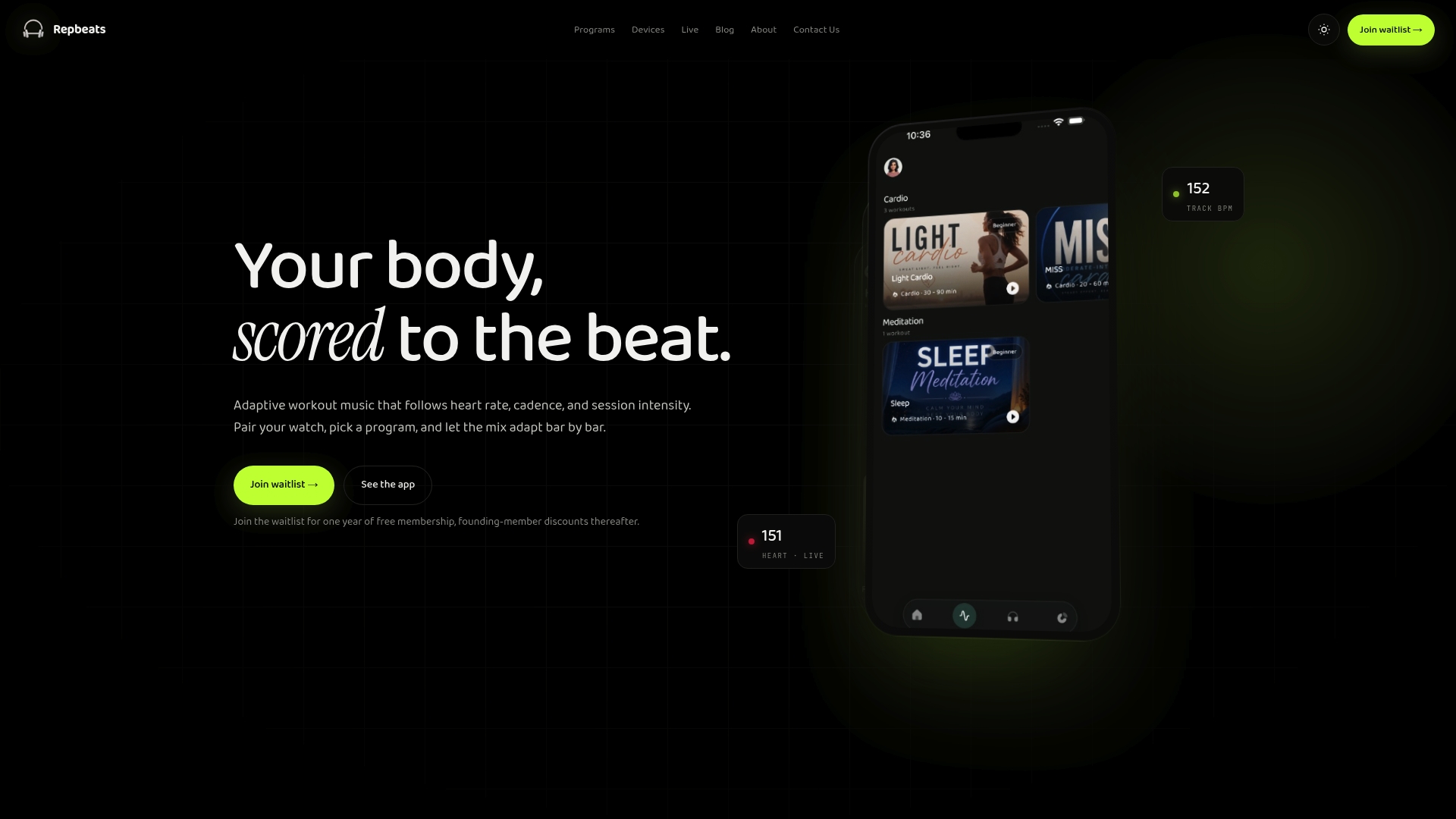
Repbeats syncs directly to wearables like Apple Watch and Fitbit and uses live heart rate and cadence data to adjust the soundtrack in real time. Its auto-DJ updates BPM every bar rather than every song, so a gradual pace shift over a long run gets reflected in the music instead of leaving you stuck with a mismatched track for four minutes. That granularity is the real difference between adaptive music and a static playlist, curated or not.
“The core idea is simple: the music should respond to what your body is actually doing, not what a playlist assumed you’d be doing when it was built last week.” That’s the practical case for adaptive tempo matching over a fixed track order, and it’s the standard Jordan Mills applies when evaluating whether a music tool actually helps a runner or just entertains them.
Spotify has moved in a similar direction with its Running Mode feature, which offers curated presets that match beats to a selected tempo and builds sessions around workout type and duration. It’s a faster setup than a hand-built playlist and a reasonable middle ground if you’re not ready to commit to a dedicated fitness app.
- Pair your wearable to whichever app you choose before you leave the house, not mid-run.
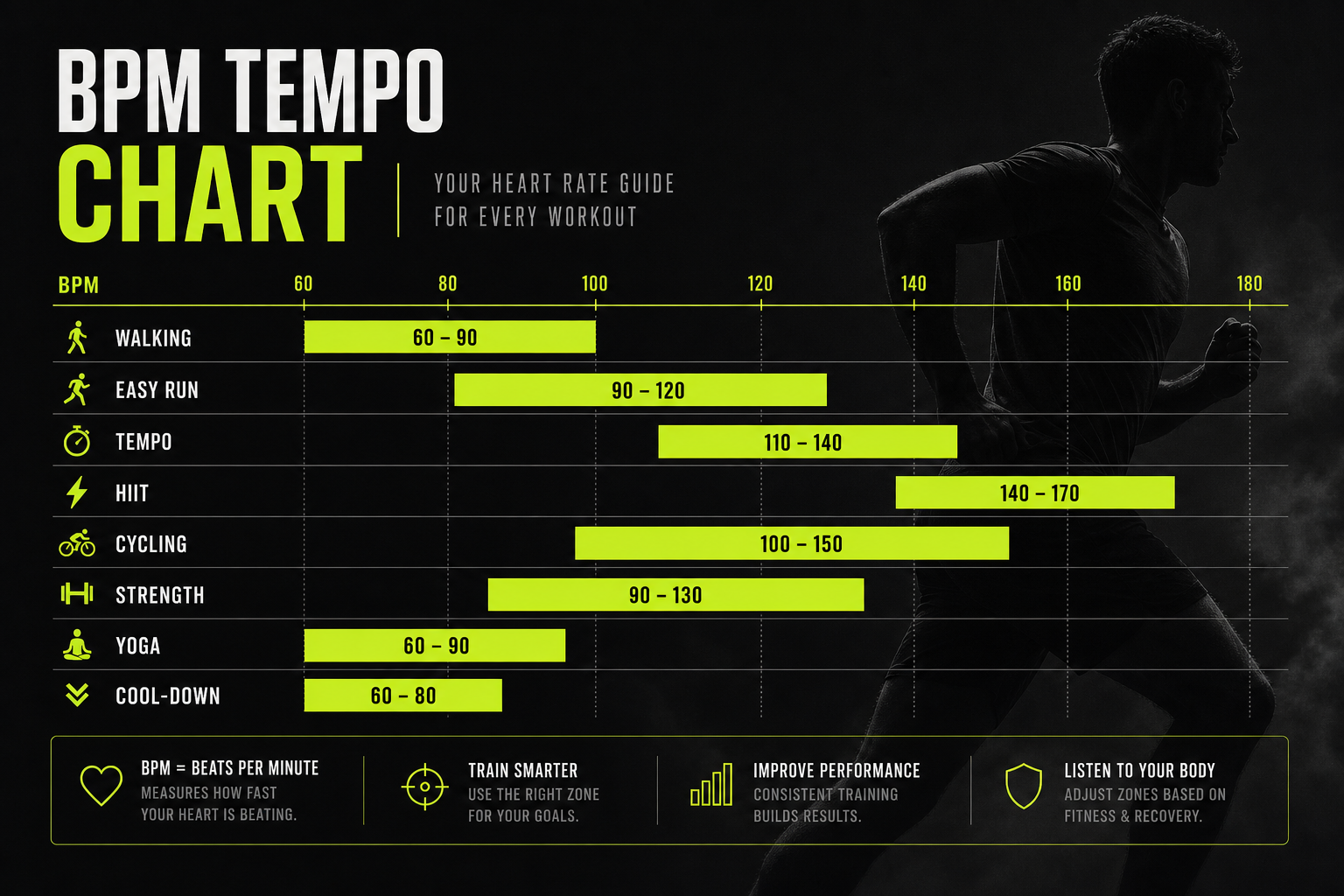
- Pick a preset or target BPM that matches the run type from the table above.
- Do a short test walk or jog to confirm the sync feels responsive before you commit to a long session.
- Keep a manual, downloaded playlist as backup for routes with unreliable connectivity.
Do Music Genres Actually Change How You Run?
Tempo matters more than genre, but genre still shapes how a given BPM feels. A 135 BPM electronic track and a 135 BPM rock song hit the same cadence target, yet they land differently in your head.
Electronic and dance tracks tend to hold the most consistent, unwavering beat, which makes them the easiest genre to build a tight BPM-matched mix around. Hip hop and pop sit close behind, with enough rhythmic drive to support cadence work while still offering the vocal hooks that many runners find more motivating than pure instrumentals. Rock and metal can push arousal higher for short, high-intensity segments, but the genre’s tempo often varies within a single song, which works against the steady-band approach that focus run music depends on.
Ambient and ambient-adjacent tracks sit at the opposite end. Research on concentration-oriented listening points to low-tempo, vocal-free ambient tracks in the 60 to 80 BPM range as the format that best supports focus for deskwork and studying. That’s a different job than pacing a run, and it explains why a great “focus music for studying” playlist usually makes a poor running mix. The genre built for stillness isn’t the genre built for rhythm.
The practical takeaway: pick genre based on personal motivation, but let BPM, not genre label, decide whether a track belongs in your running mix.
Mistakes That Quietly Wreck a Focus Run Mix
The most common mistake is trusting shuffle. A shuffled queue mixes tempos randomly, and that one slow ballad landing at mile four undoes the rhythmic lock you spent thirty minutes building.
A second mistake is chasing favorite songs over tempo fit. A track you love at 95 BPM will drag your cadence down even if it’s motivating in every other way. Save it for the drive home, not the run.
Volume creep is a subtler problem. Runners tend to push volume up as fatigue sets in, right when situational awareness matters most on shared paths and roads. Set your level before you start and resist adjusting it upward mid-run.
Using high-intensity music for every session backfires too. If your warmup primer tempo carries into an easy recovery run, you’ll run that recovery day faster than intended, which defeats the point of the easy day. And expecting music to carry you through a maximal interval session ignores the research showing the tempo effect on perceived exertion fades above roughly 75% of VO2 max. Save the mix for the runs where rhythm actually helps, and run the hard stuff by feel.
When to Trust the Playlist and When to Trust Your Body
Focus run music earns its place on easy days and long runs, where the goal is holding a steady, sustainable rhythm for an extended period. That’s where dissociation actually helps you.
Maximal-intensity work is different. Once you’re deep into an interval or a hard tempo effort, your best data comes from your breathing, your legs, and your watch, not from a track list. I’d rather see a runner pull their earbuds out at the start of a hard rep than force a beat that stopped matching their effort three minutes ago.
For more on tuning tempo to specific workouts, Repbeats covers threshold run pacing and treadmill speed to BPM mapping in more depth. Whatever mix you choose, keep situational awareness intact and let the training goal, not the playlist, decide the pace.
— Jordan Mills
Try Repbeats for Music That Adjusts to Your Run, Not the Other Way Around
Every mix in this guide eventually hits the same limit: a playlist is fixed, and your run isn’t. Your pace drifts, your heart rate climbs on a hill, and a static tempo band can only approximate what your body needs minute to minute. Some apps close that gap by syncing to popular wearables and adjusting BPM every bar to match live heart rate, cadence, and intensity, so a steady run or an endurance session gets a soundtrack that tracks what you’re doing instead of what a curator guessed you’d be doing.
If you’ve been hand-building playlists or hopping between presets to find the right tempo, it’s worth comparing that effort against an app that does the matching automatically. Check your wearable’s compatibility and review the subscription terms on the Repbeats app page, then start a session and see how the auto-DJ handles your next steady run.
Sources
For deeper BPM and playlist guidance, see Runner’s World’s steady-state and Top 40 playlists, RunnersConnect’s BPM and cadence research, and Spotify’s Running Mode announcement. Repbeats’ own treadmill music guide covers adaptive setup in more detail.
- 90-Minute Steady-State Running Playlist
- Best BPM for Running: 125-140 BPM Playlist Guide
- Spotify’s New Running Mode Brings Personalization to Your Workout — Spotify
- 90-Minute Top 40 Running Playlist to Push the Pace
FAQ
What Is the Best BPM Range for Focus Run Music?
Most runners get the strongest effect from music in the 125 to 140 BPM range, which lines up with typical running cadence and has been linked to lower perceived exertion. Faster isn’t always better. Once you’re near your cadence, matching or lightly exceeding it works better than pushing tempo far above your natural step rate.
What Kind of Music Counts as Focus Music?
Focus music splits into two different categories depending on the task. For running, it means rhythmic, steady-tempo tracks in the 125 to 140 BPM band that support pacing, while for studying or deskwork it usually means ambient, vocal-free tracks around 60 to 80 BPM meant to support concentration rather than movement.
What’s a Good Hype Song for Running?
There’s no single universal answer, but the songs that work best for pushing pace tend to share two traits: a driving, consistent tempo in the 130 to 140 BPM range and a strong beat that’s easy to lock a stride onto. Runner’s World’s Top 40 push playlist is a solid starting point if you want curated options rather than building your own.
Can Music Actually Improve Running Performance?
Music mainly changes how effort feels rather than your raw physical capacity, and a review of exercise-music research found it can cut perceived exertion by roughly 10% at easy to moderate intensities. That effect weakens once you push past about 75% of VO2 max, so treat music as a pacing and motivation tool for steady work, not a performance enhancer for maximal efforts.
Does Repbeats Work With My Running Watch?
Repbeats syncs with popular wearables including Apple Watch and Fitbit to pull live heart rate and cadence data during a run. Compatibility can vary by device model, so check the specifics on the Repbeats about page before you commit to a subscription.