Marathon Pace Music: Match Your BPM and Run Faster
Jordan MillsAugust 3, 2026 · 12 min read
Marathon Pace Music: Match Your BPM and Run Faster
TL;DR:
- Matching your playlist’s BPM to your running cadence, especially in the 125–140 range, improves pacing and effort perception.
- Repbeats automatically adjusts music tempo using live cadence data from wearables, eliminating manual playlist management during races.
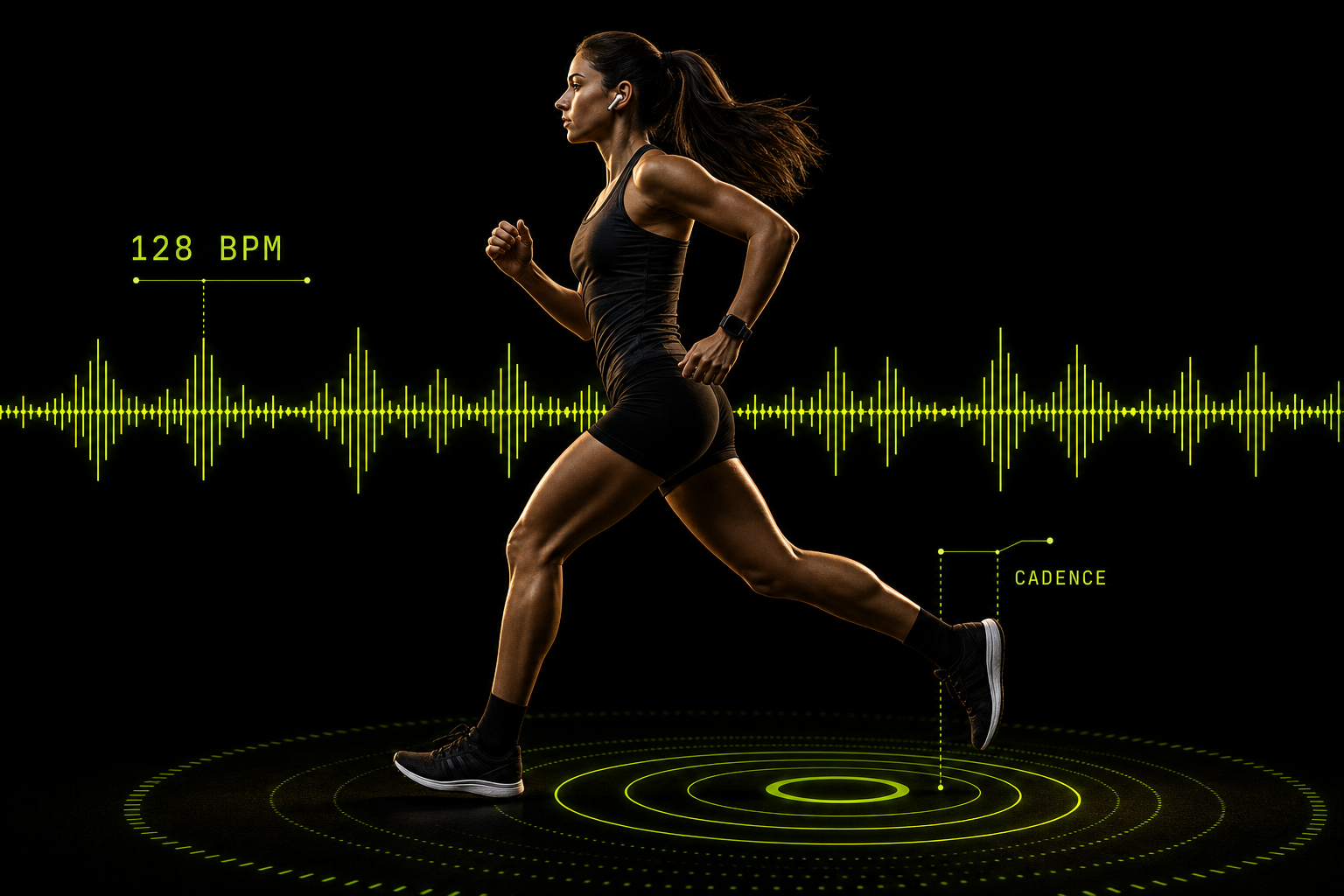
Target music in the 125–140 BPM range for most marathon paces. That single adjustment, matching your playlist’s tempo to your running cadence, is the fastest way to run more consistently and feel less beat up in the final miles. RunnersConnect research confirms 125–140 BPM as the band most supported by exercise-music studies for improving perceived effort and pace. The first step is simple: measure your cadence on your next easy run, then pull a playlist that lands within 2 BPM of that number.
- Measure cadence first. Count your single-foot strikes for 30 seconds and multiply by two. That number is your steps per minute (SPM) and your target song BPM.
- Start in a moderate BPM band. Most recreational marathon runners settle into cadences that correspond to this moderate tempo during steady-state miles.
- Test it short. Run 10 minutes at marathon pace with a matched playlist before committing it to race day. If your stride feels locked in and effort feels lighter, the match is working.
Repbeats automates this entire process by reading your cadence live from an Apple Watch or Fitbit and updating the music’s BPM every bar, so you never have to manually swap playlists mid-run.
Table of Contents
- What BPM should your marathon playlist actually be?
- How do you measure cadence and find a song’s BPM?
- Ready-to-use playlists mapped to marathon pace bands
- How to build a marathon playlist from start to finish
- When does music help your marathon prep, and when should you skip it?
- How Repbeats keeps your music in sync without manual switching
- Key Takeaways
- The case for BPM-matched playlists goes deeper than motivation
- Repbeats takes the manual work out of marathon music
- Useful sources
What BPM should your marathon playlist actually be?
The table below gives general examples of typical marathon pace categories matched with approximate running cadences and corresponding song BPM bands, intended as rough guides for playlist selection.
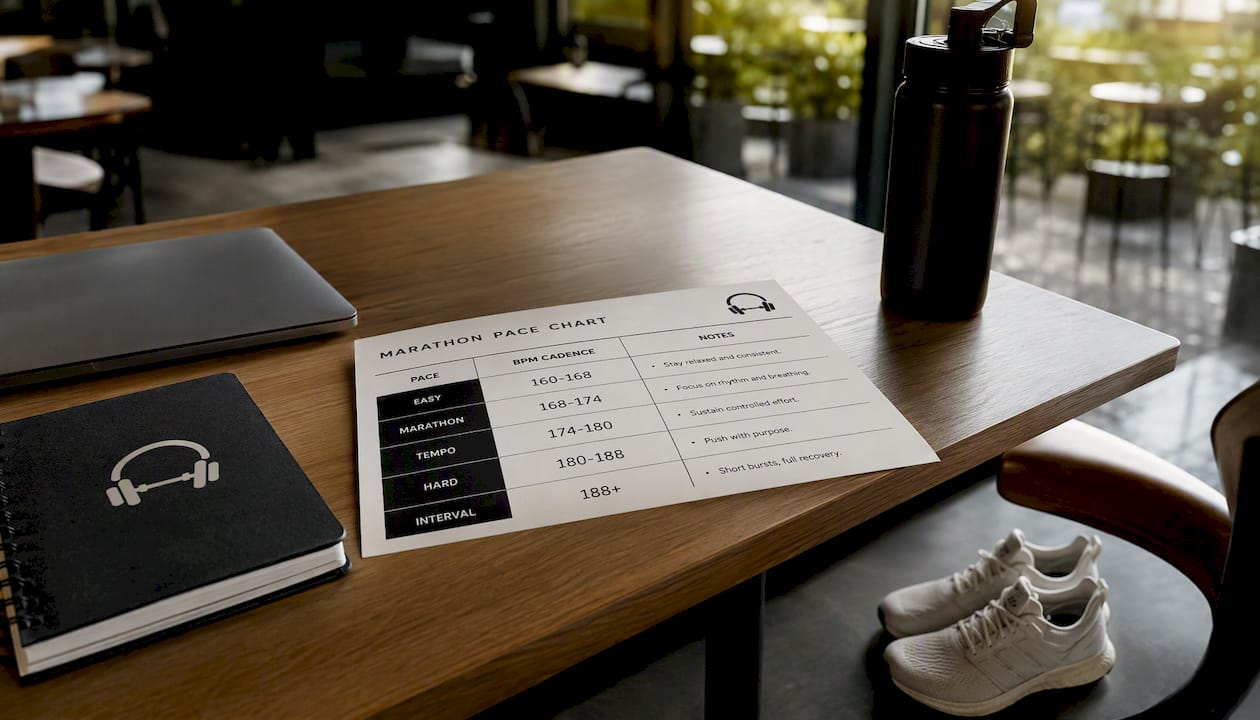
How the conversion works: count only your single-foot strikes per minute. That count equals your SPM. For most song-matching purposes, SPM and target BPM are the same number. If you count both feet as two separate beats, divide by two to get the song BPM equivalent. Many runners in the 9:00–11:00/mile range sync every other footstrike to the beat, which is why the motivational sweet spot for marathon music sits lower than raw cadence numbers might suggest.
Nudging cadence upward: if you want to gradually increase your turnover, pick songs 2–4 BPM above your current cadence. Beat-matched music helps runners maintain more consistent cadence compared with silence, and a small upward offset can coax a quicker stride without forcing it consciously.
Three quick reference rows:
- A slower pace corresponds to a lower stride rate and thus a lower target BPM range.
- A moderate pace corresponds to a moderate stride rate and corresponding BPM range.
- A faster pace corresponds to a higher stride rate and higher BPM target range.
How do you measure cadence and find a song’s BPM?
Three ways to measure your cadence live
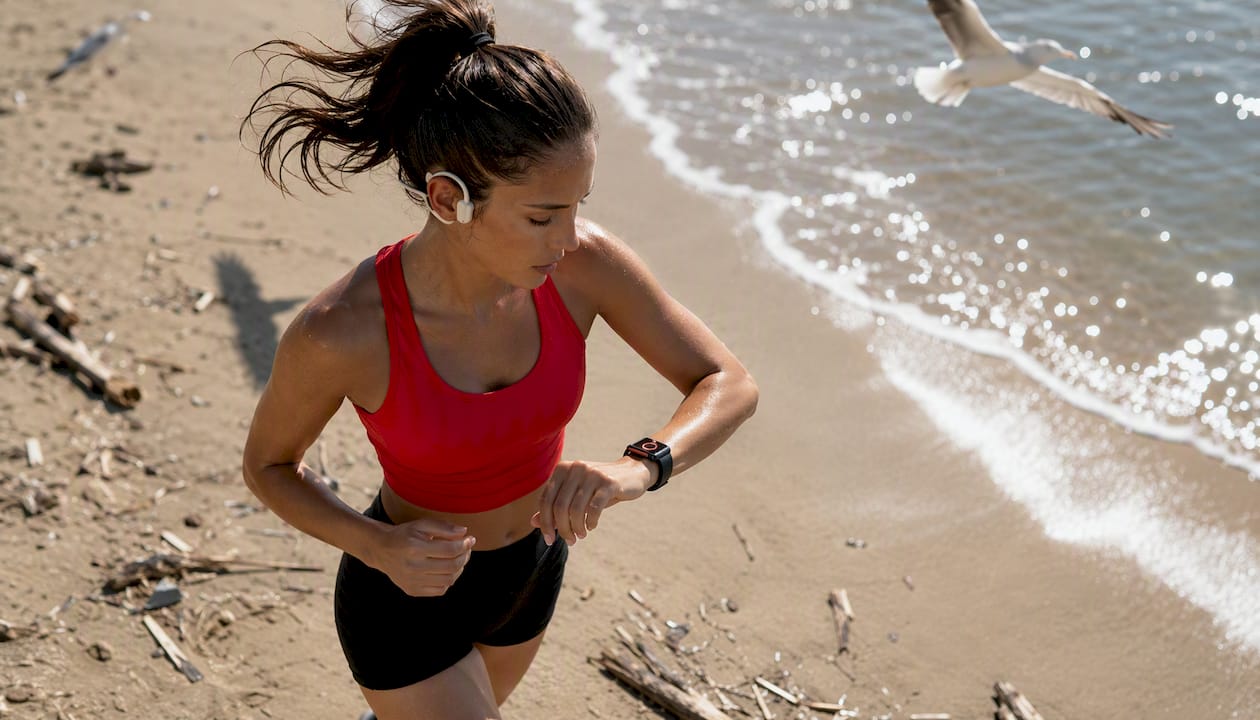
Wearable devices are the easiest option. Apple Watch and Garmin running watches both display real-time cadence in their workout metrics. Garmin shows it as “steps per minute” on the run screen; Apple Watch surfaces it through the Workout app or third-party apps like Runkeeper. Wearable sensors track cadence by detecting wrist or foot movement, and the readings are accurate enough for playlist matching.

Phone apps like Runkeeper, Strava, and Nike Run Club calculate cadence automatically from your phone’s accelerometer. No extra hardware needed.
Manual tap-count: count single-foot strikes for 30 seconds, then double it. Do this twice during a run and average the results. It takes 90 seconds and gives you a reliable baseline.
Finding a song’s BPM in under a minute
Spotify displays BPM in the track details on desktop (right-click a song → “Song Credits”). Apple Music shows it in the song info panel. For any song on any platform, sites like SongBPM.com and TuneBat return BPM instantly from a title search. Most metronome apps also include a tap-tempo feature: tap along to the beat for 10 seconds and read the BPM.
Pro Tip: Listen to a 5–10 minute playlist of songs 5–10 BPM above your marathon pace before you start your run. Pre-run music at slightly higher BPM primes arousal and lifts motivation before the first mile, without locking you into a pace that’s too fast from the gun.
For hard interval sessions, skip the music entirely. Brunel University research found that music cannot mask the effort of maximal-intensity work, and relying on it during VO2 max intervals can cause you to misjudge pacing.
Ready-to-use playlists mapped to marathon pace bands
Rather than building from scratch, start with platform playlists and filter by BPM band. Here is how each band applies across a marathon:
125–130 BPM (recovery and easy long-run miles): best for miles 1–8 when you need to hold back. Search “125 BPM running playlist” on Spotify or Apple Music. Spotify’s Get Me To The Finish Line playlist (131 songs, about 8 hours) covers this range and extends into the steady band, making it a solid seed list for long training runs.
130–135 BPM (steady marathon pace): your workhorse band for miles 8–20. Apple Music’s Ultimate Marathon Mix runs 124 songs across 7 hours 17 minutes and sits primarily in this range, with driving pop rhythms built for sustained effort.
135–140 BPM (strong marathon pace, negative split): use this band from mile 18 onward when you want to push. Save your highest-energy songs here. Search “135 BPM running” on Spotify or Apple Music’s Nike Marathon Mix for curated options.
145–155 BPM (tempo and faster-pace training runs): not for race day unless you are running sub-7:00 miles, but useful for tempo workouts and 5K training. Runner’s World publishes monthly 5K running playlists in this range. Spotify’s dedicated 5K Run playlist (12 songs, 43 minutes) is tight and fast, good for a race-pace tune-up.
160 BPM (speed work and intervals): Runner’s World’s 160 BPM list is built for faster sessions. Reserve it for track days or short race-pace repeats, not marathon miles.
- Download playlists offline before race day. Streaming failures mid-race are more common than runners expect, especially in crowded urban courses where cell coverage drops.
- Avoid shuffle mode during a race. Sequence your playlists intentionally so energy builds rather than spikes randomly.
How to build a marathon playlist from start to finish
A full marathon takes most runners 3.5–5 hours. Build three segmented playlists rather than one giant shuffle, and treat each as a distinct phase.
Warmup block (0–3 miles): 20–25 minutes of songs at 120–128 BPM. The goal is to settle your nerves and establish rhythm without pushing pace. BBC Sounds’ marathon mixes, including the Clara Amfo Marathon Mix, demonstrate this long-form energy arc well, opening with mid-tempo tracks before building.
Steady block: your longest playlist segment featuring moderately paced songs selected and arranged to allow a gradual tempo increase over time, with crossfading to smooth transitions.
Finish block (miles 20–26.2): 45–60 minutes of your absolute favorite, highest-energy songs at 135–140 BPM, in line with the research-supported marathon sweet spot. This is where music’s attention-management effect matters most. Research from the University of Colorado Anschutz shows music shifts focus away from physical distress in later miles, lowering perceived exertion when fatigue is highest.
Practical playback notes: charge your device fully the night before, enable airplane mode to save battery, and download all three playlists offline. Keep your phone in a vest pocket rather than an armband to reduce screen-lock interruptions.
When does music help your marathon prep, and when should you skip it?
Use music for:
- Easy and long runs where attention management matters more than precise effort feedback
- The later miles of a marathon, when perceived exertion is highest
- Pre-run priming with several minutes of higher-tempo music before the effort begins
- Treadmill sessions used to combat monotony
Avoid music for:
- Threshold and VO2 max intervals, where accurate effort perception is the whole point
- Technical workouts focused on form, footstrike, or hill mechanics
- Any route with traffic, intersections, or trail hazards where full audio awareness is a safety requirement
Safety specifics: bone-conduction headphones leave ears open to ambient sounds. Using a single earbud in one ear is recommended for road running in traffic. Lower volume in urban areas is advised. Verify race rules before event day, as some events restrict headphone use.
When fatigue alters your cadence in the final miles, your playlist will feel slightly off-tempo. That is normal. Rather than chasing the beat, let the music serve as motivation rather than a strict metronome. Adaptive music tools that read live cadence solve this automatically.
How Repbeats keeps your music in sync without manual switching
Manual playlist management breaks down exactly when you need it most: miles 20–26, when your cadence drops and your brain has no bandwidth to swap songs. Repbeats solves this with an auto-DJ engine that reads live cadence and heart rate from Apple Watch or Fitbit and updates the music’s BPM every bar, keeping the tempo locked to your actual stride rather than a pre-planned target.
For marathon training, the practical benefits are specific. During long runs, cadence drifts as fatigue accumulates. A static playlist goes out of sync; Repbeats adjusts. For race-day second-half pacing, the app can hold a target BPM band and nudge tempo upward as you push toward the finish. For pre-run priming, you can schedule a 5–10 minute high-BPM segment before your session starts.
Connecting a wearable takes a few minutes in the app settings. Once paired, cadence-driven auto-DJ runs in the background. You can also search songs by BPM within the app to seed your library before a run, then let the auto-DJ handle transitions from there.
Key Takeaways
Matching your playlist’s BPM to your running cadence is the single most effective way to use music for marathon pacing, and the 125–140 BPM band is the right starting point for most runners.
| Point | Details |
|---|---|
| Measure cadence first | Count single-foot strikes for 30 seconds and double it; that number is your target song BPM. |
| Start in the 125–140 BPM band | This range covers most recreational marathon paces and is the most research-supported band for perceived effort. |
| Sequence playlists by phase | Build three blocks: warmup (120–128 BPM), steady miles (130–138 BPM), and finish (138–145 BPM within the broader 125–140 BPM research-supported range). |
| Skip music for hard intervals | Music masks effort during maximal sessions; use it for easy runs and the final race miles instead. |
| Repbeats for hands-free syncing | Repbeats reads live cadence from Apple Watch or Fitbit and updates BPM every bar, removing manual playlist management. |
The case for BPM-matched playlists goes deeper than motivation
Most runners treat their marathon playlist as a mood board. Pick songs they love, hit shuffle, and hope for the best. That approach leaves a lot on the table.
The real value of pace-matched music is structural. When your footstrike aligns with the beat, your body uses that external rhythm as a pacing anchor, which reduces the cognitive load of monitoring effort. In the final miles, when your prefrontal cortex is running on fumes, that anchor does real work. Research on music’s attention-management effect confirms it shifts focus away from physical discomfort precisely when discomfort peaks.
The part most runners miss: the BPM match matters more than the genre. A 132 BPM country song will pace you as effectively as a 132 BPM hip-hop track. Build your playlists around the number first, then filter for songs you actually enjoy. That sequence, number first, taste second, is what separates a playlist that works from one that just sounds good on the couch.
One practical experiment worth running before race day: take an 8–12 mile long run with a cadence-matched playlist in the 130–135 BPM range. Note whether your perceived exertion drops in miles 6–10 compared with your usual unmatched playlist. If it does, you have your answer. If your cadence overshoots on easy miles, drop the BPM by 2–4 and retest.
Repbeats takes the manual work out of marathon music
Every runner who has fumbled with a phone at mile 22 knows the problem: static playlists do not adapt to a tired body. Repbeats connects directly to your Apple Watch or Fitbit and adjusts the music’s BPM in real time as your cadence shifts, so your soundtrack stays synchronized through every phase of the race, including the hard ones at the end.
The app includes a BPM playlist search, session scheduling, and a free trial period so you can test it across several long runs before committing. No manual switching, no dead air between songs, no playlist that goes stale when your stride slows.
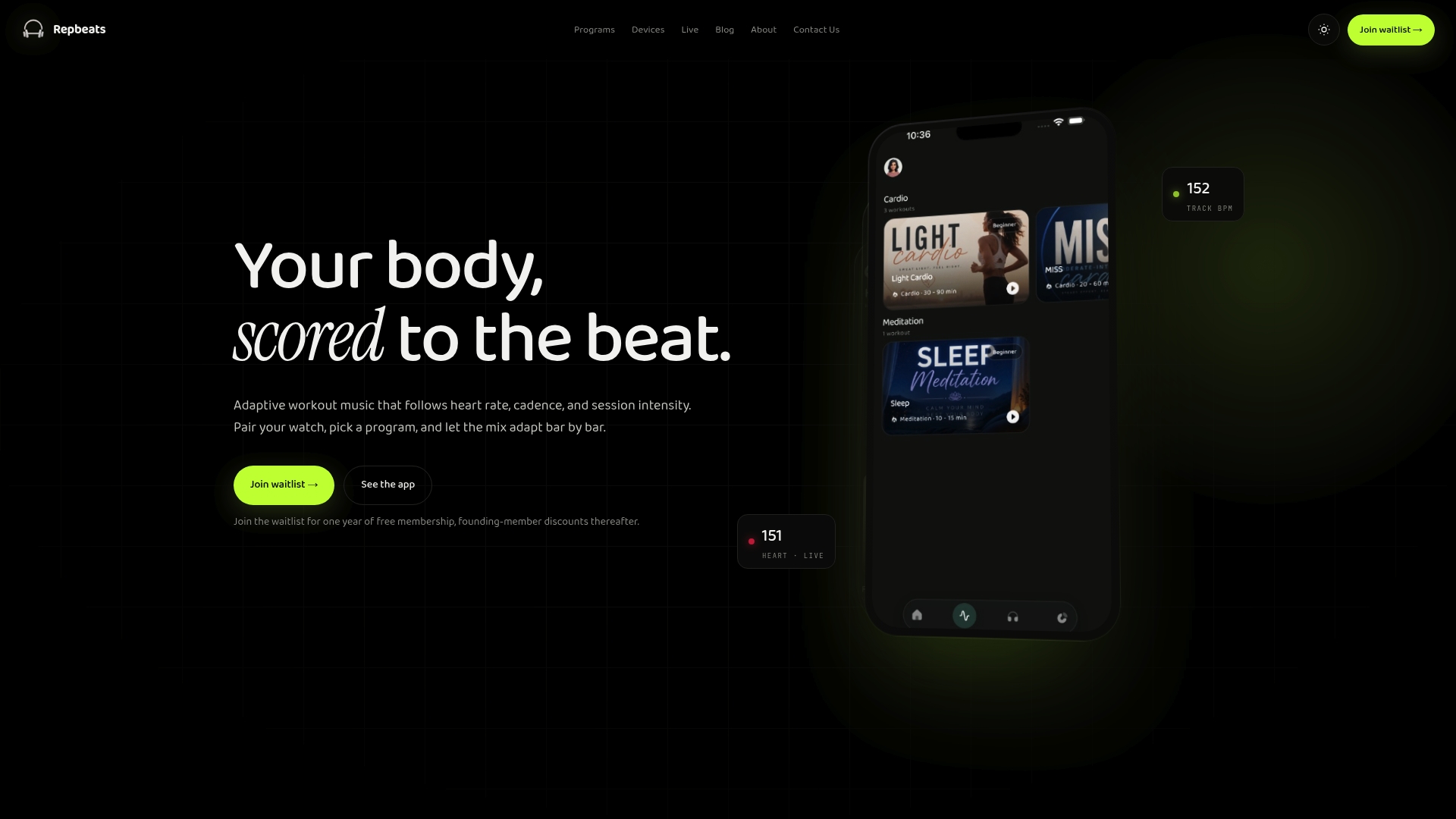
If you are training for a marathon and want music that actually tracks your effort, try Repbeats free and connect your wearable before your next long run.
Useful sources
| Source | What it covers |
|---|---|
| RunnersConnect: Running Playlist BPM | Science-backed BPM rules for running, including the 125–140 BPM motivational band and pre-run priming research |
| Brunel University: Music and HIIT | Research on why music cannot mask maximal effort and when to avoid it in training |
| University of Colorado Anschutz: Music and Perceived Exertion | How music shifts attention from physical distress and lowers perceived exertion during exercise |
| Apple Music: Ultimate Marathon Mix | 124-song, 7-hour platform playlist for marathon training with driving pop rhythms |
| Apple Music: Nike Marathon Mix | Nike-curated marathon playlist on Apple Music, useful as a seed list for the 135–140 BPM band |
| Spotify: Get Me To The Finish Line | 131-song, 8-hour Spotify marathon playlist built for endurance and sustained motivation |
| Spotify: 5K Run Playlist | Spotify’s official 5K playlist, 12 songs at race pace, useful for tempo tune-ups |
| Runner’s World: 5K Running Playlist | Monthly 90-minute playlists in the 145–155 BPM range for faster training runs |
| Runner’s World: Best 160 BPM Songs | Curated song list for 160 BPM sessions, suited to speed work and interval training |
| BBC Sounds: The Marathon Mix With Clara Amfo | Long-form editorial marathon mix demonstrating energy arc and pacing structure across a full race |
| Repbeats: Adaptive Workout Music and BPM Playlists | Product landing page for wearable-synced, cadence-driven adaptive marathon music |