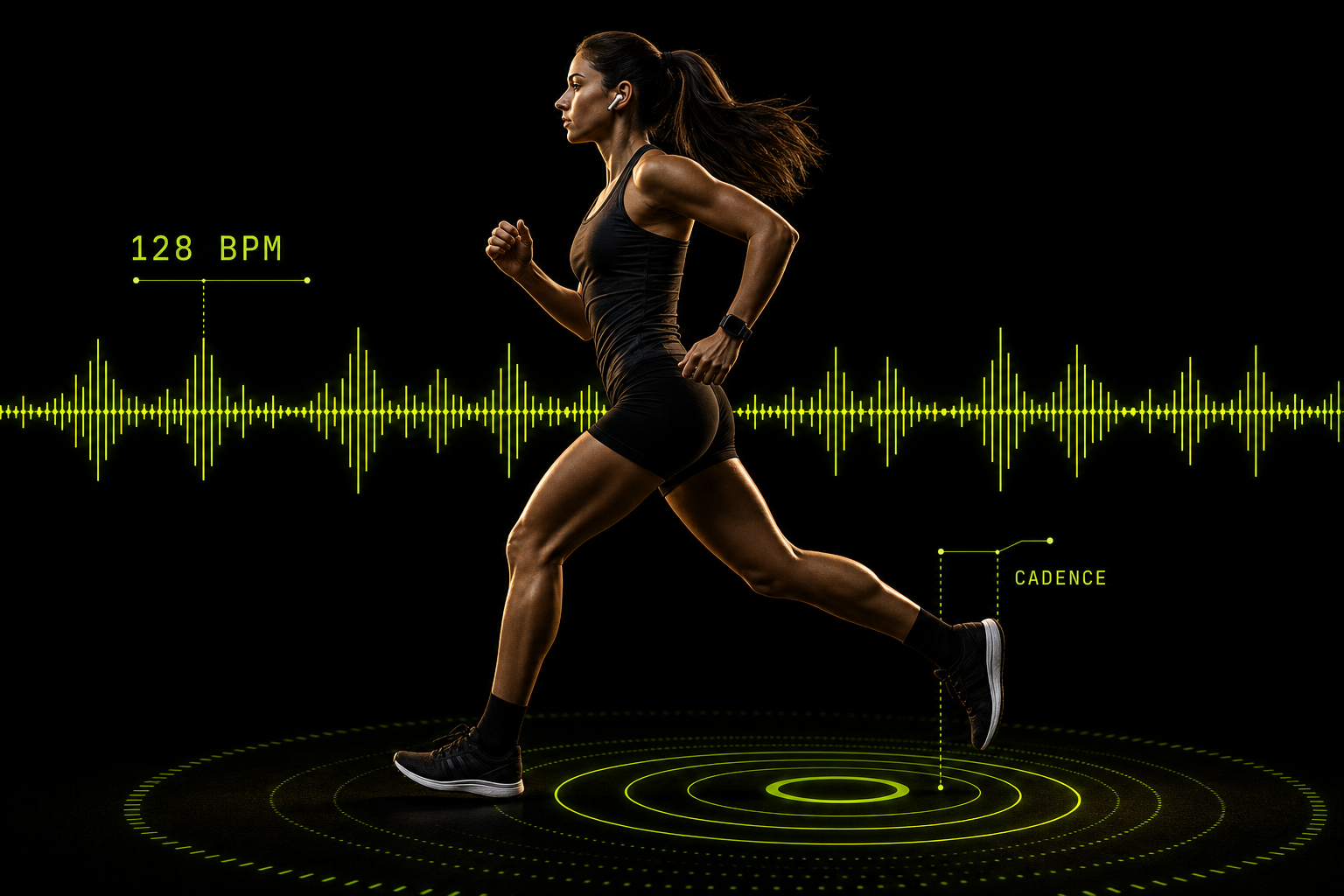
Running Heart Rate Music Alignment Tips for Runners
Jordan MillsJuly 16, 2026 · 11 min read

Running Heart Rate Music Alignment Tips for Runners
TL;DR:
- Syncing your running music’s BPM with your heart rate zones can improve performance and reduce perceived effort.
- Using rhythm entrainment and pyramid playlist structures enhances workout flow, motivation, and injury prevention during running.
Running heart rate music alignment is the practice of syncing your workout music’s BPM to your heart rate zones to improve performance and cut perceived effort. Research shows that synchronous music at moderate intensity can reduce perceived exertion by 8% to 12%. That reduction is not trivial. It means you can run harder, longer, and more comfortably without changing your training load. The technique draws on a physiological process called entrainment, where your body synchronizes its rhythms to an external beat. Pair that with the right BPM for each heart rate zone, and your playlist becomes a performance tool.
1. Running heart rate music alignment tips: start with your zones
The first step in any music alignment strategy is knowing your heart rate zones. Most runners train across five zones, from easy aerobic work at the low end to all-out sprints at the top. Each zone has a distinct physiological state, and your music should match it.

Research confirms that fast-tempo music above 100–120 BPM increases heart rate through sympathetic nervous system activation. Slow-tempo music below 60–80 BPM does the opposite, triggering parasympathetic activation and lowering heart rate. That means your music is not just a backdrop. It actively shapes your physiology.
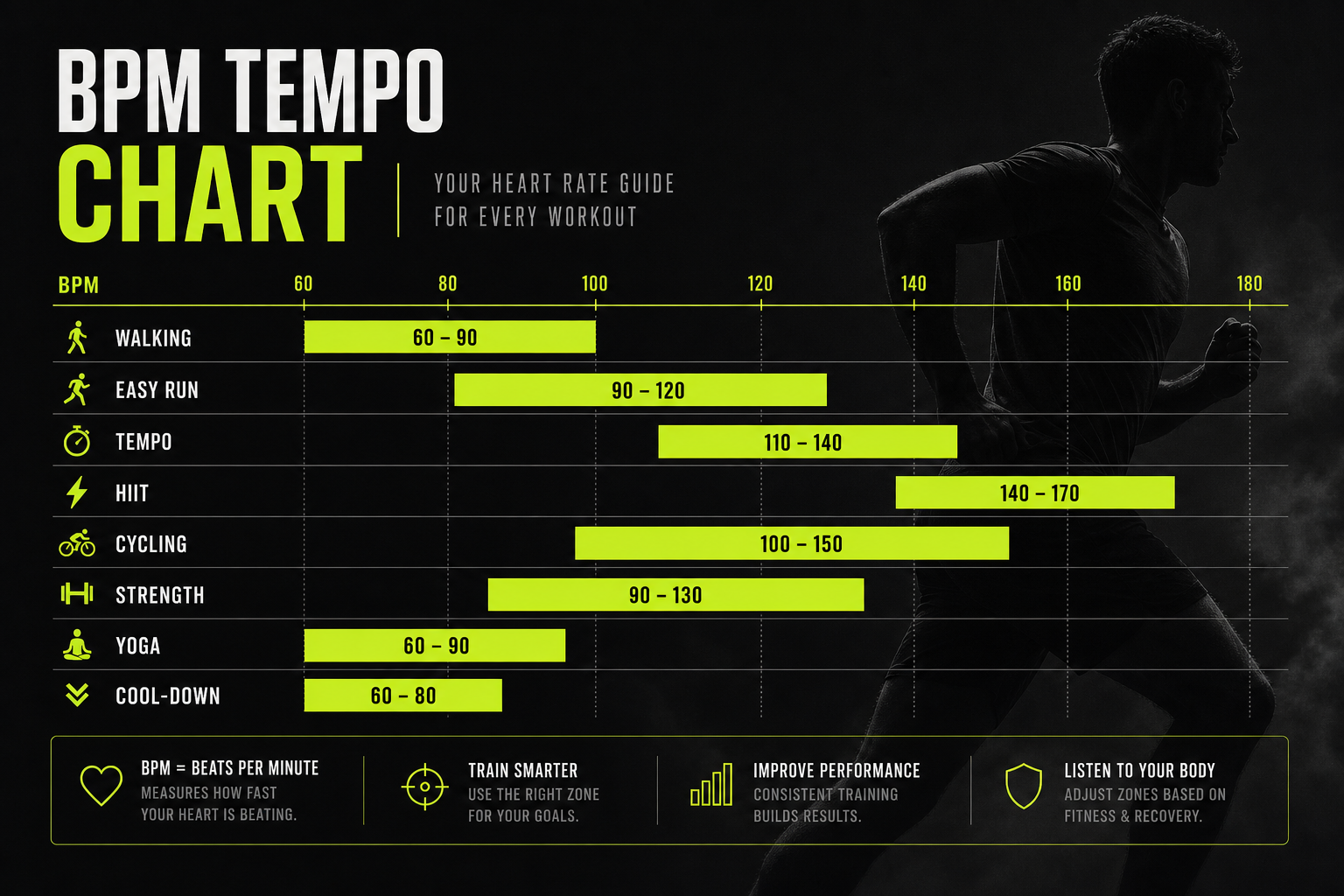
Use this table as your baseline reference:
| Heart rate zone | Running intensity | Target BPM range |
|---|---|---|
| Zone 1 (50–60% max HR) | Easy recovery | 100–120 BPM |
| Zone 2 (60–70% max HR) | Aerobic base | 120–130 BPM |
| Zone 3 (70–80% max HR) | Tempo run | 140–155 BPM |
| Zone 4 (80–90% max HR) | Threshold | 155–170 BPM |
| Zone 5 (90–100% max HR) | Sprints and intervals | 170–185 BPM |
These ranges align your music tempo with your natural stride cadence and physiological state at each intensity level.
2. Match your BPM to your stride cadence
Cadence and BPM are directly linked. Most trained runners hit an optimal cadence of 170–180 steps per minute, which maps almost exactly onto the BPM range used for high-intensity running. That alignment is not a coincidence. It is the entrainment effect at work.
Biomechanical entrainment means your body locks its movement rhythm to an external auditory beat. When your footstrike syncs with the kick drum in a track, your stride becomes more consistent. Consistent stride mechanics reduce overstriding, which is one of the leading causes of running injuries like shin splints and IT band syndrome.
“Humans entrain bodily rhythms such as heart rate and breathing to objective music structures rather than subjective perception.” The implication is clear: the beat you choose shapes your body’s response, whether you are paying attention to it or not.
For easy runs in Zone 2, a BPM of 120–130 keeps your cadence light and your effort controlled. For interval work in Zone 4 or 5, tracks at 170–180 BPM push your legs to match the beat and hold a faster, more efficient turnover.
3. Build playlists with a pyramid structure
A pyramid playlist structure is the most effective way to align your music with a complete training session. You start with lower BPM tracks during your warm-up, build toward your peak intensity, then taper back down for the cool-down. This mirrors the physiological arc of a well-designed workout.
A pyramid BPM structure aids both your physiological response and your sense of immersion during a run. When the music builds with your effort, the transition feels natural rather than jarring. When it drops back during your cool-down, your nervous system follows.
Here is how to structure a 45-minute run playlist:
- Warm-up (0–8 min): 100–120 BPM tracks. Think mid-tempo pop, light electronic, or acoustic hip-hop.
- Build phase (8–20 min): 130–150 BPM. Increase energy with uptempo rock, house, or R&B.
- Peak intensity (20–35 min): 160–180 BPM. High-energy EDM, drum and bass, or fast hip-hop.
- Cool-down (35–45 min): Drop back to 100–120 BPM. Slower tracks signal recovery.
Pro Tip: Rotate about 30% of your playlist content every two to three weeks while keeping a few anchor songs in place. Familiar tracks maintain emotional connection; fresh tracks prevent habituation and keep motivation high.
4. Use genre variety to trigger cognitive dissociation
Cognitive dissociation is the technical term for what happens when music pulls your attention away from physical discomfort. It is one of the main reasons music reduces running fatigue during hard efforts. The more engaging the music, the less mental bandwidth your brain dedicates to pain signals.
Genre variety amplifies this effect. A playlist that stays in one genre for 45 minutes becomes predictable. Predictable music loses its power to distract. Mixing genres, such as moving from hip-hop into rock into electronic, creates micro-moments of surprise that re-engage your attention.
The key constraint is energy consistency within each zone. A slow ballad dropped into a high-intensity interval playlist does not just feel wrong. Mismatched track pacing can actually increase perceived effort by breaking your physiological rhythm. Keep the BPM consistent within each zone even as you vary the genre.
5. Calibrate your heart rate zones before using adaptive tools
Adaptive music apps that respond to live heart rate data are only as accurate as the zone boundaries you set. Default zone settings are based on population averages. Your actual zones depend on your age, fitness level, and maximum heart rate. Using uncalibrated defaults means the app may switch your music at the wrong moment.
Manual adjustment of heart rate zone boundaries in adaptive apps is critical for accurate physiological alignment. A runner with a high aerobic capacity may not hit Zone 3 until 155 BPM, while a beginner might reach it at 140 BPM. The same default setting serves neither runner well.
To calibrate your zones accurately:
- Run a field test or use a lab-based VO2 max assessment to find your true maximum heart rate.
- Set zone boundaries manually in your app rather than relying on the age-based formula (220 minus age).
- Test your zones over two to three runs and adjust if the music transitions feel too early or too late.
Pro Tip: Repbeats pulls live data from Apple Watch and Fitbit to update BPM every bar. Pair that with manually set zone boundaries and you get music that responds to your actual physiology, not a statistical average.
6. Use short music interventions for recovery runs
Recovery runs are where most runners underuse music alignment. The goal of a Zone 1 or Zone 2 run is to keep heart rate low and promote physiological recovery. Music above 130 BPM actively works against that goal by stimulating sympathetic activation.
Short music interventions of 30 minutes or less effectively enhance heart rate variability indicators that matter for recovery. Heart rate variability, or HRV, is a key marker of how well your nervous system has recovered between hard sessions. Music below 80 BPM during a 20-to-30-minute easy run can support that recovery process rather than disrupt it.
Treat your recovery run playlist as a separate tool from your interval playlist. Slow, low-BPM tracks, such as ambient music, lo-fi beats, or acoustic tracks, keep your nervous system in a parasympathetic state. That is the state where adaptation and repair happen.
7. Learn how to match music and pace manually without an app
Not every runner wants to rely on technology. Manual BPM matching is a skill worth developing. You count the beats per minute of a track, compare it to your target cadence, and select tracks accordingly. Most music streaming platforms display BPM in track metadata, and free BPM-detection tools are widely available online.
The practical method is to tap your foot to the beat of a track for 15 seconds, then multiply by four. That gives you the BPM. Cross-reference it with your target zone from the table in section one. Build a folder or playlist for each zone and add tracks as you find them.
This manual approach also builds a deeper awareness of how music tempo affects your workout. Runners who understand the BPM of their music tend to make better real-time decisions, such as switching to a faster track when they need a push or dropping to a slower one when they are overcooking their effort.
8. Avoid common playlist mistakes that hurt performance
The most common mistake runners make is building one general playlist and using it for every run. A single playlist cannot serve a recovery jog and a threshold interval session. The BPM requirements are too different, and the wrong music actively works against your training goals.
The second mistake is ignoring transitions. A sudden jump from 120 BPM to 175 BPM mid-run creates a jarring shift that breaks your rhythm. Structure your playlists so BPM increases gradually, with no single jump larger than 15–20 BPM between consecutive tracks.
The third mistake is never refreshing your playlists. Rotating playlist content regularly sustains the cognitive dissociation effect that makes music useful in the first place. Stale playlists lose their motivational pull within a few weeks.
Key Takeaways
Aligning music BPM to your heart rate zones is the single most effective way to use music as a performance tool in running.
| Point | Details |
|---|---|
| Zone-specific BPM selection | Match music tempo to each heart rate zone, from 100–120 BPM for recovery to 170–185 BPM for sprints. |
| Entrainment drives efficiency | Syncing stride cadence to music BPM at 170–180 steps per minute reduces injury risk and improves form. |
| Pyramid playlist structure | Build playlists that rise in BPM through your workout and taper back down during cool-down. |
| Calibrate your zones manually | Set personal heart rate zone boundaries in adaptive apps rather than using population-average defaults. |
| Refresh playlists regularly | Rotate about 30% of content every two to three weeks to maintain cognitive dissociation and motivation. |
What I’ve learned from running with aligned music for years
Most runners treat their playlist as background noise. That is the wrong frame. Your music is a physiological input, the same way your nutrition or your sleep is. When I started treating it that way, my training changed.
The thing most articles miss is that music alignment works both ways. The right BPM pushes you into a harder effort. The wrong BPM can quietly sabotage a recovery run you thought was easy. I have seen runners wonder why their easy days feel hard, and the answer is often a 160 BPM playlist running under a Zone 2 effort.
The other thing I would push back on is the idea that you need to be plugged in every run. Some of my best long runs have been music-free. Running without audio sharpens your internal sense of pace and effort. It also makes you appreciate what a well-aligned playlist does when you do use one. The contrast is instructive.
My honest recommendation: build zone-specific playlists, calibrate your zones properly, and take one run per week without music. That combination gives you the performance benefits of heart rate music zones and the body awareness that makes you a better runner over time.
— Jordan Mills
How Repbeats automates your music-heart rate alignment
Repbeats is built specifically for runners who want their music to respond to their body in real time, not just play a pre-set playlist and hope for the best.
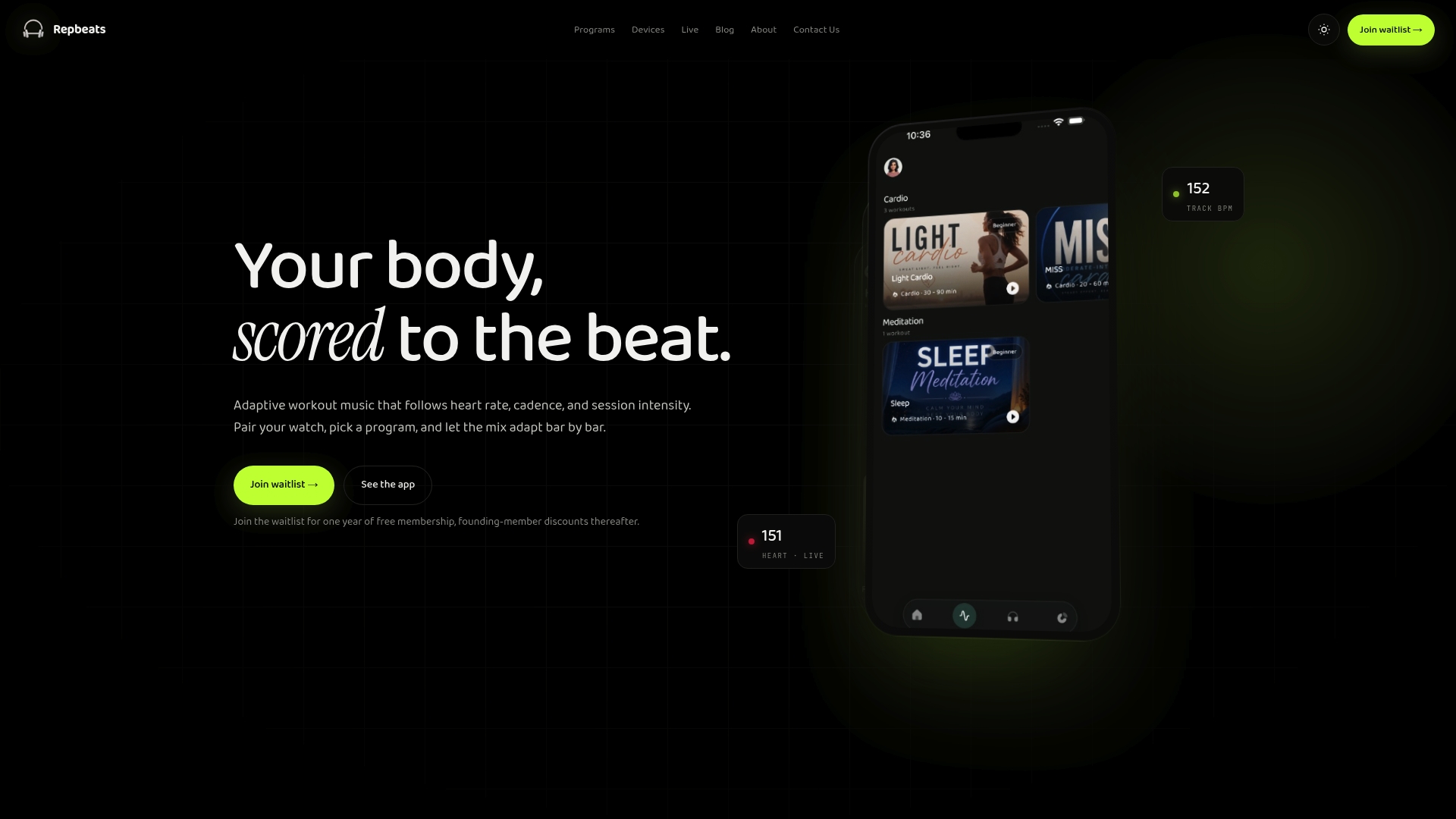
Repbeats connects to Apple Watch and Fitbit to read your live heart rate data, then uses its auto-DJ technology to update your music’s BPM every bar. When your heart rate climbs into a higher zone, the music shifts with it. When you cool down, the tempo drops. You stay in your target zone longer because the music is actively working with your physiology. Runners who want a soundtrack that adapts to their workout intensity can set their zones once and let Repbeats handle the rest.
FAQ
What BPM should I run to for easy runs?
Easy runs in Zone 1 or Zone 2 work best with music in the 100–130 BPM range. Tracks above 130 BPM can stimulate sympathetic activation and push your heart rate higher than intended.
How does entrainment improve running performance?
Entrainment synchronizes your stride cadence to the music beat, which promotes consistent mechanics and reduces overstriding. The optimal cadence of 170–180 steps per minute aligns with the BPM range used for high-intensity running.
Can music actually lower how hard a run feels?
Yes. Research shows that synchronous music at moderate intensity reduces perceived exertion by 8% to 12%. That reduction lets you sustain a harder effort for longer without a proportional increase in discomfort.
How often should I update my running playlist?
Rotate about 30% of your playlist content every two to three weeks. Keep a few familiar anchor tracks for emotional connection while adding new material to maintain the cognitive dissociation effect.
Do I need a wearable to align music with my heart rate?
A wearable makes real-time alignment automatic and accurate. Without one, you can still align music manually by selecting tracks whose BPM matches your target zone for each phase of your run.