How to Create Heart Rate Music Zones for Better Workouts
Jordan MillsJuly 10, 2026 · 11 min read

How to Create Heart Rate Music Zones for Better Workouts
TL;DR:
- Heart rate music zones link workout heart rate ranges with specific music tempos to improve effort and motivation. Using the Karvonen method ensures personalized zones, which are paired with music in BPM ranges aligned with training intensity. Updating playlists regularly and allowing some flexibility with BPM helps optimize performance and enjoyment during exercise.
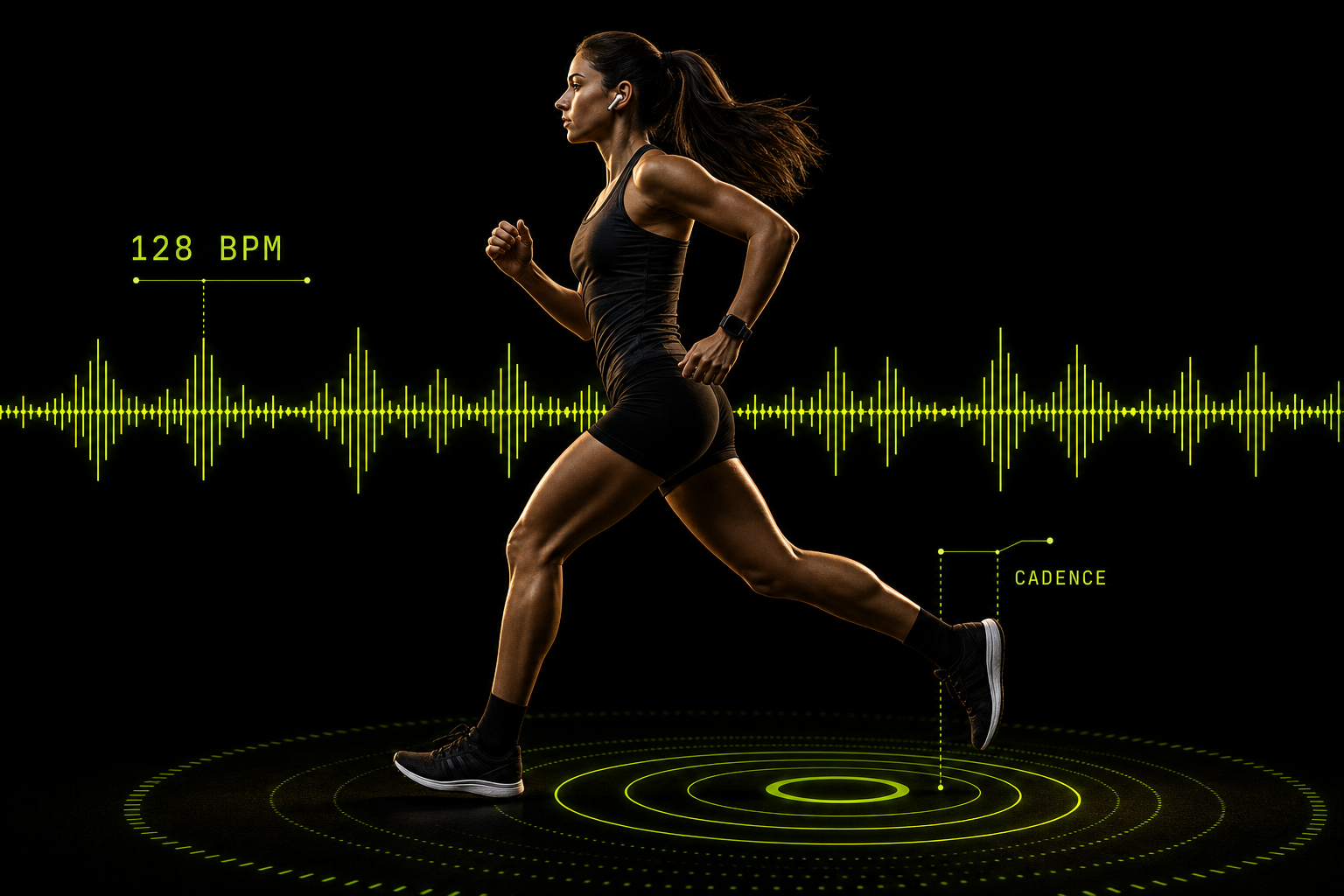
Heart rate music zones are defined as matched pairings between your training heart rate ranges and specific music tempo bands, measured in beats per minute (BPM), that work together to regulate effort and motivation. The concept draws on well-established exercise physiology: your heart rate reflects your training intensity, and music tempo influences perceived exertion in measurable ways. Research shows music reduces perceived exertion by 8–12% during Zone 2 steady-state aerobic training. That reduction is not trivial. It means you can sustain harder efforts longer, simply by choosing the right soundtrack. When you create heart rate music zones, you turn music from background noise into a precision training tool.
How to create heart rate music zones: calculating your zones first
Before you can match music to effort, you need accurate heart rate zones. Zones are meaningless without a solid personal baseline. The Karvonen Heart Rate Reserve method is the most reliable approach for personalized zone calculation. It accounts for both your resting heart rate and your maximum heart rate, producing zones that reflect your actual fitness level rather than a generic population average.

The Karvonen formula step by step
Follow these four steps to calculate your zones:
- Measure your resting heart rate (RHR). Take it first thing in the morning before getting out of bed. Use a chest strap, a wearable like Apple Watch or Fitbit, or count manually for 60 seconds. Repeat for three mornings and average the results.
- Estimate your maximum heart rate (MHR). The standard age-based formula is 220 minus your age. A more accurate alternative is the Tanaka formula: 208 minus (0.7 × age). For serious athletes, a field test or lab lactate threshold test gives the most reliable number.
- Calculate your Heart Rate Reserve (HRR). HRR = MHR minus RHR.
- Apply the Karvonen formula. Target HR = (HRR × zone percentage) + RHR. Zone 2 aerobic base, for example, sits at 60–70% of HRR.
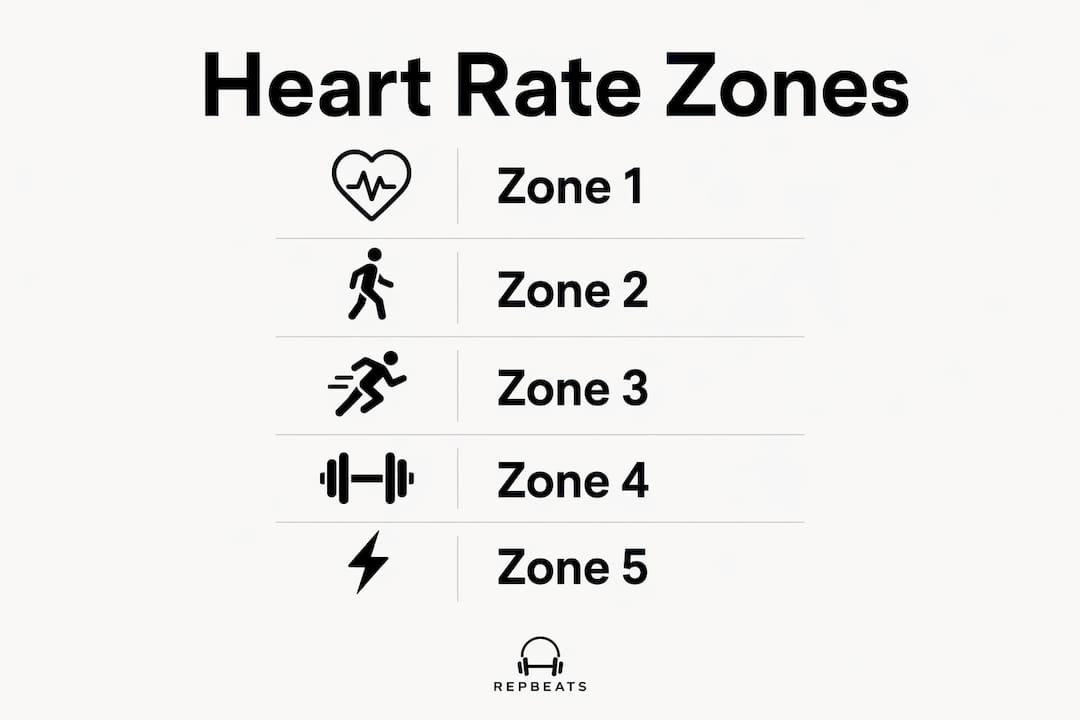
The table below shows the five standard heart rate training zones and their physiological purpose.
| Zone | % of HRR | Primary goal |
|---|---|---|
| Zone 1 | 50–60% | Active recovery |
| Zone 2 | 60–70% | Aerobic base building |
| Zone 3 | 70–80% | Aerobic capacity |
| Zone 4 | 80–90% | Lactate threshold |
| Zone 5 | 90–100% | VO2 max / peak power |
Pro Tip: Measure your resting heart rate after a full rest day, not after a hard training block. Fatigue inflates RHR by several beats, which shifts every zone calculation upward and makes your zones less accurate.
Age-based formulas are fast but imprecise. Two athletes of the same age can have maximum heart rates that differ by 20 beats or more. The Karvonen method closes that gap. If you have access to a lactate threshold test through a sports lab or certified coach, use it. Lactate threshold data produces the most sport-specific zones for runners and cyclists.
What BPM should match each heart rate zone?
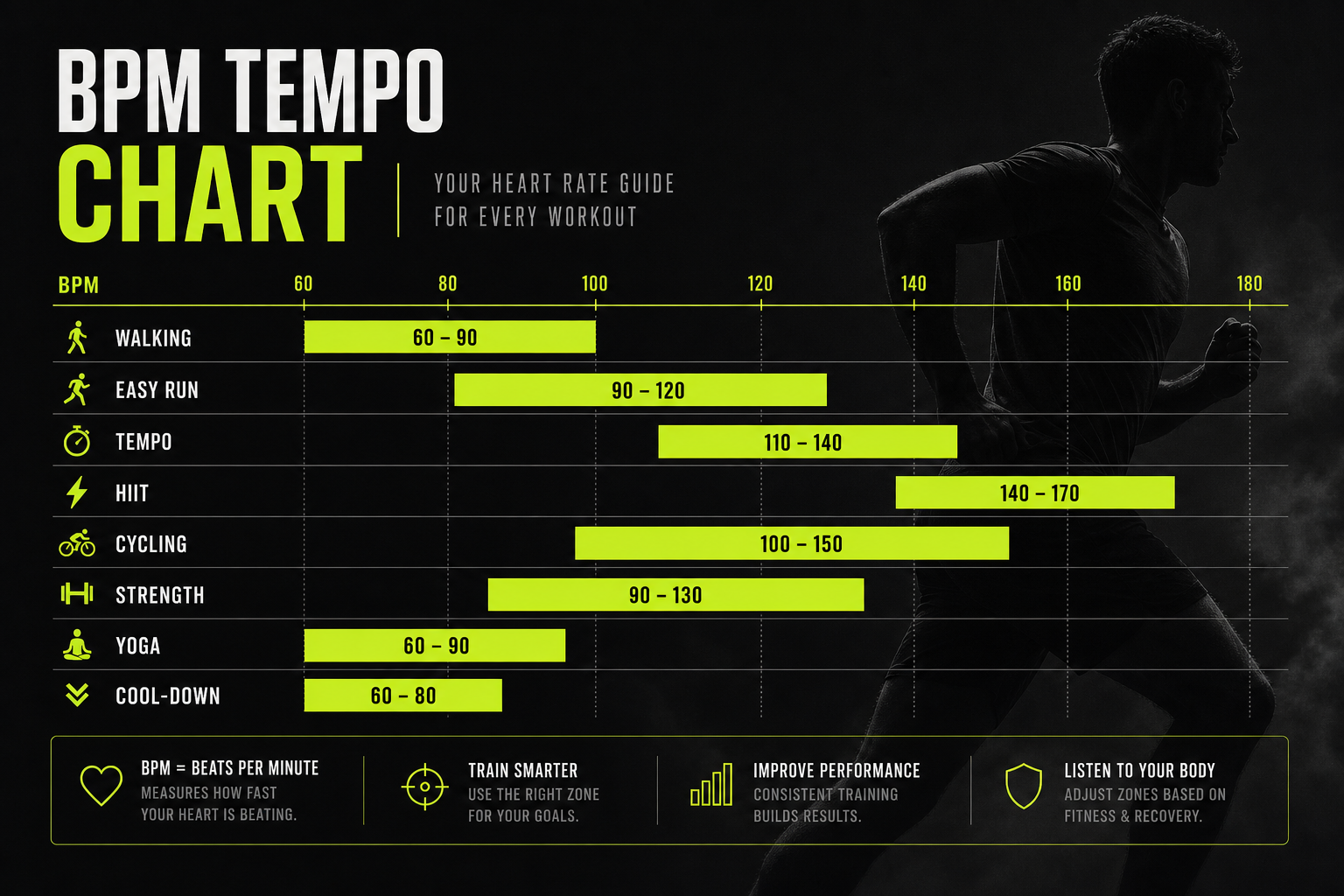
Once your zones are set, the next step is pairing them with music tempos. Research by Karageorghis and supporting literature establishes clear tempo ranges for each training intensity. The table below maps those ranges to the five zones.
| Zone | Effort level | Recommended BPM range |
|---|---|---|
| Zone 1 | Easy / recovery | 80–110 BPM |
| Zone 2 | Aerobic base | 110–130 BPM |
| Zone 3 | Moderate aerobic | 130–145 BPM |
| Zone 4 | Threshold | 145–160 BPM |
| Zone 5 | Max effort / intervals | 160–180 BPM |
The physiological logic is straightforward. Faster tempos activate the motor cortex and increase arousal, which helps you sustain higher efforts. Slower tempos calm the nervous system and reduce the urge to push beyond your target zone during recovery or warm-up.
One technique worth knowing is half-time matching. If a track runs at 160 BPM but your Zone 2 target is 130 BPM, your brain can lock onto the half-time pulse at 80 BPM instead. This works particularly well for cyclists and strength athletes whose cadence does not need to match running stride frequency. Workout tempo selection becomes more flexible once you understand this principle.
Key practical tips for building running music for different heart zones:
- Sort your library by BPM. Most streaming platforms and music apps display BPM metadata. Filter tracks into folders or playlists labeled by zone.
- Use instrumental tracks for high-intensity zones. Lyrics compete with internal focus at Zone 4 and Zone 5 efforts. Stable rhythmic patterns without vocals help you stay locked in.
- Test before race day. Run a short session with each zone playlist before committing to it for a key workout.
- Allow a 5–10 BPM buffer. Strict BPM matching is unnecessary. A track at 127 BPM works fine for a Zone 2 target of 130 BPM.
Pro Tip: If you find a track that motivates you but sits outside the target BPM range, keep it. Emotional response to music is a real physiological lever. A song that fires you up at 155 BPM can still serve a Zone 3 session better than a technically correct but uninspiring track at 140 BPM.
Music tempo offers moderate effects on perceived effort and small to moderate effects on physiological efficiency. The benefits are strongest at submaximal intensities, meaning Zones 2 and 3 respond best to tempo-matched music. At Zone 5 maximal efforts, the physiological demand overrides most psychological cues, so tempo precision matters less there.
How to structure heart rate music playlists for a full workout
A well-built heart rate music playlist mirrors the arc of your workout. Progressive playlist structure, from low BPM warm-up music through high BPM main sets and back down for cooldown, is effective for both pacing and motivation. Think of it as a musical training plan running in parallel with your physical one.
A practical structure for a 60-minute run with intervals looks like this:
- Minutes 0–10 (warm-up): Zone 1 to Zone 2 tracks, 90–120 BPM. Loose, familiar songs that ease you into movement without spiking your heart rate.
- Minutes 10–30 (aerobic base): Zone 2 tracks, 120–130 BPM. Steady, rhythmic music that holds your effort without pushing you over threshold.
- Minutes 30–45 (intervals): Zone 4 to Zone 5 tracks, 150–175 BPM. High-energy, driving tracks that match the intensity of hard efforts.
- Minutes 45–55 (recovery): Zone 3 tracks, 130–140 BPM. Slightly lower energy to bring heart rate down between intervals.
- Minutes 55–60 (cooldown): Zone 1 tracks, 80–100 BPM. Calm, slower music that signals the body to downshift.
For steady-state runs, HIIT sessions, and cycling, the same principle applies with adjusted zone distributions. A HIIT session spends more time in Zones 4 and 5. A long aerobic run stays mostly in Zone 2 with brief Zone 3 surges.
Playlist size matters too. Aim for at least 20% more tracks than your session length requires. Hearing the same song twice in one workout breaks the psychological effect. Variety also prevents your brain from anticipating tempo changes, which reduces the motivational lift that comes from a well-timed track drop.
- Build separate playlists for each workout type rather than one master list.
- Label each playlist by zone range and workout type for easy access.
- Refresh playlists every four to six weeks to prevent adaptation.
Adaptive workout music technology takes this structure further by adjusting BPM in real time based on live heart rate data, removing the need to manually sequence tracks.
Common mistakes when using heart rate music zones
The most frequent error athletes make is forcing their stride or pedal cadence to match the music BPM exactly. Forcing cadence to match BPM can cause discomfort and reduce performance. Your natural cadence is a product of biomechanics, not a metronome. Music tempo is a guide, not a rule.
Other common mistakes include:
- Using inaccurate zone calculations. If your max heart rate estimate is off by 10 beats, every zone shifts. Retest your zones after significant fitness changes or every six months.
- Ignoring resting heart rate changes. Illness, poor sleep, and overtraining all raise resting heart rate. Recalculate your zones when your morning RHR climbs more than five beats above your baseline.
- Applying tempo matching at maximal efforts. At Zone 5, your body is working too hard for music tempo to meaningfully influence effort. Save your BPM precision for Zones 2 and 3.
- Building playlists that never change. As your fitness improves, your heart rate at a given pace drops. A Zone 3 session from six months ago may now sit comfortably in Zone 2. Update your playlists when your zones shift.
“The most effective music-linked training pairs specific audio characteristics with validated heart rate zones, creating trainable physiological levers. Stable rhythmic patterns matched to your zones build muscle memory and help you anticipate effort transitions before your heart rate even confirms them.”
Flexibility is the key principle here. Real-time heart rate guidance removes much of this manual adjustment burden by letting technology respond to your body rather than requiring you to predict it.
Key Takeaways
Creating effective heart rate music zones requires accurate zone calculation using the Karvonen method, deliberate BPM selection for each zone, and progressive playlist structure that mirrors your workout arc.
| Point | Details |
|---|---|
| Calculate zones with Karvonen | Use Heart Rate Reserve, not just age-based formulas, for accurate personal zones. |
| Match BPM to zone intensity | Use 110–130 BPM for Zone 2 and 160–180 BPM for Zone 5 interval efforts. |
| Structure playlists progressively | Build from low BPM warm-up tracks through high BPM intervals and back down for cooldown. |
| Avoid forcing cadence to BPM | Treat music tempo as a guideline; personal comfort and natural cadence come first. |
| Update zones as fitness changes | Recalculate your zones every six months or after major fitness shifts. |
What I’ve learned from training with heart rate music zones
The first time I structured a playlist around actual heart rate zones rather than vibe, the difference was immediate. Zone 2 runs stopped feeling like a chore. The music held me at the right effort without me constantly checking my watch. That feedback loop, where the soundtrack confirms what your body is doing, is genuinely useful.
What surprised me most was how quickly tempo became an internal cue. After a few weeks of consistent zone-matched training, I could feel a Zone 3 effort before my heart rate monitor confirmed it. The music had trained my perception of effort as much as my aerobic system. That is a benefit most athletes overlook when they think about music for heart rate training.
The mistake I see most often is athletes building one big playlist and calling it done. Your zones shift as you get fitter. A track that pushed you into Zone 4 six months ago might barely reach Zone 3 now. Treat your playlists like your training plan: review them, update them, and retire what no longer serves the session.
The other lesson is to trust your ear over the data when the two conflict. A track that genuinely excites you will do more for your performance than a technically correct but emotionally flat choice. Use the BPM guidelines as a starting framework, then adjust based on how you actually feel during the session.
— Jordan Mills
Repbeats and the future of personalized workout music
Manually building and updating zone-matched playlists takes real time and discipline. Repbeats removes that friction by syncing music BPM directly to your live heart rate data from wearables like Apple Watch and Fitbit.
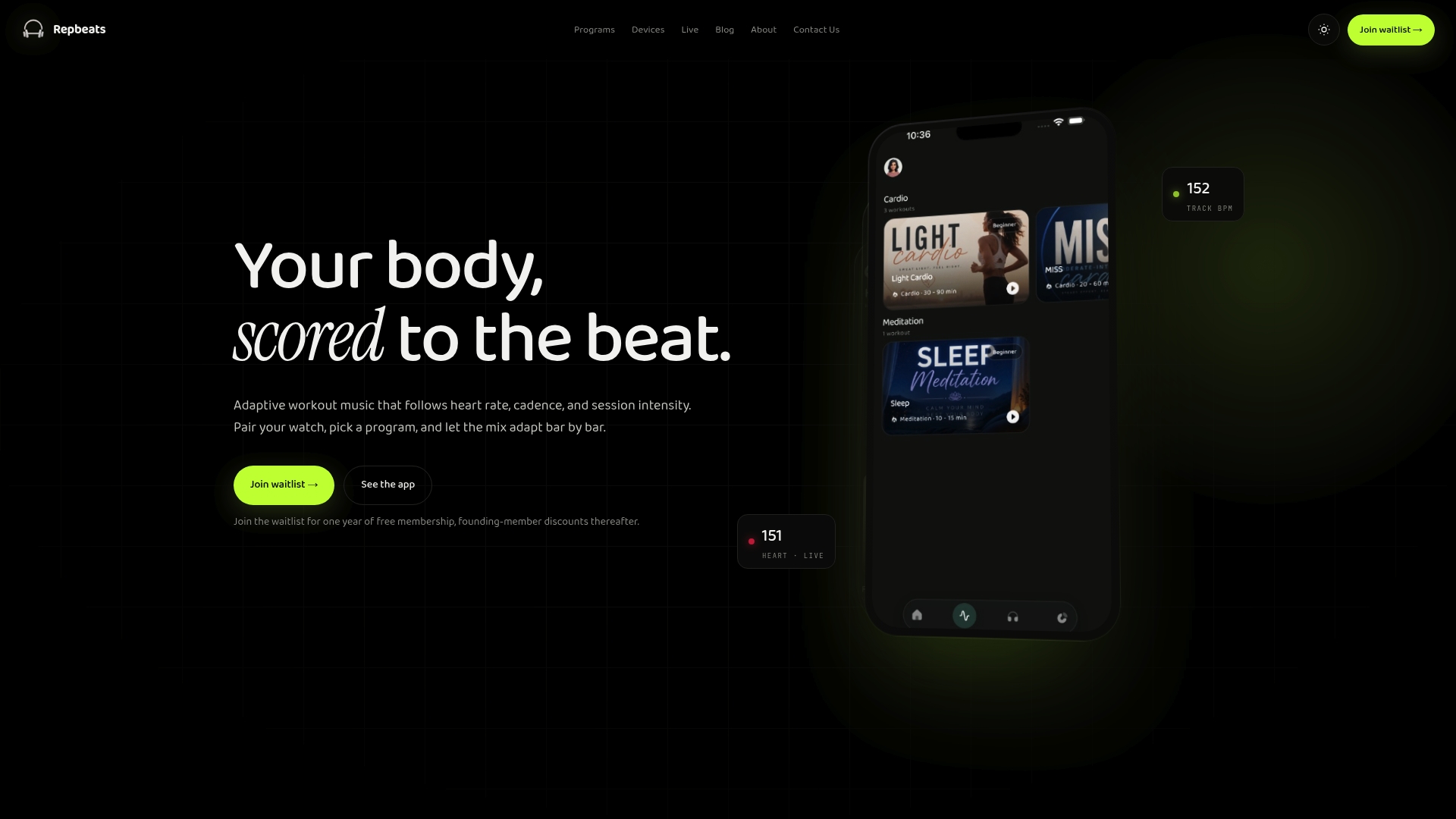
Its auto-DJ technology updates the music’s BPM every bar, so the soundtrack shifts with your effort in real time rather than following a preset sequence. When your heart rate climbs into Zone 4, the music responds. When you drop into recovery, it pulls back. Repbeats also generates BPM-matched playlists for running, cycling, and meditation, covering every training phase from warm-up to cooldown. For athletes who want the benefits of heart rate music zones without the manual setup, it is the most direct path from data to soundtrack.
FAQ
What are heart rate music zones?
Heart rate music zones are pairings between your training heart rate ranges and specific music tempo bands in BPM. The goal is to use music tempo as a physiological and motivational cue that matches your workout intensity.
How do I calculate my heart rate zones accurately?
The Karvonen Heart Rate Reserve method is the most accurate approach for personalized zones. It uses your maximum heart rate minus your resting heart rate to calculate zones that reflect your actual fitness level.
What BPM should I use for Zone 2 running?
Zone 2 aerobic base training pairs well with music in the 110–130 BPM range. This tempo supports a steady, sustainable effort without pushing your heart rate above the aerobic threshold.
Can music tempo actually improve workout performance?
Research shows music tempo offers moderate effects on perceived effort and small to moderate effects on physiological efficiency, with the strongest benefits at submaximal intensities like Zones 2 and 3.
How often should I update my heart rate music playlists?
Refresh your playlists every four to six weeks and recalculate your heart rate zones every six months or after significant fitness improvements. As your aerobic fitness grows, your zones shift and your playlists need to follow.