Lower Your Heart Rate in 5–10 Minutes with Wearable Guided Meditation
Jordan MillsSeptember 29, 2026 · 12 min read

Lower Your Heart Rate in 5–10 Minutes with Wearable Guided Meditation
Yes, guided meditation can lower or help regulate your heart rate in the short term, mainly by boosting parasympathetic activity and slowing your breathing. The evidence for lasting cardiovascular change is thinner and more mixed, so treat a calmer pulse during practice as a real but temporary physiological shift rather than proof of long-term heart health. If your resting heart rate stays elevated or something feels off, see the safety section before assuming meditation alone will fix it.
TL;DR:
- Guided meditation, especially focused-attention styles and slow breathing, can produce short-term reductions in heart rate and increase parasympathetic activity.
- Heart rate and heart rate variability react differently; breathing pace, not meditation alone, primarily drives immediate changes in heart rate variability.
- A modest drop in heart rate during meditation is normal, but long-term cardiovascular benefits from meditation are not yet conclusively proven.
- For safe practice, keep breathing slow and steady, avoid breath-holding, and monitor trends over multiple sessions rather than single readings.
- Individuals with health conditions or on medication should consult a doctor before using paced or guided meditation for heart rate management.
Table of Contents
- How guided meditation and slow breathing change heart rate and autonomic balance
- Which meditation style actually slows your heart rate?
- A 5 to 10 minute guided routine to slow your heart rate safely
- What the research actually shows about meditation and heart rate
- Safety, interpreting your readings, and when to call a doctor
- What technology-assisted meditation gets right, and where it still needs you
- A simpler way to pace your practice with adaptive music
- Sources
- FAQ
How guided meditation and slow breathing change heart rate and autonomic balance
Your heart rate is controlled by two branches of the autonomic nervous system pulling in opposite directions: the sympathetic branch speeds things up, and the parasympathetic branch, largely through the vagus nerve, slows things down. Guided meditation works mainly by nudging that balance toward the parasympathetic side, which is why a calm, well-led session often produces a measurably slower pulse within minutes.
Breathing is the lever that makes this happen fastest. Slow, even breaths, especially around six breaths per minute, engage the baroreflex, the body’s built-in pressure-sensing feedback loop, and this is often called resonance breathing because it produces the largest, smoothest swings in heart rate variability (HRV). That is also why respiration, not meditation itself, tends to be the stronger driver of HRV changes in many monitored sessions, according to research on cardiovascular changes during meditation.
Heart rate and HRV measure different things, and mixing them up leads to confusion. Heart rate is simply beats per minute. HRV is the variation in time between those beats, and higher variability generally reflects a more flexible, parasympathetic-friendly nervous system rather than just a slower average pulse.
A 2024 systematic review and meta-analysis found short-term SDNN, a common HRV metric, improved with a mean difference of 6.43 across stress-reducing interventions in adults with cardiovascular disease, according to the MDPI meta-analysis. That figure spans meditation, HRV-biofeedback, tai chi, and yoga combined, so it describes a category of practices rather than meditation in isolation.
A few points are worth holding onto from the physiology:
- Slower, evener breathing activates the baroreflex and tends to produce the clearest short-term HRV shifts.
- Heart rate and HRV can move independently, so a modest pulse drop does not always mean HRV improved, and vice versa.
- Blood pressure often dips slightly (2 to 3 mmHg in some monitored cohorts) during meditation sessions, per the same PMC review.
Which meditation style actually slows your heart rate?
Not all guided meditation styles affect the heart the same way, and the distinction matters if your goal is a lower pulse right now versus broader stress management over time.
Focused-attention (FA) meditation, where you hold attention on a single anchor like the breath or a word, has shown a direct autonomic effect in controlled research. In a randomized trial, FA meditation reduced mean heart rate from 74.0 to 71.4 beats per minute and increased rMSSD, a parasympathetic HRV marker, from 36.8 to 41.1 milliseconds, according to the PMC study comparing FA and open-monitoring meditation. That is a clear, measured drop tied to a specific technique rather than meditation in general.
Open-monitoring (OM) meditation, which involves noticing whatever arises without fixing attention on one thing, told a different story in the same trial. It reduced salivary cortisol but did not produce the same heart rate decrease, suggesting OM works through a different stress pathway rather than direct cardiac slowing.
Guided slow-breathing and HRV-biofeedback sit somewhere in between: they are not meditation in the traditional sense, but they reliably move cardiac metrics in short sessions because they directly control the respiratory rate that drives the baroreflex.
A simple way to choose:
- If you want your pulse to drop during the session itself, try guided slow-breathing or a focused-attention practice.
- If your goal is broader stress reactivity over time, open-monitoring or a mix of both styles may serve you better.
A 5 to 10 minute guided routine to slow your heart rate safely
You do not need special equipment for this, though a wearable can help you notice trends. Before you start, sit somewhere supported so your body does not have to work to stay upright, relax your jaw and shoulders, and avoid holding your breath at any point, since breath-holding can spike rather than lower heart rate. If you take heart medication or manage a diagnosed heart condition, read the safety section below before trying paced breathing on your own.
- Settle for 30 to 60 seconds. Close your eyes or soften your gaze, and let your breathing find its normal rhythm without adjusting anything yet.
- Begin paced breathing for 5 to 10 minutes. Aim for roughly six breaths per minute, which typically means a 4 to 5 second inhale and a 5 to 6 second exhale, keeping both soft rather than forced.
- Notice without judging. If your mind wanders or you catch yourself checking your pulse, gently return attention to the breath rather than the numbers.
- Finish with one minute of normal breathing. Let your breath return to its natural pace before opening your eyes or standing up, which helps you transition without a head rush.
If you are wearing a device, check it after the session rather than during it. A single reading can bounce around for reasons that have nothing to do with your practice, so look at the trend across several sessions and pair that with how calm you actually feel.
Pro Tip: Count your breaths on your fingers instead of watching a timer. It keeps your focus internal and avoids the temptation to glance at your watch mid-session.

Once the basic routine feels comfortable, you can extend sessions to 15 or 20 minutes, swap in a focused-attention approach using a neutral word or mantra, or adapt the same pacing into a body-scan format that moves attention slowly from head to feet.
What the research actually shows about meditation and heart rate
The strongest evidence for a short-term cardiac effect comes from controlled comparisons of meditation styles rather than from meditation research as a broad category. The PMC randomized trial comparing focused-attention and open-monitoring meditation is a useful anchor point because it isolated technique type and measured both heart rate and HRV directly, rather than relying on self-report.
At the review level, the picture is broader but less specific to meditation alone. The 2024 systematic review and meta-analysis reported a 24-hour SDNN mean difference of 10.92 across stress-reducing interventions including meditation, HRV-biofeedback, tai chi, and yoga, according to MDPI. Because the review pooled several intervention types, the improvement cannot be attributed to meditation specifically, and the authors’ own framing treats it as a category-level finding.
A recurring caution across this research is that breathing and meditation are often tangled together in study design. HRV is heavily dependent on respiration rate, so a study that does not control or report breathing pace can end up crediting meditation for what is really a breathing effect, a point echoed in the PMC cardiovascular review.
Key takeaways from the evidence as it stands:
- Focused-attention meditation has RCT-level support for lowering heart rate and raising rMSSD in a single session.
- Open-monitoring meditation shows a different, cortisol-focused effect rather than direct heart rate lowering.
- Systematic review data on HRV improvement spans multiple practices, not meditation in isolation, so the effect size should not be quoted as meditation’s alone.
- Short-term cardiac modulation is well documented, but evidence connecting meditation directly to long-term cardiovascular outcomes is still developing.
The practical read: expect a real, short-term dip in heart rate and a shift toward parasympathetic dominance during and immediately after a well-guided session. Do not expect that same session to functionally change your cardiovascular risk profile, since that claim outruns what the current trials support.
Safety, interpreting your readings, and when to call a doctor
A calm resting heart rate for most adults falls between 60 and 100 beats per minute, according to the American Heart Association. A reading below 60 is not automatically a problem: it shows up commonly in athletes, during sleep, and in people taking medications like beta blockers, so a lower number from meditation is not inherently a red flag.

The reverse deserves more caution. A resting heart rate above 100 beats per minute is classified as tachycardia, and a transient spike to 120 bpm can happen with anxiety alone, but it becomes concerning if it persists or comes with chest pain, breathlessness, or fainting, per the AHA’s guidance on tachycardia. Those combined symptoms warrant urgent medical attention rather than a longer meditation session.
A few practical points:
- Wearable readings vary session to session, so judge trends over days or weeks, not a single number.
- Pair the data with how you actually feel: a device reading and your subjective sense of calm should generally agree.
- Meditation can support stress management and is not a substitute for medical evaluation or treatment of a diagnosed heart condition.
What technology-assisted meditation gets right, and where it still needs you
Guided meditation works best when the pacing matches your body rather than a generic script, and that is where adaptive tools earn their place. Pairing slow, paced breathing with music that mirrors your intended cadence can make it easier to hold six breaths a minute without constantly checking a clock, which in my experience is where most beginners lose the thread of a session.
That said, no adaptive soundtrack replaces the physiology itself. The parasympathetic shift comes from your breathing and attention, not from the music, and a tool is only useful to the extent it helps you sustain the practice long enough for that shift to happen. If you manage a heart condition or take cardiac medication, loop in a clinician before treating guided sessions, technology-assisted or not, as your primary intervention.
— Jordan Mills
A simpler way to pace your practice with adaptive music
The app builds adaptive music that syncs to your heart rate, cadence, and session intensity through wearables, updating tempo bar by bar rather than sticking to a fixed track. For a guided routine built around six breaths a minute, that kind of real-time pacing can help you hold the rhythm without watching a timer or second-guessing your count.
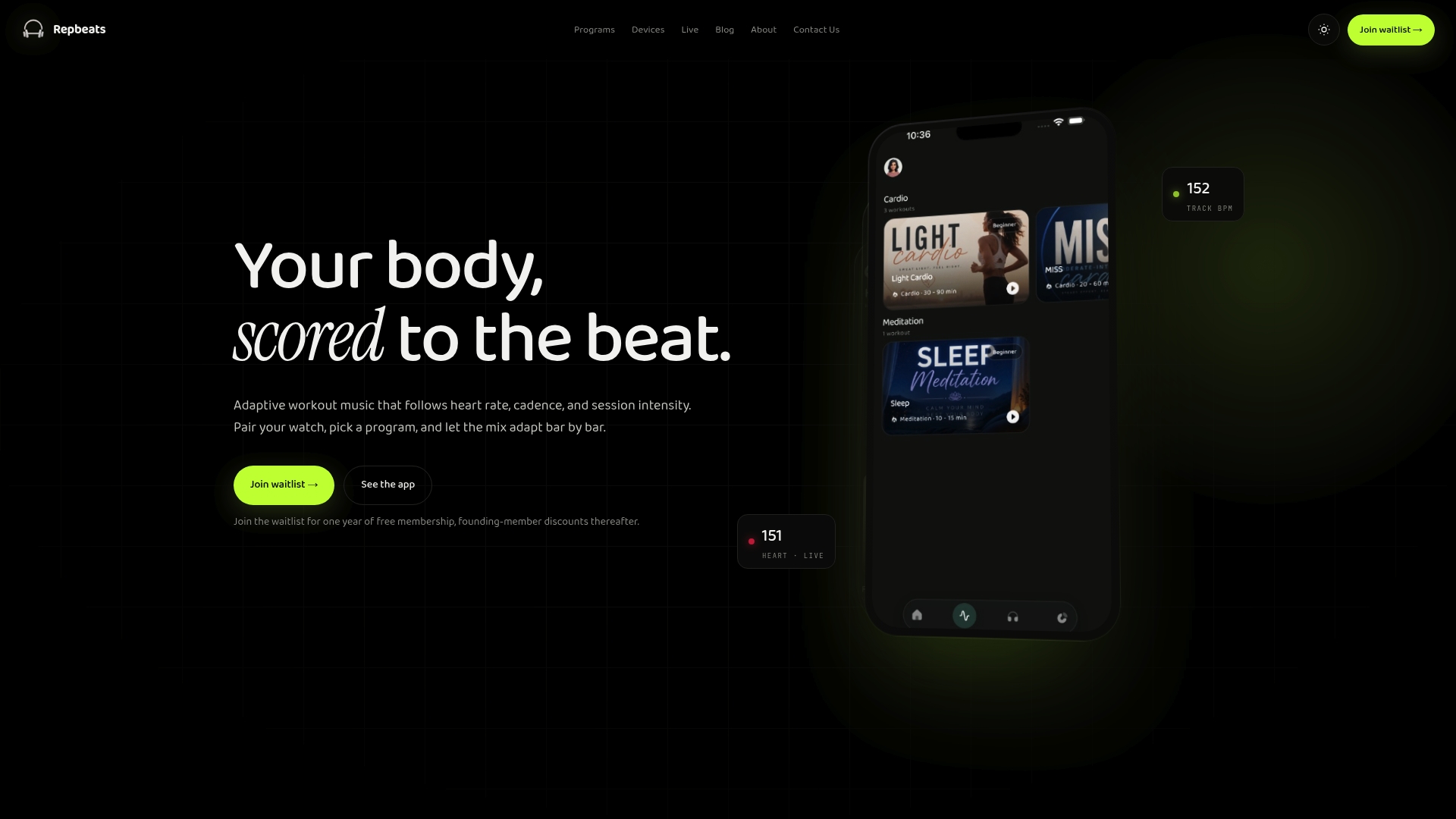
If you already track sessions on a wearable, the practical value is in the feedback loop: the app adjusts to your data rather than asking you to adjust to a static playlist, which fits naturally into the paced-breathing routine described above.
A few ways this shows up for meditation specifically:
- Adaptive tracks can help maintain a gentle, consistent cadence during paced-breathing sessions.
- Wearable integration means the music responds to your actual heart rate rather than a preset assumption.
- HRV-focused meditation tracks are built for the same resonance-breathing pacing described in this guide.
You can see how the heart-rate syncing works in more detail on the Repbeats about page, or explore the main Repbeats site to check current availability.
Sources
- All About Heart Rate (American Heart Association)
- The Effect of Stress-Reducing Interventions on Heart Rate Variability in Cardiovascular Disease: A Systematic Review and Meta-Analysis (MDPI, 2024)
- Cardiovascular and nervous system changes during meditation (PMC)
FAQ
What is a good heart rate when meditating?
There is no single target number, since a comfortable resting range for most adults falls between 60 and 100 beats per minute, according to the American Heart Association. A drop from your own baseline during a session is a more meaningful sign than matching a specific figure someone else reports.
Can meditation bring your heart rate down?
Yes, guided meditation and paced breathing can lower heart rate in the short term by shifting the nervous system toward parasympathetic dominance. A randomized trial found focused-attention meditation reduced mean heart rate from 74.0 to 71.4 beats per minute in a single session, according to PMC.
Does slow heart rate mean clogged arteries?
No, a slower heart rate on its own does not indicate clogged arteries. It can reflect fitness, medication, sleep, or a calming practice like meditation, and cardiologist commentary from the American Heart Association cautions against reading a calmer pulse as evidence of artery health one way or the other.
Is 120 bpm bad when anxious?
A heart rate around 120 beats per minute can happen with anxiety and is not automatically dangerous on its own. It becomes a concern if it persists at rest or comes with chest pain, breathlessness, or fainting, in which case the American Heart Association recommends seeking medical attention rather than waiting it out.