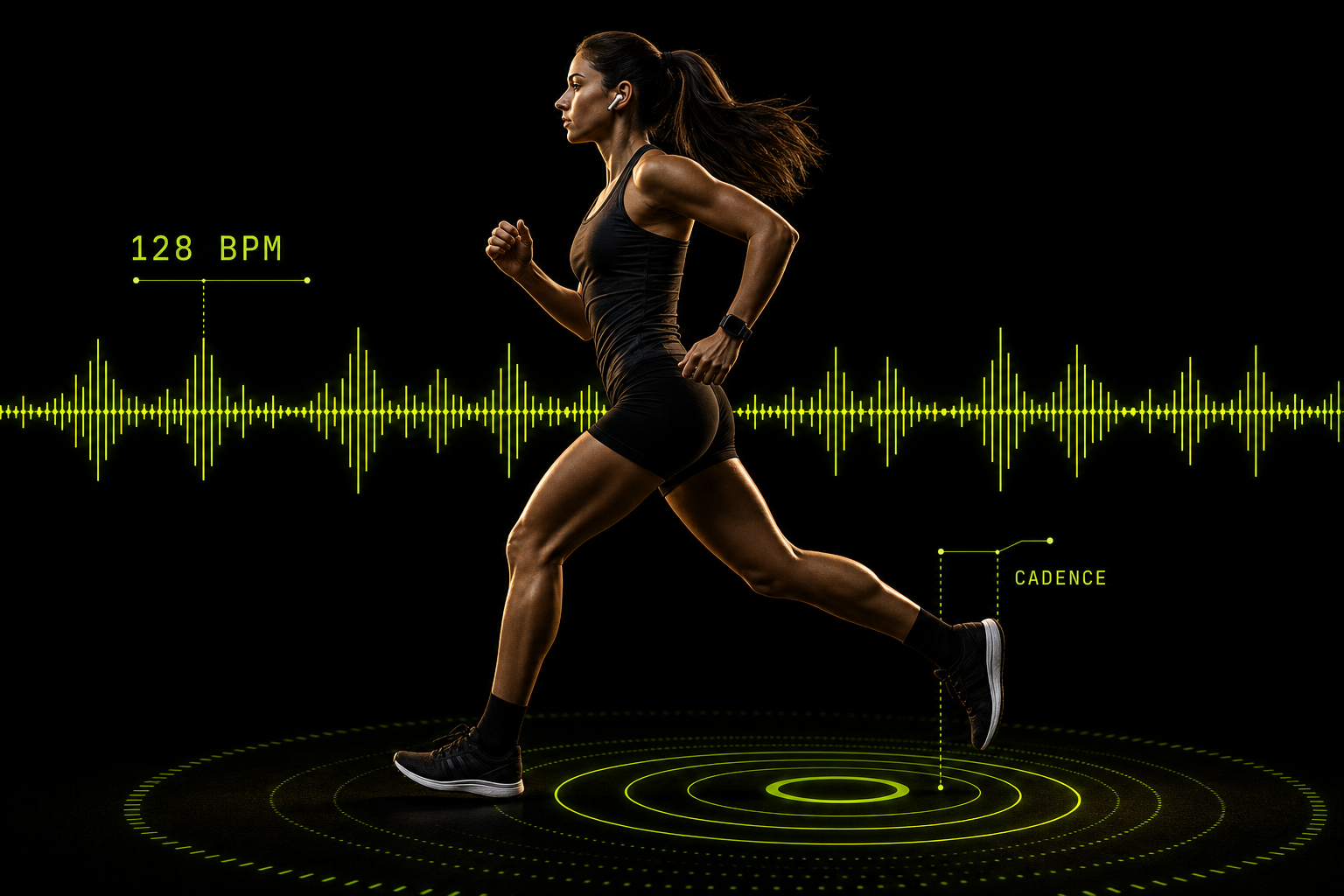
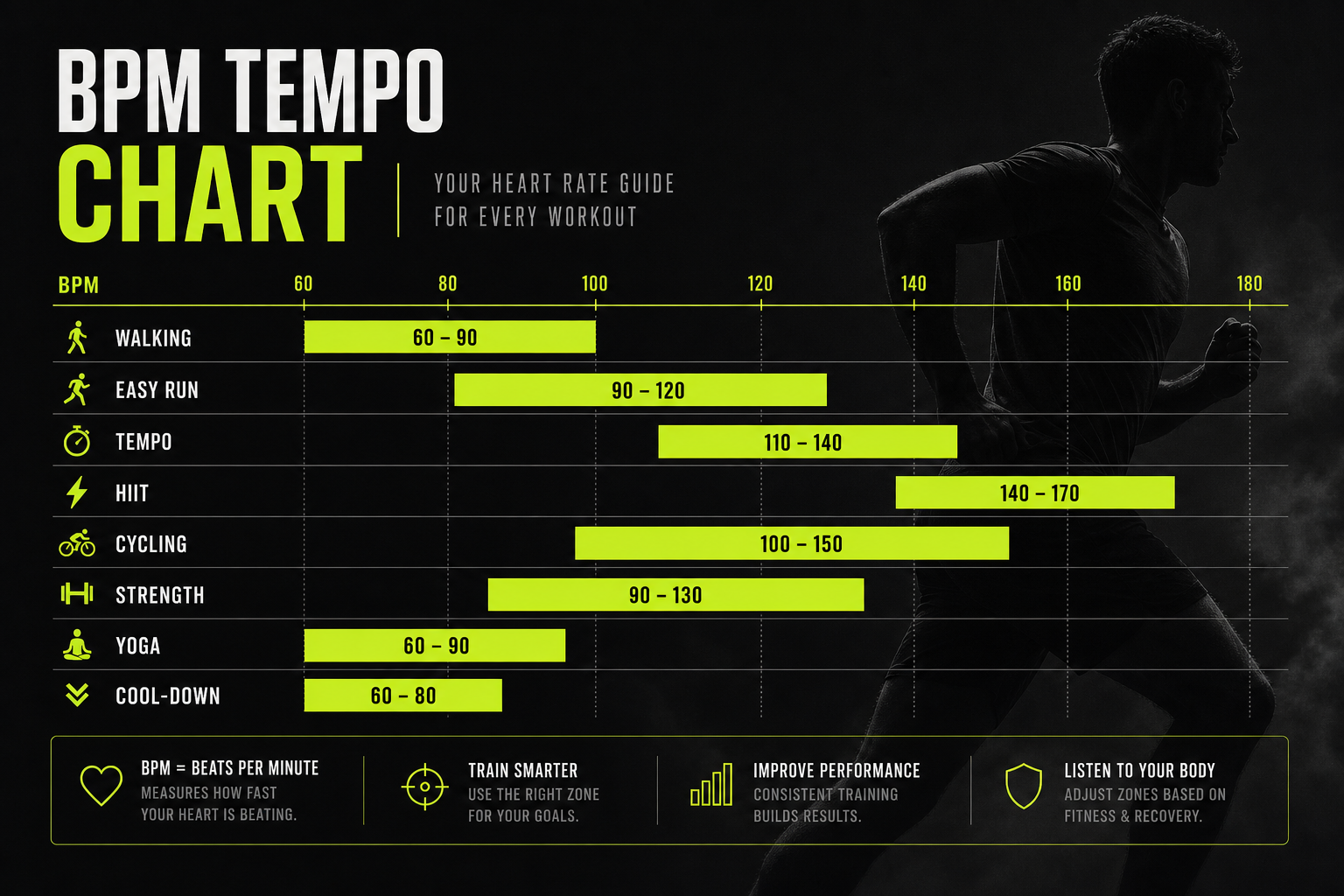
150 to 185 BPM: Long Run Music That Adapts to Your Cadence
Jordan MillsOctober 8, 2026 · 12 min read

150 to 185 BPM: Long Run Music That Adapts to Your Cadence
For most long runs, the sweet spot sits in three bands: 150 to 160 BPM for recovery-paced efforts, 160 to 170 BPM for steady aerobic runs, and 170 to 185 BPM for faster cadence work. The most reliable format is a single-BPM nonstop mix or a verified-BPM long playlist, and adaptive music that syncs live to your cadence and heart rate holds tempo tighter than any fixed playlist. Check your fit in the first two minutes: count your steps for 15 seconds and multiply by four, then ask whether the pace still feels conversational.
TL;DR:
- Measure cadence over one to two minutes, then match each beat to each step or use half beat tracks above 170 SPM.
- A 12 week study found that music 7.5% to 10% above usual cadence raised it by 8.5%; the small sample limits confidence.
- Use one tempo for cadence training, but choose a varied playlist for unstructured runs; nonstop mixes can feel repetitive after 90 minutes.
- For runs longer than two hours, combine several nonstop mixes, preview their transitions, and keep a beat only backup in case playback fails.
- Before relying on adaptive music on a long run, confirm your wearable sends live data and test the connection during a medium length session.
Table of Contents
- Best BPM ranges and ready-made playlists for long runs
- How to match music BPM to your cadence, step by step
- Building a long-run playlist that holds cadence for 60 to 180+ minutes
- Phase, entrainment, and the science: why beat alignment matters on long runs
- How adaptive, wearable-synced music like Repbeats helps on long runs
- Practical long-run setup checklist and troubleshooting
- What years of cadence data taught me about playlist building
- Try Repbeats for adaptive long-run music
- FAQ
- Sources
Best BPM ranges and ready-made playlists for long runs
Your cadence, measured in steps per minute, is the number that should drive your music choice, not the other way around. Most recreational runners land somewhere between 130 and 200 steps per minute, and tracks with a stable, unwavering tempo are what let that auditory-motor connection actually form, according to running cadence research. The mapping comes in two flavors: full-beat, where one musical beat matches one footstrike, and half-beat, where a beat lands every other step. Half-beat mapping works best once your cadence climbs above 170 SPM, since matching every single step to a full beat at that speed usually means picking tracks that feel rushed or thin.
A few practical sources cover most of what you need:
- YouTube nonstop BPM mixes run anywhere from 30 minutes to several hours and are typically labeled by exact tempo, with popular bands sitting between 160 and 181 BPM.
- Apple Music’s long-run playlists, including the aptly named Long Run collection, run close to five hours across 100 tracks, enough to cover most marathon-distance efforts without repeating.
- Spotify long-run playlists, such as this one, and Nike Run Club’s curated lists group tracks loosely by pace rather than exact BPM, which works fine for easy runs but less well when you are chasing a specific cadence.
Choose a single-BPM nonstop mix when the goal is strict cadence control, like a tempo run or a cadence-retraining block. Choose a longer mixed playlist with varied BPM when the run itself is unstructured and motivation matters more than metronomic precision. The tradeoff is real: nonstop mixes lock your rhythm but can feel repetitive past 90 minutes, while mixed playlists stay interesting but let your cadence drift without you noticing.
How to match music BPM to your cadence, step by step
Getting the pairing right takes about ten minutes of setup before your actual training starts.
- Measure your natural cadence on an easy run or with a wearable’s step-count feature, counting steps for one to two minutes and averaging the result.
- Convert that number to a BPM target. If your cadence is 165 SPM, start with tracks at 165 BPM for a one-to-one match, or 82 to 83 BPM for a half-beat mix. Decide whether you want to hold cadence steady or nudge it upward.
- Select tracks or mixes at your target BPM, then run with them while watching pace, heart rate, and how hard the effort feels. Adjust up or down in small increments if the tempo feels forced.
If the goal is to increase turnover rather than just hold it steady, the research gives a specific number to work with. A 12-week intervention that paced music 7.5 to 10% above runners’ preferred cadence produced an average cadence increase of 8.5%, and that gain held for three to five weeks after the program ended, even though the study sample was small. That is a meaningful data point for anyone trying to shorten overstriding habits without forcing a sudden, jarring change.
Keep any tempo nudge conservative and test it on a shorter run before taking it into your long session. Tempo shifts under roughly 3% are often too subtle to consciously notice, yet they still shift cadence, which makes small, gradual increases safer and more sustainable than jumping straight to a faster band.
Pro Tip: Build your cadence target in 3 to 5 BPM increments across separate runs rather than jumping 15 or 20 BPM at once. Your joints and your music library will both thank you.

Building a long-run playlist that holds cadence for 60 to 180+ minutes
A long run is not one continuous vibe. It has phases, and your playlist should match them.
Structure the mix in blocks: a warm-up section at a slightly lower BPM to ease into the effort, several steady-state blocks at your target cadence that make up the bulk of the run, a mid-run lift where tempo climbs 5 to 10 BPM to combat the mental fade that hits around the halfway mark, and a controlled finish block that either holds steady or ramps for a strong final push.
Track selection matters as much as structure:
- Prefer verified-BPM tracks or DJ-edited mixes over raw commercial singles, since many pop and hip-hop songs include tempo drift, bridges, or breakdowns that commercial mastering never designed with steady cadence in mind.
- Favor instrumental or steady-beat genres such as house, techno, or drum and bass over tracks with complex arrangements, since a prominent, consistent beat on the downbeat is what your feet actually lock onto.
- Avoid long breakdown sections or sparse bridges that bury the beat, since those stretches are exactly where cadence tends to drift without you noticing.
For runs stretching past two hours, stitch multiple nonstop mixes together rather than relying on one single file, and preview the transition points beforehand so a jarring tempo jump or dead-air gap does not interrupt your rhythm mid-stride. Keep a backup folder of pure metronome or beat-only tracks on your phone. If your main mix glitches or a track’s structure throws off your rhythm, switching to a beat-only file for a few minutes keeps cadence locked while you sort out the playback issue.
Phase, entrainment, and the science: why beat alignment matters on long runs
Tempo match is only half the equation. The other half is phase, meaning exactly where in the beat cycle your foot lands relative to the audible pulse. Researchers call the small timing gap between footstrike and beat “negative mean asynchrony,” since runners tend to land slightly ahead of the beat rather than exactly on it, and the size of that gap (the relative phase angle) turns out to matter for how strongly the music actually pulls your stride into sync.
One of the clearer findings from this research: continuous relative-phase alignment strategies, the kind where tempo adjusts smoothly rather than jumping abruptly between values, produce noticeably smoother entrainment than sudden tempo changes, and they can shift cadence and motivation without changing how hard the run actually feels.
A few other takeaways carry directly into practice. Synchronous acoustic stimuli, whether a simple metronome or full tempo-matched music, extended time to exhaustion compared with running in silence, which suggests the beat itself, not just the song’s emotional pull, does real mechanical work. Spontaneous entrainment studies also found that runners adapt their cadence to music tempo even without being told to, as long as the tempo shift stays small.
The practical rule that falls out of all this: start a track as close to a footfall as you can manage, and favor music or systems that adjust tempo continuously rather than in sudden jumps. A smooth, phase-aware transition keeps your stride locked in instead of forcing your legs to renegotiate rhythm every time a new song starts.

How adaptive, wearable-synced music like Repbeats helps on long runs
Static playlists, even well-built ones, eventually run into a basic limitation: they cannot respond to what your body is actually doing mid-run. We built an adaptive auto-DJ technology that reads live cadence and heart rate data from wearables and updates the music’s BPM bar by bar, so the tempo tracks your real effort instead of a playlist you built the night before.
That continuous, bar-by-bar adjustment is what phase-aware entrainment research points toward: smooth, incremental tempo changes outperform abrupt jumps for keeping stride locked in. Over a long run, that translates into fewer disruptive transitions, steadier cadence across hours rather than minutes, and music that shifts with you through a mid-run surge or a late fade instead of staying frozen at whatever tempo it started with.
Setting it up for a long session takes a few steps:
- Pair your wearable and confirm it is sending live cadence or heart rate data before you start.
- Let the app calibrate against your natural cadence for the first few minutes of easy running.
- Check battery level and connection stability, since a long run puts more demand on both than a quick 5K.
- Test the full setup on a medium-length run before trusting it for race-distance training.
Pro Tip: Run a 30 to 45-minute session with adaptive sync active before your next long run day, specifically to catch connection drops while there’s still time to troubleshoot them.
Practical long-run setup checklist and troubleshooting
A few minutes of prep saves a lot of mid-run frustration.
- Before you leave: charge your phone and wearable fully, confirm your playlist’s BPM labeling is accurate, load a backup beat-only file, and set your earbuds or headphones to a volume that still lets you hear traffic and other runners.
- If tempo feels off mid-run: switch to your beat-only backup mix, reset the wearable’s Bluetooth connection, or lower audio processing settings that might be adding playback latency.
- Before race day: run a 20 to 30 minute test session to confirm your playlist sequencing holds up and that adaptive sync, if you are using it, reconnects reliably after any dropout.
What years of cadence data taught me about playlist building
After years of watching runners obsess over the “perfect” playlist, the pattern that holds up is simpler than most people expect: steady beats beat clever song choices every time. A cadence-locked mix at the right BPM does more for a long run than any cleverly sequenced “hype” playlist full of tempo swings.
That said, science should inform your choices, not override them entirely. If a genre you love happens to sit at your target BPM, use it. The research on synchronization works regardless of whether the beat comes from house music or orchestral strings.
My rule of thumb: pick the tempo first, then pick songs you actually like within that tempo. Discipline on BPM, freedom on taste.
— Jordan Mills
Try Repbeats for adaptive long-run music
Long runs expose every weakness in a static playlist: the tempo drift, the awkward transition at minute 90, the mix that was perfect for your 10K pace but wrong for mile 18. We built the Repbeats app specifically to close that gap, syncing music tempo to your heart rate, cadence, and session intensity in real time, with BPM updates every bar instead of once per song.
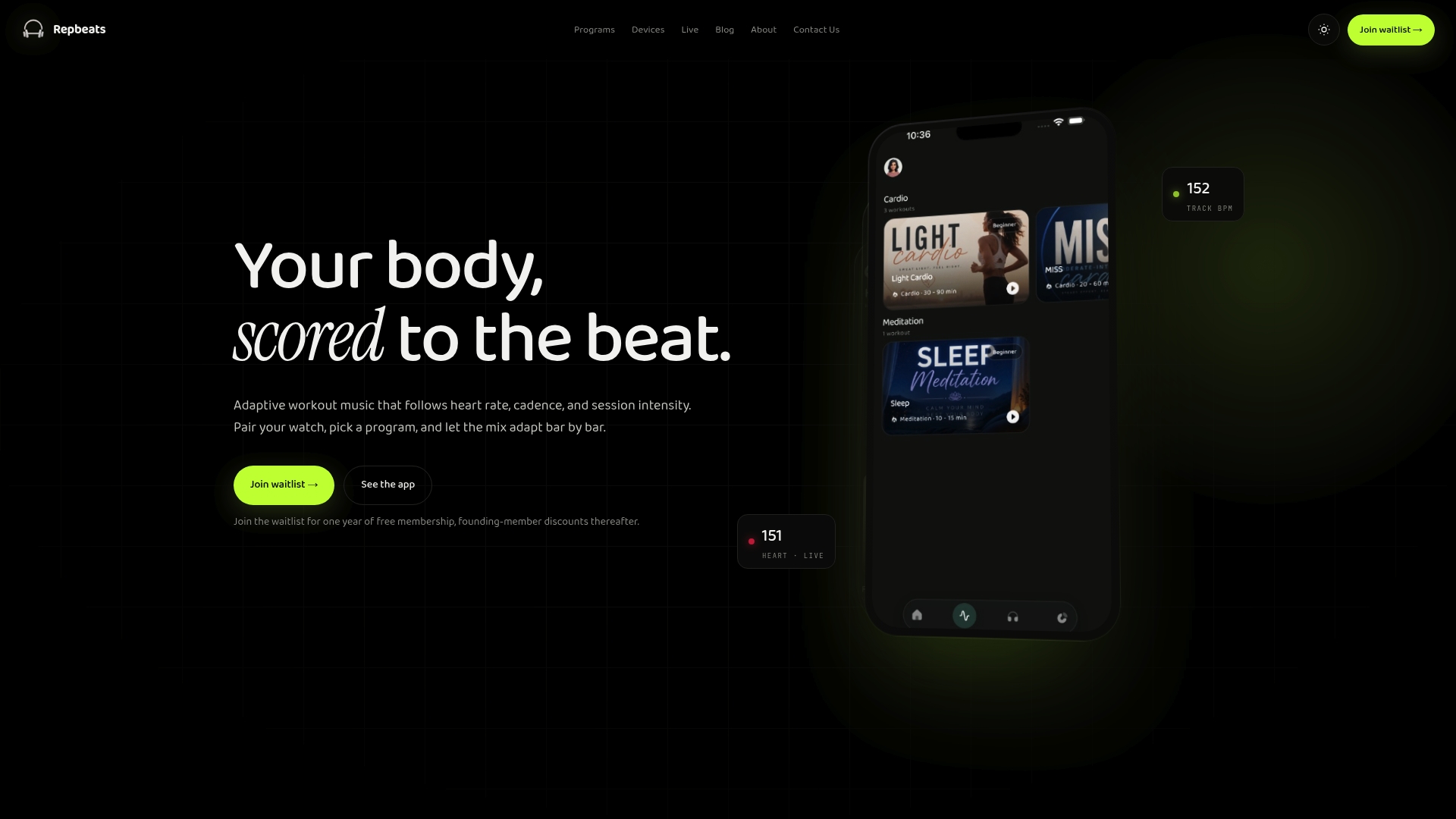
If you train with a wearable and want your music to move with your effort instead of against it, our adaptive workout music platform is built for exactly that. Start a trial run and see how cadence-locked tempo feels over real distance.
FAQ
What kind of music does The Long Run play?
“The Long Run” playlists found on streaming platforms typically feature steady, mid-to-high tempo tracks grouped loosely by pace rather than strict BPM, often spanning electronic, pop, and hip-hop genres. The Apple Music version runs close to five hours across 100 songs, making it suited to extended training sessions.
What is the best long run playlist on Spotify?
There is no single definitive answer, since the best playlist depends on your target cadence, but curated long-distance collections like this Spotify playlist are built with extended duration and consistent energy in mind. For strict cadence control, a single-BPM nonstop mix will outperform a general long-run playlist since the tempo never shifts.
What should I listen to on a long run?
Choose music or a mix labeled with a verified BPM that matches your natural cadence, generally somewhere in the 150 to 185 BPM range depending on your stride rate. Adaptive music that adjusts tempo live based on your heart rate and cadence, such as Repbeats, removes the guesswork of manually matching tracks to effort.
What songs are good for running a 7-minute mile?
A 7-minute mile pace typically corresponds to a cadence in the upper range of recreational runners, often between 170 and 180 steps per minute, so tracks or mixes labeled in that BPM band, or half that for half-beat mapping, tend to fit best. YouTube nonstop mixes in the 170 to 181 BPM range are a reliable source for this pace.
Sources
- Using beat frequency in music to adjust running cadence in recreational runners: A randomized multiple baseline design - European Journal of Sport Science
- The power of auditory-motor synchronization in sports: enhancing running performance by coupling cadence with the right beats | PLOS One
- Optimizing beat synchronized running to music - PMC
- Spontaneous entrainment of running cadence to music tempo | Sports Medicine - Open