Finish Faster With Negative Split Music: 3–5% BPM Templates
Jordan MillsSeptember 6, 2026 · 14 min read

Finish Faster With Negative Split Music: 3–5% BPM Templates
Negative-split music is a tempo plan built into your playlist: steady or slightly conservative pacing for the first half, then a measured tempo increase timed to nudge cadence and effort so you finish faster. Peer-reviewed studies back it up, showing preferred and adaptive-tempo music can improve running distance and speed while lowering how hard the effort feels. Adaptive tools like Repbeats automate the tempo shifts; a manual playlist works too if you build it right.
TL;DR:
- Tempo increases during the second half of a playlist should be gradual, typically between 2 and 5 percent, to ensure entrainment without disrupting rhythm.
- Running cadence is most reliably influenced by music within 1 to 3 percent of your baseline beats per minute, with individual entrainment ranges varying per runner.
- Adaptive tools like Repbeats automatically adjust BPM in real-time based on heart rate and cadence, reducing the need for manual playlist tuning and maintaining steady pacing.
- External cues such as music work best when used during steady effort phases, as high-intensity or technical segments require internal feedback like breathing and form.
- Building a negative split playlist involves starting at or near your baseline cadence, then gradually increasing tempo over multiple training runs, never exceeding about 10 percent per jump.
Table of Contents
- Why Tempo Changes Your Cadence and Perceived Effort
- How to Build a Negative-Split Playlist Yourself
- What BPM Targets Actually Work for Negative Splits
- How Adaptive Apps Turn This Into a Hands-Off System
- When Not to Trust the Beat
- The Psychology Behind the Second-Half Surge
- How Negative-Split Music Stacks Up Against Other Pacing Methods
- Matching the Approach to Your Experience Level and Race Distance
- Where Negative-Split Music Falls Short
- How I’d Program This Into a Four-Week Block
- Try Repbeats for Adaptive Negative-Split Pacing
- Sources
Why Tempo Changes Your Cadence and Perceived Effort
Your legs want to match the beat. That’s not a metaphor. It’s a documented phenomenon called auditory-motor entrainment, where footstrike frequency drifts toward the tempo playing in your ears. Researchers studying spontaneous cadence entrainment found that imperceptible tempo shifts, changes small enough that runners couldn’t consciously detect them, still pulled cadence toward the music. The effect was strongest within a small range near a runner’s natural tempo. Push beyond that range and the pull weakens quickly.
Preference matters as much as tempo. A systematic review and meta-analysis of preferred music in sports found it significantly lowers perceived exertion while boosting motivation and positive affect compared to non-preferred tracks or silence. That’s the psychological half of the equation, and it’s arguably the more useful one for negative splits, because the back half of any hard effort is won or lost in your head as much as your legs.
A few mechanics worth knowing before you build a playlist:
- Cadence tracks the beat most reliably during easy to moderate effort, not at your absolute limit.
- Self-selected, familiar songs outperform playlists someone else picked for you.
- Individual entrainment ranges vary, so what nudges your cadence might do nothing for your training partner.
Pro Tip: Test any tempo change on an easy run first. What feels like a natural push in a quiet gym can feel jarring at mile 8 of a half marathon.
How to Build a Negative-Split Playlist Yourself
You don’t need an app to run a negative split off tempo cues. You need a watch, a music library, and about twenty minutes of planning.
- Find your baseline cadence. Warm up for five minutes and check your steps per minute on a running watch, or count footfalls for 15 seconds and multiply by four. Most recreational runners land between 160 and 175 steps per minute.
- Pick tracks near that BPM. Start your playlist with songs matching your baseline or sitting within 1 to 3% of it. That range keeps entrainment working without forcing your form.
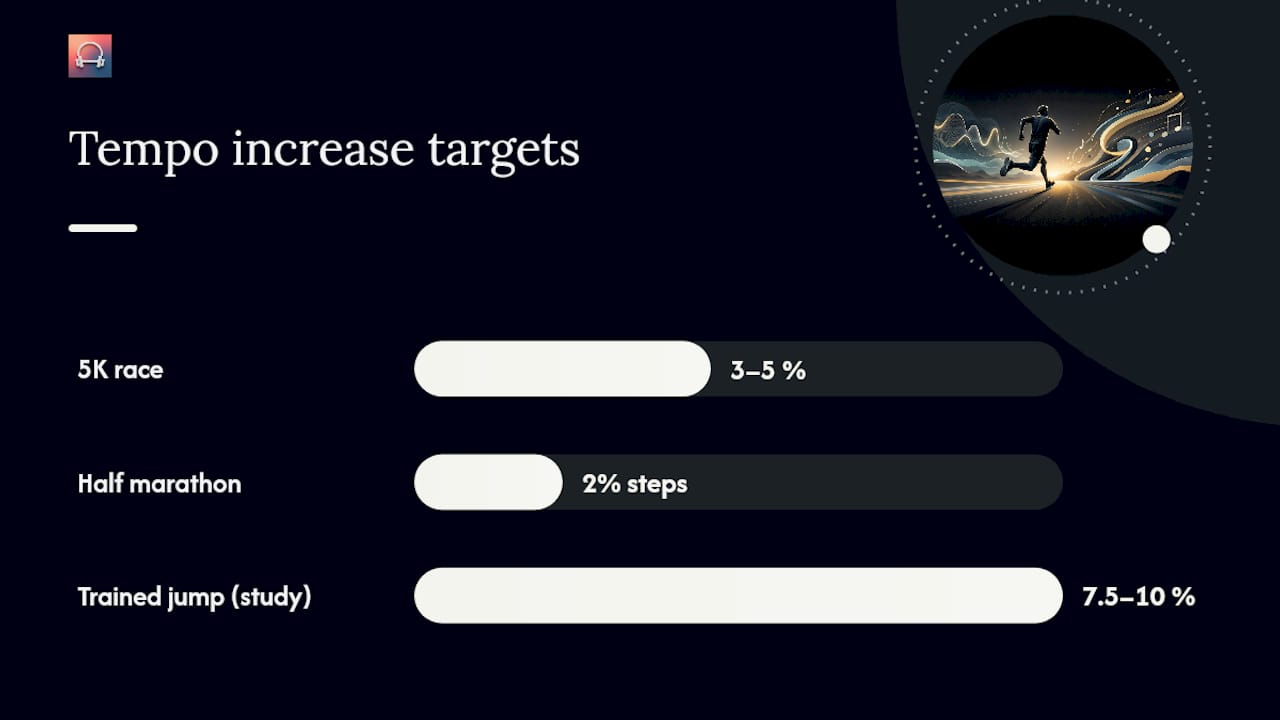
- Build the progression. Keep the first half of your playlist at or slightly below baseline BPM. For the second half, step tempo up gradually: a 5K might climb 3 to 5%, a half marathon might climb in smaller 2% increments spread across more songs.
- Sequence by song, not by mile marker. Because song length varies, line up your BPM increases with your actual pace plan rather than a fixed distance, and adjust the playlist order until the tempo curve matches your effort curve.
- Test before race day. Run the full playlist during a training run at goal pace. Note where the tempo shift felt helpful and where it felt too aggressive.
- Adjust and repeat. Small tweaks. Change one song, shift one transition point, and rerun the test. Race-day playlists should feel boringly familiar by the time you use them for real.
A 4-week cadence-training study found that music set 7.5% to 10% above baseline cadence increased actual cadence by about 8.5%, and the gain held up in follow-up testing. That’s a bigger jump than the passive entrainment range, and it worked because runners trained into it gradually over weeks, not in a single run.
Pro Tip: Never introduce a new tempo jump on race morning. Your nervous system needs at least two or three exposures to a pacing cue before it responds predictably under fatigue.
What BPM Targets Actually Work for Negative Splits
Two schools of thought exist on matching beats to steps. Some runners sync one beat to one footstrike (a 1:1 ratio), which works well at cadences between 160 and 180 steps per minute. Others prefer two beats per stride (2:1), better suited to slower cadences or songs with a strong halftime feel. Either approach can work. What matters is consistency once you pick one.
Sample progressions by distance, using baseline cadence as your reference point:
- 5K: First 1.5K at baseline BPM, then a 4 to 6% climb over the final 1.5K.
- 10K: First 6K at or slightly below baseline, then a 3 to 5% increase for the final 4K.
- Half marathon: First 10K near baseline, gradual 2 to 3% increases spaced across the last 11K rather than one big jump.
- Long training runs: Keep tempo flat or even slightly below baseline for the first two thirds, then a single 3 to 4% bump for the closing stretch.
Keep unprompted micro-adjustments at or under 3%. That’s the range where entrainment happens without conscious effort, based on tempo-shift research that found cadence responsiveness dropped off once deviations approached 2.5 to 3%. Bigger jumps, like the 7.5 to 10% cadence gains from structured training, require weeks of exposure, not a same-day surprise.
A hard ceiling worth remembering: cap any single abrupt tempo jump at roughly 10%. Beyond that, you risk disrupting stride mechanics or spiking effort faster than your body can adjust, especially late in a race when form is already breaking down. Gradual, bar-by-bar tempo changes, the kind adaptive apps handle automatically as detailed in the technical background on tempo-to-movement alignment strategies, protect against overshooting far better than a manual playlist with one dramatic key change at mile 20.
How Adaptive Apps Turn This Into a Hands-Off System
Manual playlists work, but they’re static. Your actual pace on race day never matches your spreadsheet exactly, and a fixed playlist can’t respond when you’re running faster or slower than planned. That’s the gap adaptive-tempo apps fill.
Repbeats syncs music tempo to live data from your heart rate, cadence, and session intensity, pulled from wearables like Apple Watch and Fitbit. Its auto-DJ updates BPM every bar rather than waiting for a song to end, which means the tempo curve can track your actual effort instead of a plan you wrote three days ago. Research on beat-synchronized running strategies shows that continuous, smooth phase and tempo adjustments produce more reliable entrainment than abrupt jumps between songs, which is exactly the mechanism auto-DJ is built to replicate.
Setting up an adaptive session takes a few steps:
- Pair your wearable so the app has live heart rate and cadence data.
- Choose your preferred music library, since preference drives the psychological benefit as much as tempo does.
- Set your pacing aggressiveness and negative-split goal for the session.
- Run two training sessions before trusting it on race day, and calibrate sensitivity if the tempo shifts feel too pushy or too subtle.
Pro Tip: If the first adaptive run feels like it’s rushing you, lower the sensitivity setting rather than abandoning the approach. Overshooting effort early is the most common mistake with any tempo tool, human-built or automated.
Preferred music tested in a 6-minute all-out effort improved total distance covered by roughly 10% and mean running speed by about 14% compared to running without music. That’s a controlled lab test, not a marathon, but it shows the ceiling on what tempo-matched audio can do when the match is right.
When Not to Trust the Beat
Music is a pacing tool, not a substitute for listening to your body. During max-effort intervals or technical track sessions, internal feedback, your breathing, your form, the burn in your legs, matters more than any external cue. Don’t let a driving beat talk you into ignoring warning signs.
Road safety comes first on outdoor runs. Keep one ear open or switch to bone-conduction headphones near traffic, intersections, or shared paths.
The evidence itself has limits. A broader review of music and performance found that benefits shrink at very high intensities and vary by training status, sex, and the timing of when music is introduced during the effort. Don’t expect tempo tricks to work identically for every runner or every workout.
- Skip tempo tools during max-effort or technical sessions where internal cues matter most.
- Use one-ear or bone-conduction listening near roads and traffic.
- Expect diminishing returns as intensity climbs toward maximal effort.
The Psychology Behind the Second-Half Surge
Fatigue is partly a mental negotiation. Somewhere past the halfway point, your brain starts weighing the cost of continued effort against the payoff of easing up. Music tilts that negotiation in your favor, and it does it through a few distinct channels rather than one blanket effect.
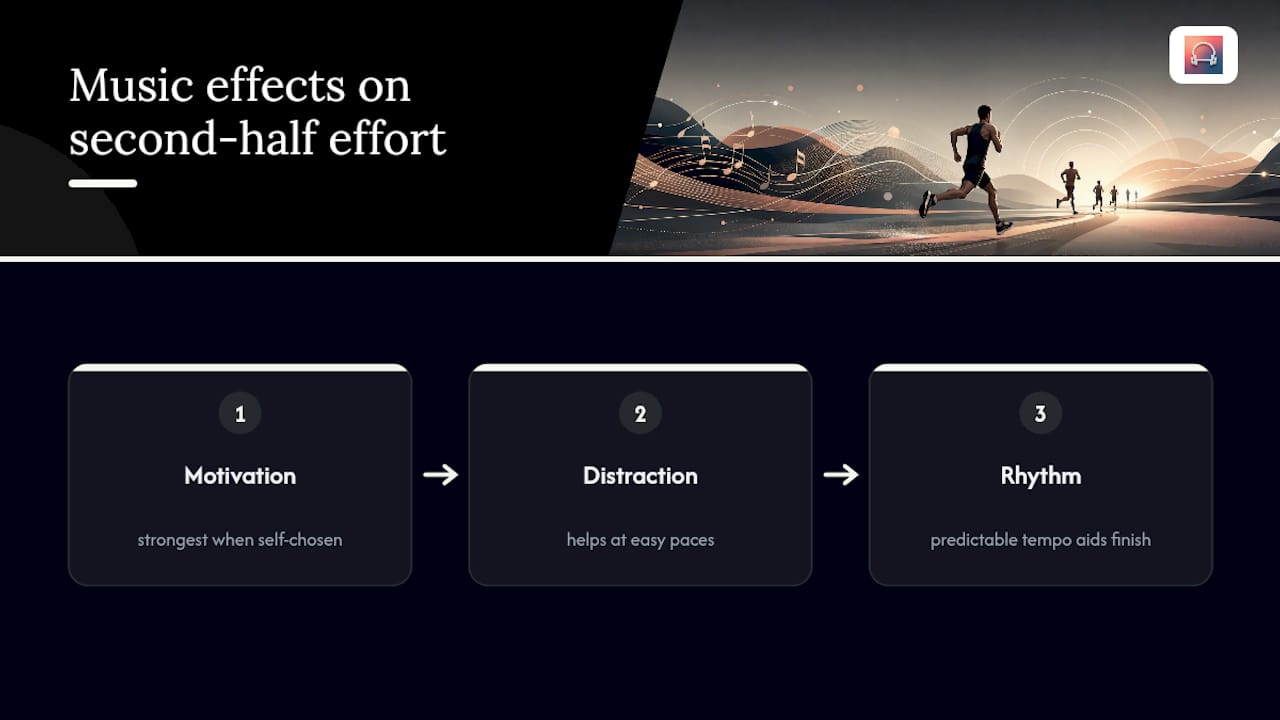
Motivation is the biggest lever. Familiar, preferred tracks trigger a documented rise in motivation and positive affect, and researchers studying preferred-music effects found the boost was strongest when runners chose the music themselves rather than following a preselected list. That personal connection to a song, the memory attached to it, the anticipation of a chorus, gives your brain something to focus on besides the discomfort building in your legs.
Distraction plays a role too, but it’s a limited one. At easy to moderate paces, music pulls attention away from internal fatigue signals, which is part of why perceived exertion drops even when actual physiological strain doesn’t change. As effort climbs toward your limit, that distraction effect weakens, because your brain can’t ignore maximal-intensity signals no matter what’s playing.
Rhythm adds a third layer: predictability. A steady or gradually building tempo gives your brain a structure to lean on, a countdown of sorts, especially in the final stretch when decision fatigue makes every choice harder. That’s why a planned tempo increase tends to work better than random shuffle play. Your brain isn’t just hearing music. It’s tracking a pattern that mirrors the effort curve you’re trying to execute.
How Negative-Split Music Stacks Up Against Other Pacing Methods
Runners have paced negative splits without music for decades, using even-effort training, GPS pace alerts, or a coach shouting splits from the sideline. Each method works. None of them address the same problem.
Pace alerts tell you what your pace was 30 seconds ago. They’re accurate but reactive; by the time your watch buzzes to say you’re 10 seconds off target, you’ve already run those 10 seconds. Tempo music, by contrast, works forward. It sets a rhythm your cadence can follow in real time, rather than reporting a number after the fact.
Effort-based pacing, where you run by feel and perceived exertion, builds genuinely useful body awareness. It’s arguably the more transferable skill for race-day pacing when there is no wearable to rely on. But it demands more cognitive discipline than most runners bring to the back half of a hard effort, exactly when decision-making gets harder. Tempo cues reduce that mental load by outsourcing part of the pacing decision to something external and steady.
Coached splits and pacing groups offer real-time feedback and social pressure, which can be powerful, but they’re only available at organized races with pacers, not on a random Tuesday tempo run. Music pacing works anywhere, in any weather, without needing another person present.
None of these approaches are mutually exclusive. The strongest negative-split execution usually combines effort awareness with an external cue, whether that cue comes from a pacer, a watch alert, or a tempo track building toward your finish.
Matching the Approach to Your Experience Level and Race Distance
A first-time 5K runner and a sub-3-hour marathoner need different versions of this strategy.
The goal isn’t precision. It’s building the habit of holding back early, since most beginners’ biggest pacing mistake is going out too fast regardless of what’s playing.
Experienced marathoners and competitive runners get the most value from adaptive systems, because a 26.2-mile effort covers too much time and fatigue variation for a static playlist to track accurately.
Trail and ultra runners face a different problem entirely: variable terrain makes fixed BPM targets unreliable, so tempo cues work better as loose motivational tools during runnable sections rather than a strict pacing framework.
Where Negative-Split Music Falls Short
Tempo tools aren’t a fix for poor training. If your fitness can’t support a faster second half, no BPM curve will manufacture that speed out of nowhere. Music nudges cadence and perception; it doesn’t create fitness you haven’t built.
Overreliance is a real risk. Runners who lean entirely on tempo cues sometimes stop developing their own internal pacing sense, which matters the moment headphones fail, a race bans them, or a course gets too crowded for safe listening. Effort-based pacing remains a skill worth training independently.
The evidence base, while genuinely encouraging, comes largely from lab tests and short-duration protocols. A 6-minute all-out test showing improved distance and speed doesn’t guarantee identical returns across a 3-hour marathon effort, where fatigue, fueling, and environmental factors add variables no playlist accounts for.
Individual variability cuts deep here too. Not every runner entrains to a beat the same way, and some find any external tempo cue distracting rather than helpful, particularly at high intensities where music’s performance benefits tend to shrink. Treat tempo-based pacing as one tool among several, tested and calibrated to your own response, rather than a guaranteed formula.
How I’d Program This Into a Four-Week Block
Two negative-split sessions a week, that’s the structure I’d default to. Week two, bump the aggressive segment slightly and check RPE against your watch data, not just how you feel in the moment. The point isn’t finding the biggest tempo shift you can tolerate. It’s finding the one that actually moves your finish time, and you won’t know that until you’ve tested it enough times to trust the data over the excitement of a new playlist.
— Jordan Mills
Try Repbeats for Adaptive Negative-Split Pacing
Building tempo progressions by hand works, but it takes real trial and error to get the transitions right. An adaptive app removes that guesswork by syncing BPM directly to your heart rate and cadence data from wearables, then adjusting the music every single bar through an auto-DJ engine instead of waiting for a song to end.
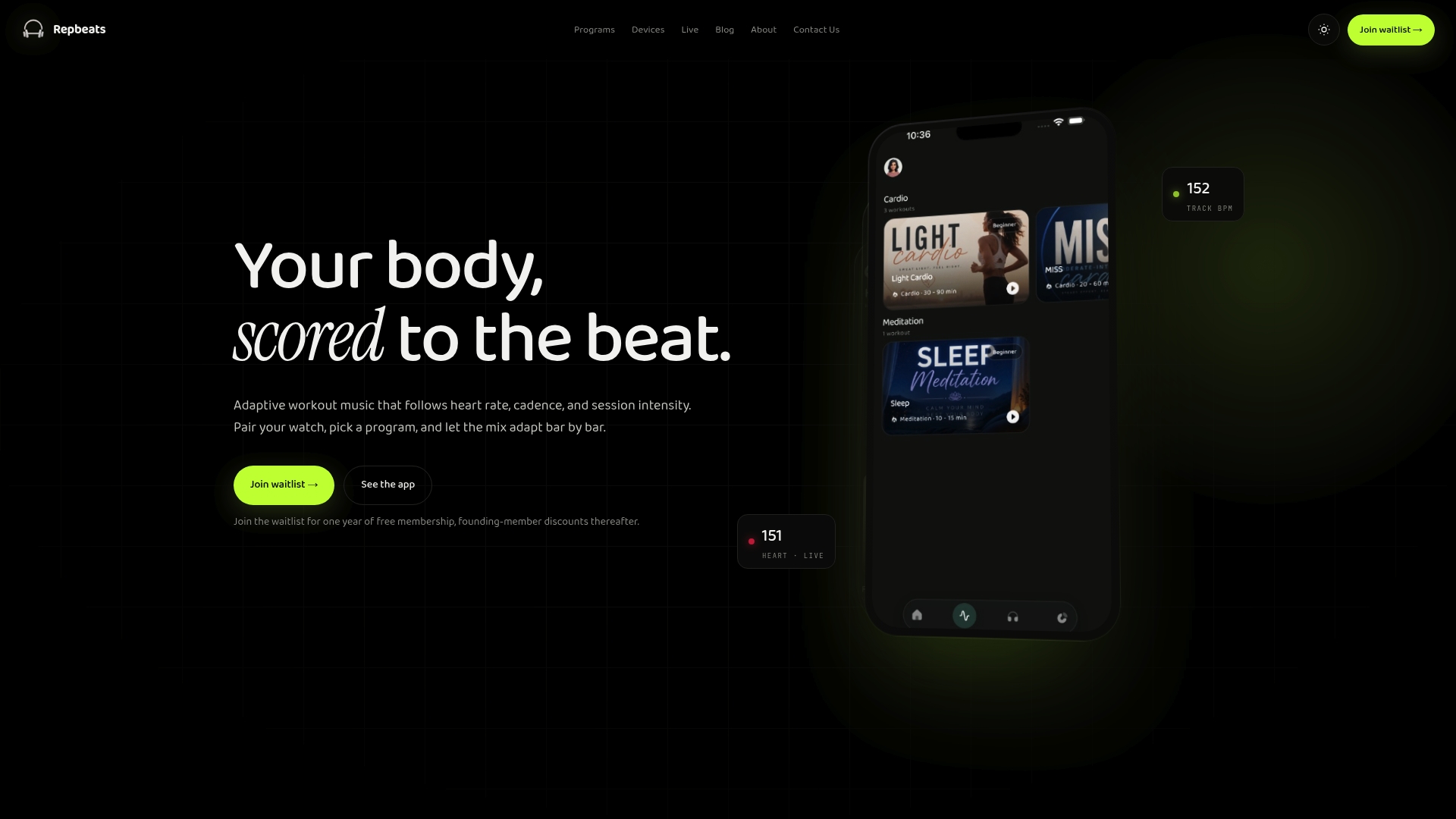
You set a pacing mode and a negative-split goal, and the app handles the tempo curve in real time based on how your run is actually unfolding, not a plan you wrote three days earlier. That means fewer awkward playlist transitions mid effort and less mental math about when to speed up. The Repbeats platform also handles cardio and meditation programs if your training extends beyond running.
Test it the same way you’d test any new pacing tool: two or three training runs before you trust it on race day. Start a free trial through the Repbeats app and see how the tempo curve feels against your own cadence before your next race.
Sources
- The Effects of Preferred Music and Its Timing on Performance, Pacing, and Psychophysiological Responses During the 6‐min Test
- Spontaneous entrainment of running cadence to music tempo
- Using beat frequency in music to adjust running cadence in recreational runners: A randomized multiple baseline design