Wearable Users: Turnkey Lab Backed Music to Hold Your Heart in Zone
Jordan MillsSeptember 10, 2026 · 9 min read

Wearable Users: Turnkey Lab Backed Music to Hold Your Heart in Zone
Stay in zone music means adaptive, tempo-synced audio that reads your live heart rate or cadence and adjusts its BPM in real time to keep you inside a target training zone. The research backs it up: synchronous music has pushed time-to-exhaustion up by 66.6% in one treadmill study and consistently lowers how hard exercise feels. Paired with a wearable, an app like Repbeats turns that science into a workout you don’t have to babysit.
TL;DR:
- Using cadence control for pace-focused workouts provides quicker adjustments, while heart rate control better suits endurance and recovery sessions.
- Setting a wide deadband of ±3 to 5% prevents overcorrection and ensures smoother musical transitions during tempo adjustments.
- Prescriptive mapping with gradual BPM shifts improves stay-in-zone accuracy and is generally preferred for maintaining targeted effort levels.
- Heart rate sensors on wrist devices may be less accurate during high activity, making chest straps a better choice for strict zone adherence.
- Beginners should start with wider deadbands and shorter intervals, gradually tightening settings as they become more comfortable with adaptive music.
Table of Contents
- How Adaptive Tempo-Synced Music Keeps You in Zone
- What the Research Actually Shows
- Setting Up Adaptive Zone Music With Your Wearable
- Picking Your Mapping and Control Signal
- Session Templates to Try This Week
- What Adaptive Music Can’t Do for You
- What Wearable Users Actually Tell Us
- Try Stay-in-Zone Music With Repbeats
- Sources
- FAQ
How Adaptive Tempo-Synced Music Keeps You in Zone
The effect at the center of all this is rhythmic entrainment: people involuntarily match their steps, pedal strokes, and even breathing to an external beat. That’s why a meta-analysis of 139 studies found music can nudge performance and effort perception without you consciously trying to keep pace.
Getting that nudge to happen automatically requires a signal chain: your wearable’s sensor reads heart rate or cadence, sends it over Bluetooth to the app, which maps that number to a target BPM and hands it to the audio engine. Repbeats updates the tempo every bar rather than waiting for a whole song to end, which keeps corrections small and musical instead of jarring.
Two things shape how well this works:
- Heart rate vs. cadence as inputs. HR responds slowly and smooths out noise, so it suits endurance and recovery work. Cadence reacts instantly to pace changes, which makes it better for interval or speed sessions.
- Prescriptive vs. descriptive mapping. Prescriptive music tells you what to do next (speed up, ease off); descriptive music just reflects what your body is already doing. A cycling pilot study found prescriptive mapping kept more participants inside their target zone and was the mapping style people preferred.
What the Research Actually Shows
The clearest single result comes from a hot, humid treadmill trial where runners listening to synchronous music lasted 376.5 seconds before exhaustion versus 226.0 seconds without it, a 66.6% jump with a moderate effect size (d=0.63, p=0.02), according to Frontiers in Psychology.
The bigger picture, from 139 combined studies:
- Performance improves modestly (g=0.31)
- Mood and affect improve more (g=0.48)
- Perceived exertion drops (g=0.22)
- Average heart rate barely moves (g=0.07), according to the multilevel meta-analytic review
That last number matters. Music changes how hard a workout feels far more reliably than it changes your actual heart rate. A field trial with trail runners found cadence-synchronous music improved pace and distance for some groups, while HR-synchronous music did more to reduce perceived exertion and extend duration for others. Results split by goal and by individual, which is exactly why the mapping choice you make matters more than the fact that adaptive music exists at all.
Study protocols vary a lot: some use treadmills, some outdoor trails, some small samples. Treat any single number as a direction, not a guarantee for your own session.

Setting Up Adaptive Zone Music With Your Wearable
Getting this right the first time saves you three sessions of fighting the app instead of running — and is much easier if you use a fitness studio booking software designed for personal trainers and athletes.
- Check compatibility. Confirm your Apple Watch or Fitbit is paired with the app, Bluetooth headphones are connected, and location/motion permissions are granted. Latency creeps in fast when a connection is flaky.
- Set your target zone. Enter your HR zone (as a percentage of max) or cadence target directly in the app rather than relying on defaults.
- Choose a wide deadband to start. A deadband is the buffer around your zone edge before the music reacts. Start around ±3 to 5% of your zone threshold so the audio nudges you instead of yanking you around.
- Set tempo smoothing. Limit BPM changes to roughly 3 to 8% per bar. This keeps transitions musical rather than sudden.
- Do a five-minute test walk before your real session to confirm the app is reading live data correctly.
Pro Tip: If the music seems to overcorrect every few seconds, widen your deadband before you touch anything else. Most jitter complaints trace back to a threshold set too tight, not a broken sensor.
If you get dropouts, check headphone battery and Bluetooth range first. If BPM ranges feel mismatched to your effort, your zone settings are probably still on a default rather than your own numbers.
Picking Your Mapping and Control Signal
Prescriptive mapping wins when the goal is staying put in a zone. It tells you to push or ease off before you drift too far. Descriptive mapping, which just mirrors your current effort back to you musically, works better for sprint finishes or when you want raw feedback rather than guidance.
Match the control signal to the goal, not habit:
- Use cadence control for pace work, speed sessions, or anything where stride efficiency matters more than staying under a heart-rate ceiling.
- Use HR control for endurance runs, fat-burning zones, or recovery rides where perceived exertion and duration matter more than exact pace.
Oscillation, where the music keeps overcorrecting back and forth, is the most common complaint from new users. A small cycling and VR feedback study found music-only feedback produced faster corrections but also more frequent exits from the target zone compared with visual cues. Widening your deadband and applying tempo smoothing addresses most of this.
Pro Tip: Cap tempo shifts at small steps per bar rather than letting the algorithm jump 15 BPM at once. Gradual is what makes the correction feel like music and not an alarm.
Session Templates to Try This Week
- Warm-up (8 to 10 minutes): Prescriptive mapping, gentle tempo ramp from 100 to 120 BPM, target HR at 50 to 60% of max.
- Steady zone session (20 to 40 minutes): Set your target zone, apply moderate smoothing, and let tempo hover in a 125 to 145 BPM band depending on activity.
- Interval/threshold set (4 to 8 rounds): Use cadence control for work intervals, switch to HR-based descriptive mapping during recovery so the music reflects your drop in effort rather than pushing you.
Beginners should widen every deadband listed above and stick to shorter interval counts. Advanced users can tighten smoothing and push BPM ranges higher once they’ve run three or four sessions and know how their body responds. Our BPM-matched workout templates walk through specific ranges by activity if you want more starting points.
What Adaptive Music Can’t Do for You
Expect more frequent small corrections with music-only feedback than you’d get from a visual heart-rate graph. That’s the nature of the tool, not a malfunction.
- Wrist-based PPG sensors lose accuracy during high-motion activity; a chest strap is the better choice when you need strict zone adherence, like in rehab protocols.
- Set conservative zone cutoffs and know your stop signal if you feel dizzy or overly fatigued. Music should never override how your body actually feels.
- Check in manually on RPE every 10 to 15 minutes. Adaptive audio is good at masking fatigue you’d otherwise notice.
What Wearable Users Actually Tell Us
People who stick with adaptive music past the first week report more enjoyable sessions, longer stretches inside their target zone, and far fewer glances down at the watch face. The trade off shows up early: the first session or two can feel busier, more corrective, than users expect from a normal playlist. That single adjustment resolves most of the “this feels twitchy” feedback we hear.
— Jordan Mills
Try Stay-in-Zone Music With Repbeats
An app can implement the system described above by reading live data from wearables like Apple Watch or Fitbit, updating BPM every bar through an auto-DJ engine, and providing in-app controls for zone targets, deadbands, and session templates, so you don’t have to stop your run to adjust the playlist.
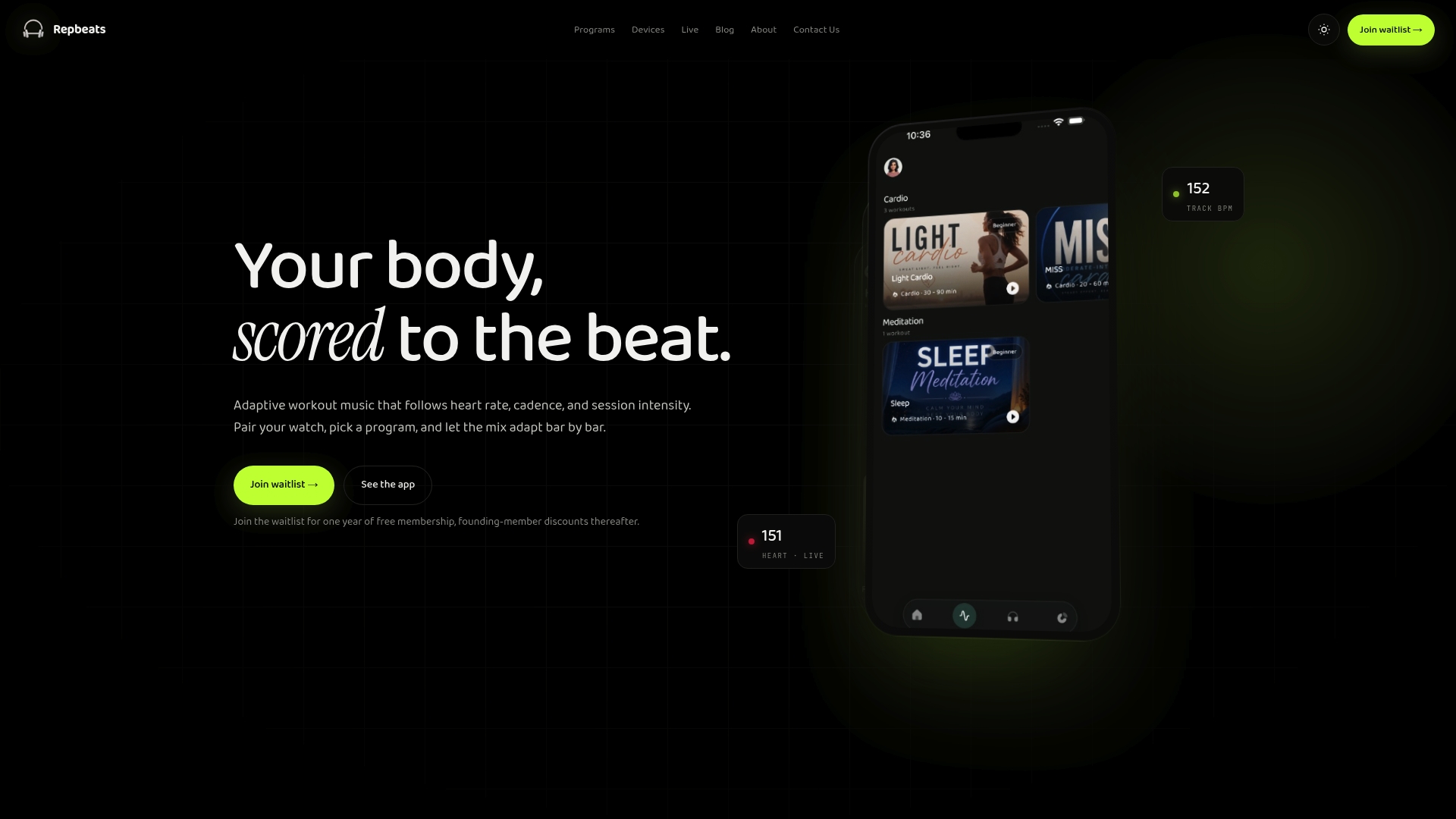
It’s built for wearable users who want their zones held automatically instead of watching a screen mid-workout. Whether you’re doing steady endurance work, interval training, or meditation sessions, the mapping adjusts to what you’re actually doing in real time. If you already understand how deadbands and smoothing work from the setup section above, you’ll get a usable session on your first try. Head to the Repbeats landing page to start your trial and load your first zone-based session today.
Sources
- Frontiers | The psychophysiological effects of synchronous music during running in the heat
- Tempo-Fit heart rate app: Using heart rate sonification as exercise performance feedback
- Effects of music in exercise and sport: a multilevel meta-analytic review
FAQ
Does synchronous music actually improve workout performance?
Yes.
Should I use heart rate or cadence to control my music?
Use cadence for pace and speed work, since it reacts instantly to effort changes, and use heart rate for endurance or recovery sessions where steady zone control matters more than instant response.
Why does the music keep overcorrecting during my run?
Your deadband is likely set too tight.
Can adaptive music replace a chest strap for accurate heart rate zones?
Not for strict clinical or rehab needs. Wrist-based sensors lose accuracy during high-motion movement, so a chest strap is the better choice when precise zone adherence is required.
How does Repbeats keep me in my target zone?
The app pulls live data from wearables like Apple Watch or Fitbit and updates the music’s BPM every bar using prescriptive mapping, nudging effort back toward the set zone without requiring manual adjustments.