Warm Up BPM: Ideal Music Tempo and Heart Rate Targets
Jordan MillsAugust 18, 2026 · 9 min read

Warm Up BPM: Ideal Music Tempo and Heart Rate Targets
That’s the entire warm up bpm equation. Adjust from there based on fitness level.
Rule of thumb: beginners stay near the bottom of every range and take the full 15 minutes; advanced exercisers can start closer to the top and compress the warm-up to 8 to 10 minutes.
- Gentle mobility: 90–110 BPM, heart rate 50–60% of max
- Standard warm-up: 100–120 BPM, heart rate 60–65% of max
- Pre-sprint or pre-lift: 120–135 BPM, heart rate up to 70% of max
- Cool-down: 60–90 BPM, heart rate descending back toward resting
Key Takeaways
| Point | Details |
|---|---|
| Core warm-up bpm range | Use 100–120 BPM music while heart rate climbs to 50–70% of max over 5–15 minutes. |
| Calculate your max heart rate | Subtract your age from 220, then apply the 50–70% zone for warm-up targets. |
| Match tempo to cadence | Use 1:1 sync for walking and lifts, 2:1 sync for running above roughly 150 steps per minute. |
| Cool down separately | Drop to 60–90 BPM after training to support heart-rate recovery and a calmer nervous system. |
| Watch for high heart rate | Dizziness, chest pain, or near-max heart rate during light effort means stop and consult a professional. |
| Automate the progression | Repbeats syncs BPM to live heart rate and cadence data, automating the climb through a warm-up. |
Table of Contents
- Why a Proper Warm-Up Depends on Tempo and Heart Rate
- What Heart Rate Should You Hit During a Warm-Up?
- Best Music BPM for Warm-Ups (and the Cool-Down Range to Remember)
- Matching Music Tempo to Your Step or Rep Cadence
- Sample Warm-Up Routines by Duration and Intensity
- How to Build a Warm-Up Playlist That Actually Works
- How Adaptive Music Apps Handle This Automatically
- When a High Heart Rate During Warm-Up Is a Warning Sign
- Skip the Manual Playlist Editing With Repbeats
- Sources
Why a Proper Warm-Up Depends on Tempo and Heart Rate
A warm-up exists to raise muscle temperature, get your heart rate up without shocking your system, and prime your nervous system for coordinated movement. Tempo is not decoration here. It’s a pacing tool.
The brain has a documented tendency to synchronize movement to rhythmic sound, which is why research on rhythm and physiological response keeps surfacing in sports science. The right BPM does not just set a mood. It helps your motor system lock into a repeatable cadence before you ask it to do anything explosive.

Pro Tip: Increase your playlist’s BPM by 5 to 10 every few minutes instead of jumping straight to your working tempo. That progression is what keeps the 5 to 15 minute window effective without frontloading fatigue.
What Heart Rate Should You Hit During a Warm-Up?
Target a light-to-moderate zone: about 50 to 70% of your maximum heart rate, which for most people lands somewhere between 90 and 130 BPM depending on age and fitness. That’s the working range. Push much past it during a warm-up and you’re not warming up anymore, you’re starting your workout early.
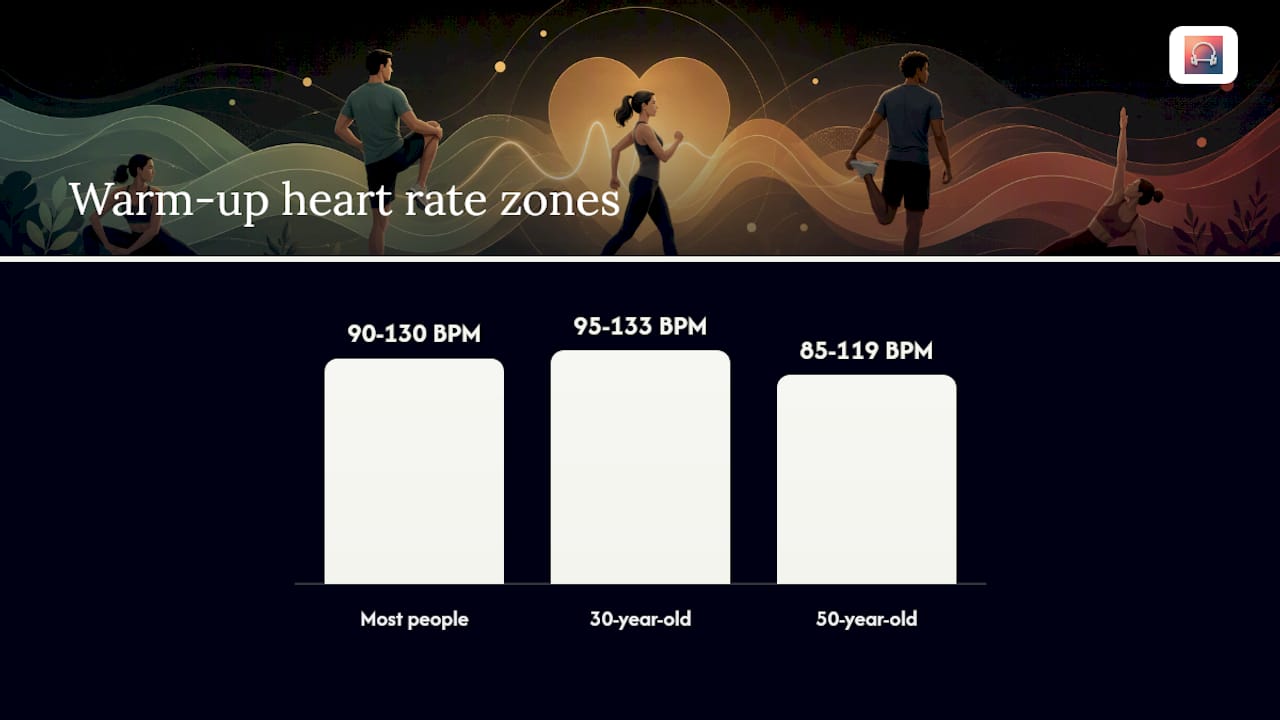
Calculate your estimate with the standard formula: 220 minus your age. A 30-year-old’s max is roughly 190, so 50 to 70% puts warm-up heart rate at 95 to 133. A 50-year-old’s max is around 170, putting the same zone at 85 to 119.
Progress through the window rather than jumping straight to target: start near 50%, and let it climb steadily toward 70% by the final minutes.
- Start at the low end for the first third of your warm-up
- Rise steadily through the middle third
- Reach your target zone by the final third, right before your main session
If your heart rate spikes near your age-predicted max during what should be light activity, that’s a mismatch worth noting. According to American Heart Association guidance on target heart rates, a very high reading during moderate effort should prompt a pause and, if it persists, a conversation with a healthcare professional.
Best Music BPM for Warm-Ups (and the Cool-Down Range to Remember)
The most commonly cited warm-up bpm band sits between 100 and 120, a range that shows up consistently across tempo research on structured training blocks. Some guides push the floor lower, recommending 90 to 110 BPM for pure mobility work, while runners often lean toward the higher end.
Here’s how the bands break down by movement type:
- 90–110 BPM: foam rolling, joint circles, light stretching. Barely elevates heart rate; good for the opening minute or two.
- 100–115 BPM: general mobilization and dynamic stretching, per the FindMyBPM workout tempo chart, which lists this as the standard warm-up mobilization band.
- 105–125 BPM: brisk warm-up walking or light jogging heading into a run. Spotify’s Running Warm Up (105-125 BPM) playlist is built specifically around this window and is widely used by runners as a plug-and-play option.
- 120–135 BPM: the final stretch before strength work or tempo running, where you want tempo just below your working intensity.
Cool-down music tempo works in reverse. Once the session ends, drop to 60–90 BPM to help your nervous system downshift; tracks like Feel The Path Unwind, Cool Down 85 BPM sit right in that pocket. Complex rhythms or busy lyrics tend to slow that recovery process, so simple, consistent beats work better here than anything designed to hype you up.
Matching Music Tempo to Your Step or Rep Cadence
The core rule: use a 1:1 sync when you want one beat per step or rep, and a 2:1 sync (half-time) when the BPM is too fast to move to comfortably. A 120 BPM track gives you 120 steps per minute in 1:1 mode, or 60 strides per minute in 2:1 mode.
For walking and light jogging during warm-up, 1:1 sync at 100 to 120 BPM feels natural. For faster running cadences, many runners find a true stride-per-beat match unsustainable and switch to 2:1, letting one beat cover two foot strikes.
- 1:1 sync: best for walking, mobility drills, and controlled lifts
- 2:1 sync: best for running and any cadence above roughly 150 steps per minute
Pro Tip: If a track feels rushed no matter how you try to move to it, that’s your cue to switch sync ratios rather than switching songs. The math often solves what the song selection can’t.
Sample Warm-Up Routines by Duration and Intensity
Pick the routine that matches your available time and today’s session goal.
- 5-minute gentle warm-up (light training days): 2 minutes mobility at 90–100 BPM, 3 minutes brisk walking at 105–115 BPM. Heart rate target: 50–55% of max.
- 8 to 10-minute moderate warm-up (standard training days): 3 minutes mobility at 95–110 BPM, 4 minutes dynamic movement at 110–120 BPM, 2 minutes light jogging or short accelerations at 120–125 BPM. Heart rate target: climbs from 50% to 65%.
- 12 to 15-minute intense warm-up (competition or max-effort days): 4 minutes mobility at 100–110 BPM, 5 minutes dynamic drills at 115–125 BPM, 4 to 6 minutes progressive accelerations at 125–135 BPM. Heart rate target: builds to 70%.
- Shorten the routine on low-energy days; lengthen it before heavy lifts, sprints, or competition
- Never skip the mobility phase, even when time is tight
How to Build a Warm-Up Playlist That Actually Works
Match playlist length to your warm-up duration, and structure the tempo to climb in step with your heart rate. A 10-minute warm-up needs roughly 3 songs at 3 to 4 minutes each, ordered from slowest to fastest.
- Start each track slightly below your target BPM for that phase, not right at it
- Skip songs with complex time signatures or erratic tempo shifts; they break your rhythm instead of reinforcing it
- Favor rhythmically consistent tracks over anything with big tempo swings mid-song
- Plan the transition between songs so BPM increases happen gradually, not in a jarring jump
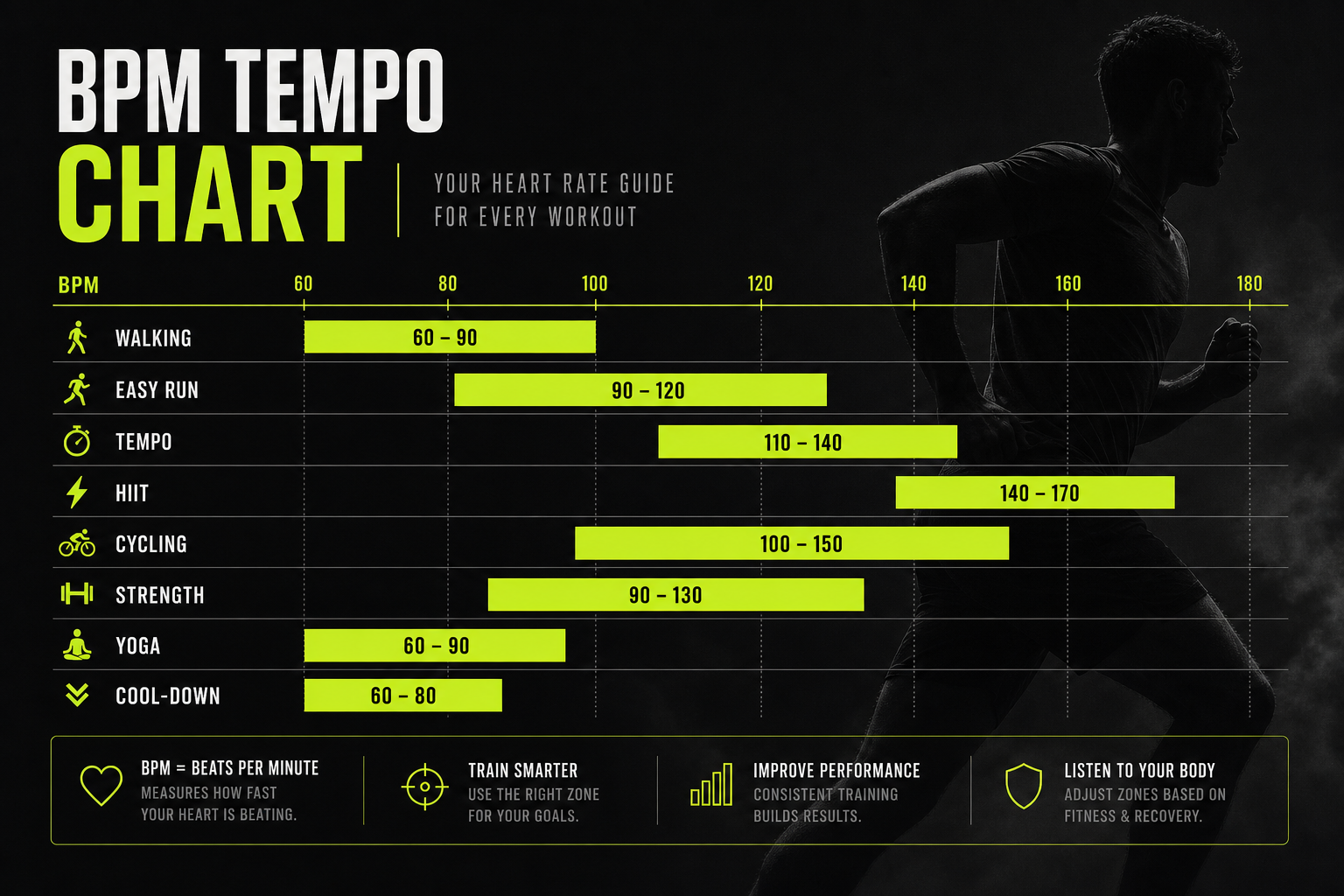
For a deeper breakdown of tempo bands by activity, this complete BPM chart by workout type covers ranges beyond just warm-ups.
How Adaptive Music Apps Handle This Automatically
Adaptive music tools sync BPM to your live heart rate and cadence, which means the progressive warm-up structure above happens without you touching your phone. The tempo rises as your heart rate rises, tracking your actual physiological state instead of a fixed song order.
- Hands-free tempo control during the entire warm-up window
- Personalized progression based on your real heart rate curve, not a generic timeline
- Better pacing adherence since the music adjusts to you, not the reverse
A runner wearing an Apple Watch gets tempo that climbs with actual heart rate data; a lifter can get rep-synced tempo shifts between warm-up sets. Repbeats is built specifically around this kind of wearable-driven intensity syncing.
Pro Tip: If you’ve ever manually skipped songs mid-warm-up because the tempo felt wrong for where your body was, that’s the exact problem adaptive syncing solves.
When a High Heart Rate During Warm-Up Is a Warning Sign
If your heart rate approaches your age-predicted max during what should be light activity, stop and reassess. Slow down, check your pulse, and rest before continuing.
- Dizziness or lightheadedness during warm-up movements
- Chest pain or unusual tightness at low intensity
- Heart rate tracking near maximum during mobility work, not sprint work
When in doubt, check your numbers against established heart-rate guidance and talk to a healthcare provider before your next session.
A note on how I build warm-ups
I build every warm-up around the same principle: start the tempo low enough that the body catches up to the music, not the other way around. My own preference runs 100 BPM for the first two minutes, climbing to 125 by minute eight, with adaptive music handling the climb so I’m not fumbling with a playlist mid-stretch.
Skip the Manual Playlist Editing With Repbeats
Repbeats syncs your warm-up music tempo directly to your heart rate and cadence, so the BPM climbs exactly when your body does instead of following a fixed track order you built the night before.
That solves the actual problem with static playlists: they can’t react when your warm-up runs faster or slower than planned. Three things make this practical for warm-up specifically:
- Wearable sync with Apple Watch and Fitbit pulls live heart rate and cadence data into the music engine
- Auto-tempo progression raises BPM automatically as your heart rate climbs through the warm-up window
- Playlist creation tools let you set a starting tempo and target range instead of picking songs one by one
The app runs on a free trial before moving to a paid subscription. If you want your next warm-up to track your actual effort instead of a Spotify order you set weeks ago, start with Repbeats and let the tempo do the pacing work.
Sources
This article is general information, not a substitute for advice from a qualified doctor. Consult a qualified healthcare professional about your own circumstances before acting on anything here.