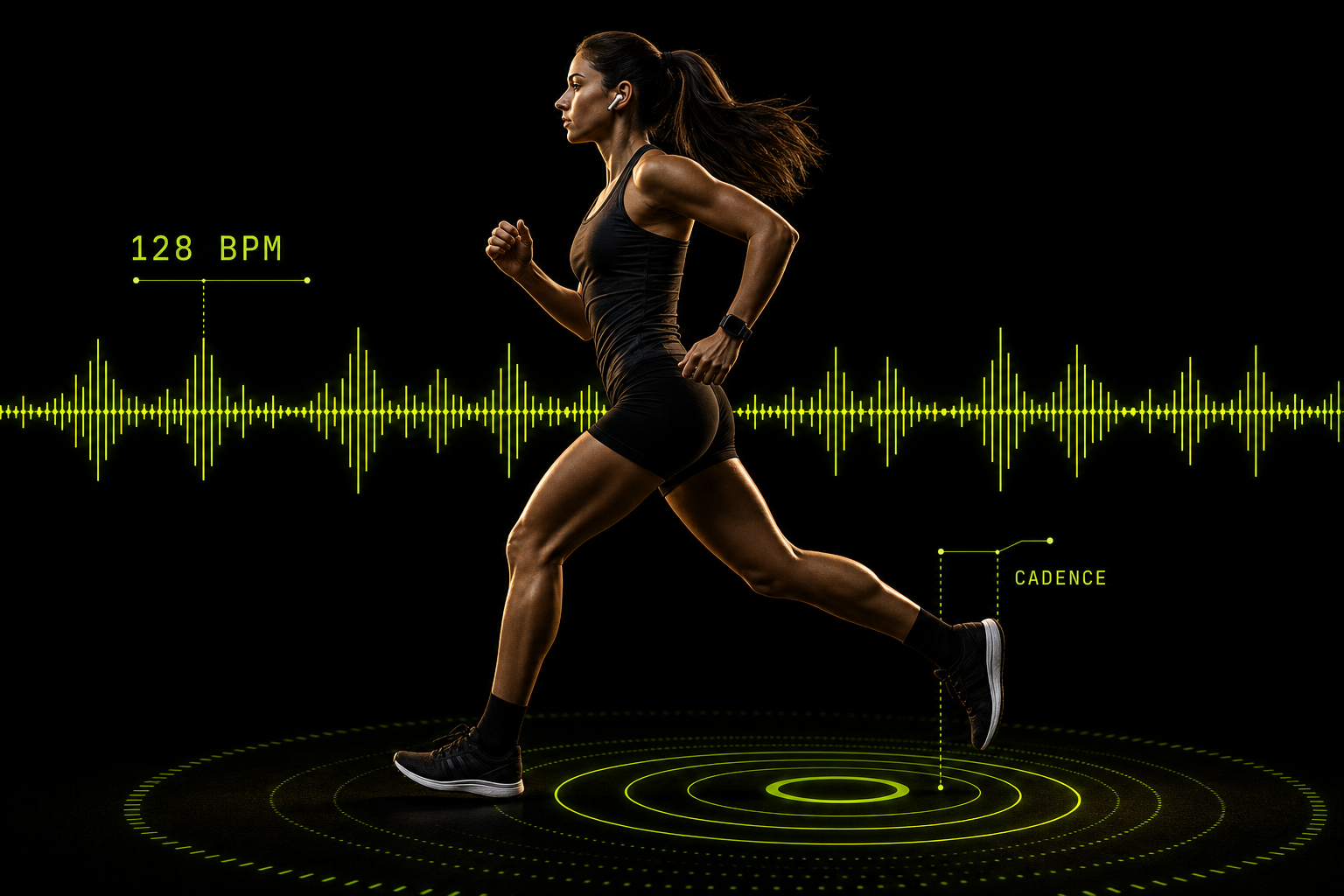
3–10% Cadence Window: Wearable Sync for Audio Cues and Music
Jordan MillsSeptember 30, 2026 · 14 min read

3–10% Cadence Window: Wearable Sync for Audio Cues and Music
Use audio cues when cadence or timing precision matters most, use music when motivation and endurance are the goal, and combine both when you want strict tempo control with a psychological lift. Research on auditory-motor synchronization and preferred music both point the same direction: cadence cues correct movement, while self-selected music lowers perceived effort. Apps like Repbeats build on both findings by blending adaptive, tempo-synced tracks with cueing in one system.
TL;DR:
- Cadence-matched music within 3 to 10 percent of natural stride rate offers better entrainment and comfort than generic playlists or fixed BPMs.
- Combining adaptive, tempo-synced music with short auditory cues improves both performance and perceived effort during structured intervals.
- Self-selected music consistently lowers perceived exertion and boosts motivation more than researcher-curated tracks, especially in longer sessions.
- Real-time tempo adjustments in apps like Repbeats maintain smooth musical flow and cadence synchronization throughout varied efforts.
- Using open-ear or bone-conduction headphones and moderating volume is essential for safety during outdoor audio-guided workouts.
Table of Contents
- How audio cues and adaptive music affect cadence, effort, and endurance
- When should you choose cues, music, or both?
- A step-by-step workflow for combining cadence cues and adaptive music
- How Repbeats builds adaptive music and cueing into one system
- Differences in cognitive and neural processing between audio cues and music
- Use cases and contexts where audio cues or music work better
- Potential downsides of relying on cues or music during training
- Designing better cues and playlists for specific activities
- What the research gets overlooked by most training advice
- Try adaptive music that adjusts to your cadence in real time
- Research and practical resources cited
- Sources
- FAQ
How audio cues and adaptive music affect cadence, effort, and endurance
Beeps, metronome ticks, and cadence-matched music work through a mechanism called auditory-motor synchronization: your body naturally tries to match movement to a repeating sound. A treadmill study in PLOS ONE found that both a plain metronome and cadence-matched motivational music extended time-to-exhaustion compared with no acoustic stimulus at all. The metronome held cadence steadier, while the motivational track also lowered how hard the effort felt.
Music’s advantage shows up most clearly in perceived exertion and mood. A multilevel meta-analysis of 30 controlled studies found small-to-moderate improvements in completion time and power output, plus large effects on how good participants felt during the session, and self-selected music produced stronger results than playlists chosen for them. A separate systematic review and meta-analysis reached a similar conclusion: preferred music reduces perceived exertion and increases motivation more reliably than music picked by someone else.
There’s a catch at the extremes. As intensity climbs toward maximal effort, music’s power to distract from fatigue signals weakens, though its motivational framing still helps people interpret how hard they’re working. Metronome-style cues don’t lose their function this way. A beep still marks the same interval whether you’re jogging or sprinting, which is part of why cadence work and interval structure tend to lean on cues rather than music alone.
A treadmill study found longer time-to-exhaustion with both metronome cues and cadence-matched motivational music compared to silence, showing that timing structure and motivational sound each add real performance value on their own.
The practical trade-offs break down like this:
- Metronome and beep cues improve cadence consistency and running economy through direct auditory-motor entrainment.
- Motivational and self-selected music lower perceived exertion and improve affect more consistently than cues alone.
- Combining a steady beat with music the athlete actually likes tends to outperform either approach used in isolation.
- Music’s distraction benefit fades near maximal effort, while cueing keeps functioning as a timing tool regardless of intensity.
When should you choose cues, music, or both?
The right choice depends on what you’re trying to fix or achieve in that specific session, not on a blanket preference for one over the other.
- Choose cues when cadence correction, gait retraining, or rehab work requires precise timing feedback, since a beep or voice prompt gives an unambiguous signal music can’t replicate.
- Choose cues for interval transitions where you need an unmistakable marker between work and rest, and in noisy environments where music would get lost or masked.
- Choose music for long steady-state runs, flow-focused sessions, or meditation, where mood and sustained engagement matter more than millisecond timing.
- Choose music, specifically self-selected tracks, when the goal is pushing perceived exertion down over a long effort.
- Combine both for structured interval sets: let a cadence-synchronous track hold your tempo while a short cue or voice prompt marks each interval boundary.
Before any session that leans on audio, run through a short device check: confirm your wearable (Apple Watch or Fitbit) is paired and reporting live data, test for playback latency that could throw off timing, and decide between open-ear or bone-conduction audio if you’re training outdoors where situational awareness matters. Keep volume low enough to hear traffic, other runners, or a coach’s voice.
Pro Tip: Test your wearable’s Bluetooth latency once before race day. A half-second delay in cadence cues is enough to throw off a rhythm you’ve spent weeks building.
A step-by-step workflow for combining cadence cues and adaptive music
Getting cues and music to work together instead of competing for attention takes a bit of setup, but the workflow is simple once it’s in place.
- Pre-session: Pick a few preferred tracks or genres, set your cadence and heart-rate targets, pair your wearable, and confirm there’s no noticeable playback lag before you start moving.
- Warm-up: Start with music tuned close to your target cadence, within about 3 to 5 percent, and layer in short cues periodically to check that your steps are actually entraining to the beat.
- Main set: Let adaptive, cadence-synchronous music carry the tempo and motivation, and reserve short, distinct cues or voice prompts for technical corrections, pace changes, or interval transitions so they stand out against the music.
- Cool-down or meditation: Shift to ambient or slower adaptive tracks, and use gentle timing cues to pace breathing or hold durations instead of hard beeps.
A few things tend to go wrong along the way:
- Tempo drift: if music gradually pulls away from your natural cadence, check whether the sync window has slipped past roughly 10 percent, the point where entrainment starts to break down.
- Bluetooth dropouts: keep your phone or watch close and avoid case interference, especially with bone-conduction headphones that rely on a stable connection.
- Noisy environments: raise cue volume or switch to haptic alerts on your wearable rather than fighting traffic or crowd noise with louder music.
How Repbeats builds adaptive music and cueing into one system
Repbeats syncs music tempo to heart rate, cadence, and session intensity in real time, using live data from wearables like Apple Watch and Fitbit. Its auto-DJ technology updates BPM every bar rather than waiting for a track to end, which keeps transitions smooth instead of jarring. That bar-by-bar approach reflects the same entrainment research covered above: small, frequent tempo adjustments (roughly in the 3 to 10 percent range) keep the beat close enough to a runner’s natural cadence to stay effective without breaking flow.
The goal in designing a system like this isn’t just picking motivational songs. It’s keeping the tempo mapping tight enough that the music functions the way a metronome does, while still sounding like a real playlist instead of a click track.
Frequent, small BPM adjustments matter more for perceived smoothness than big dramatic tempo shifts. The body notices jumps; it barely notices a beat that gently drifts toward its target.
Differences in cognitive and neural processing between audio cues and music
A short beep and a song don’t occupy your attention the same way. Simple audio cues, like a metronome tick or a single tone, are processed largely as timing signals. Your motor system can lock onto them quickly with minimal cognitive load, which is part of why they work well for precise, repetitive timing tasks like cadence correction.
Music is a denser stimulus. It carries melody, rhythm, lyrics, and emotional associations, all of which engage more of the brain’s attention and reward circuitry at once. That richer processing is likely why music affects mood and perceived exertion more strongly than a plain cue does. It also means music competes harder for attention, which matters when precision timing is the priority.
This distinction explains the split in the earlier findings: metronome cues won on cadence consistency in the PLOS ONE treadmill study, while motivational and self-selected music won on perceived exertion and affect. Neither stimulus is processed as strictly better. They’re doing different cognitive jobs, one narrow and timing-focused, the other broad and emotionally engaging. Combining them plays to both strengths: a cue for the motor system, music for everything else.
Use cases and contexts where audio cues or music work better
Audio cues tend to win in situations demanding exact timing or clear signaling. Gait retraining and rehab protocols depend on cues because the feedback has to be unambiguous and repeatable. Interval training benefits the same way: a distinct tone marking the start of a work block leaves no room for interpretation the way a musical swell might. Noisy environments, like a crowded gym or busy street, also favor cues or haptic alerts, since music can get buried under ambient sound while a sharp tone or vibration still cuts through.
Music has the edge in longer, steadier efforts where mood sustains performance more than exact timing does. Long runs, endurance cycling, and general strength sessions benefit from self-selected tracks that keep motivation high over time. Meditation and cool-down work lean on music’s slower, ambient qualities to support relaxation rather than movement precision.
Coaches working with groups often split the difference by context: cues during technical drills, music during conditioning blocks. The choice isn’t really about which stimulus is superior. It’s about matching the tool to whether the session calls for precision or sustained engagement.
Potential downsides of relying on cues or music during training
Neither approach is risk-free. Overly rigid cues can backfire if they force cadence outside a runner’s natural range. Research on spontaneous entrainment suggests pushing tempo more than about 10 percent beyond a comfortable cadence risks breaking natural rhythm and can raise perceived exertion instead of lowering it. Cues can also become a crutch: athletes who train exclusively with a beat sometimes struggle to hold pace without one, particularly in races or environments without audio support.
Music carries its own risks. High-volume in-ear headphones can mask traffic, other athletes, or a coach’s instructions, a real safety concern for outdoor training. Music can also mask internal fatigue signals at high intensity, which matters for athletes managing injury risk or heat stress, since synchronous music in hot conditions has been shown to extend time-to-exhaustion, useful for performance, but worth pairing with attention to how the body actually feels. Poorly chosen playlists, especially tracks picked by someone other than the athlete, can also underperform or even distract rather than motivate.
The practical fix for most of these issues is moderation: keep cues within a reasonable tempo window, keep volume low enough to stay aware of your surroundings, and favor tracks you’ve chosen yourself over generic playlists.

Designing better cues and playlists for specific activities
Effective audio design starts with matching the stimulus to the task, not just picking whatever sounds motivating. For cadence work, keep metronome or cue tempo within roughly 3 to 10 percent of a runner’s natural stride rate. Going wider risks breaking entrainment rather than improving it, based on the spontaneous entrainment research on comfortable cadence ranges.

For playlists, prioritize self-selection over algorithmic guesses. The evidence is consistent: preferred music outperforms investigator-selected or generic tracks on both perceived exertion and motivation. Populations matter too. Beginners and rehab patients often benefit from clearer, simpler cues with less musical complexity competing for attention, while trained athletes can handle denser adaptive tracks during high-intensity intervals without losing focus.
Context should shape delivery format as well. Outdoor training favors open-ear or bone-conduction audio to preserve awareness of traffic and terrain. Indoor or lab-style training has more flexibility for in-ear options since the environment is more controlled. Meditation and recovery sessions benefit from slower, ambient adaptive tracks paired with gentle timing cues for breath work, rather than sharp tones better suited to interval transitions. The common thread across all of it: match tempo, complexity, and format to the specific task and the specific person, rather than defaulting to one playlist or one cue style for every session.
What the research gets overlooked by most training advice
Most fitness content treats audio cues and music as competing philosophies, pick the disciplined metronome camp or the motivational playlist camp instead. The actual research doesn’t support that framing. Cues and music solve different problems: one governs timing, the other governs how effort feels. Treating them as rivals means giving up half the benefit for no real reason.
What’s underrated is how narrow the effective entrainment window actually is. A lot of training advice treats tempo matching as a rough guideline, when the evidence points to a fairly tight range, something like 3 to 10 percent of natural cadence, before the benefits reverse. Chasing a fixed BPM number without checking it against your own stride is a common and avoidable mistake.
If I’d tell a reader to prioritize one thing, it’s this: pick your own music. The research is unusually consistent that self-selected tracks beat curated ones on nearly every psychological measure. Everything else, cue placement, tempo windows, device choice, is secondary to that one decision.
— Jordan Mills
Try adaptive music that adjusts to your cadence in real time
The app builds the hybrid approach covered above directly into its features: adaptive music tempo synced to heart rate, cadence, and session intensity, with auto-DJ technology updating BPM every bar instead of waiting for a track change. It pulls live data from popular wearables, so the soundtrack shifts as your effort shifts rather than staying fixed to a preset playlist.
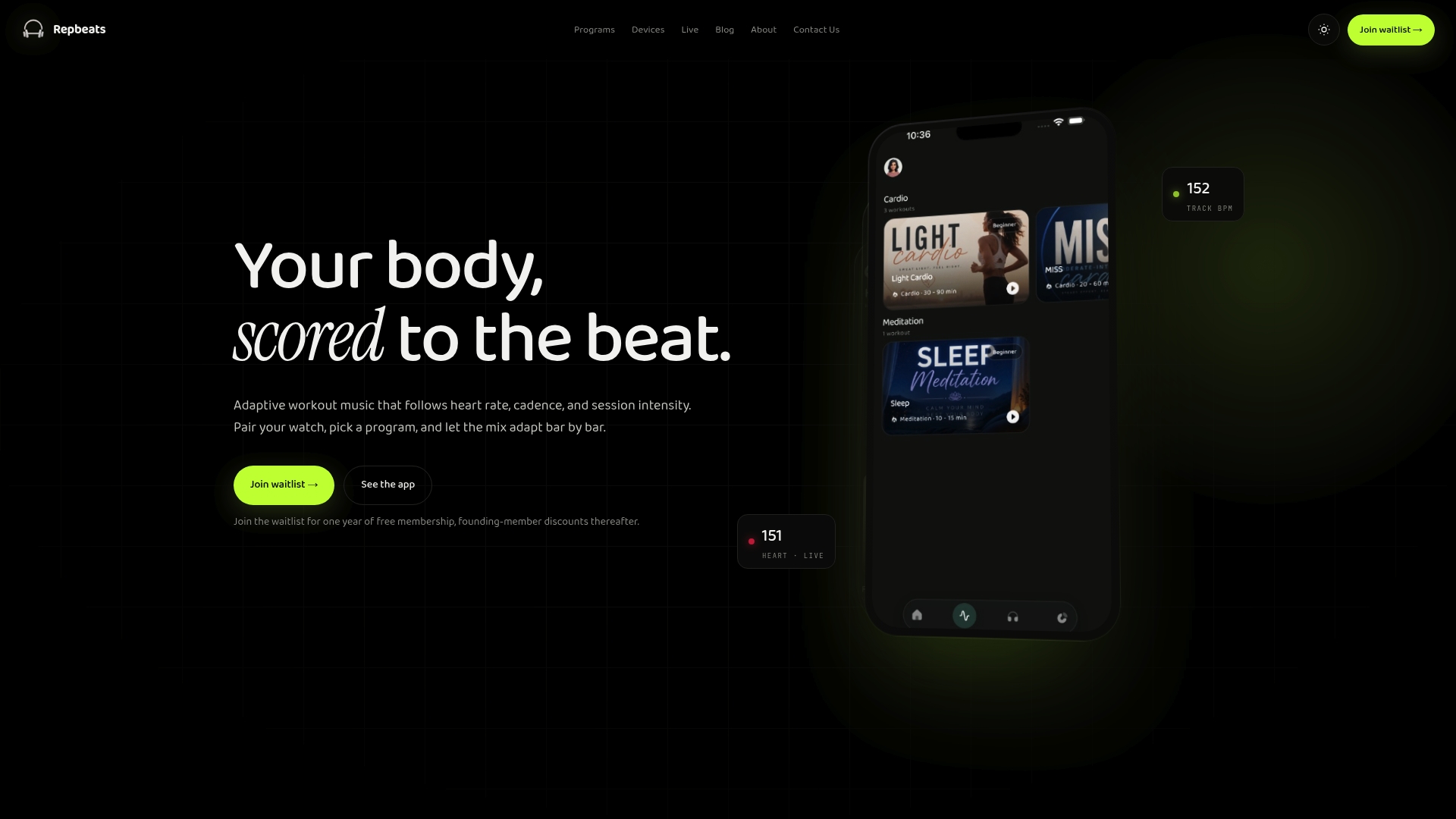
- Adaptive BPM updates every bar for smoother tempo transitions during intervals and steady runs.
- Cadence and heart-rate sync using live data from Apple Watch and Fitbit.
- Meditation and cool-down modes alongside cardio-focused programs.
It fits runners chasing cadence consistency, cyclists managing long steady efforts, meditators wanting adaptive ambient tracks, and coaches building interval structure without juggling separate cue and music apps. Pair a solid pre-workout routine, covered well by Emberk’s guide to low-caffeine options, with a soundtrack that keeps pace with your training. Learn more about the Repbeats app or visit Repbeats to get started.
Research and practical resources cited
- Preferred music and performance meta-analysis: self-selected music’s effect on exertion and motivation.
- PLOS ONE auditory-motor synchronization study: metronome and beat-matched music versus no stimulus.
- Frontiers pre-task music meta-analysis: completion time and fatigue effects across 30 studies.
- Spontaneous entrainment research: cadence-tempo matching windows.
- Repbeats: your brain on workout music: motivation and fatigue background.
Sources
- The Power of Auditory-Motor Synchronization in Sports: Enhancing Running Performance by Coupling Cadence with the Right Beats | PLOS One
- Effects of preferred music listening on physical and psychological parameters in sports: a systematic review and meta-analysis
- The effects of pre-task music on exercise performance and associated psycho-physiological responses: a systematic review with multilevel meta-analysis of controlled studies
- Sensors study on algorithmic and biosynchronous music generation
FAQ
Is it better to use audio cues or music for running cadence?
Audio cues, like a metronome or beep, are generally more reliable for strict cadence correction because they’re processed as clear timing signals. Cadence-matched music can work too, especially when it’s tuned within about 3 to 10 percent of your natural stride rate, based on entrainment research.
Does music actually reduce how hard a workout feels?
Yes, self-selected music consistently lowers perceived exertion and improves mood compared to no music or playlists chosen by someone else, according to a systematic review and meta-analysis. The effect weakens somewhat at very high intensities but doesn’t disappear.
Can combining cues and music improve performance more than either alone?
A treadmill study found that both a metronome and cadence-matched motivational music extended time-to-exhaustion compared with no acoustic stimulus, with each offering a different benefit. Combining a steady cue for timing with music for motivation tends to capture both advantages at once.
How does Repbeats combine cadence tracking with music?
Repbeats syncs music tempo to heart rate, cadence, and session intensity in real time using data from wearables like Apple Watch and Fitbit, updating BPM every bar through its auto-DJ technology. This lets the music function similarly to a cadence cue while still delivering a motivational, adaptive soundtrack.
What is the safest way to use audio during outdoor workouts?
Open-ear or bone-conduction headphones preserve awareness of traffic and surroundings better than sealed in-ear options, which matters for outdoor running or cycling. Keeping cue and music volume moderate, rather than maxed out, helps maintain that awareness without sacrificing timing feedback.