Breathing Paced Music to Calm You Now
Jordan MillsAugust 7, 2026 · 11 min read
Breathing Paced Music to Calm You Now
Breathing paced music is audio composed or timed so its phrasing guides each inhale, hold, and exhale, giving you a sound cue to breathe in sync rather than counting seconds in your head. To start immediately: pick a track or pacer matched to your target breaths-per-minute, put on headphones, and follow two full breath cycles before settling in. The music does the counting. Your only job is to follow it.
The physiological payoff is real. Slowing your breath to match a paced track activates the vagus nerve, which nudges the body toward parasympathetic dominance and measurably improves heart-rate variability (HRV). Apps like Repbeats take this further by syncing tempo live to your biometric data, but even a static album works well for most sessions.
Key Takeaways
Breathing paced music works because its tempo, phrasing, and stereo cues guide each inhale and exhale automatically, activating the vagus nerve and improving HRV without any counting.
| Point | Details |
|---|---|
| Pick your pattern first | Choose box breathing (4-4-4-4), resonant (5.5s/5.5s), or extended-exhale (4s/8s) before selecting a track. |
| Match tempo to breaths per minute | Divide 60 by your target BPM to get seconds per cycle; find a track whose phrasing repeats at that interval. |
| Use headphones and low volume | Stereo cues guide inhale and exhale; mono speakers and high volume both reduce the effect. |
| Start with 3–10 minutes daily | Practice resonance sessions during the day before using slow tracks at bedtime; log what rate feels best. |
| Consult a clinician if needed | Stop for dizziness, chest pain, or worsening breathlessness; seek advice for cardiac, pulmonary, or pregnancy concerns. |
| Repbeats adaptive option | Repbeats updates music tempo live from wearable data, keeping sessions in your optimal breathing range automatically. |
Table of Contents
- How does breathing paced music sync sound to your breath?
- What are the most common paced-breathing patterns and their timings?
- How do you match a track to your breathing pattern?
- Where can you find breathing paced music and how do you set up a session?
- Step-by-step session templates you can follow today
- When should you slow down, stop, or consult a clinician?
- What does the research say about why paced music works?
- Why adaptive music makes paced breathing easier
- Repbeats brings adaptive pacing to your breathwork sessions
- Sources
How does breathing paced music sync sound to your breath?
The mechanics come down to three elements: tempo, phrasing, and stereo or tonal cues.
Tempo sets how many breath cycles fit per minute. One musical bar or phrase typically equals one full breath cycle, so a track running at six phrases per minute guides six breaths per minute without any counting on your part.
Phrasing marks the transition points. Composers build in a distinct onset, often a bell strike, choral swell, or rising string, to signal the inhale. The sound softens or fades toward the exhale tail. That contrast is what lets your nervous system follow the track without reading a timer.
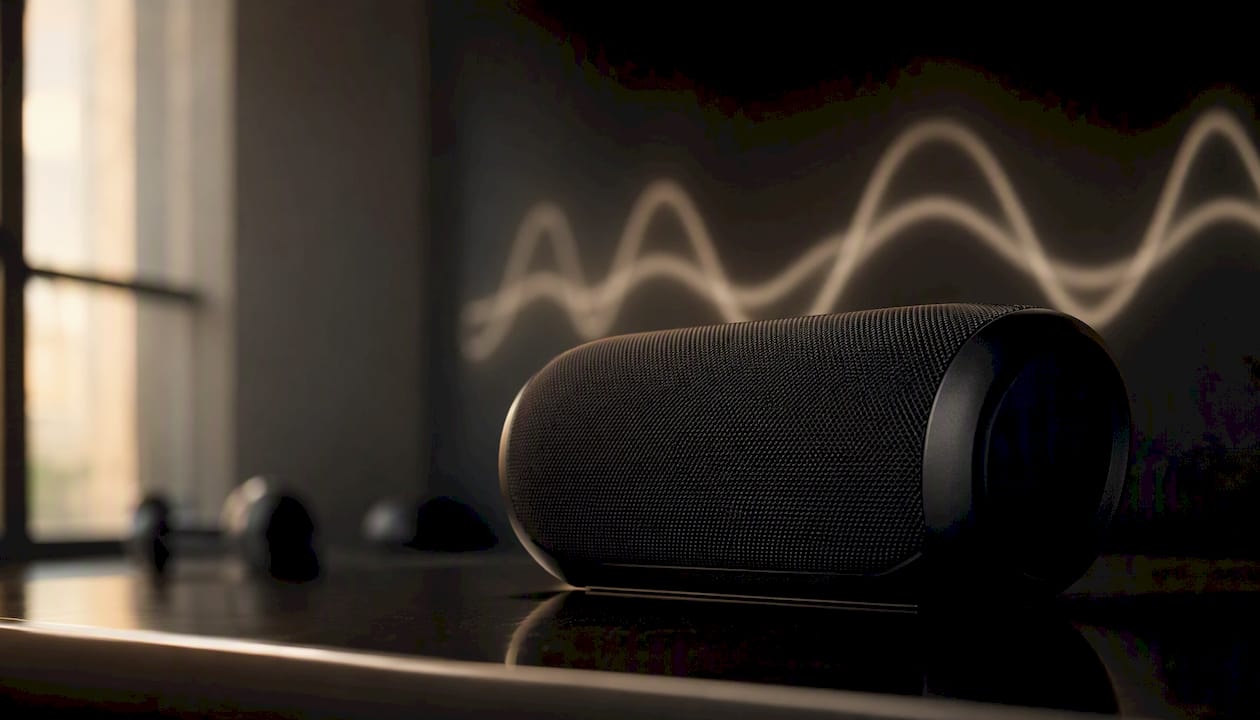
Stereo motion adds a spatial layer. Breathing Cycles describes how sound panning from left to right cues the inhale, then reverses on the exhale, creating a nonverbal guide that keeps sessions more meditative than a voice prompt would. You stop thinking about breathing and just breathe.
The physiology behind the longer exhale matters here. When your exhale runs longer than your inhale, vagal activity increases and HRV rises. That shift is the measurable signal that your parasympathetic system is taking over. A track with a 4-second inhale and 8-second exhale is not just relaxing in a vague sense; it is structurally biased toward calming.
Pro Tip: When you hear a choral swell or a left-to-right stereo sweep, treat it as your inhale cue. When the sound softens or pans back, exhale. You never need to count.
What are the most common paced-breathing patterns and their timings?
Each pattern below has a fixed inhale/hold/exhale structure. The breaths-per-minute figure tells you what tempo to look for in a track.
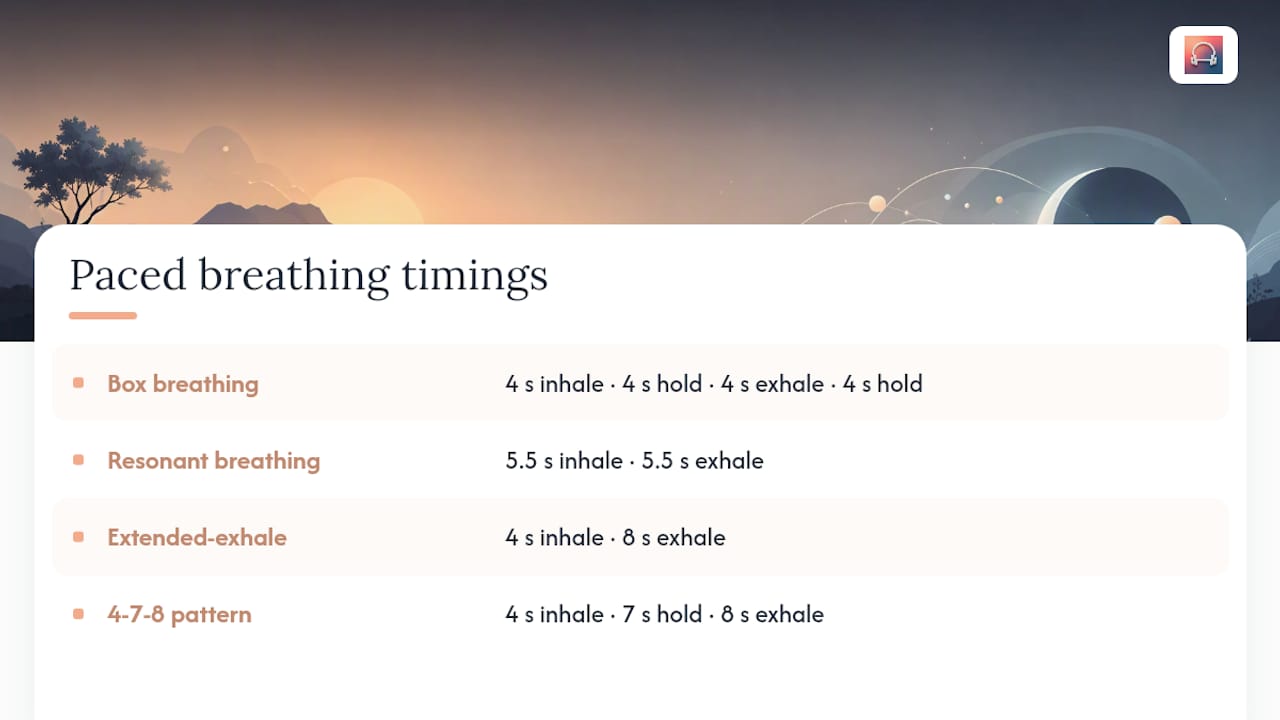
Jenna Citrus’s Exhale album on Spotify covers timings from roughly 60 breaths per minute down to about 2 breaths per minute across 25 tracks, including 4:4 box breathing, 5:5 resonant breathing, and extended-exhale variants. Adrian Kuipers’ Breathing Concerts takes a composer-driven approach, building pieces explicitly around 5.5 seconds in / 5.5 seconds out for heart coherence and 4-4-4-4 for box breathing.
For immediate calm, the extended-exhale or gentle-slow patterns are easiest to follow. Box breathing suits a focused reset during the workday. The 4-7-8 pattern, with its long hold, is better saved for a lying-down sleep-prep session once you are comfortable with breath retention.
How do you match a track to your breathing pattern?
These four rules let you evaluate any track in under a minute.
-
Convert your target rate to seconds per breath cycle. Divide 60 by your target breaths-per-minute. At 6 BPM, each cycle is 10 seconds. At 3.75 BPM (box breathing), each cycle is 16 seconds. A track whose phrasing repeats every 16 seconds is a match.
-
Listen for a clear inhale onset. Bells, rising swells, or stereo movement from left to right mark the start of a cycle. Tracks with a soft, fading exhale tail are easier to follow than tracks with uniform texture throughout.
-
Check the instrumentation. Minimal ambient textures, sparse piano, or sustained pads let the phrasing breathe. Busy percussion or dense layering competes with the breath cue and makes it harder to follow. For guidance on how ambient textures are structured for this purpose, the ambient meditation music guide at Repbeats is worth a read.
-
Test for three full cycles before committing. If the phrasing feels slightly off, move to the next-slower or next-faster track in the same album or playlist. A small tempo mismatch compounds over a 10-minute session.
Pro Tip: Never jump more than one tempo step at a time. If 6 BPM feels rushed, try 5.5 BPM before dropping to 5. Sudden large tempo shifts can trigger mild lightheadedness.
Soul Retreat’s free online breath pacer defaults to a longer-exhale rhythm near six breaths per minute and pairs audio cues with a visual circle that expands on inhale and contracts on exhale. It is a reliable starting point when you want to test a rate before committing to a full album.
Where can you find breathing paced music and how do you set up a session?
Source types
Streaming platforms now carry pattern-specific albums and singles. Apple Music hosts box breathing tracks by artists like Sorry Ghost, and Spotify carries albums such as Box Breathing Practice by Jamis Patonga and Anandani, released in 2026, with phrasing matched to the 4-4-4-4 technique. Search queries that work: “6 BPM breathing music,” “box breathing music 4-4-4-4,” “resonance breathing track,” or “HRV paced breathing.”
For downloadable HRV-tuned files, Endo-education offers tracks labeled at fixed rates from 4.5 to 7.5 BPM, so you can pick a rate and download it for offline use. Adaptive-music apps like Repbeats go a step further by updating tempo in real time based on wearable data, which removes the need to pre-select a rate.
Setup checklist
- Headphones (over-ear or in-ear both work; stereo cues matter, so avoid mono speakers)
- Comfortable posture: seated upright or lying flat, spine neutral
- Volume at low-to-moderate, low enough that you can hear your own breath
- Timer or session length set before you start (3, 10, or 20 minutes depending on the template below)
- Optional: a wearable like the Voltra biometric band to track HRV response across sessions
Pre-made tracks suit most users. A breath pacer gives more control over rate and is better when you are actively testing your resonance frequency. Adaptive apps sit between the two: they respond to your state rather than asking you to pre-select it.
Step-by-step session templates you can follow today
3-minute quick calm
- Sit upright, headphones on, volume low.
- Choose a 6 BPM track or the Soul Retreat pacer at its default setting.
- Follow the extended-exhale pattern (4 in / 8 out) for the full three minutes.
- If the pace feels tight, let your exhale run slightly shorter and return to the full ratio when comfortable.
10-minute resonance / HRV practice
- Set a 10-minute timer. Choose a track at 5.5 or 6.0 BPM from the HRV paced breathing library.
- Spend the first two minutes at your natural rate, then match the track’s phrasing.
- Core eight minutes: follow the 5.5s in / 5.5s out rhythm. Close your eyes after the first full cycle.
- If your mind wanders, use the next inhale cue to re-anchor. No need to restart.
- Log how the session felt (calm, neutral, restless) to track what rate works best for you.
20-minute deep-slowing sleep prep
- Lie flat, lights off or dimmed. Choose a track that starts near 6 BPM and slows toward 4 BPM over the session, or use a playlist that sequences slower tracks.
- Begin with the gentle-slow pattern (5s in / 5s out). Let the music guide the shift rather than forcing a slower rate.
- If you reach the 4-7-8 pattern comfortably, hold for seven seconds only if breath retention feels natural. Skip the hold if it creates tension.
- Allow yourself to fall asleep if the session runs long. That is the goal.
Pro Tip: Practice daytime resonance sessions before using slow tracks at bedtime. Learning what 5.5 BPM feels like while awake makes it much easier to follow at night.
When should you slow down, stop, or consult a clinician?
Paced breathing is gentle for most people, but a few signals mean you should stop and return to your normal breath rate:
- Lightheadedness or dizziness that does not pass within two normal breaths
- Chest tightness or pain
- Shortness of breath that worsens during the session
- Tingling in the hands or face (a sign of over-breathing or hyperventilation)
Consult a clinician before starting paced-breathing practice if you have a heart or lung condition, are pregnant, manage panic disorder, or if a biofeedback device shows an adverse HRV response during sessions.
Adaptations that reduce risk: shorten or remove hold phases, pick a faster comfortable rate (7 BPM rather than 5.5), and reduce breath depth. Never force a slow rate. The body responds better to gradual progression than to an abrupt drop in breathing rate.
What does the research say about why paced music works?
The core mechanism is well-established. Slowing breath to around 5–6 breaths per minute tends to produce the strongest HRV responses in adults, a finding supported by HRV paced breathing collections that let users explore adjacent rates without specialized biofeedback equipment. Many adults cluster near 5.5–6.0 breaths per minute as their personal resonance frequency.
Longer exhales drive this effect. When the exhale exceeds the inhale in duration, vagal activity increases and the parasympathetic system becomes dominant. Breathing Cycles documents this mechanism and explains how stereo motion and tempo work together to maintain the target rate without voice prompts.
Music with clear inhale/exhale cues also improves adherence. When a bell or swell marks each cycle onset, listeners maintain target rates more consistently than when counting silently. That adherence gap matters: a session where you drift off-rate for half the time delivers a fraction of the physiological benefit. Using heart-rate data to tune meditation tracks adds another layer, letting tempo respond to your actual state rather than a fixed preset.
Why adaptive music makes paced breathing easier
Static tracks set a rate and hold it. That works well when your resting state matches the track’s assumption, but your breath rate on a stressful afternoon is not the same as on a calm Sunday morning. Repbeats uses live wearable data to update tempo every bar, keeping the music aligned with where you actually are rather than where a composer guessed you might be.
The practical advantage: you do not need to pre-select a rate, test three tracks, or restart when the phrasing feels off. The app reads your cadence or heart rate and adjusts. For HRV-focused practice, that live feedback loop, explained in depth in the HRV meditation music guide, means the music stays in your productive range throughout the session. Wearables like the Voltra Air supply the respiratory and biometric signals that make this possible.
Repbeats brings adaptive pacing to your breathwork sessions
Most paced-music options ask you to pick a rate and hope it fits. Repbeats does the opposite: its auto-DJ technology reads live data from your Apple Watch, Fitbit, or compatible wearable and updates the music’s BPM every bar, so the tempo follows your body rather than a fixed preset.
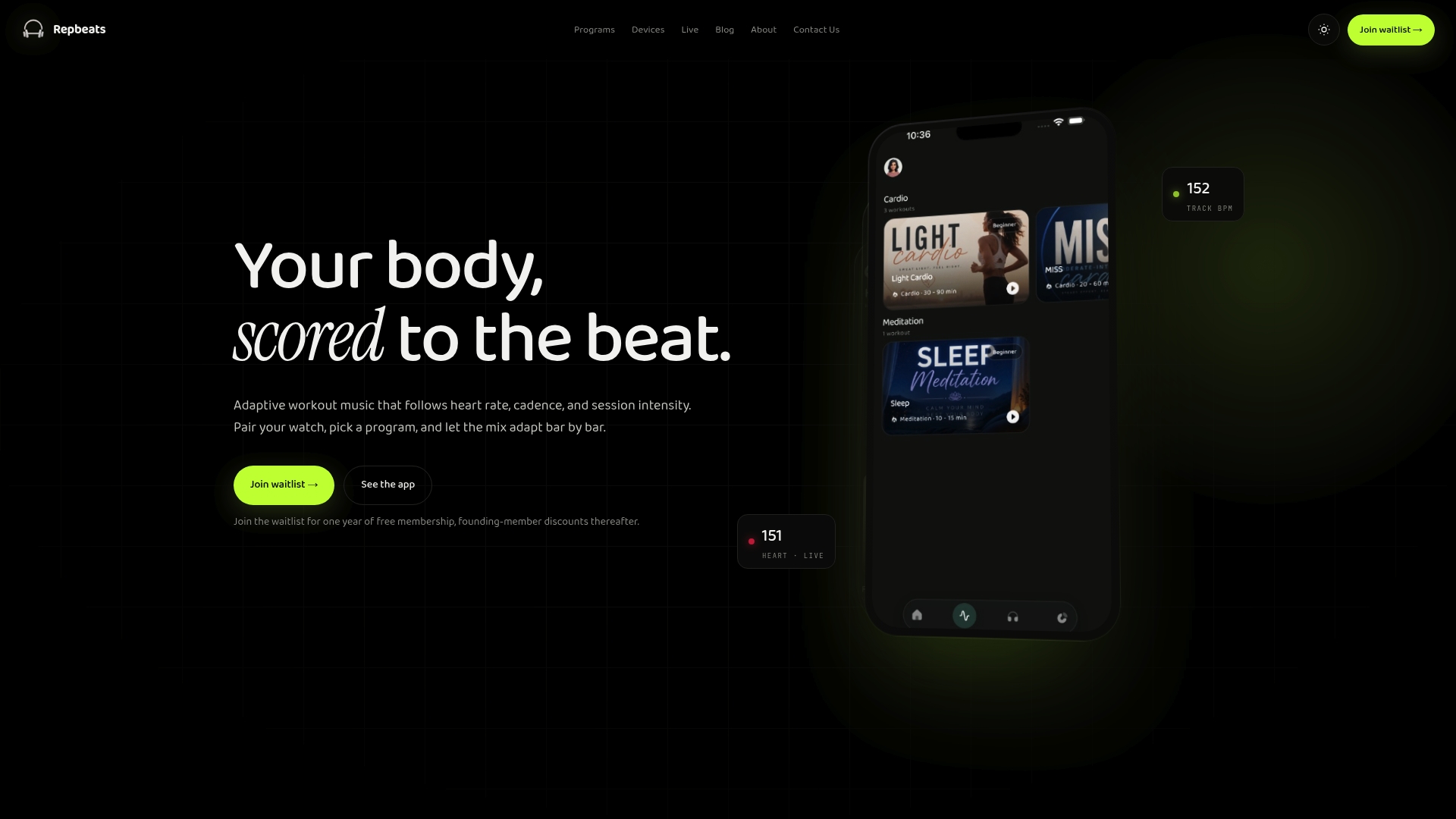
For meditation and breathwork specifically, Repbeats offers prebuilt low-BPM session templates, a searchable library of slow-tempo tracks, and hands-free tempo control that keeps you in a safe, comfortable breathing range without manual adjustment. The app’s wearable integration means your HRV response can inform the session in real time, something no static album can do. Repbeats launches with a free trial period (current waitlist members receive a full free year). Start your paced-breathing practice with Repbeats and let the music do the pacing.
Sources
- Exhale: Guided Breathing Meditations: Sync Your Breath to Measured Musical Beats - Album by Jenna Citrus | Spotify
- Breathing Cycles – Musikk for ro, fokus og balanse
- Free Online Breath Pacer | Soul Retreat Breathe
- HRV Paced Breathing Music