Ambient Meditation Music for Fitness Apps: A Practical Guide
Jordan MillsJuly 27, 2026 · 12 min read
Ambient Meditation Music for Fitness Apps: A Practical Guide
TL;DR:
- Ambient meditation music features slow-evolving soundscapes with no vocals or sudden changes, helping calm the nervous system after intense workouts. Using adaptive apps like Repbeats that respond to wearable data ensures smooth transitions from high-intensity activity to restful states, with gradual volume and tempo decreases over several minutes. Over time, practitioners should aim to reduce dependence on music, fading it out to foster internal calm and natural meditation skills.
Ambient meditation music is a low-dynamics soundscape designed to support meditation and post-workout cooldowns without demanding your active attention. For fitness app users, the practical takeaway is simple: after a hard run or HIIT session, you want tracks that evolve slowly, stay quiet, and never surprise you. Apps like Repbeats can automate this transition using live data from your Apple Watch or Fitbit, ramping tempo and volume down as your heart rate drops.
TL;DR checklist:
- Track type: long, slowly evolving, no vocals, no sudden spikes
- Ramp length: a gradual transition over several minutes depending on session intensity
- Volume target: significantly quieter than your workout peak
Table of Contents
- What is ambient meditation music, and how does it sound?
- Why does ambient music actually help with meditation and recovery?
- How do you pick the right ambient tracks for post-workout meditation?
- How should adaptive apps transition from high-intensity to ambient?
- Sample presets and quick-start settings
- Common mistakes when using ambient music in meditation apps
- How to reduce reliance on ambient music over time
- Key Takeaways
- The case for letting the app do the heavy lifting
- Repbeats makes adaptive ambient transitions automatic
- Useful sources
What is ambient meditation music, and how does it sound?
Ambient meditation music is a genre of soundscapes built around texture and slow evolution rather than rhythm or hooks. It creates a sense of space, and the defining quality is that it is “ignorable yet interesting” — present enough to mask distractions, undemanding enough that your mind stops tracking it.
Core sonic characteristics:
- Long, evolving arcs: tracks run 10–60 minutes with gradual harmonic shifts, no sudden key changes
- Minimal or no vocals: lyrics activate language-processing centers and compete with inward attention
- Low dynamic range: no loud drops, percussive hits, or builds that pull focus
- Atmospheric processing: reverb and delay create spatial depth without adding complexity
- Predictable harmonic frames: repetitive structures that shift slowly, so the brain stops anticipating
Common sound sources include synth pads, soft piano tones, field recordings (rain, wind, water), and instruments like Tibetan singing bowls or hang drums. This is different from white noise, which has no musical content, and different from traditional workout music, which uses a steady beat and lyric-driven hooks to drive effort. Ambient meditation music sits in a middle space: structured enough to feel intentional, sparse enough to disappear into the background.
Why does ambient music actually help with meditation and recovery?
The evidence is stronger than most people expect. Peer-reviewed research shows that ambient music used for sleep and relaxation can shorten sleep onset latency and improve subjective sleep quality, with measurable benefits appearing after about three weeks of regular use. Shorter windows, as few as three consecutive days, show early effects on perceived calm.

The mechanism matters here. Instrumental ambient music reduces cognitive load by bypassing language-processing centers entirely. Without lyrics, your brain stops involuntary meaning-making and settles inward. Add environmental elements like rain or water sounds, and you get a secondary effect: positive memory activation that shifts attention away from physical or mental stressors.
For post-workout use specifically, this matters because your nervous system is still in a sympathetic state after intense exercise. Ambient music with no rhythmic pulse gives the parasympathetic system room to activate without competing signals. Practitioner guidance from Keith Lacy emphasizes matching music to the nervous system’s current state, not the state you want to reach, which means starting with something slightly more active and ramping down rather than cutting straight to silence.
How do you pick the right ambient tracks for post-workout meditation?
The selection criteria for fitness-app use are more specific than general ambient listening. A track that works for background study may still be too melodically active for a post-run cooldown.
Selection checklist:
- Duration: at least ten minutes; longer tracks preferred for extended sessions
- Dynamics: no sharp volume peaks above the average loudness
- Vocals: none; even wordless vocals can trigger language processing
- Arc predictability: the track should feel similar at minute 2 and minute 12
- Spectral density: lean toward sparse mid-range content, avoid bright high-frequency leads
- Loudness consistency: look for tracks mastered at low integrated LUFS (around -23 LUFS for streaming)
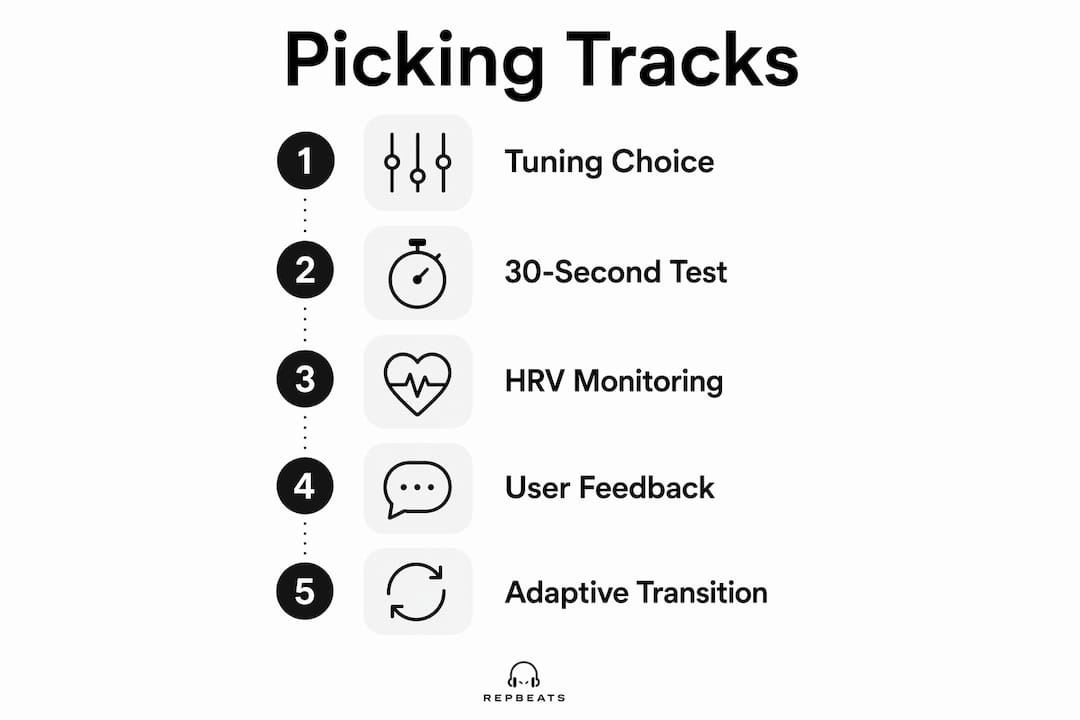
If you prefer a specific tuning, 432 Hz tracks are widely available and some users report a subjectively warmer feel, though the evidence for unique physiological benefits beyond placebo is limited. Use it if it works for you.
For quick evaluation, ambient listening guides recommend a 30-second self-test: if you start actively following the music within 30 seconds, it is too engaging for meditation. A five-minute physiological check works well in app contexts: if your heart rate is still trending down and you feel calm, the track is doing its job.
Pro Tip: In Repbeats, use your Apple Watch or Fitbit HRV trend during the first five minutes of a cooldown track. If HRV is rising and HR is falling, the track is working. If neither moves, swap to a sparser option.
How should adaptive apps transition from high-intensity to ambient?
This is where most apps get it wrong. Cutting from a 160 BPM running track to a 60 BPM ambient pad is jarring enough to spike cortisol, not lower it. The transition needs to be gradual and sensor-driven.
Step-by-step transition sequence:
- Detect intensity drop: use HR zone data from Apple Watch or Fitbit; trigger the transition when HR drops below 75% of max HR or cadence falls below 100 steps per minute
- Open a smoothing window: hold the current track for 30–60 seconds before beginning any tempo change
- Apply tempo interpolation: reduce BPM by no more than 5 BPM per 30 seconds toward a 50–70 BPM target
- Ramp volume down: drop no more than 2 dB per 10 seconds; target 15–20 dB below workout peak
- Crossfade to ambient track: use a 20–30 second crossfade once tempo and volume are within range
- Open a silent window (optional): for guided breathwork, fade to near-silence (below -40 dB) at the 8–10 minute mark
The wearable data driving these decisions is the key advantage of adaptive systems over static playlists. A static playlist cannot know your HR dropped faster than expected today.
| Wearable Signal | Ramp Duration | Volume Target | Tempo Target |
|---|---|---|---|
| HR drops 10–15% from peak | 8–12 min | -15 dB from workout | 60–70 BPM |
| HR drops 15% from peak | 5–8 min | -15 to -20 dB from workout | 50–60 BPM |
| HR drops >25% from peak | 3–5 min | -20 dB from workout | about 50–70 BPM |
Sample presets and quick-start settings
Three preset lengths cover most post-workout scenarios. Use these as starting points and adjust based on your wearable feedback.
| Preset | Duration | Ramp Time | Target Loudness | Tempo Anchor | Track Type |
|---|---|---|---|---|---|
| Short reset | short duration with gradual ramp | moderate volume reduction | medium tempo | Drone or soft pad |
| Standard cooldown | moderate duration with gradual ramp | quieter volume | slower tempo | Nature-enhanced ambient | | Deep recovery | longer duration with gradual ramp | lowest volume | slowest tempo | Slow piano or field recording |
When searching music libraries for these tracks, use metadata tags like: ambient, drone, meditation, no-beat, soundscape, atmospheric, instrumental only. On streaming platforms, filter by tempo below 70 BPM and exclude “workout” or “upbeat” genre tags.
Quick-start checklist for Repbeats users:
- Set cooldown trigger: HR zone drop to Zone 1–2
- Select preset duration based on session length (short for HIIT, long for endurance)
- Enable auto-crossfade at 20 seconds
- Turn on HRV monitoring to validate track choice in the first five minutes
Common mistakes when using ambient music in meditation apps
A few failure modes show up repeatedly, and they are easy to fix once you know what to look for.
- Tracks with buried lyrics or vocal chops: even processed vocals trigger language centers; check the full track before adding it to a preset
- Abrupt crossfades under 10 seconds: anything shorter than 15 seconds is audible as a cut and can spike attention
- Loudness mismatch between workout and cooldown tracks: if the ambient track is louder than expected, normalize both to the same integrated LUFS before loading
- Melody-heavy segments mid-track: some ambient tracks have a melodic peak around the midpoint; preview the full track or use a waveform view to spot these
- Extreme stereo motion: wide panning effects that sweep left to right draw attention involuntarily; prefer centered or gently wide stereo images
- Starting ambient too early: if HR is still above 80% of max, the body is not ready to receive calm signals; let the wearable trigger the transition, not a fixed timer
How to reduce reliance on ambient music over time
Ambient music is a tool for lowering the barrier to meditation, not the destination. The goal, especially for experienced practitioners, is to use it less over time.
- Days 1–3: use a full ambient track for the entire session; focus on breath, not the music
- Week 1–2: begin fading the track out at the midpoint of each session; sit in near-silence for the second half
- Week 3+: research suggests cumulative benefits consolidate around the three-week mark; this is a good point to try a fully silent session
- Ongoing: use ambient tracks only for high-stress days or when environment noise is unavoidable; treat silence as the default
Practitioners often fade music out mid-session deliberately to prevent users from following the music’s structure instead of their breath. Build this into your app settings as a scheduled fade rather than a manual action.
Pro Tip: Track your resting HR and HRV trends in Apple Watch or Fitbit over three weeks. If both are improving, your meditation practice is working regardless of whether you still use ambient support.
Key Takeaways
Ambient meditation music works because it removes the sonic triggers that compete with inward attention, giving your nervous system a clear path toward calm after intense exercise.
| Point | Details |
|---|---|
| Core definition | Low-dynamics, slowly evolving soundscapes with no vocals and no sudden changes |
| Selection rule | Choose tracks with no peaks above 6 dB over average, duration 10+ minutes, no lyrics |
| Transition timing | Trigger ambient ramp when HR drops below 75% of max; ramp over 3–12 minutes |
| Five-minute test | If HR trends down and HRV rises in the first five minutes, the track is working |
| Repbeats integration | Repbeats uses Apple Watch and Fitbit data to automate ambient ramps and preset selection |
The case for letting the app do the heavy lifting
Most fitness app users approach ambient meditation music the same way they approach a static playlist: pick something that sounds calm and hope for the best. That works until it doesn’t. The moment a track has a melodic peak you didn’t expect, or the crossfade cuts too fast, the session is over mentally even if you keep sitting.
What the evidence actually points to is that the transition is where most of the work happens. Getting from 160 BPM and elevated cortisol to genuine parasympathetic activation is not a passive process. It requires a deliberate, sensor-aware ramp, and that is exactly what adaptive systems are built for. The mood-matched playlist research reinforces this: matching audio to physiological state in real time produces meaningfully different outcomes than fixed sequencing.
The other thing most guides miss: ambient music is most useful as a scaffold, not a permanent feature. Use it to make the first few weeks of post-workout meditation feel accessible. Then start fading it. The meditation guidance that holds up across traditions is consistent on this point: the music should eventually become unnecessary. If you are still dependent on it after two months, the app is doing too much of the work.
Repbeats makes adaptive ambient transitions automatic
Post-workout meditation is one of the highest-value recovery tools available, and the difference between a session that actually calms your nervous system and one that just fills time usually comes down to the transition quality.
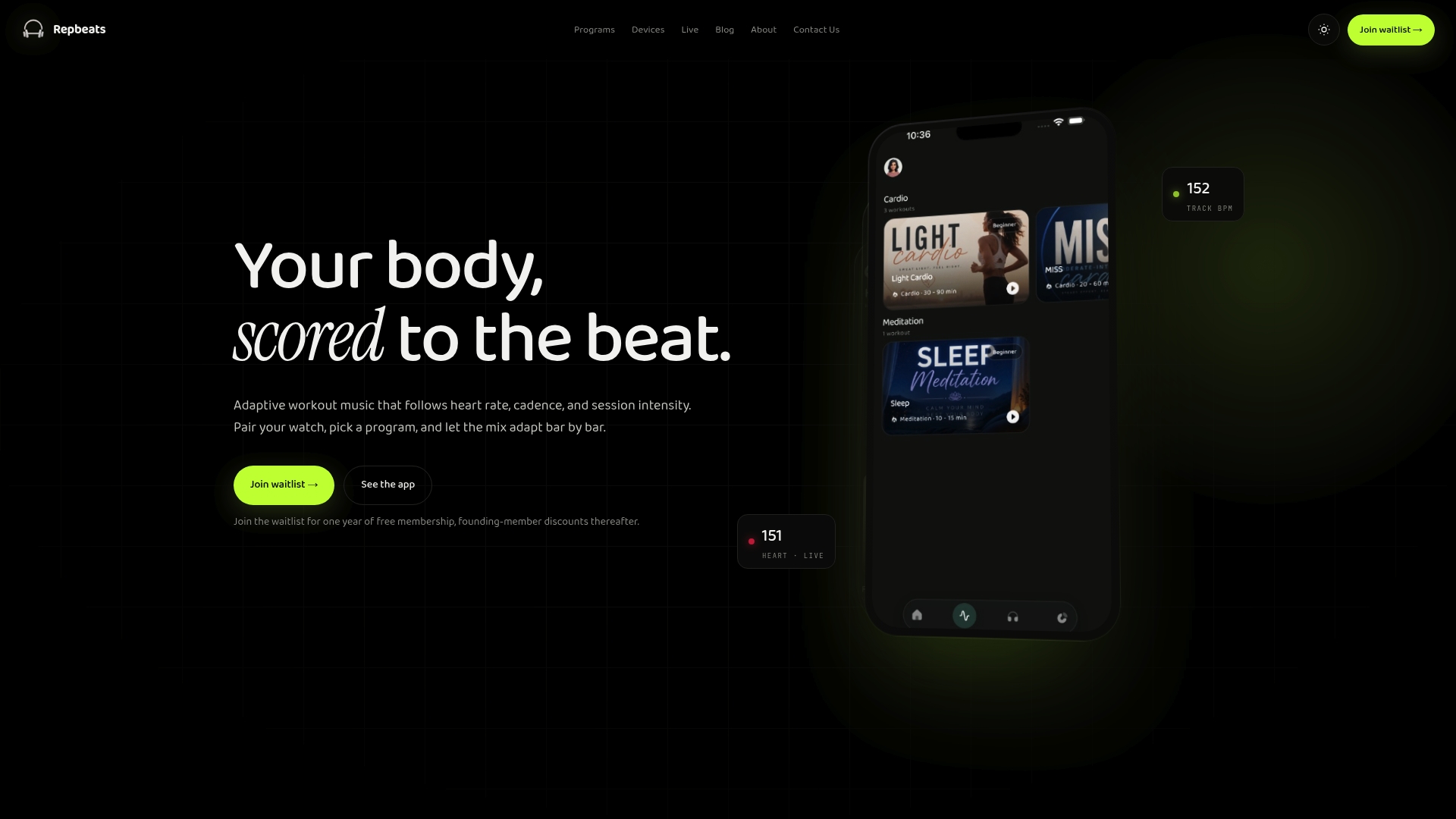
Repbeats connects directly to your Apple Watch or Fitbit, reads your HR zone in real time, and triggers a smooth ambient ramp the moment your intensity drops. The auto-DJ adjusts BPM bar by bar, crossfades to pre-loaded ambient presets, and can open a silent window for breathwork without any manual input. No fixed playlists, no jarring cuts, no guesswork about whether the track you picked is actually working. Try Repbeats and load one of the built-in ambient cooldown presets on your next session.
Useful sources
- Effect of sleep ambient music on sleep quality and mental health in college students — Peer-reviewed study documenting shortened sleep onset latency and improved sleep quality metrics; supports the three-week intervention timeline and early-effect claims.
- UCL: Rain sounds, chimes — why ambient music is changing how we relax — Source for James Kilner’s neuroscience perspective on ambient music as an antidote to overstimulation.
- Does Meditation Music Work? What the Evidence Says | HowWorks — Practical breakdown of what makes meditation music effective, including the 432 Hz evidence review and fade-out technique.
- What Is Ambient Music? Complete Guide to Sound as Environment — Detailed production-level explanation of ambient sonic characteristics including texture, reverb, and extended duration.
- Instrumental Music for Meditation: What Actually Works — Evidence for why removing lyrics reduces cognitive load and supports inward attention.
- MelodyCraft: Ambient music guide — Source for the 30-second self-test heuristic for evaluating whether a track is attention-light enough for meditation.
- Reddit: What makes a piece ambient? — Community discussion that surfaces the “ignorable yet interesting” descriptor and practical listener criteria.