Cyclists: Cadence Sensor Music Using BPM ÷2 to Match RPM
Jordan MillsSeptember 24, 2026 · 16 min read

Cyclists: Cadence Sensor Music Using BPM ÷2 to Match RPM
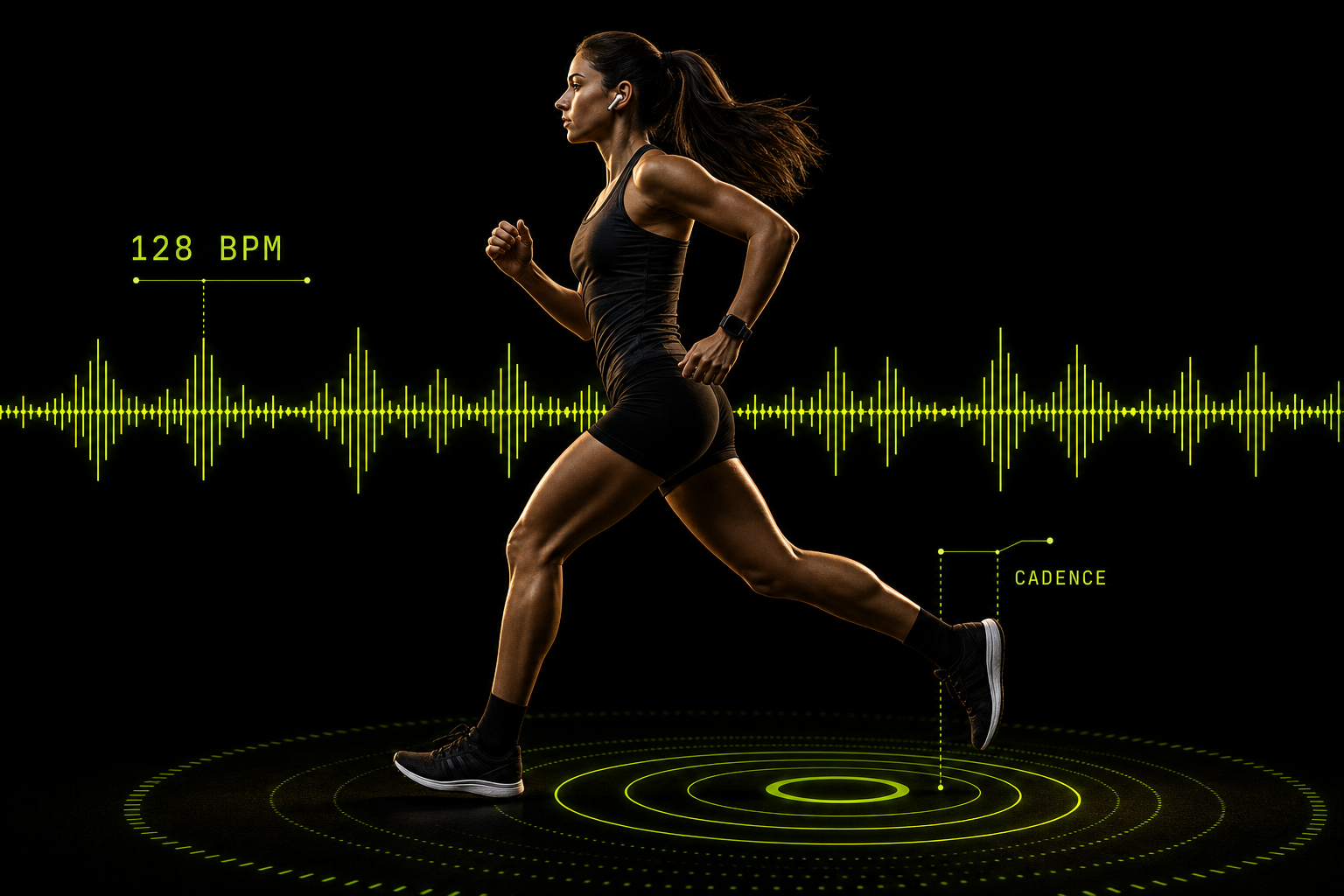
Yes, you can use cadence sensors and wearables to drive music tempo, and matching tempo to cadence reliably raises enjoyment while nudging some performance metrics upward. A controlled trial found that a 10% faster tempo program increased cycling power by 3.5% and distance by 2.1%, and apps like Repbeats now pull live cadence and heart rate to shift BPM bar by bar rather than relying on a static playlist
TL;DR:
- A 10% increase in music tempo can boost cycling power by 3.5% and distance by 2.1%, according to controlled trial data.
- Pairing a Bluetooth or ANT+ cadence sensor with a music app typically takes under two minutes and can result in a latency of just a few seconds for real-time tempo adjustments.
- Effective playlists for cadence zones should consist of steady, minimal-tempo-drift tracks verified with BPM analysis, grouped into 10-BPM pools for quick selection.
- Syncing music to cadence is most beneficial during solo training on trainers or quiet roads, with full attention needed to be on safety during technical or group rides.
- Adaptive apps like Repbeats can update in real time to your cadence and heart rate, providing dynamic tempo matching that outperforms static playlists.
Table of Contents
- How Does a Cadence Sensor Music Setup Actually Translate RPM to BPM?
- What Sensors Work and How Do You Pair Them With Minimal Lag?
- How Do You Build or Choose Playlists for Target Cadence Ranges?
- How Do You Run a Cadence-Based Workout With Synced Music?
- Why Does Cadence-Synced Music Actually Help? The Research and the Realistic Expectations
- Total Cost Overview of Cadence Sensors Compatible With Music Apps
- What Should You Look for When Buying a Cadence Sensor for Music Syncing?
- Which Brands and Models Work Best for Music Synchronization?
- How Do You Fix Connectivity and Sync Problems With Music Apps?
- When Should You Actually Use Cadence-Synced Music, and When Should You Skip It?
- Try Repbeats for Cadence-Synced Training
- Primary Studies, Reviews, and Repbeats Resources
- Sources
- FAQ
How Does a Cadence Sensor Music Setup Actually Translate RPM to BPM?
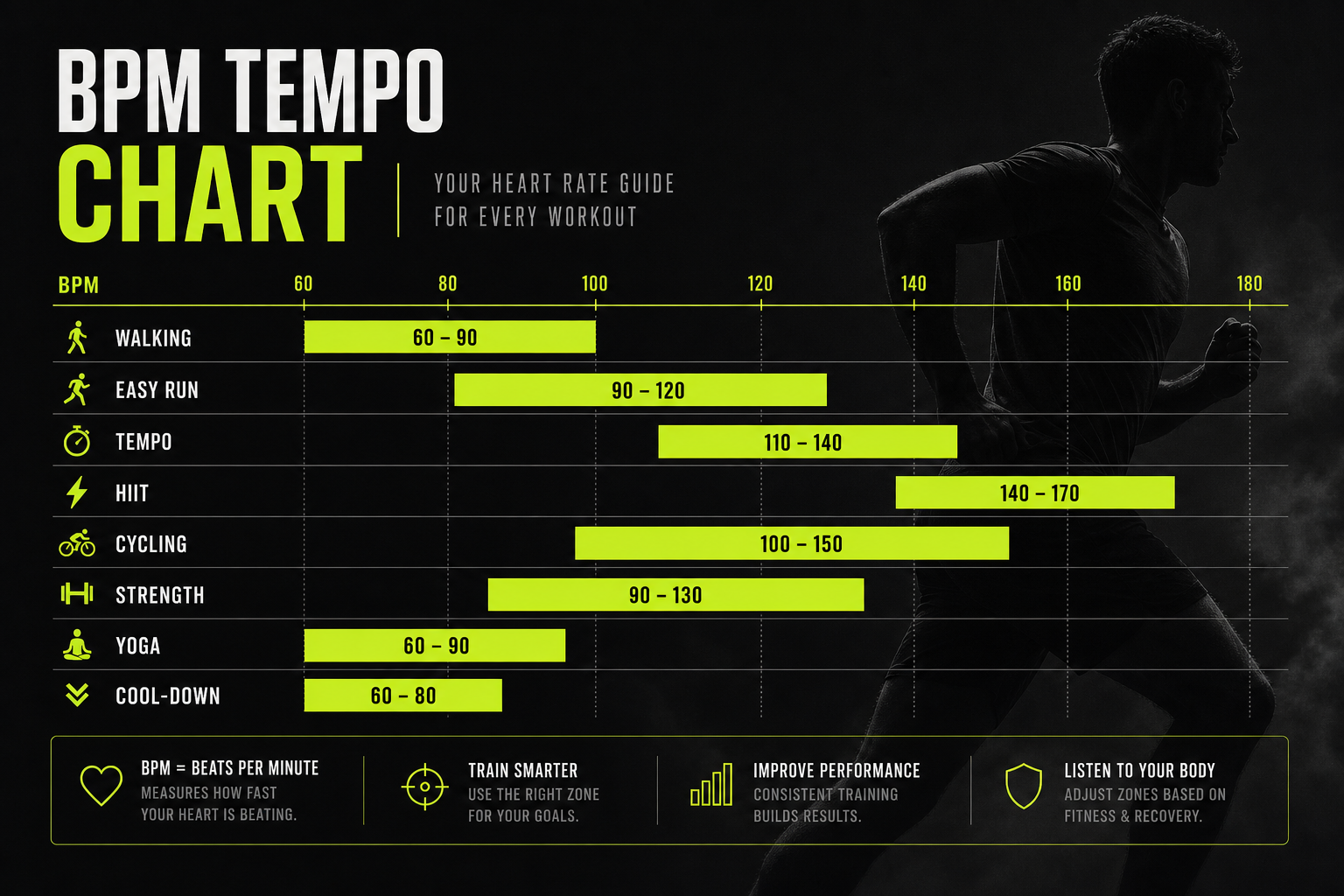
The starting rule is simple: BPM divided by two equals your target RPM for most 4/4 tracks. A song at 160 BPM lands you around 80 RPM, which is why coaches and the Repbeats team use this ÷2 mapping as the default for steady pedaling.
That 1:2 ratio works because most pop, rock, and electronic music sits in 4/4 time, and a pedal stroke naturally syncs to every other beat rather than every single one. At very high cadences (100+ RPM sprints), some riders switch to a 1:1 mapping instead, since a 200 BPM track is rare, and a 100 BPM track at 1:1 feels punchier for short bursts.
Rough BPM windows to work from:
- Cadence drills (85 to 100 RPM): target 170 to 200 BPM using the ÷2 rule.
- Tempo rides (75 to 85 RPM): target 150 to 170 BPM.
- Recovery spins (55 to 65 RPM): target 110 to 130 BPM.
- Sprint efforts (100+ RPM): either 200+ BPM at ÷2, or 100 to 110 BPM at 1:1.
Odd-meter songs (waltz time, some hip-hop with swung beats) throw this off because the “beat” your legs feel doesn’t land where the metronome marking says it should. Skip them for cadence work and save them for warm-up or cool-down instead.
What Sensors Work and How Do You Pair Them With Minimal Lag?
A few sources of live cadence data work with today’s music apps: magnetless BLE and ANT+ cadence sensors that strap to your crank arm, GPS cycling computers that broadcast cadence over Bluetooth, smartwatches that already track cadence and heart rate, and even a phone’s built-in accelerometer for casual indoor rides. Independent testing on IMU-based sensors found an average over-prediction of about 0.9 RPM in the normal training range, which is close enough for music syncing even if it wouldn’t satisfy a lab.
Pairing usually takes under two minutes:
- Open your music or training app and enable Bluetooth or ANT+ scanning.
- Grant sensor and Bluetooth permissions when prompted.
- Select your sensor from the discovered devices list and confirm the live RPM readout matches your actual pedaling.
- Start a short test ride and watch whether the music tempo tracks your cadence changes within a few seconds.
Latency is where most setups fail. If the gap between a cadence change and the music’s response feels sluggish or the tempo jumps erratically, your app’s smoothing window is probably too short or too long. A two to three second smoothing window tends to prevent jumpy tempo swings without feeling delayed.
Pro Tip: Run a one-minute test where you deliberately spike your cadence from 70 to 95 RPM. If the music takes more than a few seconds to respond, or overshoots the tempo, adjust the smoothing setting before you commit to a full session.
When live sync isn’t available, such as on a spotty subway ride to the gym, fall back to a pre-built BPM playlist matched to your planned cadence for that day.
How Do You Build or Choose Playlists for Target Cadence Ranges?
Curated BPM playlists, the kind Spotify organizes by tempo, work fine for fixed-effort sessions like a steady tempo ride where the cadence target won’t change. Building your own pays off for interval work, where you need clean jumps between BPM zones without hunting through a generic playlist mid-effort.
Pick tracks with a steady, driving beat and minimal tempo drift. Skip songs with long rubato intros, tempo-shifting bridges, or breakdown sections. Simple guidelines that hold up in practice:
- Favor electronic, house, and straightforward rock tracks over songs with live-band tempo drift.
- Use a BPM analyzer (many are free and built into DJ software) to verify a track’s actual tempo before adding it, since streaming metadata is sometimes off by a few BPM.
- Group songs into BPM “pools” in 10-BPM bands (150 to 160, 160 to 170) so you can grab a track fast during a session.
- For interval work, pre-select one pool per effort level rather than trying to find a song in real time.
A drill playlist built for 170 to 190 BPM, a tempo playlist at 150 to 165 BPM, and a sprint pool at 100 to 115 BPM (1:1 mapped) cover most structured sessions without extra work.
How Do You Run a Cadence-Based Workout With Synced Music?
Three templates cover most training goals, and all three work whether your music adjusts live or you’re working from pre-sorted BPM pools.
- Cadence drill: 10-minute warm-up at 120 BPM, then four 3-minute blocks at 90 to 95 RPM (180 to 190 BPM) with 2-minute recoveries at 110 BPM, finishing with a 5-minute cool-down.
- Tempo ride: 15-minute build to 160 BPM, then 30 to 45 minutes holding 78 to 82 RPM (156 to 164 BPM), watching for cadence drift as fatigue sets in.
- Interval session: alternate 2-minute efforts at a 20% BPM jump above your baseline tempo with 2-minute recoveries at baseline, repeated 6 to 8 times. The discrete jump, rather than a slow ramp, gives your legs a clearer cue that the effort has changed.
Log three things after each session: average power (if you have a meter), distance covered, and your perceived exertion rating. That data is what actually tells you whether tempo-matched music is doing anything for you, rather than just feeling more fun. Fun is a legitimate reason on its own, but separating psychological lift from real output change matters if you’re structuring a training block.
Why Does Cadence-Synced Music Actually Help? The Research and the Realistic Expectations
The clearest experimental evidence comes from a submaximal cycling trial: a 10% tempo increase raised power by 3.5% and distance by 2.1%, while slowing tempo by 10% cut power by nearly 9.8%. That’s a real, measurable effect, but it’s a modest one, not a transformation.
Broader review evidence points to why: music functions mainly as a psychological lever. It boosts enjoyment and helps manage perceived exertion rather than rewiring your muscles.
Music’s main value during exercise comes from how it shapes enjoyment and effort perception, not from a direct mechanical push on the muscles themselves.
That distinction, drawn from a systematic review on music as an ergogenic aid, matters because individual optimal cadence varies widely between riders, sometimes by 15 to 20 RPM according to field-based cadence research. That’s exactly why a fixed playlist can’t compete with adaptive tools. Some apps build auto-DJ features to update BPM every bar using live cadence and heart-rate streams, so the target adjusts to you instead of asking you to adjust to it.
Total Cost Overview of Cadence Sensors Compatible With Music Apps
Magnetless BLE and ANT+ cadence sensors, the kind that broadcast to both cycling apps and music apps simultaneously, typically run somewhere between budget aftermarket units and premium bundled sensors sold alongside power meters. Brands like Bryton sell standalone dual-connectivity cadence sensors that pair over both Bluetooth and ANT+, which is the combination you want if your music app only speaks one protocol.
If you already own a smartwatch that tracks cadence, such as most modern Apple Watch or Garmin models, you have zero additional hardware cost since the watch can broadcast that data to a compatible app. The tradeoff is accuracy: wrist-based cadence estimates during cycling are generally less precise than a crank-mounted sensor, since the watch is inferring pedal stroke from arm motion rather than reading it directly.
Phone accelerometer options cost nothing beyond the app itself but only work reliably on stationary trainers, where the phone can sit still relative to the pedaling motion. On a moving bike, road vibration and phone placement make accelerometer-based cadence too noisy to trust for music sync.
The real cost driver isn’t the sensor, it’s the ecosystem. A crank sensor that only talks ANT+ is a poor fit if your music app requires Bluetooth, so check protocol compatibility before comparing prices. Most riders find the sweet spot is a dual-protocol BLE/ANT+ sensor, which avoids the compatibility gap entirely and typically pays for itself in fewer setup headaches.

What Should You Look for When Buying a Cadence Sensor for Music Syncing?
Protocol support comes first. A sensor that broadcasts both Bluetooth Low Energy and ANT+ simultaneously will work with nearly every music and cycling app on the market, while an ANT+ only sensor can lock you out of phone-based apps that lack an ANT+ receiver.
Update rate and accuracy matter more for music sync than most riders assume. A sensor that only reports cadence every few seconds will make your music’s tempo changes feel sluggish, even if the app’s smoothing is well tuned. Look for sensors with sub-second broadcast intervals, since research on accelerometer-based cadence measurement shows that even lightweight IMU sensors can hit acceptable accuracy when the sampling rate is high enough.
Battery life and mounting style are the practical dealbreakers. Magnetless sensors that strap to the crank arm avoid the alignment fuss of old magnet-and-spoke setups, and most now run 200-plus hours on a coin-cell or rechargeable battery.
A short buying checklist:
- Dual BLE/ANT+ broadcast, not just one protocol.
- Magnetless, crank-mounted design for easier install and consistent readings.
- Confirmed compatibility with your specific music app (check the app’s supported-device list before buying).
- A battery rated for at least 100 hours of ride time.
- A companion app or firmware that lets you check raw RPM output, useful for the latency test described earlier.
Skip anything that requires a proprietary head unit to function. If a sensor only talks to one brand’s cycling computer, it likely won’t broadcast to your phone’s music app at all.
Which Brands and Models Work Best for Music Synchronization?
Independent, magnetless BLE and ANT+ cadence sensors from established cycling brands are the safest bet for music syncing, since they broadcast openly rather than locking data inside a proprietary ecosystem. Bryton’s Smart Cadence Sensor is one widely available example, offering dual Bluetooth and ANT+ output with a straightforward crank strap install and a battery life measured in months rather than weeks.
CatEye and Saris also sell magnetless cadence sensors in the same category, both broadcasting standard ANT+ and BLE cadence profiles that most third-party apps read without extra configuration. Because these sensors follow the open cadence broadcast standard rather than a closed protocol, they tend to be the most reliable choice when your priority is compatibility with a music app rather than a matched bike computer.
Smartwatches deserve a mention too. If you already wear an Apple Watch or a Garmin with cycling cadence tracking, you can often skip buying a separate sensor entirely. The accuracy tradeoff versus a crank-mounted unit is real, but for casual cadence-synced rides, the convenience of using hardware you already own outweighs the small accuracy gap for most riders.
Whatever you choose, verify the exact model against your music app’s published compatibility list before buying. Sensor firmware updates occasionally change broadcast behavior, and an app that worked with last year’s model isn’t guaranteed to read this year’s revision without an update on both ends.
How Do You Fix Connectivity and Sync Problems With Music Apps?
Most sync complaints trace back to one of three causes: a stale Bluetooth pairing, a permissions issue, or a smoothing setting that’s fighting against a genuinely erratic cadence signal.
If your sensor shows as paired but the music tempo isn’t responding, start by forgetting the device in your phone’s Bluetooth settings and re-pairing from inside the music app itself. Apps often need their own permission grant separate from the phone-level Bluetooth pairing, and skipping that step is the single most common reason a sensor “connects” but data never reaches the app.

If the readout works but tempo changes feel jumpy or overshoot your actual cadence, widen your smoothing window. A two to three second window is a reasonable starting point, and most apps let you adjust it in settings rather than living with the default.
Dead zones are another frequent culprit, especially indoors near a trainer’s motor or a Wi-Fi router, both of which can interfere with Bluetooth signal. Moving your phone closer to the sensor, or switching from BLE to ANT+ if your sensor supports both, usually resolves it.
If nothing else works, check for a firmware update on the sensor itself. Manufacturers occasionally patch broadcast timing issues that specifically affect third-party apps rather than their own branded cycling computer, and an outdated sensor firmware is easy to overlook when troubleshooting software instead.
When Should You Actually Use Cadence-Synced Music, and When Should You Skip It?
Solo training, whether on a trainer or a quiet road you know well, is where cadence-synced music earns its keep. Group rides and technical descents are a different story: locking into a tempo target while dodging a pothole or holding a wheel in a pack is a distraction you don’t need.
If you ride with any music on the road, bone conduction headsets or a single earpiece keep one ear open to traffic. Cut the music entirely for technical sections, descents, or anywhere your full attention belongs on the road, not the beat.
Try it, but log your numbers rather than assuming a big jump. The gains are real but modest, and that’s worth knowing going in.
— Jordan Mills
Try Repbeats for Cadence-Synced Training
Some fitness apps pull live cadence and heart-rate data from wearables and update the music’s BPM bar by bar, so the track adjusts to your pedaling instead of the other way around. That auto-DJ approach solves the biggest weakness of a static BPM playlist, which is that it can’t respond when your cadence drifts mid-ride.
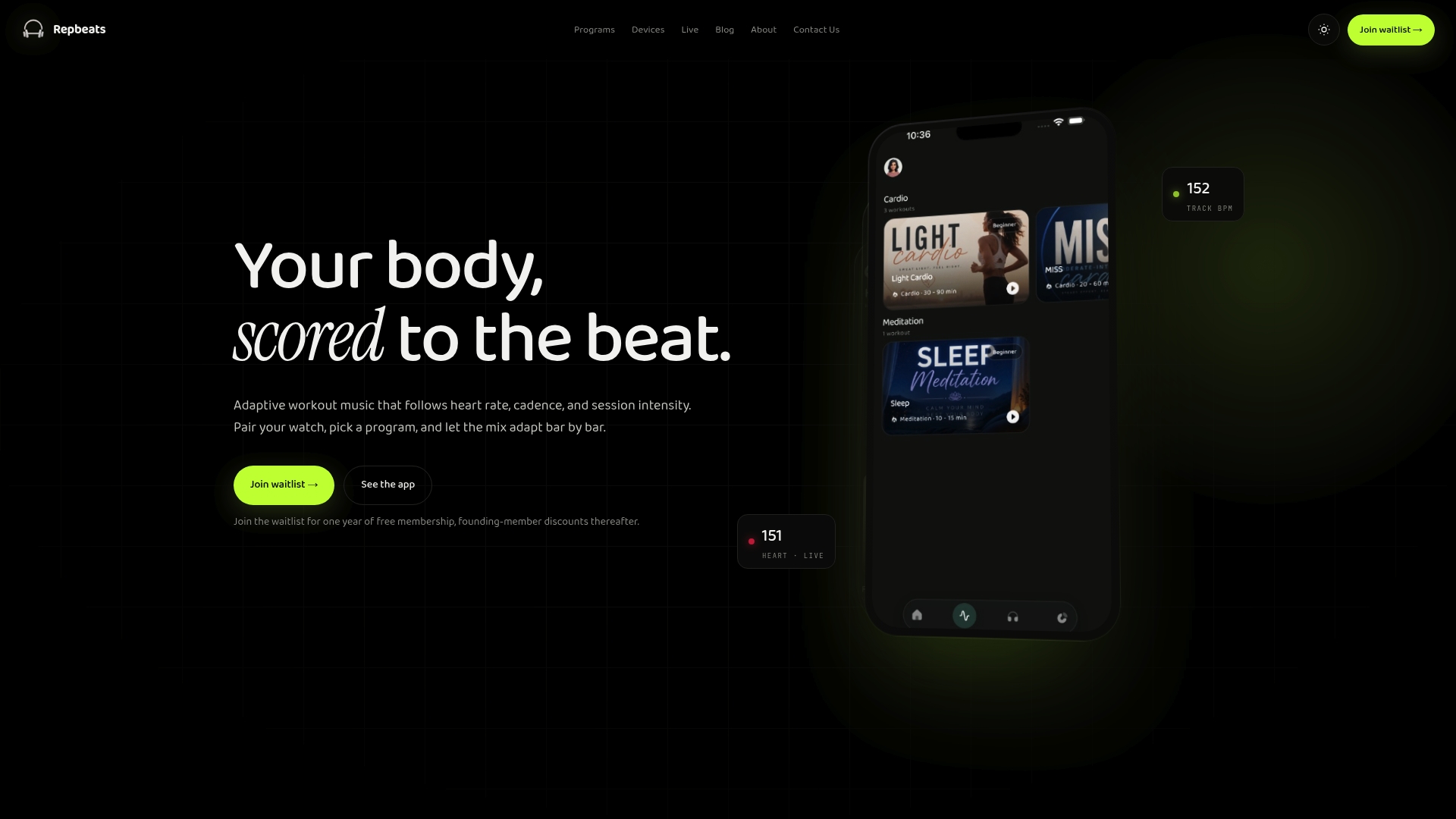
Getting started takes three steps: install the Repbeats app, pair your cadence sensor or wearable through the app’s Bluetooth setup, and run a 10-minute test ride to feel how the tempo tracks your effort in real time. If the sync feels off on that first ride, adjust the smoothing setting before your next session rather than writing off adaptive music altogether.
Current pricing and trial details are listed on the Repbeats site, where you can also read more about how the auto-DJ technology handles heart-rate and cadence data together.
Primary Studies, Reviews, and Repbeats Resources
- Effects of music tempo upon submaximal cycling performance
- Music as an ergogenic aid: systematic review and mechanisms
- Determining optimal cadence for an individual road cyclist from field data
- IMU-based cadence measurement for road cycling
- 4-Week Cadence Plan: Make Your Workout Music Follow Your Heart Rate
- Use Wearable Cadence Data for Playlists
Sources
- Effects of music tempo upon submaximal cycling performance
- Music as an ergogenic aid: systematic review and mechanisms
- Determining optimal cadence for an individual road cyclist from field data
- IMU-based cadence measurement for road cycling (proof of concept)
FAQ
What Is the Purpose of a Cadence Sensor?
A cadence sensor measures how fast your pedals turn, reported in revolutions per minute, so you can pace training by cadence rather than guesswork. When paired with a music app, that same RPM signal can drive real-time BPM changes rather than just showing up on a bike computer screen.
Is a Cadence Sensor Worth It for Music-Synced Training?
For riders who want tempo-matched training, yes: a magnetless BLE/ANT+ sensor typically costs less than a full power meter and delivers accurate enough data for music sync, with IMU-based methods showing under 1 RPM average error in the normal training range. It also unlocks the adaptive-tempo benefit shown in controlled research, where faster music tempo modestly increased power and distance.
What Sensors Work With Cadence Music Apps?
Magnetless BLE and ANT+ crank sensors, dual-protocol smartwatches, and GPS cycling computers that broadcast cadence over Bluetooth all work with most cadence-aware music apps, including Repbeats. Phone accelerometers work only on stationary trainers, where movement noise is minimal.
What Is a Good Cadence for a Cyclist?
Most road cyclists ride comfortably between 80 and 95 RPM for steady efforts, though optimal cadence varies significantly by individual, sometimes by 15 to 20 RPM between riders with similar fitness levels. That variation is exactly why adaptive, individualized tempo tracking tends to outperform a single fixed cadence target for everyone.
How Do You Convert BPM to Cadence for Cycling Music?
Divide the song’s BPM by two to estimate your matching pedal RPM for most 4/4 tracks, so a 170 BPM song targets roughly 85 RPM. For very high-cadence sprint work, some riders switch to a 1:1 mapping instead, matching each pedal stroke to a single beat.