Runners: Raise Cadence With 1–3% Tempo Shifts Using Pace Matched Music
Jordan MillsOctober 2, 2026 · 11 min read

Runners: Raise Cadence With 1–3% Tempo Shifts Using Pace Matched Music
Pace-matched music aligns beats per minute to your step rate, or sometimes your heart rate, so your music and stride stay synchronized. This typically produces a steadier cadence and a lower perceived effort during training. The evidence behind it is promising but mixed: results vary by study design, runner, and even sex, so treat the benefit as real but individual.
TL;DR:
- Small, steady tempo shifts of 1 to 3 percent can naturally increase a runner’s cadence, improving performance without causing discomfort.
- Matching music BPM to your actual steps per minute requires measuring your cadence first, as many runners often guess their pace incorrectly.
- Using half-time matching (songs at roughly half your cadence) benefits faster runners, especially during interval training and tempo runs.
- Adaptive apps like Repbeats that sync music tempo in real-time through wearables can maintain optimal cadence with minimal manual adjustment.
- For effective pacing, build playlists with songs at 65 to 75 BPM for easy runs or around 80 to 90 BPM for faster efforts, based on your training goals.
Table of Contents
- How does pace-matched music actually sync with your stride?
- What does the research say about pace-matched music and running?
- How do you build a pace-matched playlist step by step?
- How do wearables and adaptive apps handle tempo and heart rate?
- How Repbeats builds adaptive, pace-matched music into training
- Ready-made BPM templates for common running paces
- Why cadence-matched training deserves more attention than it gets
- Let Repbeats handle the tempo math for you
- FAQ
- Sources
How does pace-matched music actually sync with your stride?
Beats per minute is simply the tempo of a song, and matching it to your steps per minute means choosing music that physically lines up with your foot strikes. A 1:1 match means one beat equals one step, which works well for walking or easy jogging around 120 to 140 steps per minute. Faster runners often prefer half-time matching, where one beat covers two steps, letting a song at 75 to 80 BPM support a cadence of 150 to 160 steps per minute without sounding rushed.
This alignment relies on something researchers call auditory-motor synchronization: your nervous system naturally wants to time movement to a strong beat. Acoustic stimuli that match cadence have been shown to extend time to exhaustion compared to running without music, and beat prominence, meaning how clearly the beat stands out in the mix, helps runners hold that rhythm steady.
Tempo alone does not explain the full effect. Motivational qualities like groove and the “danceability” of a track add a psychological push that works somewhat independently of BPM, which is why two songs at the same tempo can feel completely different underfoot.

What does the research say about pace-matched music and running?
The science on cadence-synced music is still young, but the available trials point in a consistent direction. A treadmill study involving 19 participants found that both metronome beats and synchronous motivational music extended time to exhaustion compared to running in silence, with beat prominence helping runners hold their pace.
Small, nearly imperceptible tempo shifts can spontaneously pull a runner’s cadence toward the music’s beat, according to a study of 16 recreational runners. Larger, abrupt tempo changes broke that spontaneous entrainment, meaning gradual shifts work better than sudden jumps.
A separate 12-week trial tested a more deliberate approach: starting with seven runners and finishing with five, researchers used music set 7.5% to 10% above each runner’s baseline cadence and saw cadence rise by roughly 8.5% during the program, an effect that held even after the music stopped. The sample is small, which limits how far the finding generalizes, but it supports using music as a genuine training tool rather than just background noise.

A biosynchronous trial with 54 trail runners added a sex-specific wrinkle: heart-rate-synchronous music produced the largest reduction in perceived effort for female participants, while cadence-synchronous music helped with step timing more broadly. The practical takeaway is to start with conservative tempo targets, since the research supports small, steady shifts overdramatic ones.
How do you build a pace-matched playlist step by step?
Building your own BPM-matched playlist takes less effort than most runners expect, and the process breaks down into three steps.
- Measure your cadence by counting steps on one foot for 30 seconds during an easy run on a flat, familiar route, then doubling that number and multiplying by two for steps per minute. Repeat this over two or three runs since cadence shifts with fatigue and terrain.
- Choose your mapping. A 1:1 match suits walking or recovery jogs around 120 to 140 BPM, while half-time matching (BPM at roughly half your cadence) suits faster paces, so a 160 steps-per-minute runner might look for songs around 80 BPM.
- Find and adjust songs by BPM using playlist tools that sort by tempo, or use DJ software to nudge a track’s tempo up or down a few percent without distorting pitch. Avoid stretching a song more than about 5 to 8%, since heavy manipulation can make vocals and rhythm sound unnatural.
Pro Tip: Start with tempo increases of just 1 to 3% and rehearse the new cadence with a simple metronome app before building an entire playlist around it.
How do wearables and adaptive apps handle tempo and heart rate?
Adaptive audio tools generally fall into two categories: cadence-sensing systems that track your step rate through a phone’s accelerometer or a wearable, and heart-rate-sensing systems that adjust music based on your pulse. Cadence-driven tools suit runners focused on stride consistency and speed work, while heart-rate-driven tools suit those managing effort across intervals or long steady runs, consistent with the sex-specific perceived-effort findings from the trail-running trial.
Before choosing a tool, check for a few practical features.
- Live BPM sync that updates the tempo continuously rather than only at the start of a workout.
- Tempo stretching versus song selection, since some apps change a track’s actual speed while others simply queue up songs closer to your current pace.
- Wearable pairing with devices you already own, since a tool that cannot read your watch is only half useful.
- Library access broad enough that matching BPM does not mean listening to the same ten songs on repeat.
Test any adaptive app for latency and phase alignment, meaning how closely a new beat lines up with your actual footstrike, since a half-second lag undoes much of the benefit. Wearables like Apple Watch support workout-linked playback, but Apple’s own documentation describes autoplay and playback control, not live tempo adaptation, so matching tempo to a live cadence signal typically requires a dedicated adaptive-audio app layered on top.
How Repbeats builds adaptive, pace-matched music into training
Repbeats is one app built specifically around this problem. It synchronizes music tempo to heart rate, cadence, and session intensity using auto-DJ technology that updates the beat every bar rather than at fixed intervals, which keeps the music tracking your effort in near real time.
- Some apps pull live data from wearables like Apple Watch and Fitbit to personalize the listening experience during a workout.
- The auto-DJ approach adjusts BPM continuously instead of simply swapping songs when pace changes.
- The app’s resources cover building BPM-matched playlists and half-time templates for readers who want a starting point.
- A companion guide on pace-to-BPM math walks through converting running pace into usable tempo targets.
For runners who would rather not manually hunt for songs by tempo, this kind of continuous adjustment removes a step the field studies above still require by hand.
Ready-made BPM templates for common running paces
Matching tempo to pace gets easier with a few fixed reference points, since you rarely need to calculate cadence from scratch once you know your usual training zones.
- Walking or warm-up (110 to 120 steps per minute): match 1:1 with songs at 110 to 120 BPM for a relaxed start.
- Easy run (130 to 150 steps per minute): use half-time songs around 65 to 75 BPM, or 1:1 tracks in the 130 to 150 range if you prefer a quicker feel underfoot.
- Tempo run (155 to 165 steps per minute): half-time matching around 78 to 83 BPM tends to feel smoother than forcing a 1:1 match at that speed.
- Intervals (165 to 180 steps per minute): alternate half-time songs near 83 to 90 BPM for work periods with slower 65 to 75 BPM tracks for recovery.
For a simple 20 to 30 minute easy run, build five or six half-time tracks in the 65 to 75 BPM range and order them so tempo rises slightly as you warm up. For intervals, alternate higher and lower BPM blocks in four-minute segments, and try to start each new song close to a footstrike rather than mid-stride, since abrupt transitions can briefly break your rhythm.
Why cadence-matched training deserves more attention than it gets
Most running advice treats music as background motivation, a playlist to distract you from discomfort. The research tells a more specific story: tempo and beat prominence can shape cadence directly, not just mood, and the gains come from small, deliberate adjustments rather than cranking up energetic songs.
The conventional wisdom overrates “pump-up” playlists and underrates precision. A high-energy track at the wrong tempo can still leave your stride ragged, while a quieter song at the right BPM can smooth it out. The entrainment research on small tempo shifts makes a strong case that 1 to 3% changes are where the real control lives, and that larger jumps mostly just feel jarring.
If you take one thing from the evidence, prioritize measuring your actual cadence before you touch a playlist. Most runners guess their steps per minute and get it wrong by a wide margin, which means they are matching music to a number that does not reflect how they actually run. Fix that first, then worry about songs.
— Jordan Mills
Let Repbeats handle the tempo math for you
Building playlists by hand works, but it means constant adjusting as your pace shifts within a single run. Some apps remove that manual step by syncing tempo to heart rate, cadence, and session intensity automatically, using live data from wearables.
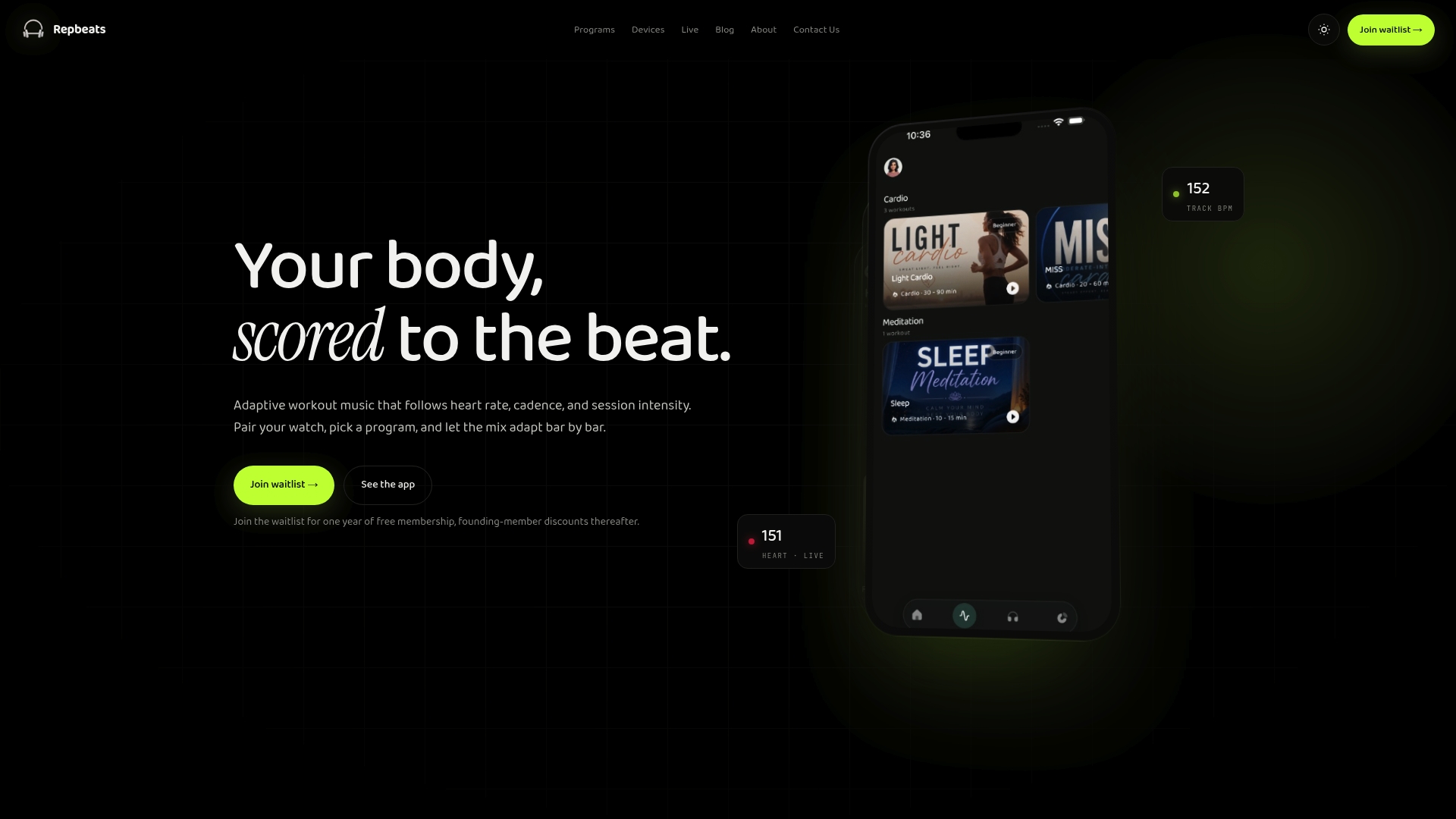
The app suits runners who already track cadence but find manual BPM matching tedious, and anyone managing structured workouts like intervals or tempo runs where effort changes minute to minute. Since the auto-DJ engine updates tempo every bar, you get the kind of fine-grained adjustment the field studies above achieved only through careful, manual song selection.
If the playlist templates earlier in this piece felt like a good start but too much ongoing effort, Repbeats is built to take that work off your hands going forward.
FAQ
What are some good songs for running by pace?
The right song depends on your steps per minute rather than the song itself: match tracks 1:1 to your cadence for walking or easy jogs, or use half-time BPM for faster paces. Tools that sort libraries by tempo, along with guidance on pace-to-BPM conversion, make it easier to find specific tracks for your own cadence.
What are the musical terms for pace?
In music, pace is described through tempo, measured in beats per minute, with terms like allegro (fast) or andante (moderate) describing general speed categories. For running purposes, BPM is the term that matters most, since it maps directly to steps per minute.
What are some good songs for a 10-minute mile pace?
A 10-minute mile typically falls in the moderate cadence range, often tracked using half-time matching, where songs around 65 to 75 BPM support a steps-per-minute count closer to 140. Exact song choices depend on personal taste, but filtering a music library by that BPM range is the most reliable way to find fits.
What are some fast pace songs?
For faster running, half-time matching around 80 to 90 BPM generally supports cadences in the 160 to 180 steps-per-minute range common in tempo runs and intervals. Research on deliberately elevated tempo found that music set 7.5% to 10% above baseline cadence increased step rate during training, suggesting songs slightly faster than your current comfort zone can help you build speed.
Sources
- The power of auditory-motor synchronization in sports: enhancing running performance by coupling cadence with the right beats - PubMed
- Spontaneous entrainment of running cadence to music tempo - PubMed
- Using beat frequency in music to adjust running cadence in recreational runners: A randomized multiple baseline design - PubMed
- On Performance and Perceived Effort in Trail Runners Using Sensor Control to Generate Biosynchronous Music - PubMed