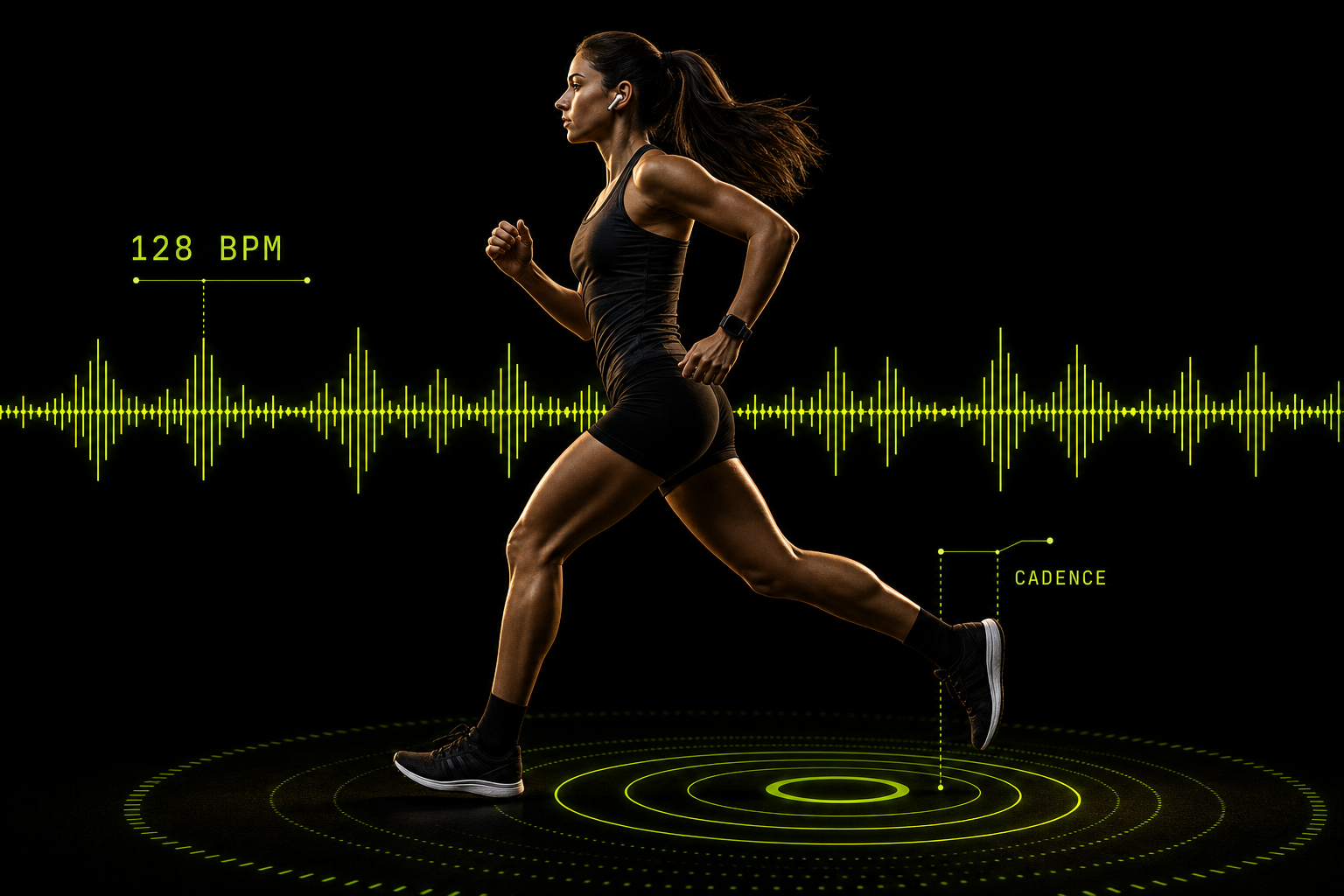
Runners: Fix Cadence Faster, Test Metronome vs Music in 5–10 Minutes
Jordan MillsSeptember 8, 2026 · 17 min read

Runners: Fix Cadence Faster, Test Metronome vs Music in 5–10 Minutes
Use tempo-matched music when you need motivation, especially on easy runs and long runs. Use a metronome or discrete beat when you need precision, especially for short gait-retraining drills or cadence resets. Music wins on adherence and perceived effort; a metronome wins on exact synchronization. Start by measuring your current cadence, then run a 5 to 10 minute test with each method before deciding.
TL;DR:
- Metronomes provide precise, unchanging beats ideal for short gait correction drills but can become monotonous and lack motivation over long sessions.
- Tempo-matched music boosts motivation, reduces perceived effort, and improves long-run adherence, with an average benefit of roughly two extra minutes of endurance in studies.
- Using music at high volume or with both ears covered can impair environmental awareness, especially on roads or shared trails, increasing safety risks.
- Combining tools smartly involves using metronomes for technical drills and music for volume and enjoyment, with adaptive apps like Repbeats aligning tempo to real-time cadence.
- Gradually increasing cadence by 2 to 5 percent in small steps and tracking actual steps per minute ensures safe, effective improvements without overloading tissues.
Table of Contents
- Running Metronome vs Music: The Real Comparison
- What the Science Says About Cadence and Running Form
- How Music Changes the Way a Run Feels
- Which Tool Fits Each Type of Run?
- Finding Your Ideal BPM and Progressing Safely
- Setting Up Apps, Wearables, and Earbuds for Reliable Tempo
- How Repbeats Combines Precise Tempo With Music You Actually Want to Hear
- Building a Running Playlist That Actually Matches Your Cadence
- Running With Both Music and Awareness of Your Surroundings
- Testing Both Methods on Yourself
- Try Tempo-Matched Music on Your Next Run
- Sources
Running Metronome vs Music: The Real Comparison
The two tools solve different problems, and that’s the part most runners miss. A metronome gives you an unambiguous, unchanging pulse. Music gives you a pulse wrapped in something your brain actually wants to listen to. Neither is objectively “better.” They’re built for different jobs.
Metronome, straight talk:
- Precision. The beat never drifts, never swells into a chorus, never distracts you with lyrics about someone’s ex.
- Best for gait retraining, cadence resets, and short drills where you’re trying to nail an exact step rate.
- Downside: it gets annoying fast. A flat beep for 40 minutes is closer to a dentist’s waiting room than a workout soundtrack.
- Downside: it offers zero motivational lift. It won’t make the last two miles of a long run feel shorter.
Tempo-matched music, straight talk:
- Motivation. A within-subject study on running performance found runners finished a mile faster listening to music (8.89 minutes on average) than in silence (9.29 minutes), while metronome pacing in that same trial didn’t beat silence in any meaningful way.
- Lower perceived effort. Runners consistently report a session feels easier with the right soundtrack, even when their pace is identical.
- Better long-run adherence. People stick with music-backed training plans longer because the sessions don’t feel like a chore.
- Downside: beat prominence varies by song. A track with a driving four-on-the-floor kick is easy to run to; a track with syncopated production is not.
- Downside: at high volume or with both ears covered, music can mask traffic, other runners, and trail hazards.
Quick decision checklist:
Ask three questions before you pick a tool for a given session. What’s the actual goal, form correction or motivation? Where are you running, a quiet treadmill or a busy street? And how much do you personally tolerate a repetitive beep versus a song you’ve heard 400 times this month? If the goal is technical and short, grab the metronome. If the goal is enjoyment and distance, grab the music. If you’re honestly not sure, that uncertainty itself is useful information. It usually means the session doesn’t have a strict cadence target, which means music is the safer default.
What the Science Says About Cadence and Running Form
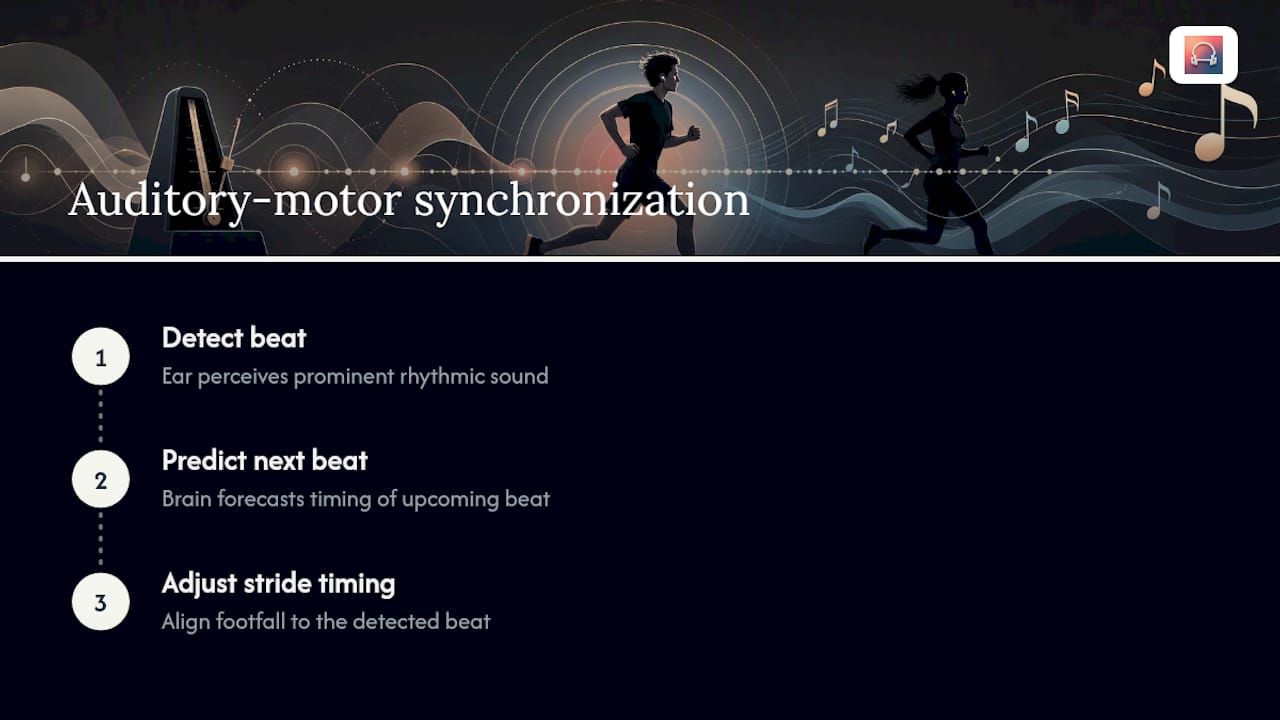
Auditory-motor synchronization is the technical term for what happens when your footfalls lock onto a rhythmic sound. It’s not automatic. Your brain has to detect the beat, predict where the next one falls, and adjust stride timing to match. This works better with some sounds than others.
Beat prominence is the deciding factor. A metronome click has a razor-sharp attack and zero ambiguity about when the beat lands. That’s exactly why it’s still the gold standard for lab research and gait retraining. Music is messier. A song’s beat can be buried under vocals, reverb, or a slow build, which makes the “correct” moment to plant your foot less obvious to your nervous system.
Despite that fuzziness, music still works. Research published in PLOS One on auditory-motor synchronization in sports found that acoustic stimuli, whether metronome or motivational music, extended time to exhaustion by roughly two minutes compared with running in silence. The mechanism appears to be twofold: a prominent beat helps stabilize cadence, and a motivating soundtrack changes how the brain interprets fatigue signals.
Key number: Acoustic stimuli added about two extra minutes to time-to-exhaustion versus silence in controlled trials, and tempo-matched music improved average one-mile time compared with running unaccompanied.
The one-mile study cited above adds a wrinkle worth sitting with: metronome pacing alone didn’t produce a statistically meaningful improvement over silence, while music did. That’s a strong hint that raw synchronization isn’t the whole story. Motivational content, personal preference, and even lyrics seem to add value that a flat click can’t replicate.
A caveat here matters. Most of these trials use small samples, often a few dozen recreational runners, and many happen on a treadmill rather than outdoors, where wind, terrain, and traffic complicate the picture. What’s robust across the research is the direction of the effect, not the exact size. Acoustic rhythm helps. Motivational content helps more. Beyond that, expect variation from person to person.
The practical payoff for your form: cadence that drifts too low tends to correlate with overstriding, which increases vertical impact and loading on the knees and shins. A steady beat, whether from a click or a song, tends to keep your step rate from sagging as fatigue sets in during the back half of a run.
How Music Changes the Way a Run Feels
Music doesn’t just sound better than a metronome. It changes how your brain processes fatigue signals in real time, and that’s the entire reason it beats a click on longer efforts.
The effect is called dissociation. A good playlist pulls attention away from the discomfort of hard breathing and heavy legs, and that redirection shows up as a lower rating of perceived exertion (RPE) even when your actual physiological load hasn’t changed. A bioRxiv preprint on motivational content and running fatigue found that motivational music reduced trunk RMS acceleration, a rough proxy for running economy and smoothness, and tended to lower perceived exertion compared with a neutral, metronome-like stimulus. In plain terms: the same tempo, delivered as a song you like instead of a beep, made runners move a little more efficiently and feel a little better doing it.
That dissociative effect is a double-edged sword. On an easy run or a long steady effort, tuning out discomfort is exactly what you want. On a technical trail, in traffic, or during genuinely hard interval work where you need to monitor your breathing and form closely, tuning out too much can work against you. A sports-medicine perspective on running with music flags this directly: music helps motivation and adherence but can reduce situational awareness at the exact moments you need it most.
Practical ways to get the upside without the risk:
- Save full-volume, both-ears-in music for treadmills, tracks, or closed paths.
- On roads or shared trails, run with one earbud out or keep volume low enough to hear a car horn.
- Save the metronome or no audio at all for technical terrain, night running, or unfamiliar routes.
- Match the emotional intensity of the track to the session; save the anthems for the last mile of a long run, not the warmup.
Pro Tip: If a song makes you want to speed up but your plan calls for an easy pace, skip it. The dissociative effect works against you here, since it will happily let you drift into a harder effort than you intended without you noticing until your legs tell you tomorrow.
Which Tool Fits Each Type of Run?
Matching the tool to the session is where most of the confusion clears up. Here’s how to think about five common run types.
- Easy runs and base training. Default to tempo-matched music. The goal is aerobic development and enjoyment, not precision, and a metronome adds nothing here except monotony.
- Long runs. Music again, especially in the second half when attention naturally wanders. Save a mid-run form check by briefly switching to a metronome or footpod cadence readout for 60 to 90 seconds, then switch back.
- Speed work and tempo intervals. Pace and effort should drive these sessions, not a fixed beat. A metronome can help for isolated cadence drills before or after the main set, but forcing your legs to match a beep during a hard 800 rarely goes well.
- Gait retraining and rehab. This is the metronome’s home turf. Short, discrete drills with an unambiguous beat produce the clearest mechanical change, which is exactly what you want when you’re trying to correct a specific fault like overstriding.
- Cadence drills embedded in any session. Five to ten minutes of metronome-guided running, tucked into a warmup, builds the muscle memory that later transfers even when the metronome isn’t running. A tempo run guide can help structure how BPM targets map onto threshold efforts specifically.
The pattern across all five: metronomes earn their keep in short, targeted doses. Music earns its keep over volume and duration. Trying to force one tool to do the other’s job is usually where runners get frustrated with both.
Finding Your Ideal BPM and Progressing Safely
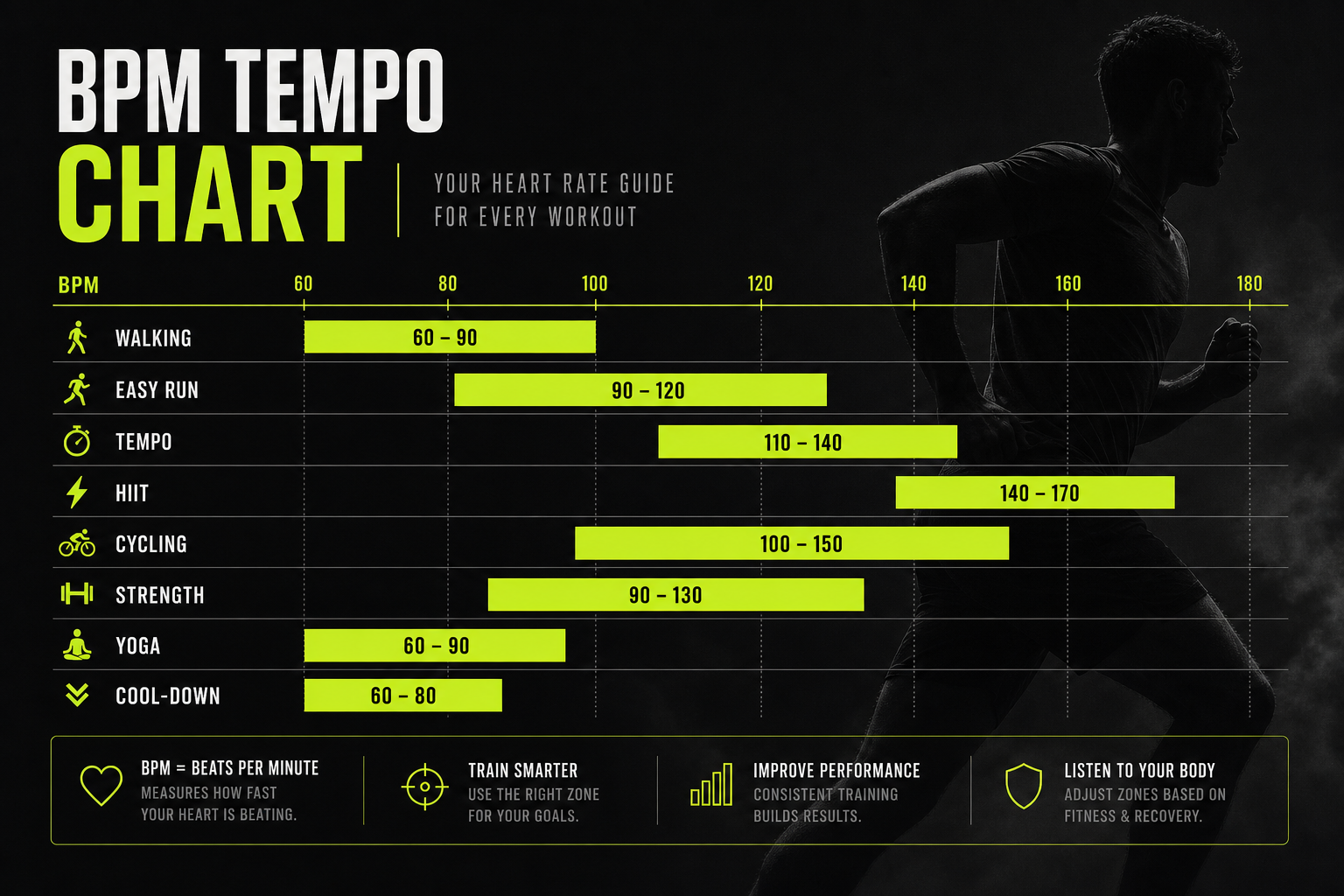
Start by measuring where you actually are, not where you think you are. A running watch with cadence tracking gives you the fastest read. Without one, count your right-foot strikes for 30 seconds and multiply by four; that’s your steps per minute (SPM).
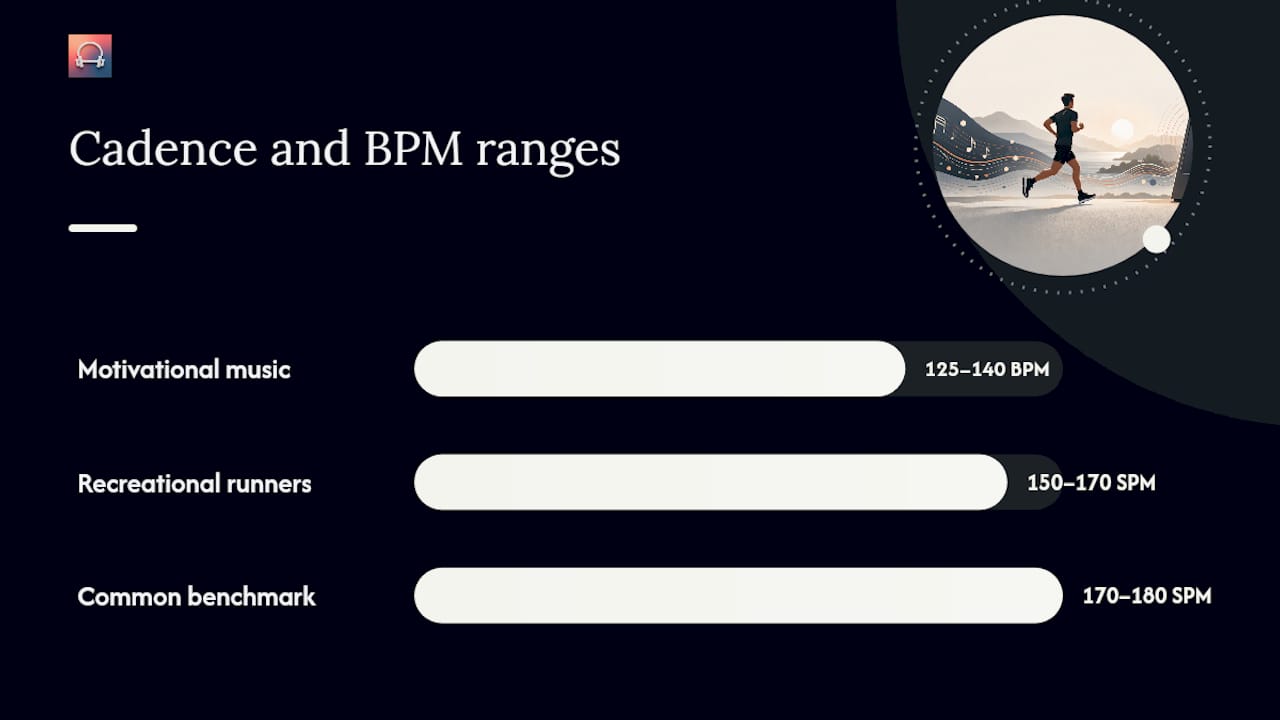
Most recreational runners land somewhere in the 150 to 170 SPM range, and the often-cited “ideal” of 170 to 180 SPM is a benchmark, not a rule everyone must hit. For motivational music, a BPM guide from Runners Connect points to 125 to 140 BPM as the sweet spot that raises arousal and delays fatigue without forcing an unnatural stride rate. Since most music is written in straightforward time signatures, one beat per footfall means BPM and SPM line up almost directly.
The numbers that matter: A validated motivational range sits at 125 to 140 BPM, and safe cadence adjustments should move in 2 to 5 percent increments rather than jumping straight to a target number.
How to progress without hurting yourself:
- Pick your current cadence as the baseline, not an aspirational number pulled from an article.
- Increase your target by 2 to 5 percent, not more, and hold that new cadence for a week or a handful of drills before increasing again.
- Run a 5 to 10 minute drill at the new cadence within an otherwise easy run, rather than trying to hold it for the whole session immediately.
- Stop increasing the moment you notice altered gait, new soreness, or any joint pain. Cadence changes stress different tissues than your body is used to, and that adaptation takes weeks, not one run.
Entrainment, the process of your stride locking onto an external beat, works best when the target tempo sits close to your natural cadence, generally within about 2 to 2.5 percent. Jump too far past that and you’ll fight the beat instead of following it.
Setting Up Apps, Wearables, and Earbuds for Reliable Tempo
The gear you use changes how well any of this actually works in practice. A basic metronome app just clicks at a fixed BPM you set manually. An adaptive music app goes further, adjusting the song’s tempo in real time to match your cadence or heart rate, which matters because your natural rhythm shifts as you fatigue, climb hills, or change pace.
What to look for and set up:
- A running metronome app with adjustable BPM and, ideally, a haptic option so you’re not relying on audio alone in noisy environments.
- A running watch or footpod for real-time cadence feedback; this is the fastest way to know if you’re actually hitting your target, not just guessing.
- Haptic buzzes on your wrist work well for outdoor runs where you want a beat cue without covering both ears.
- Earbuds: consider bone-conduction or single-ear-out setups on roads, and check that whatever you choose has a stable, snug fit so a beat you can feel doesn’t shift with every stride.
- Playlists should hold a consistent BPM band, ideally within a few beats of your target, rather than swinging from 110 to 160 across the same run.
A useful cross-discipline parallel comes from percussion training, where matching drumstick weight to the exact demands of a piece prevents the kind of fatigue that throws off timing over a long set, the same logic behind matching load to rhythm that runners apply when picking a stable BPM band instead of a jumpy one. A basic pace tracker can also help you correlate your cadence data with pace in real time, which is useful when you’re testing whether a new BPM target is actually helping or just adding noise.
How Repbeats Combines Precise Tempo With Music You Actually Want to Hear
Repbeats is built around a specific gap in this whole comparison: a metronome is precise but demotivating, and a fixed playlist is motivating but doesn’t adapt when your cadence or heart rate changes mid-run. An adaptive auto-DJ technology updates a track’s BPM every bar, pulling live data from wearables to keep the music’s tempo aligned with your actual cadence and heart-rate zone as they shift.
What that looks like in practice:
- The tempo adjusts automatically as you speed up on a downhill or slow down late in a long run, instead of leaving you stuck at a fixed BPM that no longer matches your stride.
- It draws on real-time wearable data, so the adjustment reflects your actual physiological state rather than a preset number.
- It works for both cardio sessions and meditation programs, serving different training needs.
| Best use case | Why adaptive music helps |
|---|---|
| Long runs | Keeps tempo motivating and phase-aligned as fatigue sets in during later miles |
| Treadmill pacing | Removes guesswork by syncing BPM directly to your set pace |
| Tempo warmups | Gradually raises BPM to ease you into faster cadence without an abrupt jump |
If you’ve been switching between a metronome app and a fixed playlist and getting frustrated with both, that’s the exact use case Repbeats was designed to close.
Building a Running Playlist That Actually Matches Your Cadence
Picking songs by “does this sound fast” is how most people build running playlists, and it’s why so many of those playlists fall apart around mile three. Start with a BPM range instead of a vibe. Most music streaming platforms and BPM-lookup tools list a song’s tempo, so you can filter before you even hit play.
Aim for a tight band, not a wide one. If your target is motivational-pace running, stay within the 125 to 140 BPM range noted earlier, and keep every track within roughly 5 BPM of your target rather than letting the playlist swing wildly between a slow ballad and a sprint-tempo anthem. That consistency is what keeps your cadence stable instead of surging and dragging with every song change.
Pay attention to where the beat sits in the mix. Tracks with a clean, forward kick drum are far easier to run to than tracks that bury the rhythm under atmospheric production or a slow build-up intro; you want the beat obvious within the first few seconds, not hidden until the second verse.
Order matters more than most runners think. Sequence your playlist so tempo rises gradually rather than randomly, mirroring a warmup, steady middle, and a stronger push near the end. If you’re training cadence specifically, consider dedicating a short section of the playlist, just two or three tracks, to a slightly higher BPM band as a structured drill rather than hoping a random song nudges you there. And revisit your library every few weeks. A song you loved in January can lose its motivational punch by March simply from repetition, even if the BPM is still perfect.
Running With Both Music and Awareness of Your Surroundings
The dissociative benefit that makes music so effective at lowering perceived effort is the same trait that can put you at risk if you’re not deliberate about volume and route choice.
Covering both ears at high volume on a road run means you may not hear a car approaching from behind, a cyclist calling out, or another runner on a blind curve. That’s not a hypothetical; it’s the specific tradeoff a sports-medicine perspective on music and running calls out directly: music genuinely helps motivation and adherence, and it genuinely reduces your ability to react to environmental cues if you let it.
The fix isn’t to ditch music. It’s to match your setup to your environment. On a closed track, a treadmill, or an empty trail you know well, full volume and both earbuds are reasonable. On a shared multi-use path, a busy street, or anywhere with blind corners and vehicle traffic, drop to one earbud, keep volume low enough to hear ambient sound, or switch to bone-conduction headphones that leave your ear canal open entirely.
Time of day and lighting compound the risk. Running with music in low light, where drivers and cyclists already have a harder time seeing you, is a worse combination than the same volume in daylight on a familiar route. If you’re logging a run somewhere new for the first time, that’s a good candidate for silence or a metronome instead of music, at least until you know where the tricky crossings and blind spots are.
The same logic applies to intensity. Hard interval sessions with heavy breathing already reduce how well you can hear anyway, so treat those as a cue to run somewhere controlled, like a track or treadmill, rather than pushing a max effort with headphones in on an unfamiliar road.
Testing Both Methods on Yourself
The fastest way to settle the metronome versus music question for your own stride is a two-week experiment. Run three sessions per week using tempo-matched music, and three using a metronome or discrete beat, keeping distance and effort roughly equal.
Log your cadence, your RPE, and how the run actually felt afterward. Look for patterns: did cadence hold steadier with the beep, but did you enjoy the music sessions enough to run them longer or faster without noticing? Most runners land on a hybrid, music for volume and enjoyment, short metronome drills for form correction, rather than picking one tool permanently.
— Jordan Mills
Try Tempo-Matched Music on Your Next Run
If you’ve been toggling between a metronome app for precision and a separate playlist for motivation, an adaptive app closes that gap by doing both at once. It pulls live data from wearables and adjusts a track’s BPM every bar, so the beat tracks your actual cadence and heart-rate zone instead of sitting at a fixed tempo you set before you started running.
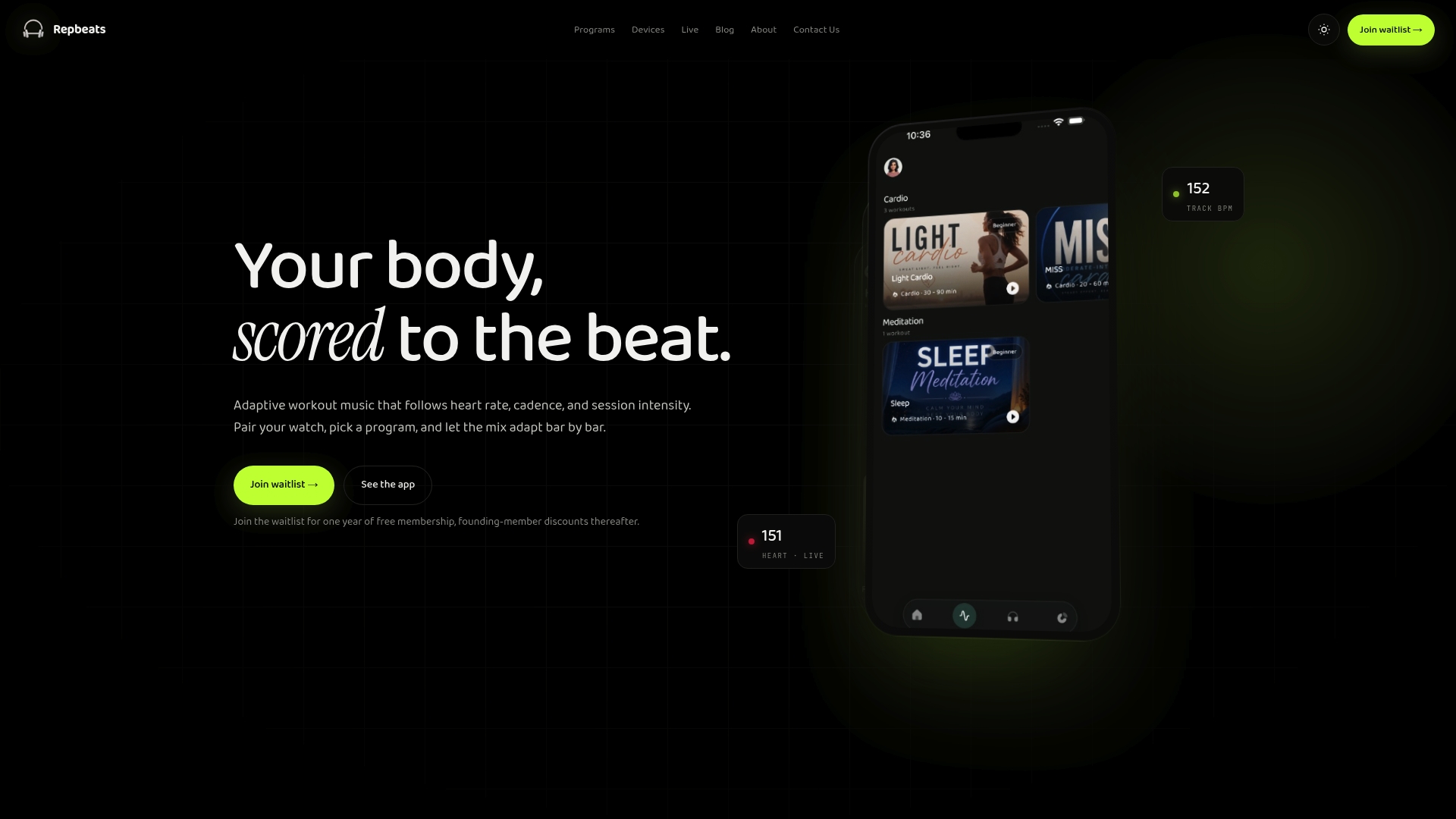
That matters most on long runs, treadmill sessions, and tempo warmups, exactly the scenarios where a static playlist drifts out of sync and a plain metronome gets tedious fast. Instead of manually switching tools mid-run, the tempo adapts around you.
Head to Repbeats and try it on your next run to see how adaptive tempo feels compared with a fixed playlist or a standalone metronome app.
Sources
- Running Playlist BPM: 5 Science-Backed Rules for Better Runs - Runners Connect
- The power of auditory-motor synchronization in sports (PLOS One)
- Effects of auditory stimuli (music, metronome) on one-mile run time — study (WKU digitalcommons)
- Impact of music on running fatigue: motivational content effects (bioRxiv preprint)