Why Music Tempo Affects Exercise: The Science Explained
Jordan MillsJuly 19, 2026 · 9 min read

Why Music Tempo Affects Exercise: The Science Explained
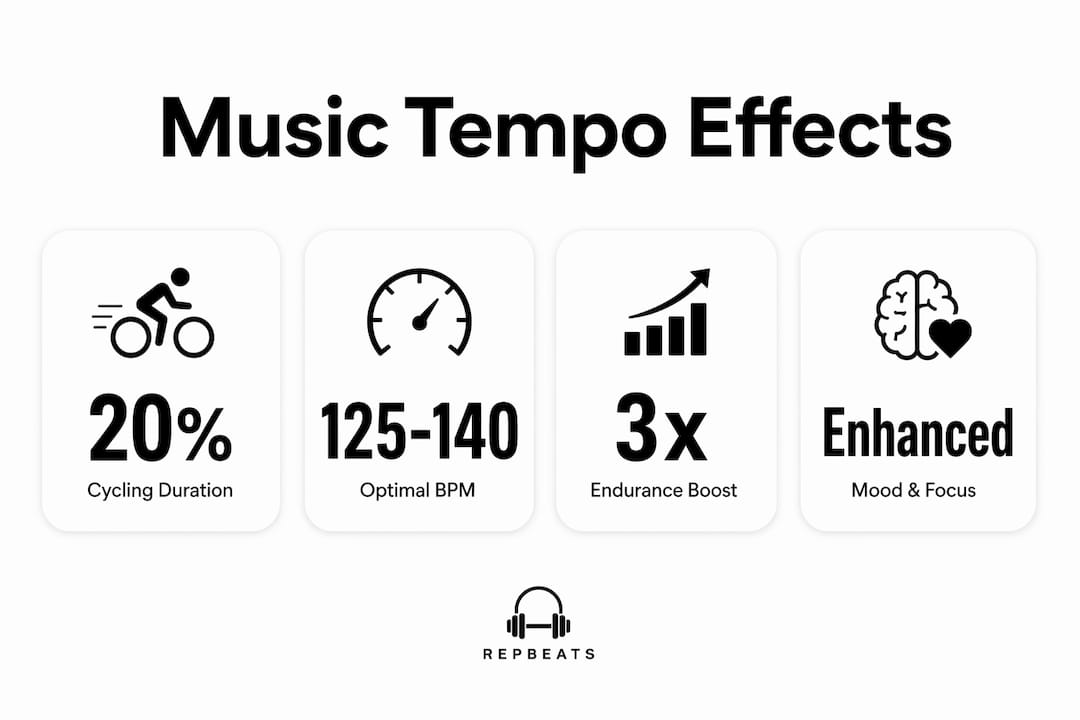
Music tempo directly shapes how long you can exercise, how hard it feels, and how motivated you stay throughout a session. Faster tempos in the 125–140 BPM range improve endurance and delay fatigue by synchronizing your movement patterns and masking the brain’s effort signals. Researchers at the University of Jyväskylä found that cyclists listening to self-selected music at 120–140 BPM exercised longer compared to silence, with no reported rise in perceived exhaustion. The British Association of Sport and Exercise Sciences (BASES) and Dr. C.I. Karageorghis have built entire psychophysiological frameworks around this effect, confirming it works across aerobic and anaerobic contexts alike.
Here is what the research consistently shows:
- Endurance improves when tempo matches movement cadence, reducing wasted energy and extending time to exhaustion.
- Perceived exertion drops with fast-tempo music, particularly during steady-state aerobic work.
- Mood lifts even when effort stays high, because music regulates emotional arousal independently of physical strain.
- Motivation increases with self-selected music, more so than with generic playlists.
- Neural entrainment locks your motor patterns to the beat, cutting the cognitive load of maintaining pace.
How music tempo changes your physiology during a workout
The most striking finding from tempo research is what music does not change: your heart rate and blood lactate levels stay essentially the same whether you train with music or without it. What shifts is your tolerance for the discomfort those physiological signals create. According to BASES, music does not reduce physiological strain but raises the threshold at which discomfort becomes intolerable, allowing you to keep going longer despite identical internal signals.
That distinction matters for how you interpret the data. Studies comparing exercise with and without self-selected music show similar heart rate and lactate concentrations across conditions, yet participants consistently exercise longer when music is playing. The University of Jyväskylä cycling study is the clearest example: Cyclists exercised 20% longer (35.6 minutes with music vs 29.8 minutes in silence) with no measurable increase in physiological cost.
Synchronous music, where your movement cadence matches the beat, adds a second layer of benefit. Auditory-motor synchronization enforces a consistent cadence, reducing the energy wasted in variable, uneven rhythms. Think of it as the difference between rowing with a coxswain calling the stroke and rowing without one. The beat acts as an external metronome, and your muscles stop spending energy recalculating pace every few seconds.
The BASES expert statement links optimal performance to the 125–140 BPM range, with synchronous music improving endurance task performance significantly. The effect is stronger in aerobic exercise than in anaerobic work, partly because steady-state activities give the body more opportunity to lock onto a consistent rhythmic cue.
| Physiological metric | Without music | With fast-tempo music (120–140 BPM) |
|---|---|---|
| Cycling duration | 29.8 min (silence) | 35.6 min (with fast-tempo music 120–140 BPM) |
| Heart rate | No significant change | No significant change |
| Blood lactate | Similar levels | Similar levels |
| Perceived exertion (RPE) | Baseline | Reduced notably during endurance exercise |
| Endurance task performance | Baseline | Significant improvement |
A few additional patterns worth noting:
- RPE reductions during exercise vary between endurance and high-intensity intervals, with endurance generally showing a greater decrease, based on research comparing tempo conditions.
- The aerobic benefit of synchronous music is well established; anaerobic performance gains are real but more modest.
- Heart rate variability data does not show a consistent tempo-driven effect, which reinforces the psychological rather than purely cardiovascular mechanism.
Why your music preferences shape how hard you push
Personal preference is not a soft variable in this research. It is one of the strongest predictors of whether music actually improves your workout. Self-selected music generates higher emotional arousal and motivation than generic playlists, and that gap translates directly into exercise capacity.

The psychological pathway runs through emotional arousal. When you hear music you genuinely like at a tempo that matches your energy level, your brain releases dopamine-adjacent responses that raise positive affect and lower the perceived cost of effort. You are not working less hard. You are simply valuing the experience more, which changes how long you are willing to sustain it.
Tempo preference also interacts with exercise intensity in a specific way. Exercisers naturally gravitate toward faster tempos as their workout intensity rises. This is not random. Higher arousal states call for stimulative input, and fast, upbeat music provides it. Slow or soft music during high-intensity work creates a mismatch that can actually blunt performance by failing to meet the brain’s arousal demand.
A 2020 study published in Frontiers in Psychology found that psychological benefits persist even when RPE stays elevated during high-intensity exercise. Participants reported higher positive mood while listening to music despite unchanged effort levels. The mood benefit and the exertion benefit are partially independent, which means music helps even when it cannot fully mask how hard you are working.
Pro Tip: Build separate playlists for different training zones. A 128 BPM playlist for your aerobic base work and a 138–140 BPM playlist for threshold intervals lets your brain receive the right arousal cue at the right moment, rather than forcing a mismatch mid-session.
The neural and cognitive mechanisms behind tempo’s effect on performance
The core mechanism is auditory-motor synchronization, sometimes called neural entrainment. When you hear a steady beat, your motor cortex begins to anticipate the next pulse and times muscle activation accordingly. This is not a conscious process. It happens automatically, the same way your foot taps to a song without you deciding to tap it. During exercise, that automatic synchronization locks your stride rate, pedal cadence, or stroke rhythm to the music, cutting the cognitive overhead of self-regulating pace.
Dr. C.I. Karageorghis, whose work at Brunel University London has defined much of the field, frames the ergogenic effect of music as multifactorial. His research emphasizes that tempo, volume, rhythm, and lyrical content all interact to influence neural activity and effort perception. No single element explains the full effect.

The dissociation effect is particularly relevant for endurance athletes. Music redirects attentional focus away from internal fatigue signals (labored breathing, burning muscles) toward the external auditory stimulus. This is not suppression. The signals are still there. The brain simply allocates less processing weight to them, which changes the subjective experience of effort without altering the underlying physiology.
For high-intensity intervals, the mechanism shifts slightly. At near-maximal effort, full synchronization with the beat becomes harder to maintain, and the dissociation effect weakens because internal signals become too loud to ignore. What fast-tempo music does instead is serve as a psychological arousal anchor, priming the nervous system for explosive output before and during the interval. The beat does not pace you; it charges you.
Meta-analyses across 139 studies confirm the breadth of these effects. Effect sizes land at g=0.48 for affective valence, g=0.31 for physical performance, g=0.22 for perceived exertion, and g=0.15 for oxygen consumption. The performance and mood effects are the most robust. The oxygen efficiency gain is smaller but real, suggesting that synchronized movement wastes less energy at the cellular level.
Key mechanisms at a glance:
- Auditory-motor entrainment locks cadence to the beat, reducing energy lost to rhythm variability.
- Attentional dissociation redirects focus away from fatigue signals during moderate-intensity work.
- Arousal regulation primes the nervous system for high-intensity efforts via stimulative tempo.
- Cognitive load reduction removes the mental cost of self-pacing, freeing resources for sustained output.
- Mood elevation operates independently of exertion, sustaining motivation even when effort is high.
Understanding how rhythm improves output at the neural level helps explain why tempo selection is not just a preference question. It is a performance variable.
What the latest research reveals about tempo and endurance
The may 2026 University of Jyväskylä study brought fresh precision to what researchers had long suspected. Cyclists using self-selected music at 120–140 BPM exercised longer than those in silence, with the difference entirely attributable to psychological fatigue tolerance rather than any change in cardiovascular or metabolic load. The study design isolated the tempo variable carefully, making it one of the cleaner demonstrations of the endurance effect in recent literature.
A 2023 systematic review and meta-analysis on pre-task music found that listening to music before exercise improves relative peak power and mean power, with modest fatigue reduction effects source. Pre-task music works through arousal priming: the right tempo before a session raises readiness and lowers the perceived cost of starting, which matters enormously for training adherence over weeks and months.
| Research finding | Effect | Source |
|---|---|---|
| Self-selected 120–140 BPM music | 20% increase in cycling duration (35.6 min vs 29.8 min) | University of Jyväskylä, 2026 |
| Fast-tempo music vs. silence (RPE) | Notable reduction (endurance) | Frontiers in Psychology, 2020 |
| Synchronous music, endurance tasks | Significant performance gain | BASES expert statement |
| Pre-task music (meta-analysis) | Modest fatigue reduction | Frontiers in Psychology, 2023 |
| Music effect on affective valence | g=0.48 | BASES meta-analysis summary |
The emerging picture from this body of work is that tempo’s benefits are not uniform across all exercise types. Endurance activities, where cadence is repetitive and sustainable, show the largest gains. High-intensity intervals benefit more from arousal priming than from synchronization. Recovery periods respond well to slower tempos that accelerate parasympathetic reactivation. Treating tempo as a single dial set once per workout misses the full potential of music as a training tool.
Repbeats addresses this directly. Its auto-DJ technology reads live heart rate and cadence data from wearables like Apple Watch and Fitbit, then updates the music’s BPM every bar to match current exercise intensity. Rather than a static playlist, you get a soundtrack that shifts with your physiology, keeping the tempo in the optimal zone whether you are in a warm-up, a threshold block, or a cooldown. For runners and cyclists who want to apply the adaptive music principles the research supports, that kind of real-time synchronization removes the guesswork entirely.
Electric bike riders working on paced interval training can also benefit from tempo-matched audio. The O2Feel Amplitude 7 pairs well with adaptive audio approaches, giving riders a platform where cadence and resistance can align with a tempo-driven soundtrack for more consistent effort regulation.
Key Takeaways
Music tempo is one of the most well-documented ergogenic tools in exercise science, with effects on endurance, perceived effort, mood, and motor efficiency confirmed across hundreds of studies.
| Point | Details |
|---|---|
| Optimal BPM range | 125–140 BPM consistently links to peak endurance performance in aerobic exercise. |
| Endurance gain | Cyclists at 120–140 BPM exercised 20% longer (35.6 min vs 29.8 min) than those in silence with no added physiological cost. |
| RPE reduction | Fast-tempo music reduces perceived exertion more during endurance than high-intensity exercise. |
| Physiology unchanged | Heart rate and lactate levels stay similar with or without music; the gain is psychological fatigue tolerance. |
| Self-selection matters | Music you choose yourself generates stronger motivation and exercise capacity than generic playlists. |