120–140 vs 150–180 BPM: Wearable Sync for Focus vs Hype Music
Jordan MillsSeptember 21, 2026 · 11 min read

120–140 vs 150–180 BPM: Wearable Sync for Focus vs Hype Music
Use focus tracks (steady, lower-arousal tempo) for sustained output, long runs, or meditation, and hype tracks (high-BPM, driving beats) for intervals or short power efforts. Focus music keeps cadence consistent and effort controlled; hype music raises arousal and pushes output higher for shorter bursts. Wearable-synced apps make the switch automatic, matching tempo to heart rate or cadence in real time.
TL;DR:
- Focus tracks typically stay in 120-140 BPM with minimal variance, making them ideal for long, steady efforts or meditation.
- Hype tracks run between 150-180 BPM with energetic builds, suited for high-intensity intervals like HIIT or hill sprints.
- Increasing music tempo by around 10% can improve cycling distance, power, and cadence during submaximal exercise, according to research.
- Wearable apps match music tempo to heart rate and cadence within narrow windows, with gradual adjustments to maintain synchronization.
- Using adaptive music that responds to effort levels helps maintain proper pacing and improves performance, especially during session transitions.
Table of Contents
- Focus vs Hype Music: What Actually Separates Them
- What Does the Research Say About Tempo and Performance?
- How Do Wearables Turn Heart Rate Into a BPM Target?
- Which BPM Should You Use for Each Type of Session?
- How Repbeats Applies These Focus and Hype Templates
- What Most Guides Get Wrong About Workout Music
- Try Adaptive Music That Matches Your Actual Effort
- Research and Product Pages Used in This Guide
- Sources
- FAQ
Focus vs Hype Music: What Actually Separates Them
The difference isn’t just vibe. It’s measurable in BPM, arrangement, and how much a track wants your legs to move faster.
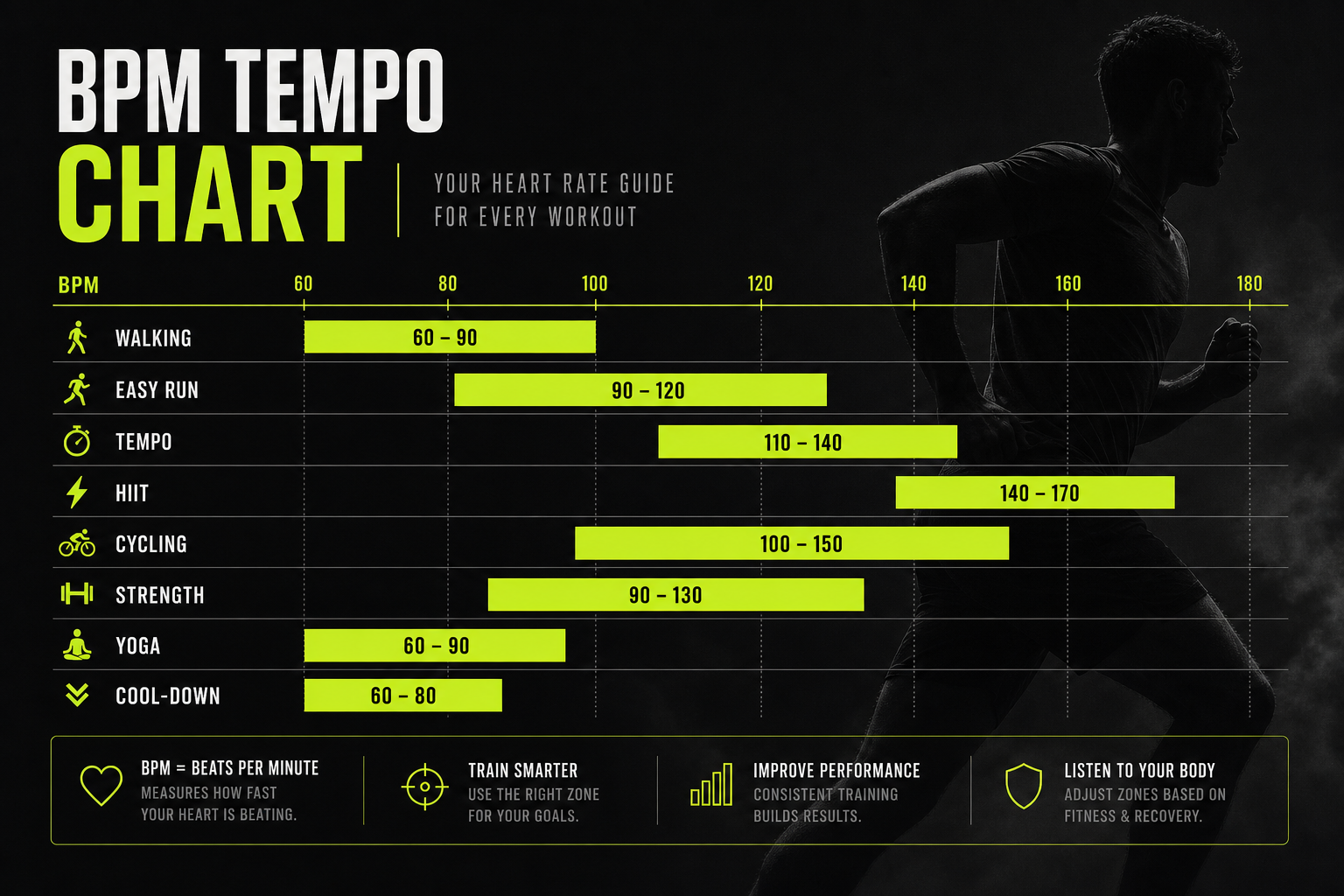
Focus tracks typically sit in a lower, tighter BPM band (often 120 to 140 BPM) with minimal tempo variance. Percussion stays understated, builds are gradual or absent, and vocals (if present) rarely spike in intensity. The goal is a track that disappears into the background of a steady-state run, a long ride, or a meditation session. It doesn’t ask you to speed up.
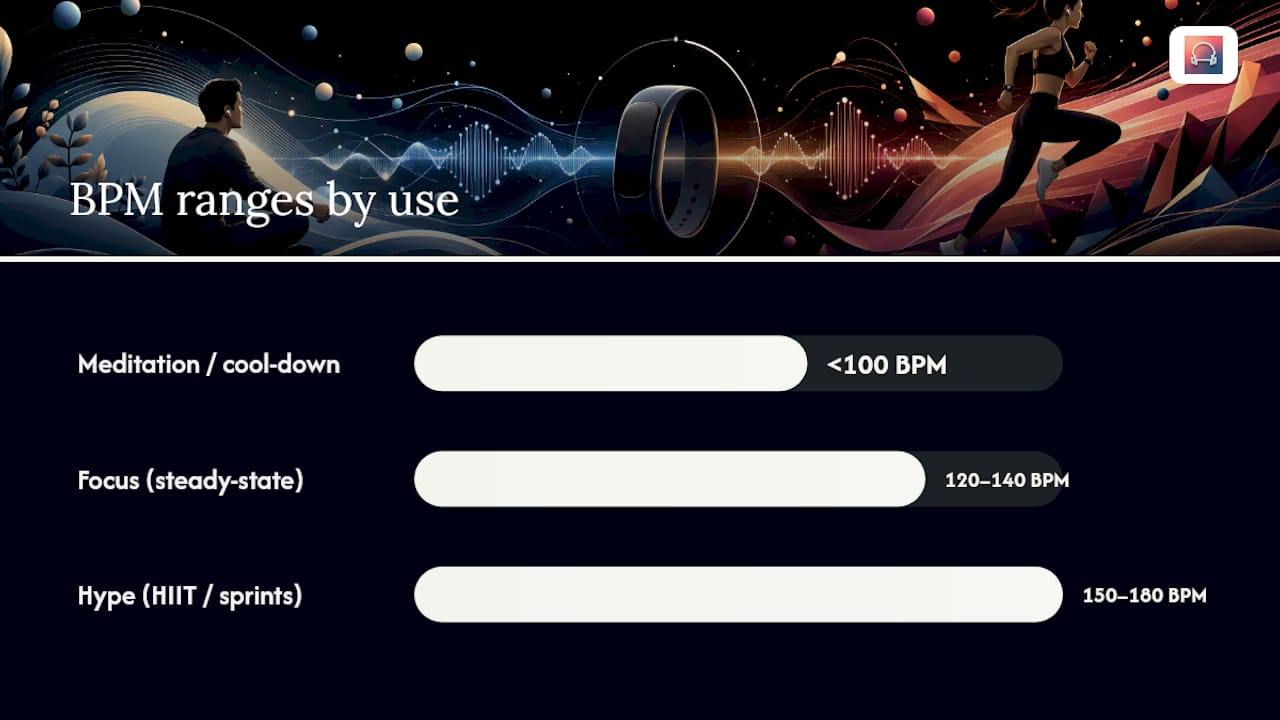
Hype tracks run higher, usually 150 to 180 BPM or beyond, with a strong, forward-driving downbeat. Percussion is prominent, builds are dramatic, and lyrical or instrumental intensity escalates deliberately. These tracks encourage cadence increases, which is exactly the point during a HIIT block or hill sprint.
Here’s the practical shorthand:
- 30 to 60 minute steady-state run: Pick tempo-stable focus tracks with low BPM variance. Constant beat, no surprises.
- 20 to 30 minute HIIT session: Pick hype tracks with strong downbeats that climb in energy during work intervals.
- Meditation or cool-down: Drop below 100 BPM with sparse arrangement and no percussion emphasis.
Spotting the difference is usually instant once you’re listening for it. If a track makes you want to speed up without trying, it’s hype. If it just sits there supporting your rhythm, it’s focus. For a deeper breakdown of tempo windows, BPM explained by workout type covers the ranges in more detail.
What Does the Research Say About Tempo and Performance?
Tempo genuinely changes output, not just mood. Multiple controlled studies back this up, and the effect sizes are consistent even if they’re not dramatic.
Speeding up music tempo by roughly 10% increased distance covered per unit time, power output, and pedaling cadence in submaximal cycling protocols, according to research on music tempo and cycling performance. Slowing the tempo produced the opposite effect, cutting those same metrics. That’s a controllable lever, not a one-off finding.
Running research tells a similar story. Work published in PLOS One found that cadence-matched motivational music significantly extended time to exhaustion compared to running without music, while also lowering perceived exertion at submaximal intensities. That’s two separate mechanisms doing separate jobs: auditory-motor synchronization stabilizes cadence and running economy, while the motivational quality of a track raises arousal and lets you tolerate more effort before it feels hard.
A study in the MDPI journal International Journal of Environmental Research and Public Health adds a caveat worth knowing: fast music reduces subjective fatigue perception across exercise intensities, but the effect is more reliable at submaximal loads than at true maximal efforts. Push hard enough, and physiology takes over regardless of what’s playing.
Broader work on exercise duration and music found that total exercise duration was significantly higher with music than without it in young adult subjects, with music also increasing maximum heart rate in some cases.
The honest takeaway: tempo-matched music produces modest, reliable improvements in endurance and perceived effort, not dramatic transformations. Individual response varies, and the benefit shrinks as you approach maximal intensity. It’s a real edge, not magic.
How Do Wearables Turn Heart Rate Into a BPM Target?
Adaptive music apps work by mapping a live biosignal, usually heart rate or cadence, to a target BPM band, then adjusting the track’s tempo to match.
The logic is straightforward: your wearable reports heart rate zone or step cadence, the app translates that into a target tempo, and the music shifts within a narrow window, often ±4 to 10 BPM, to keep movement feeling natural rather than jarring. Too wide a window and the tempo swings feel erratic. Too narrow and the app can’t respond fast enough to real changes in effort.
Synchronous playback, where the beat lines up tightly with your cadence, tends to outperform asynchronous playback for auditory-motor coupling. Research on synchronous versus asynchronous music in cycling found synchronous conditions reduced perceived limb discomfort and improved affective response compared to asynchronous or no-music controls, even without changes in oxygen consumption.
Update frequency matters just as much as the mapping logic. Biosignal-driven algorithmic music systems that adjust tempo bar-by-bar, rather than in abrupt jumps, tend to feel smoother and less disruptive during a run. Sudden tempo jumps break the auditory-motor coupling your brain just built.
To get the most out of this technology:
- Connect both heart rate and cadence data where your wearable supports it. HR alone misses gait rhythm; cadence alone misses effort intensity.
- Check your pairing settings for latency. A half-second lag between a cadence spike and a BPM shift is enough to feel off.
- Favor apps with frequent, small tempo updates over occasional large ones.
Pro Tip: If your adaptive music ever feels like it’s fighting your stride instead of matching it, check your wearable’s Bluetooth connection stability first. Most “bad algorithm” complaints are actually pairing dropouts causing delayed or stale BPM data.
Wearables like Apple Watch and Fitbit provide the raw HR and cadence streams these systems depend on, as detailed in how wearables measure exercise intensity.
Which BPM Should You Use for Each Type of Session?
Templates beat guesswork. Here’s how to structure four common session types by tempo.
Warm-up ramp: Start 10 to 20 BPM below your target working tempo and ramp up over 5 to 10 minutes. This mirrors how your cardiovascular system actually warms up, gradually, not instantly.
Steady-state focus sessions: Hold a target BPM band with tight variance, roughly ±3 to 5 BPM, for the full session length. A 30 to 60 minute run or ride works best with a track list that stays boring on purpose.
Hype intervals: Alternate work BPM (150 to 180+) with recovery BPM (110 to 130) on a fixed cycle, commonly 30 seconds to 4 minutes per interval depending on your protocol. Switch musical energy at the exact moment the interval changes, not before or after.
Meditation and recovery: Drop into an 60 to 90 BPM window with sparse arrangement, minimal percussion, and no tempo variance at all.
A few rules worth locking in:
- Never use high-arousal, cadence-driving hype tracks in situations requiring situational awareness, like outdoor cycling in traffic.
- Match interval switches to your actual work/rest ratio, not a fixed playlist length.
- Reassess your steady-state BPM window every few weeks as fitness improves; what felt hard at 140 BPM in January often feels easy by March.
For a longer-term structure, a four-week cadence plan walks through how to adjust these bands as your baseline fitness shifts.
How Repbeats Applies These Focus and Hype Templates
Repbeats builds this exact framework into the app itself. It synchronizes music tempo to heart rate, cadence, and session intensity pulled from wearables like Apple Watch and Fitbit, and its auto-DJ technology updates BPM every bar rather than in jarring jumps, which lines up with what the research on gradual tempo adaptation supports.
Setting it up follows the same logic as the templates above:
- Connect your wearable and let it stream heart rate and cadence data.
- Choose your session goal: steady-state, interval, or meditation.
- Pick a matching template (warm-up ramp into steady focus, or warm-up into hype intervals with recovery drops).
- Run the session and let the auto-DJ adjust BPM in real time as your effort changes.
The app covers both ends of the spectrum this guide describes: focused cardio sessions where tempo stays steady, and meditation programs where BPM drops low and stays there. It’s built around the same principle the studies above point to, tempo that tracks your actual physiology tends to beat a fixed playlist.
Pro Tip: Run your first Repbeats session as a steady-state test before trying intervals. It’s the easiest way to feel how the bar-by-bar BPM updates behave before you’re also managing work/rest timing.
What Most Guides Get Wrong About Workout Music
Most advice treats “workout music” as one category, as if the same playlist should carry you through a warm-up, a tempo run, and a finisher. The research doesn’t support that. Auditory-motor synchronization and motivational arousal are separate mechanisms, and conflating them is why so many “hype playlists” fail during long steady efforts. A track that spikes your adrenaline for 90 seconds becomes exhausting at minute 40.
The bigger blind spot is treating tempo as fixed rather than adaptive. A 140 BPM track feels perfect at the start of a run and wrong by mile four, once your cadence has settled and your heart rate has climbed. Static playlists can’t respond to that. This is where wearable-synced adjustment earns its place: not as a novelty feature, but as the mechanism that keeps auditory-motor coupling intact as effort changes.
If there’s one thing readers should prioritize, it’s matching tempo variance to session type before worrying about genre or mood. Get the BPM band right, and the rest is preference.
— Jordan Mills
Try Adaptive Music That Matches Your Actual Effort
This app is designed for the workflow described in this guide: it reads heart rate and cadence from wearables and adjusts BPM bar by bar, eliminating the need to manually swap playlists between different workout phases.
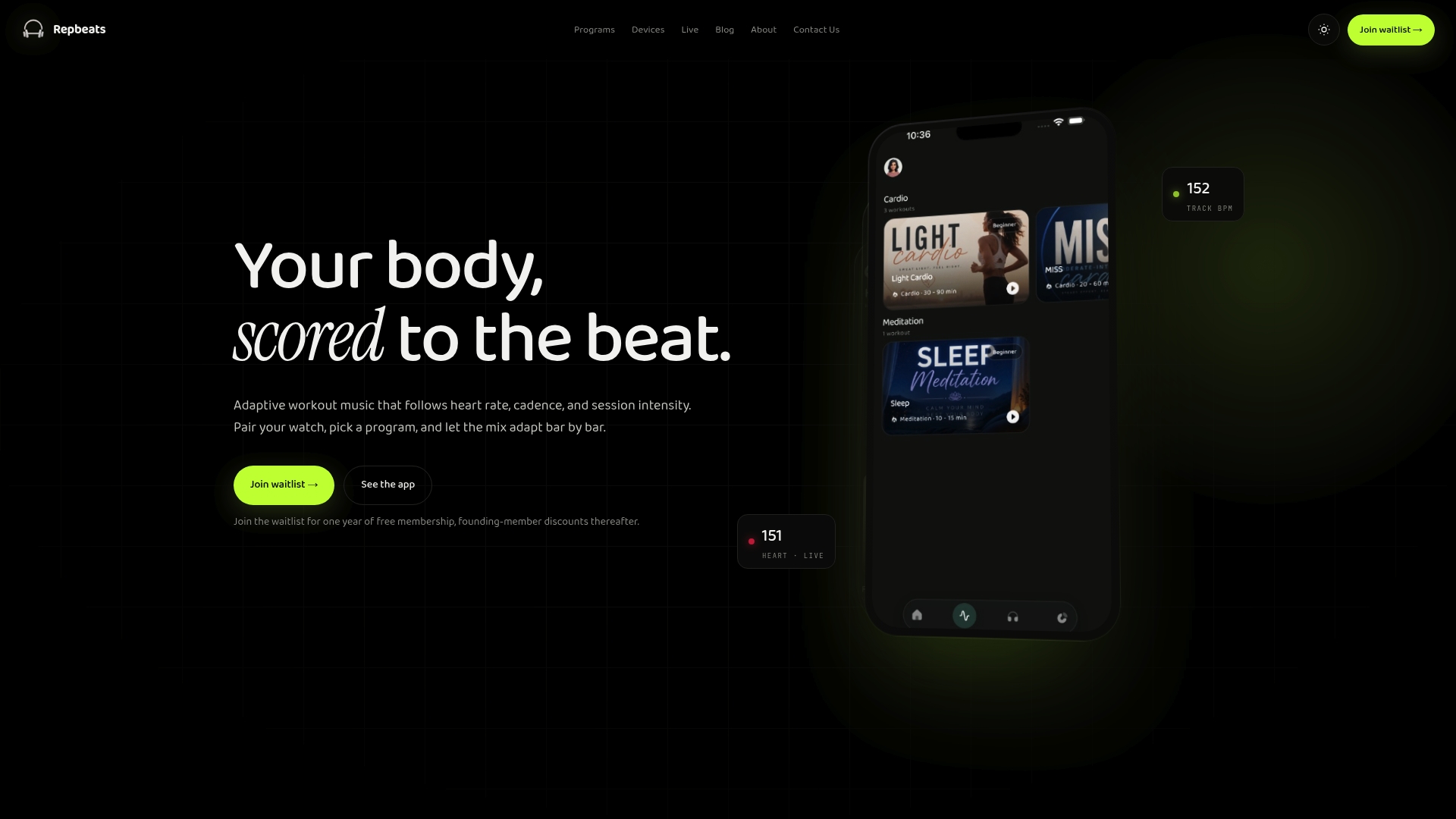
You connect your wearable once, pick a goal (steady-state, interval, or meditation), and choose a template. From there, the auto-DJ handles the tempo switching in real time, following the same focus-to-hype logic covered throughout this piece. Read more about how the Repbeats app approaches adaptive tempo, or head to the Repbeats homepage to join the waitlist and get started with your wearable.
Research and Product Pages Used in This Guide
The performance claims in this guide draw on peer-reviewed work published in PLOS One, MDPI’s International Journal of Environmental Research and Public Health, and cycling tempo research from Wiley. Product details on adaptive tempo syncing come from Repbeats.
Sources
- The Power of Auditory-Motor Synchronization in Sports: Enhancing Running Performance by Coupling Cadence with the Right Beats | PLOS One
- Effects of music tempo upon submaximal cycling performance
- Music and exercise performance improvements in young adults (PMC article)
- The Effect of Music Tempo on Fatigue Perception at Different Exercise Intensities | MDPI
FAQ
What’s the difference between focus and hype workout music?
Focus music holds a steady, lower BPM with minimal variance, ideal for sustained efforts like distance running or meditation. Hype music runs at a higher BPM with a strong downbeat, designed to push cadence and effort up during short, intense intervals.
Does faster music actually improve exercise performance?
Yes, within limits. Studies show a 10% tempo increase can raise distance covered, power output, and cadence in submaximal cycling protocols, though the effect weakens as intensity approaches maximal effort.
How does Repbeats decide what BPM to play?
Repbeats syncs tempo to heart rate, cadence, and session intensity using data from wearables like Apple Watch and Fitbit, updating BPM every bar through its auto-DJ system rather than making abrupt jumps.
What BPM should I use for a HIIT interval session?
Work intervals typically sit at 150 to 180+ BPM, with recovery periods dropping to 110 to 130 BPM. Switch musical energy right at the interval transition to keep the auditory-motor cue aligned with your effort change.
How much does Repbeats cost?
Current pricing details for Repbeats are available directly on the Repbeats website.