The Best Meditation Music BPM for Every Goal
Jordan MillsAugust 7, 2026 · 14 min read
The Best Meditation Music BPM for Every Goal
For most meditation goals, 50–80 BPM is your starting range. That window sits below the average resting heart rate and gives your autonomic nervous system a clear signal to shift toward calm. Most people feel the difference within a few minutes.
Quick alternatives by goal:
- Sleep: 40–60 BPM, ideally drifting lower as the track progresses
- Moving meditation or yoga: 70–100 BPM, depending on pace
- Post-workout cooldown: Start near your current heart rate, then ramp down to 55–65 BPM over 10–15 minutes
Personal preference matters more than any single number. If a track at 60 BPM feels too slow or too mechanical, try 70 BPM. Disliked music raises stress regardless of tempo.
Key Takeaways
For most people, 50–80 BPM is the right starting range for meditation music, with the ideal tempo sitting 10–20 BPM below your current resting heart rate and moving gradually lower as the session progresses.
| Point | Details |
|---|---|
| Best starter BPM range | 50–80 BPM covers most meditation goals; begin 10–20 BPM below your resting heart rate. |
| Gradual ramps outperform fixed tempos | Tracks that descend from ~60 BPM to ~50 BPM produce stronger relaxation than a static tempo. |
| Verify BPM before you commit | Use Tunebat or a tap-tempo app to confirm metadata accuracy before building a regular practice around a track. |
| Instrumentation shapes the effect | A 60 BPM track with sharp percussion can feel more tense than a 75 BPM track with soft, sustained tones. |
| Repbeats automates the process | Repbeats adjusts tempo every bar using live wearable data, removing the need to manually select or edit tracks. |
Table of Contents
- How meditation music BPM affects your body
- Practical BPM ranges for every meditation goal
- Where to find meditation tracks labeled by BPM
- How to pick the right BPM for your body and session
- How to check or set a track’s BPM
- Adaptive BPM technology makes personalization automatic
- Common misconceptions about BPM in meditation music
- What actually matters more than the exact number
- Repbeats adapts your meditation music in real time
- Sources
How meditation music BPM affects your body
Tempo is not just a stylistic choice. It is a physiological input. Music below 80 BPM tends to activate the parasympathetic nervous system, the branch responsible for rest, digestion, and recovery. Music above 120 BPM does the opposite, pushing the sympathetic system toward higher arousal, faster breathing, and elevated cortisol. Research from Ask The Scientists confirms that slow instrumental music in the 50–80 BPM range is associated with deeper breathing, lower blood pressure, and a reduced heart rate.
The mechanism behind this is called entrainment: your heart rate and breathing tend to synchronize with a steady external rhythm over time. A track sitting at 60 BPM gives your body a target to follow downward. This is why the average pop song at roughly 116 BPM keeps you alert and engaged, while a 60 BPM ambient piece pulls you in the opposite direction.
One well-documented example is the track “Weightless” by Marconi Union. Psychiatrist found that the piece, which opens near 60 BPM and gradually slows to around 50 BPM, produced significant anxiety reductions in a small preoperative patient sample. The gradual tempo ramp, not just the low BPM, was central to the effect.
One important caveat: familiarity and personal taste moderate all of this. A track you actively dislike can increase stress markers regardless of its tempo. The physiology is real, but it is not overriding.
Practical BPM ranges for every meditation goal
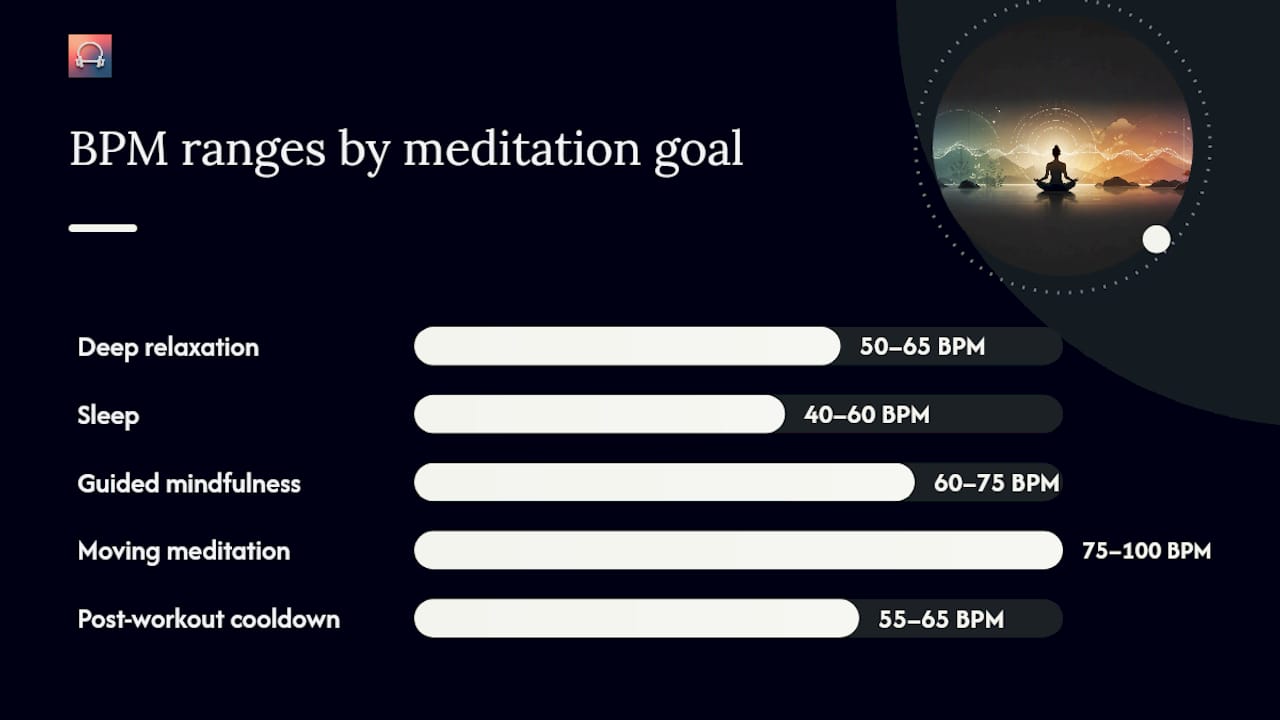
The table below maps common use cases to their typical BPM range, the physiological effect you can expect, and where to find labeled examples.
| Best for | Typical BPM range | How it feels / physiological effect | Where to find examples |
|---|---|---|---|
| Deep relaxation | 50–65 BPM | Slows breathing, lowers heart rate, promotes alpha brainwaves | Spotify search “60 BPM meditation”; Tunebat-verified albums |
| Sleep | 40–60 BPM | Deepens parasympathetic response, reduces cortisol | YouTube “sleep meditation music 50 BPM”; Spotify ambient albums |
| Guided mindfulness | 60–75 BPM | Calm but alert; supports focused attention without drowsiness | Calm app playlists; Spotify “mindfulness music” |
| Moving meditation / yoga | 75–100 BPM | Maintains gentle movement rhythm without raising arousal | Spotify yoga playlists; YouTube “yoga flow music 80 BPM” |
| Post-workout cooldown | Start at current HR, ramp to 55–65 BPM | Guides heart rate down gradually; eases the sympathetic-to-parasympathetic shift | Streaming cooldown albums; Repbeats adaptive programs |
Spotify hosts tracks explicitly labeled by tempo, including a 60 BPM instrumental meditation track that makes it easy to verify what you are actually listening to. Albums like Meditative (BPM 50) by Yoga Music on Spotify show how common BPM labeling has become in this category.
A few edge cases worth noting. Paced-breathing practices (like box breathing or 4-7-8) benefit from tracks with a clear, slow pulse rather than purely ambient textures. Guided meditation with a voice track works best when the background music sits at 55–65 BPM and stays simple enough not to compete with the narration. For walking meditation, 80–90 BPM tends to match a relaxed stride without feeling rushed.
Raw BPM is only part of the picture. Instrumentation, rhythmic complexity, and sudden changes all shape how a track actually feels. A 60 BPM track with a driving snare drum can feel more tense than a 75 BPM track built from soft piano and strings. The Calm blog’s meditation music guide highlights how elements like 432 Hz tuning, binaural beats, and ambient drones interact with tempo to shape the overall experience, even when the BPM is identical.
Where to find meditation tracks labeled by BPM
Finding tempo-specific tracks is easier than most people realize. Both Spotify and YouTube have enough BPM-tagged content that a direct search usually works.
On Spotify:
- Search “meditation music 60 BPM” or “relaxing music 50 BPM” directly in the search bar. Many albums and tracks include the BPM in their title.
- Check album metadata on individual track pages. Spotify does not always display BPM natively, but third-party tools like Tunebat list BPM and key for thousands of meditation tracks and playlists, making it a fast verification step.
- Browse curated playlists under “Focus,” “Sleep,” or “Meditation” categories. Many are already built around slow tempos even when BPM is not in the title.
On YouTube:
- Search “meditation music 60 BPM” or “sleep music 50 BPM.” YouTube creators in the ambient and meditation space frequently label their uploads with exact BPM in the title or description.
- Long-form uploads (1–3 hours) are common and often loop a consistent tempo, which is useful for extended sessions.
Verifying BPM metadata:
Metadata is not always accurate. A track labeled “60 BPM” may have been tagged automatically and could be off by several beats. The fastest verification method is to use Tunebat or a similar service to cross-check the listed BPM against the audio analysis. For tracks you plan to use regularly, a 30-second tap-tempo check (tap along to the beat on your phone’s metronome app and read the average) takes under a minute and catches obvious errors.
Pro Tip: When browsing for ambient meditation music, look for tracks with no sudden rhythmic breaks or tempo changes mid-track. A consistent tempo throughout is more important for entrainment than hitting an exact BPM number.
For post-workout cooldown specifically, Streaming platforms including Spotify host dedicated cooldown and recovery albums that bridge the gap between fitness and meditation music, with tempos designed to ease the transition from elevated heart rate to rest.
How to pick the right BPM for your body and session
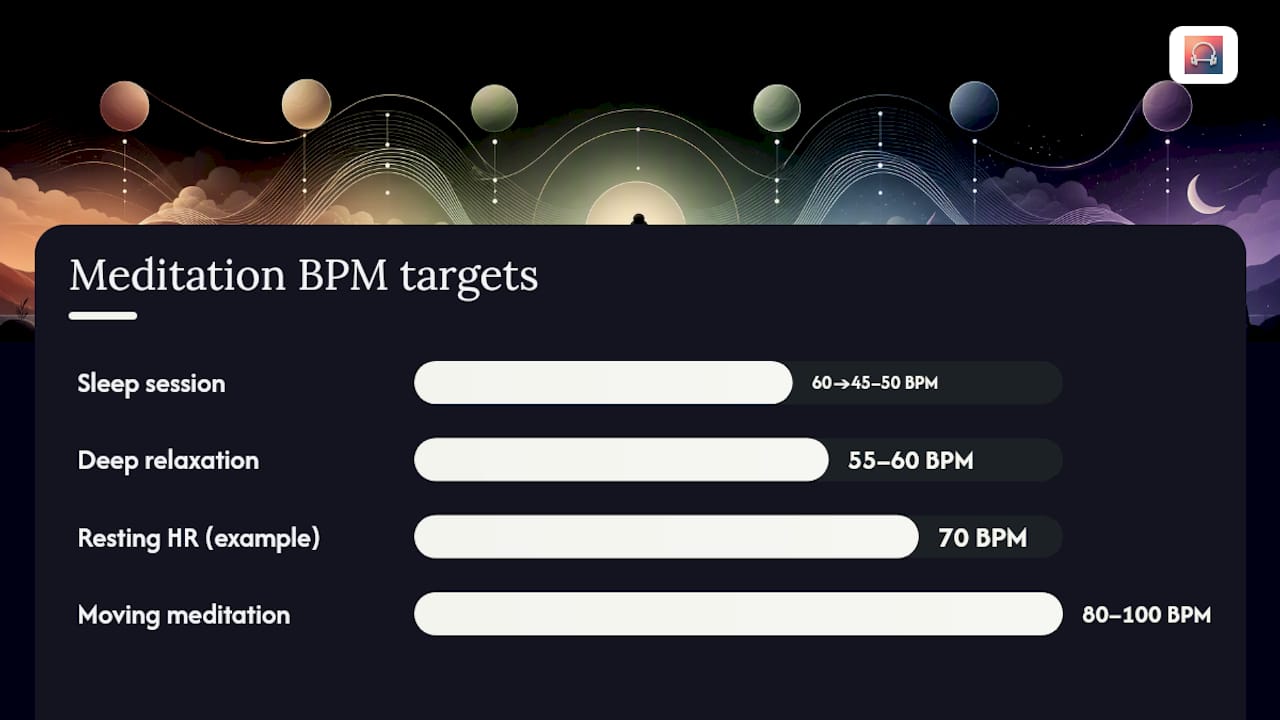
Start with this rule: for deep relaxation, try a BPM that is 10–20 beats below your current resting heart rate. If your resting heart rate is 70 BPM, a track at 55–60 BPM gives your body a clear downward target without feeling jarring.
Here is a simple five-step test to find your personal sweet spot:
- Check your resting heart rate. Use a wearable, a phone camera pulse reader, or count manually for 30 seconds and double it. Do this before you start the session.
- Pick a starting BPM. Subtract 10–15 from your resting heart rate. That is your opening tempo.
- Listen for five minutes. Play a track at that BPM and pay attention to your breathing. Is it slowing? Are your shoulders dropping? If you feel restless, the tempo may still be too fast.
- Adjust in 5 BPM steps. If the track feels too slow or mechanical, go up 5 BPM. If you feel alert rather than calm, drop 5 BPM. Small steps matter here.
- Note what worked. After the session, write down the BPM and how you felt. Three or four sessions of this builds a reliable personal baseline.
For sleep sessions, start at your resting heart rate minus 10 BPM and let the track drift lower. Many effective sleep tracks move from 60 BPM down to 45–50 BPM over 20–30 minutes. For moving meditation or yoga, 80–100 BPM keeps the body engaged without pushing into aerobic territory.
Syncing tempo to your heart rate removes most of this guesswork, particularly for post-workout sessions where your heart rate is elevated and a fixed-tempo track may feel mismatched.
Pro Tip: Avoid sudden tempo shifts between tracks. A jump of more than 10 BPM between consecutive tracks can interrupt the entrainment effect and pull you out of a relaxed state. Use gradual ramps of 5–10 BPM over several minutes instead, or choose a playlist where tracks are sequenced by descending tempo.
How to check or set a track’s BPM
Measuring BPM:
- Tunebat (web): paste a Spotify or Apple Music link and get the BPM and key instantly. Free and accurate for most mainstream tracks.
- BPM Analyzer (desktop, free): drag and drop an audio file for a quick reading.
- Tap tempo apps (iOS/Android): apps like Tempo or simply your phone’s built-in metronome let you tap along to a beat and read the average. Takes about 15 seconds.
- Manual method: count the beats in 15 seconds and multiply by four. Less precise but good enough for a rough check.
Editing tempo:
If a track you love sits at 70 BPM and you want it at 60 BPM, you have two main options. Time-stretching in a DAW (Digital Audio Workstation) like GarageBand, Ableton Live, or the free editor Audacity slows the track while preserving pitch.
Pitch-shifting is a different tool. It changes the pitch without changing tempo, which is useful for tuning adjustments but not for BPM work.
Pro Tip: When you export a time-stretched track for looping, check that the loop point is clean. A slight gap or click at the loop boundary breaks the meditative state immediately. Audacity’s “Crossfade Loops” effect smooths this out in a few clicks.
For streaming sessions, you do not need to export anything. Re-exporting as a loopable file makes more sense when you plan to use the track offline or in a guided session you are leading.
Adaptive BPM technology makes personalization automatic
Fixed-tempo tracks work well when your starting heart rate is predictable. They fall short when it is not, which is most of the time after exercise, a stressful day, or a poor night of sleep.
Adaptive BPM systems solve this by reading your current physiological state and adjusting tempo in real time. The core modes are:
- Heart-rate follow: the music tempo tracks your heart rate, staying slightly below it to guide it downward.
- Gradual cooldown ramp: the system starts at your current heart rate and ramps tempo down to a target zone (typically 55–65 BPM) over a set number of minutes.
- User-controlled target: you set a destination BPM and the system handles the transition, adjusting every few bars rather than jumping.
Neuroscience hardware and software research from Emotiv supports this direction, highlighting how brain and heart data can be used to measure and personalize meditation audio in ways that fixed tracks cannot match.
The practical advantages are real. No manual editing, no jarring tempo jumps between tracks, and no need to rebuild a playlist every time your resting heart rate changes. For post-workout meditation cooldown in particular, starting near your elevated heart rate and letting the system guide you down produces a far more comfortable transition than dropping straight to 60 BPM.
Repbeats is built around exactly this approach. Its auto-DJ technology updates tempo every bar using live data from wearables like Apple Watch and Fitbit, and it includes dedicated meditation and cooldown programs alongside its cardio modes. The heart-rate-guided soundscapes feature makes it one of the more practical tools for anyone who moves between workouts and meditation in the same session. Wellness and spa operators have also started integrating adaptive audio into recovery environments, a trend covered in detail by Revively’s spa and recovery vertical.
A short privacy note: adaptive systems that use wearable data process biometric information. Check the app’s privacy policy before connecting a device, particularly if you use the same wearable for health monitoring.
Common misconceptions about BPM in meditation music
“There is one perfect BPM for meditation.” There is not. The effective tempo depends on your current heart rate, your session goal, and your personal response to music. A 60 BPM track that works perfectly after a rest day may feel too slow after a hard run when your heart rate is still at 90 BPM.
“Lower is always better.” Below 40 BPM, most people stop perceiving a clear pulse and the entrainment effect weakens. Extremely slow tempos can feel unsettling rather than calming, particularly for new meditators who need a gentle rhythmic anchor.
“BPM is the only variable that matters.” Instrumentation, harmonic complexity, sudden dynamic changes, and even the tuning of the track all interact with tempo. A 60 BPM track with a sharp attack on every beat can feel more tense than a 75 BPM track with soft, sustained tones. Smooth, simple arrangements tend to outperform complex ones at any given BPM for relaxation purposes.
“Binaural beats replace the need for correct BPM.” Binaural beats operate on a different mechanism (the difference between two frequencies played in each ear) and are often layered over ambient tracks. They do not override the physiological effect of tempo. A binaural beat track at 100 BPM still carries the arousal signal of that tempo.
“Streaming platforms always label BPM accurately.” Automated tagging is imperfect. Cross-check with Tunebat or a tap-tempo app before committing a track to a regular practice.
What actually matters more than the exact number
The obsession with finding the “correct” BPM for meditation is understandable, but it slightly misses the point. The research on tracks like “Weightless” is compelling precisely because the tempo was not static. It moved. The gradual descent from 60 BPM to 50 BPM over several minutes is what guided listeners’ heart rates downward, not the arrival at a fixed number.
Most meditation music guides treat BPM as a destination. It is more useful to think of it as a direction. Start somewhere near your current physiological state and give the music a clear path downward. A track that begins at 70 BPM and ends at 55 BPM will outperform a static 55 BPM track for most people coming in from a busy day, because the body needs time to follow.
The other thing most guides underweight is instrumentation. A 60 BPM track with a prominent kick drum and sharp transients carries a very different physiological signal than a 60 BPM track built from bowed strings and soft pads. The tempo sets the pace; the arrangement sets the tone. Both matter. Focusing only on BPM while ignoring timbre, dynamics, and rhythmic complexity is like choosing a running shoe based only on weight and ignoring the fit.
For practical use, the habit that makes the biggest difference is simply checking your heart rate before you start and choosing a tempo that gives your body somewhere to go. That single step, done consistently, produces better results than any fixed playlist.
Repbeats adapts your meditation music in real time
Most fixed-tempo playlists are built for an average starting state. Your starting state is never average, especially after a workout, a stressful commute, or a disrupted night of sleep.
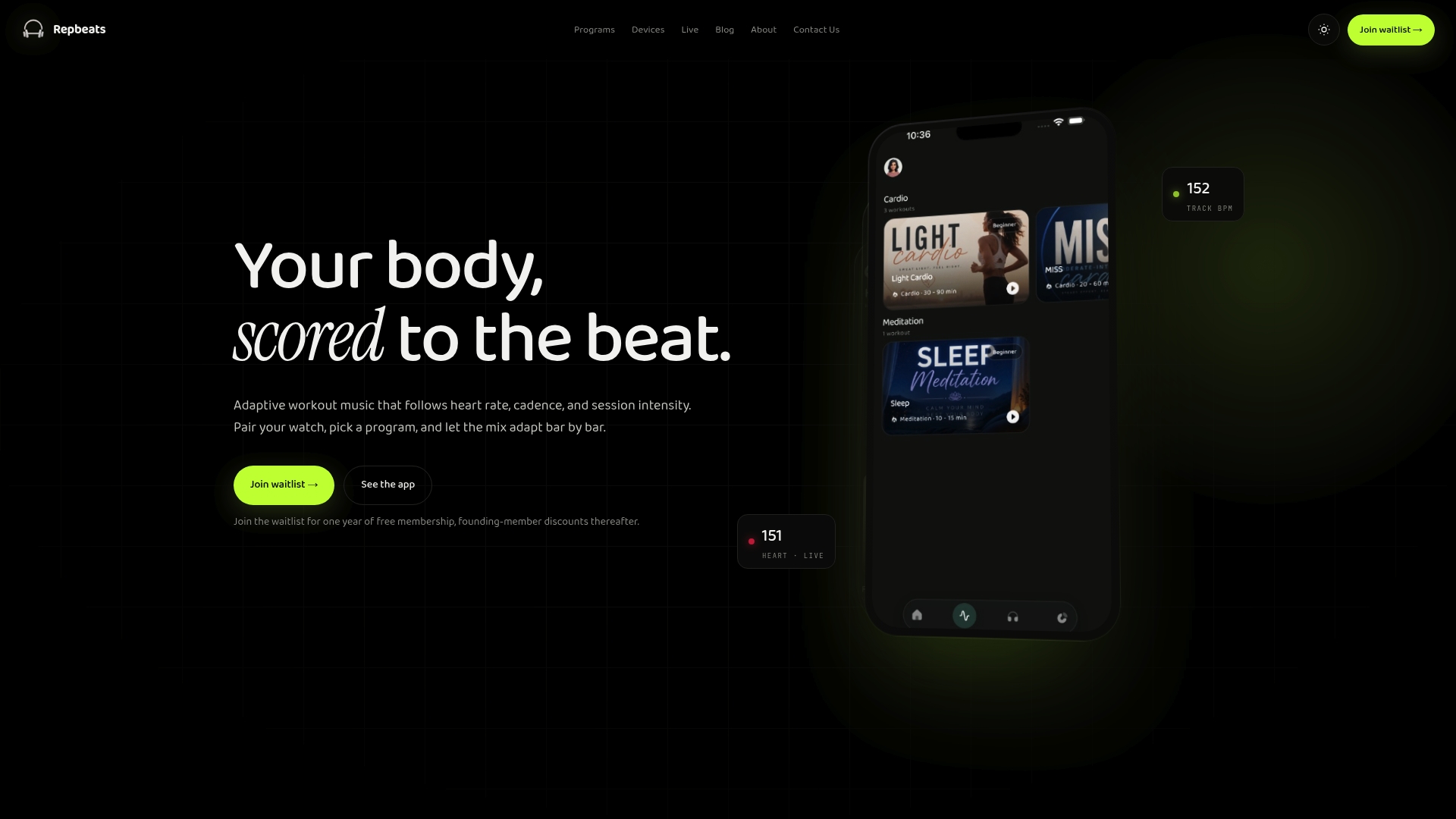
Repbeats reads your live heart rate from Apple Watch or Fitbit and adjusts the music tempo every bar, guiding you from wherever you are down to your target meditation zone. No manual playlist editing, no jarring tempo jumps, and no guesswork about which BPM to pick. The app includes dedicated meditation and cooldown programs alongside its cardio modes, so the same session that ends your run can flow directly into a structured cooldown. Available on iOS and Android, with a free year included at launch. Repbeats and let the music follow your body instead of the other way around.
Sources
- The Science of Using Music to Relieve Stress - Ask The Scientists
- World’s Most Relaxing Song May Reduce Anxiety by 65%
- Best meditation music: 7 types to try in your practice — Calm Blog
- Key & BPM for Meditation Zen (Best Meditation Music) - Tunebat
- Emotiv | Brain Data Measuring Hardware and Software Solutions