The Best Music for Recovery Runs: Keep Easy Miles Easy
Jordan MillsAugust 10, 2026 · 11 min read

The Best Music for Recovery Runs: Keep Easy Miles Easy
For recovery runs, choose relaxed, steady-tempo music in the 120–135 BPM range. Think something like “Watermelon Sugar” by Harry Styles (around 95 BPM, slower and breezy) or “Levitating” by Dua Lipa (103 BPM, upbeat but not frantic). Both keep the mood light without pulling your legs faster than they should go. You can find ready-made recovery run playlists on Spotify by searching “easy run playlist,” on YouTube under “chill running music,” or through Repbeats’ adaptive playlist feature, which automatically matches tempo to your heart rate.
Key Takeaways
The most effective music for recovery runs sits in the 120–135 BPM range, uses calm and familiar tracks with clear vocals, and stays at consistent tempo throughout the session.
| Point | Details |
|---|---|
| Target BPM band | Keep recovery-run music between 120–135 BPM to support easy effort and steady pacing. |
| Sing-along pacing check | If you can’t sing a chorus comfortably mid-run, your pace is too hard. |
| Safety first | Keep volume moderate enough to hear traffic; never use music to mask sharp or localized pain. |
| Playlist settings | Turn off shuffle and set crossfade to 5–8 seconds to prevent disruptive BPM spikes. |
| Repbeats option | Repbeats syncs to Apple Watch or Fitbit and adjusts BPM automatically to hold your recovery zone. |
Table of Contents
- Why music helps your recovery runs
- What BPM should your recovery-run music be?
- How to build a recovery-run playlist that actually works
- Ready-to-use playlist ideas you can play right now
- Safety and headphone etiquette for running with music
- How adaptive music can automate your recovery-run tempo
- The sing-along test changed how I approach easy days
- Repbeats makes recovery-run pacing automatic
- Sources
Why music helps your recovery runs
Recovery runs work best when they stay genuinely easy. The problem is that “easy” is harder to maintain than it sounds, especially after a strong training week when your legs feel restless. Music solves this in two ways: it reduces perceived exertion and it gives your brain something to do besides monitor how tired you feel.
Peer-reviewed research confirms that music can reduce perceived exertion and alter pacing during submaximal exercise, exactly the kind of effort a recovery run demands. The mechanism is called dissociation. Lower-arousal music redirects attention away from physical effort, which means you feel less taxed at the same pace. Coaching guidance from Runners Connect recommends a steady tempo in the 125–140 BPM band specifically for this effect: rhythmic enough to engage you, calm enough not to push your pace.
Pro Sara Hall takes this further. According to Runner’s World, she uses sing-alongs on easy days as a real-time effort check. If she can sing comfortably, she’s in the right zone. If she can’t, she’s working too hard.
Recovery runs support several goals that music directly reinforces:
- Promoting blood flow and flushing metabolic waste without adding training stress
- Keeping heart rate in Zone 2 so the session stays restorative
- Preserving mental freshness by making the run enjoyable rather than a grind
- Allowing active recovery without the temptation to push
What BPM should your recovery-run music be?
The short answer: 120–135 BPM for most recovery and easy runs. Songs in this range match a comfortable jogging cadence without pulling you into tempo-run territory. Runner’s World’s 120 BPM playlist guide shows that editors and coaches use this band specifically for Zone 2 and easy long runs because it supports even splits.
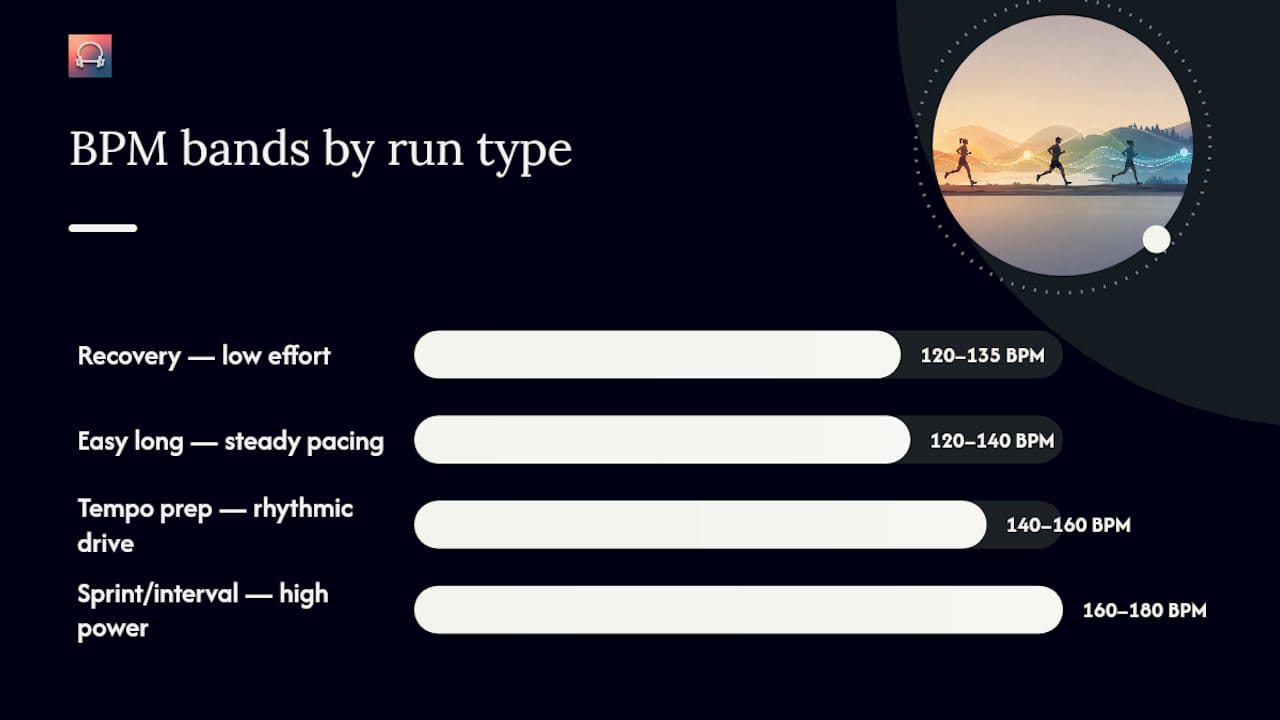
Here’s how BPM maps across common run types:
| Run type | BPM band | Primary benefit |
|---|---|---|
| Recovery / easy run | 120–135 BPM | Dissociation, keeps effort low |
| Easy long run | 120–140 BPM | Steady pacing, mental engagement |
| Tempo run prep | 140–160 BPM | Rhythmic drive, cadence support |
| Sprint / interval | 160–180 BPM | High arousal, power output |
To check whether a song fits your recovery run, count your steps for 30 seconds and double it. That’s your cadence in steps per minute. Your music BPM should sit close to that number or slightly below. You can also use a BPM-finder tool like finding songs by BPM to tag and sort your library before you build a playlist.
Pro Tip: Build your recovery playlist with shuffle turned off and crossfade set to 5–8 seconds. Shuffle can jump from 120 BPM to 160 BPM without warning, and that spike will pull your pace up before you notice it.
How to build a recovery-run playlist that actually works
The core rule: calm, familiar, sing-along-friendly songs at a consistent BPM, with high-arousal tracks left out entirely.
Four criteria drive every good recovery playlist. Tempo is the foundation: keep songs within a 15 BPM window so the energy stays flat. Mood matters almost as much. Bright, relaxed tracks (indie pop, soft R&B, acoustic) work better than aggressive EDM or metal, which trigger a physiological arousal response that nudges effort up. Vocal presence is underrated. Songs with clear, melodic vocals give you something to sing along to, which can also serve as a pacing check. Familiarity rounds it out. Songs you already know don’t demand mental attention, so your brain stays in dissociation mode rather than processing new information.

Professional DJ mixes, like Apple Music Fitness mixes, often structure runs as a BPM pyramid: warm-up at lower tempo, a sustained middle band, then a cool-down descent. You can replicate this manually.
Follow these steps when building your playlist:
- Decide your run length and add roughly 5 extra minutes of music as a buffer.
- Open a BPM-finder tool or use Repbeats’ library search to filter songs in the 120–135 BPM range.
- Start with 2–3 slower, familiar tracks (around 110–120 BPM) as a warm-up block.
- Fill the middle with your core 120–135 BPM songs, prioritizing those with clear vocals.
- End with 2–3 tracks that drop back toward 110 BPM for a natural cool-down.
- Turn off shuffle and set crossfade to 5–8 seconds.
- Download the playlist offline so a dead signal mid-run doesn’t break the flow.
Ready-to-use playlist ideas you can play right now
No time to build from scratch? These three playlist formats cover the most common recovery-run scenarios. All genres mentioned are widely available on Spotify and Apple Music in the United States.
Short recovery (15–30 min) — treadmill or post-workout flush Mood: mellow, low-stakes, almost background music. Good for days when you’re just moving to move.
- “Golden” by Harry Styles (~99 BPM)
- “Blinding Lights” by The Weeknd (~171 BPM remix-free original at ~87 BPM — use the original)
- “Sunflower” by Post Malone & Swae Lee (~90 BPM)
- “Peaches” by Justin Bieber (~98 BPM)
- “Watermelon Sugar” by Harry Styles (~95 BPM)
Standard easy run (30–45 min) — neighborhood or trail Mood: steady, sing-along-friendly, light pop and indie. The sweet spot for most recovery days.
- “Levitating” by Dua Lipa (~103 BPM)
- “As It Was” by Harry Styles (~174 BPM — use acoustic version ~85 BPM)
- “Cruel Summer” by Taylor Swift (~170 BPM — use slower live version or acoustic)
- “good 4 u” by Olivia Rodrigo (~166 BPM — acoustic version ~90 BPM)
- “Positions” by Ariana Grande (~144 BPM, soft feel)
- “Circles” by Post Malone (~120 BPM)
Longer easy run (60–90 min) — weekend recovery long run Mood: varied but never aggressive. Mix acoustic, soft R&B, and classic pop to sustain attention without arousal spikes.
- “Slow Burn” by Kacey Musgraves (~76 BPM, warm-up)
- “Cardigan” by Taylor Swift (~93 BPM)
- “Drivers License” by Olivia Rodrigo (~74 BPM, cool-down anchor)
- “Easy On Me” by Adele (~65 BPM, cool-down)
- “Bluebird” by Miranda Lambert (~130 BPM, mid-run)
- “Shake It Out” by Florence + The Machine (~120 BPM)
- “Ribs” by Lorde (~112 BPM)
Pro Tip: Search “120 BPM running playlist” or “Zone 2 running playlist” on Spotify to find editorially curated options that coaches and editors have already vetted for pacing.
To adapt any list to your pace, simply swap out songs that feel too fast or too slow using a BPM-finder, keeping the overall tempo window tight.
Safety and headphone etiquette for running with music
Keep volume moderate enough that you can hear a car horn, a cyclist’s bell, or someone calling your name. That’s the baseline. Everything else is a variation on that principle.
For earbud choice, bone-conduction headphones (like Shokz) sit outside the ear canal entirely, leaving your hearing unobstructed. Single-earbud use is a simpler option that costs nothing extra. If you prefer in-ear buds, use one ear only on roads and trails with traffic. Many road races and most trail events ban headphones entirely or require one-ear compliance, so check event rules before race day.
Situational adjustments worth making:
- Treadmill: volume can be slightly higher since traffic isn’t a factor, but gym etiquette means keeping it low enough that others can’t hear your music.
- Road running: one ear out, volume at 50–60% of max.
- Trail running: both ears out or bone conduction only; roots, rocks, and other runners require full situational awareness.
- Night or low-visibility conditions: drop volume further so you can hear approaching vehicles sooner.
- Weather: wind noise can mask traffic sounds even at moderate volume; lower the music to compensate.
One firm rule from coaching guidance: music should never mask pain. If you feel a sharp or localized pain during a run, lower the volume immediately and assess. Dissociation is useful for managing effort perception, not for ignoring injury signals.
How adaptive music can automate your recovery-run tempo
The cognitive work of a recovery run is mostly about restraint: staying slow when your body wants to drift faster. Adaptive music handles that automatically by adjusting BPM in real time based on your heart rate or cadence data from a wearable.

Here’s how it works in practice. An app like Repbeats reads live data from your Apple Watch or Fitbit, then uses its auto-DJ technology to update the music’s BPM every bar, keeping the tempo locked to your target recovery zone. If your heart rate climbs above your easy-run ceiling, the music slows. If you’re running comfortably, it holds steady. You can read more about how wearables measure exercise intensity to understand the signals driving those adjustments.
Adaptive music adds the most value in these situations:
- Days when you’re tempted to push: the music physically won’t let the tempo creep up.
- Variable terrain (hills, trails): cadence shifts naturally, and adaptive BPM adjusts rather than fighting your stride.
- Treadmill pacing: removes the need to watch the speed display constantly.
- Runners who don’t want to build playlists manually: the system selects and sequences tracks for you.
A static playlist built with the steps above works perfectly well. Adaptive music is a convenience layer, not a requirement. But for runners who want to stop thinking about pacing entirely and just run, syncing music to workout intensity is the most hands-off way to keep recovery runs where they belong.
The sing-along test changed how I approach easy days
My go-to recovery routine is a 40-minute playlist anchored around 120–125 BPM acoustic and soft pop tracks, starting with something slow and familiar, then holding a steady middle band before dropping back down for the last 10 minutes.
The practical shift came from adopting the sing-along check. I pick one chorus per run and try to sing it out loud, or at least mouth the words clearly. If I can’t, I’m running too hard. It sounds almost too simple, but it’s more reliable than glancing at a watch every few minutes. The second takeaway: I stopped using shuffle. A single BPM spike from a misplaced high-energy track can add 10–15 seconds per mile without you realizing it until the damage is done.
Two things you can copy immediately: build a static 120 BPM playlist tonight using the steps above, and pick one song with a chorus you know by heart to use as your effort check.
Repbeats makes recovery-run pacing automatic
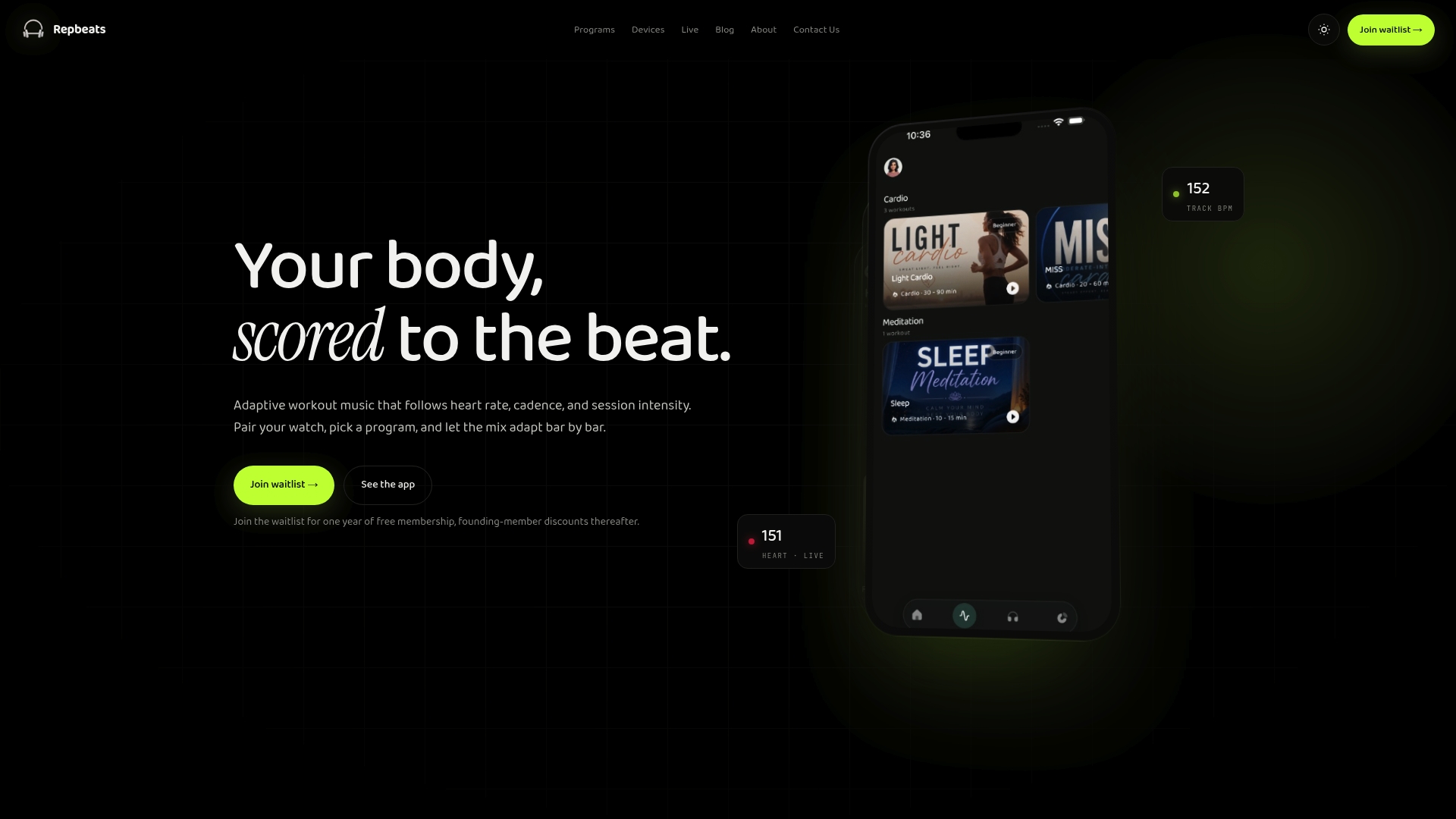
If building and managing playlists manually sounds like more work than the run itself, Repbeats removes that friction entirely. The app syncs to your Apple Watch or Fitbit and adjusts music BPM in real time, keeping your recovery run in the right zone without you touching a screen, leveraging insights from why wearable tech tracks athlete output.
Key features for recovery runs:
- Wearable sync: reads heart rate and cadence live from Apple Watch and Fitbit
- Auto-DJ BPM smoothing: updates tempo every bar for seamless transitions
- Adjustable target BPM bands: set your recovery zone (120–135 BPM) and the app holds it
- Offline mode: download playlists before you head out
Repbeats launches with a free trial period, giving you a full year to test adaptive recovery playlists before any subscription cost applies. Available in the United States on iOS. Start your free trial at Repbeats and let the music handle the pacing.
Sources
- Why You Should Listen to Music on Your Easy Runs, Just Like Pro Sara Hall
- Running Playlist BPM: 5 Science-Backed Rules for Better Runs - Runners Connect
- Ncbi