Cooldown Meditation Music, From 50–80 BPM to Heart Rate Sync
Jordan MillsOctober 15, 2026 · 8 min read

Cooldown Meditation Music, From 50–80 BPM to Heart Rate Sync
The best cooldown meditation music is slow, steady, and mostly instrumental, at roughly 50–80 BPM or with no pulse at all. Pair it with breathing near six breaths per minute for a 5–15 minute session after your physical cooldown. Move through arrive, settle, deepen, and return. Skip lyrics, sudden dynamic jumps, and fast pulses that wake your nervous system back up.
TL;DR:
- At 60 beats per minute, each beat lasts one second, so five beats can pace each inhale and exhale without checking a clock.
- Choose five to ten minutes for a reset, or ten to fifteen after training; HRV and performance benefits take four to eight weeks of practice.
- Change the sound gradually, no more than once every 30 to 60 seconds; if paced breathing feels forced, follow the music and lengthen your exhale.
- With a mental health or trauma history, consult a professional, avoid emotionally charged music, and do not exceed about 50 minutes without a treatment plan.
Table of Contents
- Why does music help your body shift out of training mode?
- What should you look for in tempo, timbre, and harmony?
- How should you structure a post-workout cooldown session?
- What does a ready-to-use cooldown playlist look like?
- What mistakes and safety points should you watch for?
- Our perspective: make the cooldown a habit, not a project
- Let your cooldown music follow your heart rate
- FAQ
- Sources
Why does music help your body shift out of training mode?
Hard training pushes you into a high-sympathetic state: elevated heart rate, fast breathing, a body primed for action. Recovery begins when you deliberately move toward a parasympathetic state, and your breath is the quickest lever you have. Research on slow breathing found that 4.5–7 breaths per minute improves vagal tone and heart rate variability (HRV), with about six breaths per minute commonly used as the target.
Music’s job here is practical. One recovery-focused source describes it as “sonic wallpaper”: present enough to hold the space, subtle enough to disappear. Drones, soft pads, and nature beds fit that description better than anything with a hook. Instrumental tracks also reduce distraction, which is why music meditation guidance favors them for stabilizing breath and focus.
Breathing target: about six breaths per minute (the range studied is 4.5–7) supports vagal tone and HRV.
What should you look for in tempo, timbre, and harmony?
Think of the track as a pacing device for your lungs. Use these rules, drawn from practical meditation music guidelines, as a filter when browsing:
- Tempo: breathwork works well at 56–68 BPM, a body scan at 50–60 BPM, and gentle movement at 65–80 BPM. For stillness, drop the pulse entirely.
- Texture: warm pads, long drones, singing bowls, soft piano, and nature beds. Avoid percussive hits and bright, sharp transients.
- Harmony: stay in one key or tonic. Pentatonic or gentle modal material keeps tension from building.
- Dynamics: keep volume consistent and changes minimal. A soft high-cut filter takes the glare off bright sounds.
- Familiarity: a track you personally find distracting will undermine the session, whatever its specs say, so personal preference counts.
Pro Tip: At 60 BPM, one beat equals one second, so a 5-second inhale and 5-second exhalation line up with five beats each.
If you want to go deeper on the sound design side, see our guide to ambient meditation music.

How should you structure a post-workout cooldown session?
Match the length to your time and your training load. For a quick reset, 5–10 minutes is enough. Athlete protocols describe a 10–15 minute parasympathetic reset as evidence-informed for recovery, and you can extend the session after a very hard workout.
Shape the session with a steady arc, and change the music slowly. Production guidance advises one change every 30–60 seconds and no surprises.
- Arrive: sit or lie down, let your breathing be whatever it is, and let the music start softly.
- Settle: shift to slow nasal breathing, around five seconds in and five seconds out.
- Deepen: hold the roughly six-breaths-per-minute rhythm, or run a body scan from feet to head.
- Return: let breathing go natural, notice the room, and let the music brighten slightly.
- Close: end on a soft tone or gentle fade, then open your eyes without rushing.
Interval bells work well as quiet timers marking each phase, so you never have to check a clock. If breathing at a fixed pace feels forced, simply follow the music and keep your exhale slightly longer than your inhale.
What does a ready-to-use cooldown playlist look like?
Build one of these from your streaming library, or look for tracks matching the archetypes below.
- 5–10 minutes: one minute to arrive, three to six minutes of core resonance breathing, one to two minutes to return. Use a 60 BPM pad, soft rain, and a single bowl strike to mark the end.
- 10–20 minutes: arrive for one to two minutes, settle for three to six, then deepen for six to ten with a body scan and a bowl strike every two to three minutes. Stay in the 50–66 BPM range, and exit over one to two minutes.
- 45–90 minutes (evening recovery): long arcs, slow fades, brief micro-silences, and very low dynamics. Sample recipes exist for 20, 45, and 90 minute sessions.
Archetypes to search for: a drone layered with rain, a pad with faint piano, a bowl interval piece, or a pure nature bed. Albums built for this purpose already exist, such as this post-workout meditation release. For help choosing between rain and instrumentation, read nature sounds versus music for meditation.
What mistakes and safety points should you watch for?
People respond to music very differently, and the American Music Therapy Association’s listening program guidance says so plainly: avoid songs that trigger intense emotional responses, and talk with a health professional if you have a mental-health or trauma history.
Session length: the same guidance advises against going beyond about 50 minutes per session without a treatment plan.
Common technical mistakes, with quick fixes:
- Sudden key or tempo changes: pick tracks that stay in one place, or fade between them.
- Loud transients: choose instrumentally minimal tracks with no sharp attacks.
- Melodic earworms: swap a tune you hum for a drone or pad.
- Uneven volume: normalize levels so no track jumps out.
- Emotionally charged lyrics: go instrumental.
Our perspective: make the cooldown a habit, not a project
Most athletes skip the cooldown meditation not because it fails but because it feels like extra admin. The fix is placement. Attach a short session to the end of your stretch, or do it before the drive home, and start there daily. Then build toward 10–15 minutes, since measurable HRV and performance benefits typically take four to eight weeks of consistent practice.
The part nobody enjoys is managing playlists with a sweaty thumb. That is where adaptive, wearable-synced music earns its place: tempo that follows your heart rate down removes a decision and nudges your breath toward a slower rhythm. For more on the idea, see how real-time heart rate guides soundscapes.
— Jordan Mills
Let your cooldown music follow your heart rate
We built Repbeats so your music adapts to you instead of the other way around.
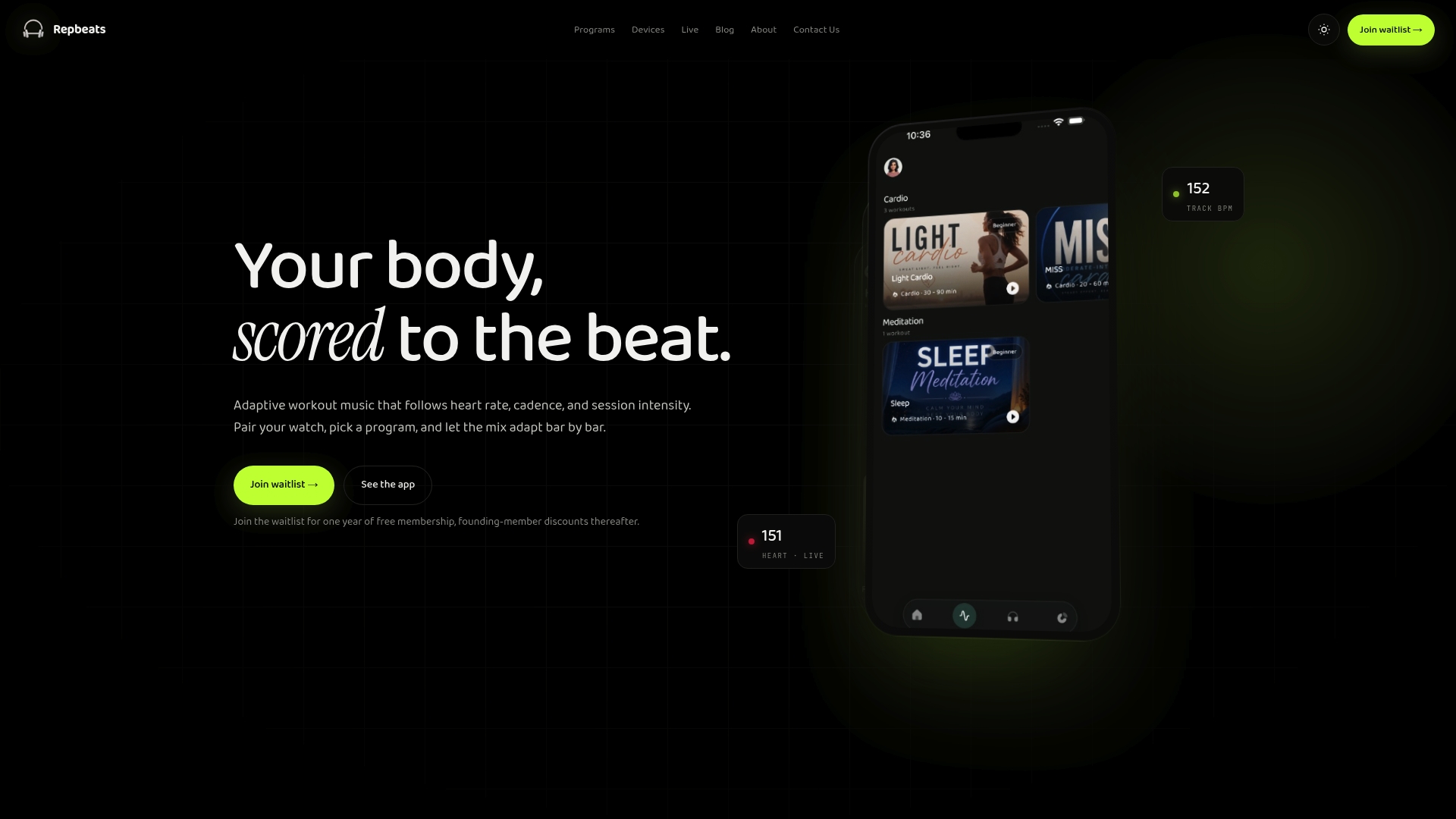
- We synchronize music tempo to your heart rate, cadence, and session intensity using popular wearables like Apple Watch and Fitbit.
- Our auto-DJ updates the beats per minute, so your tempo can ease down as your body does.
- We offer meditation programs alongside cardio, so your cooldown has a place in the same app.
Learn what we do on our about page, then try a cooldown after your next session.
FAQ
What BPM is best for cooldown meditation music?
Aim for slow, steady music at roughly 50–80 BPM, or choose pulse-free ambient tracks. Practical guidelines suggest about 56–68 BPM for breathwork and 50–60 BPM for body scans.
How long should a post-workout meditation last?
Five to ten minutes works for a quick reset. Athlete protocols describe 10–15 minutes as an evidence-informed parasympathetic reset, and longer sessions suit harder training days.
Should cooldown meditation music have lyrics?
Instrumental is the safer choice. Lyrics pull attention away from your breathing, and AMTA guidance cautions against emotionally charged songs.
Can music really help with breathing at six breaths per minute?
Yes, as a pacing aid. A steady track near 60 BPM gives you one beat per second, so you can count breaths against it while you aim for the resonance range studied for HRV.
Sources
- Pmc
- Best Music for Meditation and Deep Relaxation - Stress Audio
- Guidance for Music Listening Programs | American Music Therapy Association (AMTA)
- Meditation for Athletes: Evidence-Based Protocols for Performance and Recovery — The Workout Mag
- How to Make Meditation Music: Drones, Breath & Session Arcs | Veena