Athletes: 3 Evidence Based Templates for Effort Based Music
Jordan MillsOctober 4, 2026 · 17 min read

Athletes: 3 Evidence Based Templates for Effort Based Music
Music reliably improves mood and produces small-to-moderate gains in exercise performance, with the largest effects coming from fast-tempo and tempo-synchronized tracks. A meta-analytic review of 139 studies found consistent improvements in affect, performance, and perceived effort. For practice, that means stimulating, upbeat music works best before a workout, while tempo-synced or adaptive music works best during intervals and steady-state efforts.
TL;DR:
- Fast-tempo and tempo-synchronized music during exercise produce larger performance improvements and reduce perceived effort compared to slower or unsynchronized tracks.
- Pre-task music, especially self-selected, enhances exercise completion times, mood, and subjective feelings, but its effects on perceived exertion are limited during high-intensity efforts.
- Adaptive music systems that adjust tempo in real time based on heart rate or cadence show promising benefits, though current research is limited by small and short-duration studies.
- Synchronization benefits are most effective for rhythmic activities like running, cycling, and rowing, while mood-driven music better supports irregular or dynamic workouts.
- Matching BPM closely to workout cadence or effort level maximizes benefits, with slower tracks suited for recovery and high-arousal tracks for intervals or intense effort.
Table of Contents
- What the research says about music and exercise performance
- Why music changes how hard exercise feels
- How to match BPM to your workout for maximum effort
- Adaptive music systems and what the evidence shows
- Three workout templates to test effort-based music
- Where the evidence runs thin
- What years of watching this research taught me
- Putting adaptive music to work with Repbeats
- FAQ
- Sources
What the research says about music and exercise performance
The strongest evidence on effort based music comes from a meta-analytic review covering 3,599 participants and 598 effect sizes drawn from 139 studies. It looked at how music affects psychological, physiological, psychophysical, and performance outcomes during exercise and sport, and the pattern across all four domains points in the same direction: music helps, and tempo decides how much.
Three numbers from that review anchor almost everything else in this guide:
- Affective valence improved with a moderate effect (g = 0.48), meaning people simply felt better while exercising with music.
- Physical performance improved with a small-to-moderate effect (g = 0.31), covering outcomes like output, speed, and work completed.
- Perceived exertion dropped with a small effect (g = 0.22), so the same workout felt a little easier.
Fast-tempo music produced larger performance gains than slow-to-medium tempo music, according to the meta-analytic review, and exercise-context listening (gym sessions, runs, rides) tended to show stronger benefits than music used during competitive sport, where attention is already pulled toward the task itself.
Pre-task music, the kind played before the clock starts, carries its own body of evidence. A systematic review with multilevel meta-analysis of controlled studies analyzed 30 controlled studies through May 2023 and found that listening to music before exercise improved completion time, relative mean power, and peak power, along with strong gains on subjective feeling states. Self-selected music, tracks the athlete picked rather than ones assigned by a researcher, tended to produce the largest effects. That same review found pre-task music could lower cortisol after exercise and lift mood, though its influence on perceived exertion during intense effort looked more limited once the activity itself demanded most of the athlete’s attention.
A separate strand of research has moved from static playlists to systems that change the music in real time. A 2025 exploratory systematic review and meta-analysis of personalized interactive music systems, PIMS for short, looked at 17 intervention arms across 6 eligible studies. It reported significant improvements in physical activity levels and affective valence when adaptive systems were compared with non-adaptive music. Tempo itself acted as a significant moderator of the results (p = 0.04), meaning how fast the music ran mattered more than whether the system was adaptive at all. The same review flagged a real limitation: many included studies were small, short-duration feasibility trials rather than large randomized work, so the effect sizes, while promising, deserve some caution.

A large meta-analysis found that fast-tempo, synchronized music produces larger performance gains than slow or medium-tempo tracks, which is the single most useful fact for anyone building a workout playlist.
Put together, these three bodies of work tell a consistent story. Music before exercise lifts mood and primes performance. Music during exercise, especially fast and synchronized, nudges output up and effort down. Adaptive systems that adjust music in real time appear to amplify both effects, though the evidence base for adaptive systems is still younger and thinner than the decades of pre-task and in-task music research behind the headline meta-analysis.
Why music changes how hard exercise feels
Three separate mechanisms explain why a playlist can change a workout, and knowing which one is active tells you what kind of music to choose.
The first is auditory-motor synchronization, often called rhythmic entrainment. When a movement, a stride, a pedal stroke, a stroke rate, locks onto a musical beat, the body’s motor control system gets an external timing cue it can predict and use. That predictability appears to improve movement efficiency and can make effort feel more fluid, because the nervous system spends less energy on timing itself and more on producing force. This mechanism only works when the activity has a steady, repeatable rhythm: running, cycling, rowing, and similar movements qualify, while a HIIT circuit with constantly changing exercises does not.
The second mechanism is attentional distraction. Perceived exertion depends partly on how much spare attention is available to notice fatigue signals from the body. Music competes for that same limited attentional bandwidth, so some of the signal that would otherwise register as “this is hard” gets crowded out by the sound. The Ballmann review describes this as an intensity-dependent effect: at low-to-moderate effort, music has plenty of room to compete with fatigue signals and win, but as intensity rises toward maximal effort, internal signals from working muscles and labored breathing start to dominate attention regardless of what’s playing. That same review also notes that some randomized controlled trials found no perceived exertion benefit at very high intensities, which lines up with the distraction model: there’s only so much attentional capacity to redirect.
The third mechanism runs through mood and arousal rather than attention or motor timing. Upbeat, energizing music raises psychological arousal and vigor, which can shift pacing decisions and raise an athlete’s willingness to sustain a hard effort a little longer. This pathway explains why pre-task music, heard before the body is even under load, still produces measurable performance gains: it’s not changing movement mechanics, it’s changing the athlete’s state going into the effort.
- Synchronization suits rhythmic, repeatable movements like running, cycling, and rowing, where a beat can lock to a stride or stroke.
- Distraction works best at low-to-moderate intensities, where there is still spare attention for music to occupy.
- Mood and arousal effects show up most clearly before exercise starts or during steady, sustainable efforts.
- Mixed or irregular movement (circuit training, team sports) usually benefits more from motivational music than strict tempo matching.
Knowing which mechanism is doing the work changes what you should actually play. For a tempo run or a long cycling effort, synchronization matters, so BPM-matched music earns its place. For a warm-up or a workout built from constantly changing movements, the mood and distraction pathways matter more than beat-matching, so energizing, preferred music beats a precisely tempo-mapped track.
Pro Tip: Save strict BPM matching for steady, rhythmic efforts like tempo runs or endurance rides, and switch to simply energizing, preferred music for warm-ups and mixed-movement training.
How to match BPM to your workout for maximum effort
Turning the mechanisms above into a usable system starts with tempo. Running cadence for most recreational runners sits in a broad band, and matching music BPM to that cadence is the most direct way to put auditory-motor synchronization to work. Cycling cadence operates differently, since pedaling rhythm is usually slower and steadier than running stride rate, which makes cycling one of the most forgiving activities for strict 1:1 tempo matching. Rowing follows a similar logic: stroke rate is slow and highly regular, so a tightly matched BPM track can lock in almost perfectly.
Here is a simple way to build your own tempo map:
- Measure your actual cadence for the activity, counting steps, pedal strokes, or rowing strokes per minute rather than guessing.
- Match BPM to cadence directly for activities with a 1:1 stride-to-beat relationship, or to half the cadence if you prefer a beat every other step.
- Allow a window of about plus or minus 4 to 6 BPM around that target, since musical phrasing rarely lands on an exact number and a small offset still feels synchronized.
- Prefer strict synchronization for cycling and rowing, where cadence is steady and predictable, and loosen the rule for running or variable-stride activities, where stride length naturally drifts with fatigue and terrain.
- Reserve the fastest tempo tracks for intervals and tempo efforts, since faster tempo produced the larger performance gains in the meta-analytic review, and save slower, lower-arousal tracks for recovery intervals or cool-downs.
Song structure matters as much as BPM. A track with a big motivational chorus is most useful when that chorus lands during the hardest part of an interval, not during the recovery jog between reps. Trimming intros, extending choruses, or using “outpoint” style rearrangement to shift a song’s peak section toward an interval’s peak effort keeps the motivational payoff where it does the most good, and avoids the flat feeling of a song fading into its quiet bridge section just as the work gets hardest. Guides on efficient playlist creation cover practical techniques for this kind of transition management, which becomes especially useful once you’re building playlists by hand rather than relying on an adaptive system.
Self-selected music tends to outperform pre-selected music, according to the pre-task music meta-analysis, which found larger effects on completion time and feeling states when athletes chose their own tracks rather than having music assigned to them. That preference effect matters most for motivation and mood; for strict synchronization work, a song you don’t love but that happens to sit at exactly the right BPM can still deliver the motor-timing benefit even if it scores lower on enjoyment. Our tempo and pacing guide covers additional detail on matching rhythm to different training phases.
Adaptive music systems and what the evidence shows
Personalized interactive music systems, or PIMS, are platforms that adjust a track’s tempo in real time based on data from the athlete, most often heart rate or cadence, rather than playing a fixed, pre-built playlist. The core features that define a PIMS are real-time tempo adjustment, integration with a sensor or wearable data stream, and some degree of personalization to the individual’s effort level rather than a one-size-fits-all BPM target.
The 2025 exploratory systematic review and meta-analysis is the most direct evidence on how well these systems work. Adaptive systems produced improvements in physical activity levels and affective valence compared with non-adaptive music. Tempo moderated these results significantly (p = 0.04), which supports the broader finding across the research that tempo, not just adaptivity itself, drives much of the benefit.
- Heart-rate-based mapping adjusts BPM as heart rate climbs or drops, aiming to keep musical energy aligned with physiological effort.
- Cadence-sync matches BPM directly to stride or pedal rate measured from a wearable, supporting the auditory-motor synchronization mechanism described earlier.
- Workouts that benefit most tend to be steady-state or interval sessions with a clear effort structure, like tempo runs, threshold rides, or structured cardio intervals.
- Feasibility-stage evidence means many PIMS studies so far are short, small, proof-of-concept trials rather than long randomized work, so treat individual claims with some caution even as the category-level effect looks promising.
For athletes using wearables like a running watch or heart rate strap, the practical appeal of PIMS is removing the manual work of building and re-sequencing playlists by hand. Our guide on how wearables measure exercise intensity covers the data side of this integration in more detail, including what a device can and cannot capture accurately mid-session.
Three workout templates to test effort-based music
Three session types illustrate how to put these principles into practice, each targeting a different mechanism from earlier in this guide.
- Tempo-synced interval session: Run or ride 6 to 8 intervals of 3 minutes each, matching BPM to your measured cadence with a plus or minus 5 BPM window, and place each song’s highest-energy section at the midpoint of the interval rather than the start.
- Cadence-matched tempo run: For a continuous 20 to 40 minute tempo effort, build a single playlist at a fixed BPM matched to your steady-state cadence, prioritizing cycling or rowing if your stride is less consistent than your pedal or stroke rate.
- Pre-task power warm-up: Spend 8 to 10 minutes before a max-effort session listening to fast, self-selected, high-arousal music with no synchronization requirement since the goal here is mood and motivation rather than motor timing.
A short implementation checklist keeps the testing process honest rather than anecdotal. Start by measuring your actual cadence or heart rate zones for the session type you’re testing. Pick a BPM target or playlist based on the template that matches your workout. Trial it across one or two sessions rather than a single run, since a single bad night of sleep can skew how a session feels. Track both your subjective perceived exertion and an objective marker, pace, power, or heart rate, so you’re not relying on feel alone. Then adjust the BPM window or song selection based on what the data and the feeling both tell you.
A few implementation errors show up repeatedly. Song structure mismatches happen when a track’s energetic section lands during a rest interval instead of the work interval, which wastes the motivational payoff exactly when it matters most; rearranging or trimming the track, or choosing a different one, fixes this. Latency with wearables can cause BPM to lag a few seconds behind actual cadence or heart rate changes, which feels jarring during fast transitions; this is a known limitation of real-time data streaming and tends to be more noticeable on sudden intensity changes than during steady efforts. Abrupt tempo shifts between songs can break synchronization rhythm entirely, so a system or playlist that ramps BPM gradually between tracks holds the auditory-motor benefit better than one that jumps instantly from a slow song to a fast one.

Pro Tip: Test any new effort-based playlist across at least two sessions before judging it, since a single outlier workout (bad sleep, high stress, unfamiliar route) can make even a well-matched playlist feel wrong.
Our guide to syncing music with workout intensity walks through additional phase-by-phase pacing examples if you want more structured templates to adapt.
Where the evidence runs thin
Music’s benefits are not unlimited, and knowing the boundaries matters as much as knowing the headline effects.
- High-intensity ceiling: benefits appear to shrink as intensity climbs toward maximal effort, since internal fatigue and breathing signals increasingly dominate attention regardless of what’s playing, a pattern the Ballmann review describes as intensity-dependent.
- Small, heterogeneous PIMS studies: the 2025 exploratory review covered only 6 eligible studies and 17 intervention arms, several of them short feasibility trials, so the large effect sizes reported deserve a cautious read until larger randomized work replicates them.
- Individual differences: music preference, training status, and even personality traits moderate how much benefit any given athlete gets, which is part of why self-selected music consistently outperforms assigned tracks in the pre-task literature.
- Research gaps: the field still needs longer randomized trials, more standardized ways of measuring perceived exertion and performance, and objective, hardware-based endpoints rather than self-report alone.
None of this undercuts the core finding. It simply means effort-based music is a genuine, moderate-sized tool, not a guarantee, and it works best as one input among several rather than a substitute for training fundamentals.
What years of watching this research taught me
The biggest misconception about effort-based music isn’t that people overestimate it, it’s that they apply it backward. Most runners and cyclists default to the loudest, most aggressive track they own for the hardest part of a workout, when the research actually points toward tempo and synchronization mattering more than raw energy or genre. A moderately paced, precisely BPM-matched track will often beat a screaming, off-tempo anthem for a steady tempo effort, because the mechanism doing the work is motor timing, not adrenaline.
The second thing people get wrong is treating all workouts the same. A circuit session with constantly shifting movements has no steady rhythm to synchronize with, so chasing BPM precision there is largely wasted effort. That’s a mood and arousal problem, not a synchronization problem, and the fix is picking music you genuinely like, not music that hits an exact number.
What stands out most from the data is how much the PIMS research, thin as it still is, points toward real-time adjustment mattering more than static personalization. A playlist built once and never touched again, even a well-built one, is working against a body that changes effort level constantly. Systems that adjust mid-session are solving a real problem, even if the long-term randomized evidence is still catching up to the early results.
— Jordan Mills
Putting adaptive music to work with Repbeats
The research is clear that tempo matching and real-time adjustment carry some of the largest benefits in the effort-based music literature, but building that by hand, measuring cadence, calculating BPM windows, re-sequencing playlists mid-run, is a lot to manage while you’re also trying to train. That’s the specific problem our app solves.
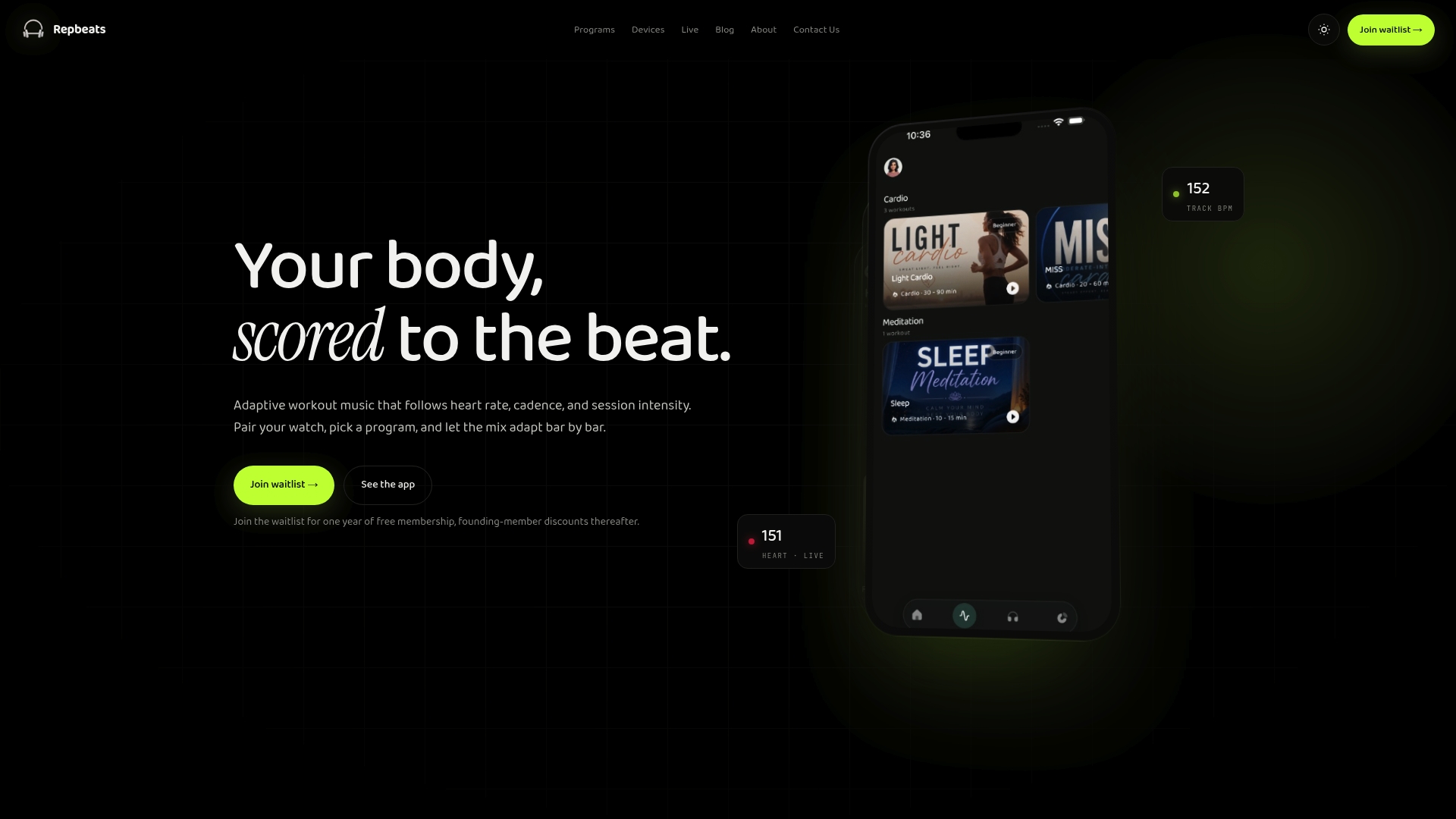
Our Repbeats app syncs music tempo to your heart rate, cadence, and session intensity using live data from wearables like Apple Watch and Fitbit, so the BPM-to-cadence mapping described earlier happens automatically instead of manually. Our technology updates beats per minute every single bar, which keeps pace with real-time changes in effort rather than locking you into one static playlist for an entire session.
- The system pulls live data from popular wearables to adjust music tempo as intensity changes.
- Technology updates BPM every bar, so the music tracks effort in real time rather than lagging behind it.
- Cardio and meditation programs are supported, covering both high-synchronization training and lower-arousal recovery work.
Effort-based music works best as one part of a broader training approach, so keep tracking your own perceived exertion and objective markers even while trying it. Visit our Repbeats page to see how the adaptive system works and what to expect from a trial session.
FAQ
What songs talk about effort and relationships?
Many popular songs use physical effort and exercise as a metaphor for emotional work in relationships, though no systematic research catalogs this as a category. If you’re building a workout playlist, song lyrics matter far less than tempo and personal preference, which are the factors the performance research actually measures.
What type of music do high IQ people listen to?
There is no reliable scientific consensus linking a specific music genre to intelligence, and no source in the effort-based music research addresses this question. Music choice for exercise performance depends far more on tempo, personal preference, and workout type than on genre or any association with intelligence.
What is the 35 year rule in music?
There is no established “year-based rule” recognized in the music or exercise science research reviewed here. Definitions of this phrase vary across informal sources, so it is not something supported by the meta-analytic or systematic review evidence this guide draws on.
What is the best music to listen to for productivity?
The clearest research-backed guidance is for exercise rather than general productivity: fast-tempo, self-selected music tends to produce the largest performance and mood benefits during physical effort. For focused desk work, the same general principle of choosing preferred music over assigned tracks likely applies, though that specific context falls outside the exercise-focused studies cited here.
Sources
- Effects of Music in Exercise and Sport: A Meta-Analytic Review
- Personalized Interactive Music Systems for Physical Activity and Exercise: Exploratory Systematic Review and Meta-Analysis
- The effects of pre-task music on exercise performance and associated psycho-physiological responses: a systematic review with multilevel meta-analysis of controlled studies
- The Influence of Music Preference on Exercise Responses and Performance: A Review