The Best Fartlek Workout Music: Playlists, BPM Rules, and Templates
Jordan MillsAugust 9, 2026 · 14 min read

The Best Fartlek Workout Music: Playlists, BPM Rules, and Templates
Use a playlist that maps low-energy song sections to easy jogging and high-energy choruses to surges. That’s the core mechanic of a music-driven fartlek, and it works immediately with zero gear. Open a fartlek-labeled Spotify album, warm up for 5–10 minutes at an easy pace, then let the first chorus signal your first surge. If you want the tempo to adjust automatically to your cadence and heart rate, Repbeats handles that without any manual skipping. Research published in PLOS ONE confirms that synchronizing music to cadence increases time-to-exhaustion compared with running in silence, and a Frontiers randomized crossover study found the same benefit holds even in hot, humid conditions.
Key Takeaways
Tempo-synced music, matched to your cadence rather than just played at high volume, consistently extends time-to-exhaustion and lowers perceived exertion in controlled running studies.
| Point | Details |
|---|---|
| Map song sections to effort | Verse = easy jog, pre-chorus = ramp, chorus = surge, bridge = active recovery. |
| Match BPM to phase | Use 125–135 BPM for easy jogging and 165 BPM for sprint intervals. |
| Evidence backs tempo-sync | PLOS ONE and Frontiers studies both show longer run time and lower RPE with cadence-matched music. |
| Static vs. adaptive playlists | Static playlists suit flat routes; adaptive apps like Repbeats suit varied terrain and wearable users. |
| Safety first outdoors | Keep one ear open and cache your playlist offline before every run longer than 45 minutes. |
Table of Contents
- Where can you find ready-made fartlek playlists?
- How does song structure map to fartlek effort changes?
- How do you build a fartlek playlist that actually works?
- Ready-to-run music-driven fartlek workout templates
- Why does tempo-synced music actually improve running performance?
- How do wearables and apps auto-sync music to your cadence?
- Safety and practical tips for music-driven fartleks
- Why adaptive music is worth trying for your fartlek
- Repbeats syncs your fartlek music to your actual pace
- Why I think adaptive music is the underrated edge in fartlek training
- Sources
Where can you find ready-made fartlek playlists?
The fastest starting point is Spotify. Search “fartlek run” or “interval running” and you’ll find albums like Fartlek Run: Music For Running By Fartlek Training Method that are already sequenced for effort changes. The Suno Fartlek Running Playlist offers a varied genre mix with tracks explicitly structured for verse/chorus mapping. Podcast-style running shows on Spotify also embed coaching cues between tracks, which removes the guesswork entirely.
Static playlists are free, quick, and require no setup. Their limitation: they don’t know your pace. If your cadence drifts on a hill or your HR spikes earlier than expected, the playlist keeps playing at its fixed tempo while you’re already out of sync.
That’s where adaptive apps earn their place. Repbeats reads live cadence and heart rate data from wearables like Apple Watch and Fitbit, then updates the music’s BPM every bar to match your current effort zone. No manual skipping, no tempo mismatch on a climb.
- Static playlists (Spotify, Suno): best for flat routes, predictable pacing, and first-time music fartleks.
- Adaptive apps (Repbeats): best for varied terrain, wearable users, and anyone who wants cadence-locked intervals without touching their phone.
Pro Tip: If you’re running trails or a hilly road loop, go adaptive. A static playlist timed for flat-road surges will fire a chorus right as you’re grinding uphill, which breaks the effort cue entirely.
How does song structure map to fartlek effort changes?
The song itself becomes your interval timer. Map slower, lower-energy sections to easy jogging and high-energy sections to surges, and you’ve built a fartlek without a stopwatch.
A standard pop or rock track gives you a natural four-part structure. The verse carries moderate energy, perfect for a comfortable jog. The pre-chorus ramps tension, which maps to a controlled acceleration. The chorus hits hard, and that’s your surge. The bridge or post-chorus drops back, signaling active recovery. Lifehacker’s music-fartlek guide describes this approach directly and notes that fartlek has “no wrong answers,” so skipping or repeating a track mid-run is a legitimate adjustment, not a failure.
The underlying mechanism is auditory-motor synchronization. When a beat is prominent and consistent, your footfalls naturally lock to it, which stabilizes cadence and reduces the energy cost of maintaining a pace. Tracks where the verse and chorus are clearly distinct in energy make this locking effect stronger. Songs with a muddy, undifferentiated structure, where every section sounds roughly the same, don’t give your body a clear cue to shift gears.
If a song’s sections aren’t distinct enough, treat the whole track as a single surge or recovery block rather than forcing a mapping that isn’t there. The design-HIIT guidance on song-structure intervals recommends using audio-analysis tools to check section timestamps before building a playlist, which takes about two minutes per track.
How do you build a fartlek playlist that actually works?
Start with BPM. The tempo of a track sets the ceiling for how fast your cadence can naturally lock to the beat. A practical BPM guide maps workout phases to these ranges:
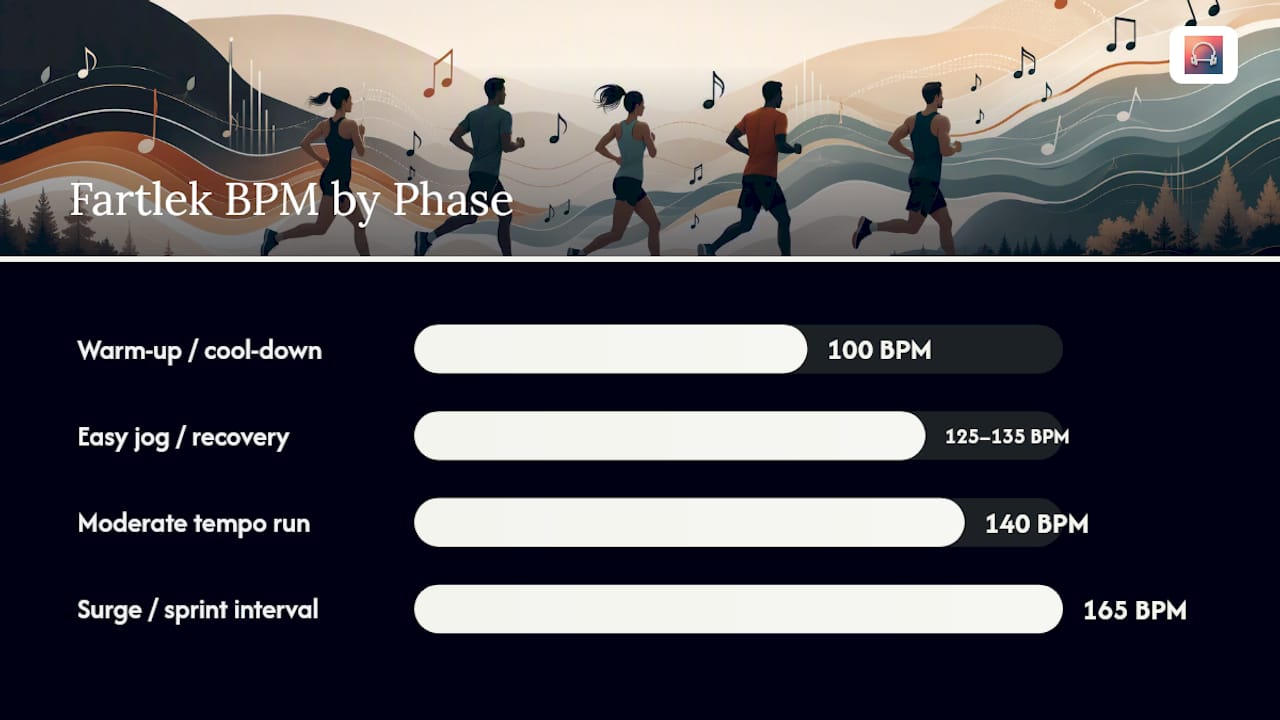
| Running Phase | BPM Range | Example Genres |
|---|---|---|
| Warm-up / cool-down | 100 BPM | Acoustic, lo-fi hip-hop |
| Easy jog / recovery | 125–135 BPM | Pop, indie rock |
| Moderate tempo run | 140 BPM | Hip-hop, electronic, rock |
| Surge / sprint interval | 165 BPM | EDM, drum and bass, punk |
Beyond BPM, four rules make a playlist reliable:
- Clear section contrast: choose tracks where the chorus is noticeably louder, faster, or more energetic than the verse. Artists like Dua Lipa, Kendrick Lamar, and AC/DC tend to have high contrast. Ambient or lo-fi tracks rarely do.
- Chorus length matching your target interval: a 30-second chorus maps to a short sprint; a 45–60-second chorus suits a longer tempo surge. Check this before adding a track.
- Consistent beat: avoid tracks with heavy syncopation or irregular time signatures during surge sections. A 4/4 beat with a prominent kick drum locks cadence most reliably.
- Sequencing: alternate a surge-tempo track (165+ BPM) with a recovery-tempo track (125–135 BPM) rather than stacking all your hard songs together.
For songs with multiple high-energy sections, decide in advance: either treat every chorus as a surge (good for short-interval workouts) or designate only the final chorus as the surge and jog through the earlier ones. Mixing those decisions mid-run breaks the rhythm of the session. The sync music to workout intensity guide covers how to pre-map this before you lace up.
Ready-to-run music-driven fartlek workout templates
These four templates are built around song durations and section lengths. Each one assumes a 5–10 minute easy warm-up jog and a 5-minute cool-down walk or easy jog, as Lifehacker recommends and Men’s Health’s fartlek guide reinforces for RPE-based scaling.
-
5-4-3-2-1 Pyramid. Pick five tracks in descending chorus length: roughly 60s, 50s, 40s, 30s, and 20s choruses. Surge through each chorus at RPE 8, jog through each verse at RPE 4–5. Total surge time drops with each song, so effort increases as fatigue builds. Total workout: 25–35 minutes including warm-up and cool-down. Shorten by using 3 tracks instead of 5.
-
Repeated chorus sprints. Choose one high-energy track with a clear, repeating chorus (think a 3-minute pop song with three distinct choruses). Surge every chorus at RPE 8–9, recover every verse at RPE 4. Repeat the track 3–4 times. This is the simplest template for beginners because the effort cue is identical every round. Total workout: 20–25 minutes.
-
Long-surge steady pop. Select 3–4 tracks with extended, high-energy sections lasting 60–90 seconds (stadium rock, anthemic EDM). Surge the entire high-energy section at RPE 7, recover during verses and bridges at RPE 4–5. This template builds aerobic capacity rather than pure speed. Total workout: 30–40 minutes.
-
Hills mapped to song sections. Use a track with a long build (verse + pre-chorus) to cover the uphill approach, then hit the chorus at the crest and carry the surge 10–15 seconds past the top. Recover on the descent during the bridge or outro. Men’s Health notes that hill fartleks naturally increase RPE, so drop your surge target by one RPE point (aim for 7 instead of 8) when the gradient is steep.
Pro Tip: If a chorus is shorter than your target interval, queue the next track immediately and treat its intro as a continuation of the surge. Pairing two 20-second choruses back-to-back gives you a 40-second effort block without any tempo gap.
Why does tempo-synced music actually improve running performance?
The short answer: it keeps your cadence stable and makes hard efforts feel less hard. The PLOS ONE study on auditory-motor synchronization tested three conditions on a treadmill: no music, a metronome synchronized to cadence, and motivational music matched to cadence. Both acoustic conditions produced longer time-to-exhaustion than silence, pointing to cadence consistency and running efficiency as the primary drivers.
The Frontiers crossover study pushed this further by running participants in a heat chamber. With synchronous music, they ran longer and reported lower perceived exertion than in the no-music trials, with moderate-to-large effects in a small sample of approximately 12 participants. The heat context matters for summer training: the benefit of tempo-synced music appears to hold even when environmental stress is high.
Key finding: Synchronous music, meaning music matched to your cadence rather than just any high-energy playlist, produced the strongest performance effects in both studies.
The practical design rule that follows: a track with a prominent, consistent kick drum or bass line enables cadence locking better than a track that is simply loud or emotionally intense. High energy alone doesn’t produce the synchronization effect. The beat has to be clear enough for your nervous system to latch onto it. The Repbeats article on how music tempo affects your workout explains the physiological pathway in more detail if you want to go deeper.
How do wearables and apps auto-sync music to your cadence?
The setup takes about three minutes. Pair your wearable (Apple Watch, Fitbit, or a compatible Garmin) with the app, set your target cadence range or HR zones, choose a song pool or let the app select tracks, then start running. The app reads live data and adjusts the music’s BPM to match your current cadence or zone.
Repbeats handles this with its auto-DJ engine, which updates the BPM every bar rather than waiting for a full song to finish. That granularity matters during a fartlek: when you surge, the tempo shifts up within seconds rather than waiting for a track transition. When you recover, it drops back without you touching your phone. The wearable cadence data guide walks through how to export or use cadence data to pre-build BPM-matched playlists as a complement to live sync.
A few troubleshooting points worth knowing:
- Tempo sounds off: usually a cadence mismatch. Check whether your wearable is reading steps per minute or strides per minute (double-count error). Adjust the target cadence in the app by half if the music feels twice as fast as your stride.
- Beat feels too slow during surges: increase your target HR zone ceiling or set a minimum BPM floor so the app doesn’t drop below surge tempo during a brief HR lag.
- Dropouts mid-run: cache your song pool offline before leaving the house. Streaming-dependent apps lose sync on dead-signal routes.
Wearable tech tracking for athletes has expanded significantly, and the NSB guide on wearable athlete output tracking covers how modern devices capture cadence, HR, and power data that adaptive music apps can use. The Repbeats guide on how wearables measure exercise intensity goes into the specifics of how those signals translate into tempo decisions.
Safety and practical tips for music-driven fartleks
Always run 5–10 minutes easy before your first surge. Your tendons and connective tissue need that ramp-up time regardless of how motivated the playlist makes you feel at the start.
For outdoor runs, keep at least one ear open. Bone-conduction headphones (AfterShokz/Shokz models are the most widely used) let you hear traffic and trail hazards while keeping the beat audible. A single earbud in your dominant ear works too. Never run near traffic with both ears fully sealed by noise-isolating earbuds, regardless of how well the playlist is working.
Pro Tip: Before a long run, download your playlist or cache your Repbeats song pool offline. Bluetooth latency and signal dropouts kill the cadence-lock effect mid-surge, and re-syncing while running is a distraction you don’t need.
A few terrain-specific adjustments:
- On steep uphills, let the song play without forcing a surge. Use the climb itself as the effort and treat the chorus as a mental cue to maintain form rather than accelerate.
- At traffic stops, pause the timer mentally but keep the music running. Resume your effort cue at the next chorus rather than trying to restart the song.
- On treadmills, the cadence-lock effect is strongest because pace is controlled. Use this setting to calibrate your BPM preferences before taking a music-fartlek outside.
Battery prep matters on runs longer than 45 minutes. Charge your wearable and headphones the night before, and check that your app’s offline cache is current. A dead earbud at minute 30 of a 50-minute session is a fixable problem that takes 30 seconds to prevent.
Why adaptive music is worth trying for your fartlek
Most runners who try a music-fartlek once stick with it, but they often plateau at the same playlist. The real leverage comes from testing one session per week where the music drives the pacing decision rather than a watch or a coach’s plan. That single shift, letting the chorus tell you when to go, removes the cognitive load of interval timing and frees you to focus on form and breathing.
Static playlists work well enough on familiar routes. The gap shows up on varied terrain, in heat, or when fatigue arrives earlier than expected. A chorus that fires at the wrong moment either forces a surge you can’t sustain or trains you to ignore the cue entirely, which defeats the purpose. Adaptive tempo-sync solves this by keeping the music’s energy level calibrated to where you actually are, not where the playlist assumed you’d be.
The metric worth tracking over a two-week trial: HR recovery after each chorus surge. If your HR drops faster between surges by week two, the cadence-locking and pacing consistency are working. That’s a more honest signal than perceived effort alone, and it gives you something concrete to adjust, whether that’s BPM ceiling, surge duration, or recovery length.
Repbeats syncs your fartlek music to your actual pace
Every fartlek is different. Your pace on Tuesday after a rest day is not the same as Friday after a hard week, and a static playlist doesn’t know the difference. Repbeats does. It reads your live cadence and heart rate from Apple Watch or Fitbit and updates the music’s BPM every bar, so the tempo always matches the effort you’re actually putting out, not the effort the playlist assumed.
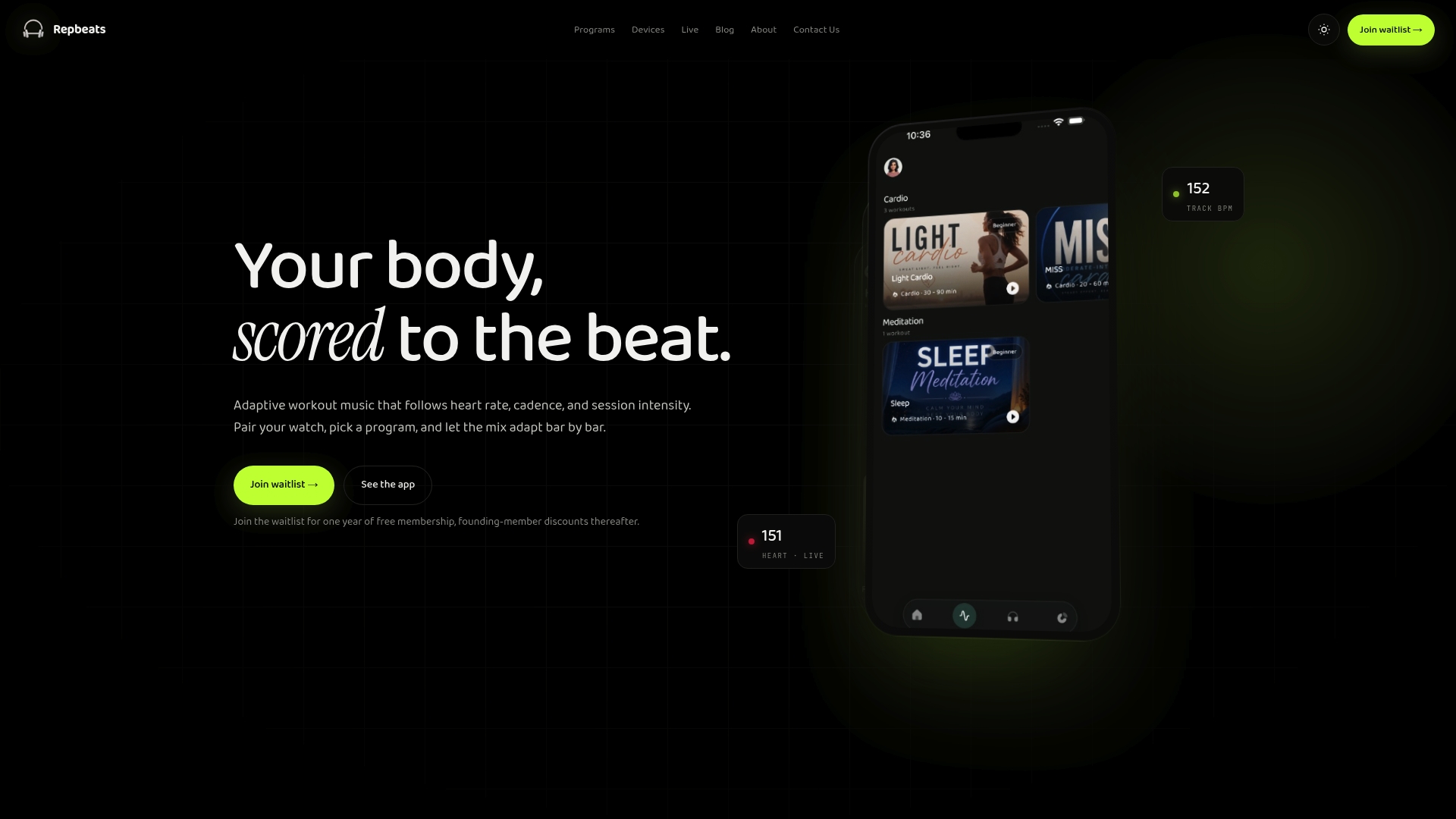
For fartlek runs specifically, Repbeats’s auto-DJ engine means the surge sections of your music arrive when your body is ready for them, not on a fixed clock. You get curated song pools built for interval structure, real-time tempo shifts that eliminate manual skipping, and the same wearable integrations that power serious training apps. The free trial gives you full access to test a complete fartlek session with wearable sync before committing to a subscription. Start your first adaptive fartlek session at Repbeats and see how different it feels when the music moves with you.
Why I think adaptive music is the underrated edge in fartlek training
The conventional wisdom says fartlek is about freedom: run hard when you feel like it, back off when you don’t. That’s true, and it’s also why most runners’ fartlek sessions quietly drift into glorified easy runs after the first two surges. The effort cue disappears when there’s no external trigger.
Music fixes that, but only if the music is actually doing the cueing. A random high-energy playlist gives you motivation. A tempo-synced, section-mapped playlist gives you a pacer. Those are different things. The research from PLOS ONE and Frontiers isn’t just interesting science: it’s a practical argument for choosing tracks with a prominent beat and matching that beat to your cadence, not just picking whatever feels hype.
Where I think most runners leave performance on the table is the static-playlist trap. They find a playlist that worked once and run it forever, even as their fitness changes and their cadence shifts. Adaptive tempo-sync, the kind Repbeats delivers via wearable integration, closes that gap automatically. You don’t need to rebuild your playlist every training block. The music adjusts to you.
My recommendation: run one music-driven fartlek per week for two weeks. Track HR recovery after each surge. By the second week, you’ll have real data on whether the tempo-sync is working, and you’ll know whether to tighten the BPM ceiling or extend the recovery sections. That’s a more useful feedback loop than how the run felt.
Sources
- How to Do Fartlek Runs (and Different Kinds to Try) | Lifehacker
- The Power of Auditory-Motor Synchronization in Sports: Enhancing Running Performance by Coupling Cadence with the Right Beats | PLOS ONE
- The Heat Is On: Effects of Synchronous Music on Psychophysiological Parameters and Running Performance in Hot and Humid Conditions | Frontiers