Running with Music: Pros and Cons for Everyday Runners
Jordan MillsAugust 6, 2026 · 14 min read
Running with Music: Pros and Cons for Everyday Runners
Music is a genuine ergogenic aid for most runners. A meta-analysis published in Springer Nature found that preferred music listening significantly improves motivation and reduces perceived exertion compared with non-preferred or no music at all. That said, running with music pros and cons cut both ways: the same earbuds that carry you through mile 18 can mask a car horn, hide a developing shin splint, or leave you helpless on race day when headphones are banned. Music works best as a deliberate tool, not a default habit. Easy runs, long slow-distance sessions, and treadmill work are where it earns its keep most reliably. Technical trails, busy roads, and threshold workouts are where it tends to cost more than it gives.
Key Takeaways
Music is a proven ergogenic aid for most runners, but its benefits depend on preference, tempo matching, and choosing the right sessions for audio.
| Point | Details |
|---|---|
| Preferred music reduces RPE | Tracks you genuinely like lower perceived exertion more than non-preferred or background music. |
| BPM matching improves economy | Align playlist tempo to your cadence (150–180 BPM range) for better stride consistency. |
| Safety requires deliberate choices | Use bone-conduction headphones or single-earbud mode on roads; skip audio on technical trails. |
| Practice silence regularly | At least two silent runs per month builds internal pacing cues and race-day resilience. |
| Repbeats syncs tempo in real time | Repbeats adapts BPM every bar using live cadence and heart rate data, outperforming static playlists across changing intensities. |
Table of Contents
- What are the real benefits of running with music?
- What are the real drawbacks of running with music?
- What does the science actually say about music and running?
- How to use music strategically in your training
- When should you run with music and when should you go silent?
- How music affects your mood and stress beyond motivation
- How genre and tempo shape your running performance
- The case for treating music as a training variable, not a comfort blanket
- Repbeats adapts your music to how you actually run
- Useful sources and further reading
What are the real benefits of running with music?
The most consistent upside is motivational. Music gives your brain something to process besides discomfort, and that cognitive load shift translates directly into willingness to keep going. Runners who train with audio tend to log more miles and stick to plans longer, particularly during the grind of base-building weeks.
Reduced perceived effort. Dr. Costas Karageorghis, one of the leading sport psychologists studying music and exercise, describes music as a psychological buffer: it elevates positive mood states and blunts the perception of fatigue, letting you sustain higher effort without consciously registering the strain. This is not a placebo effect. The Springer meta-analysis cited above confirmed the effect across multiple studies, with preference being the key moderator. Tracks you actually like work; algorithmically generated playlists you’re indifferent to work far less.

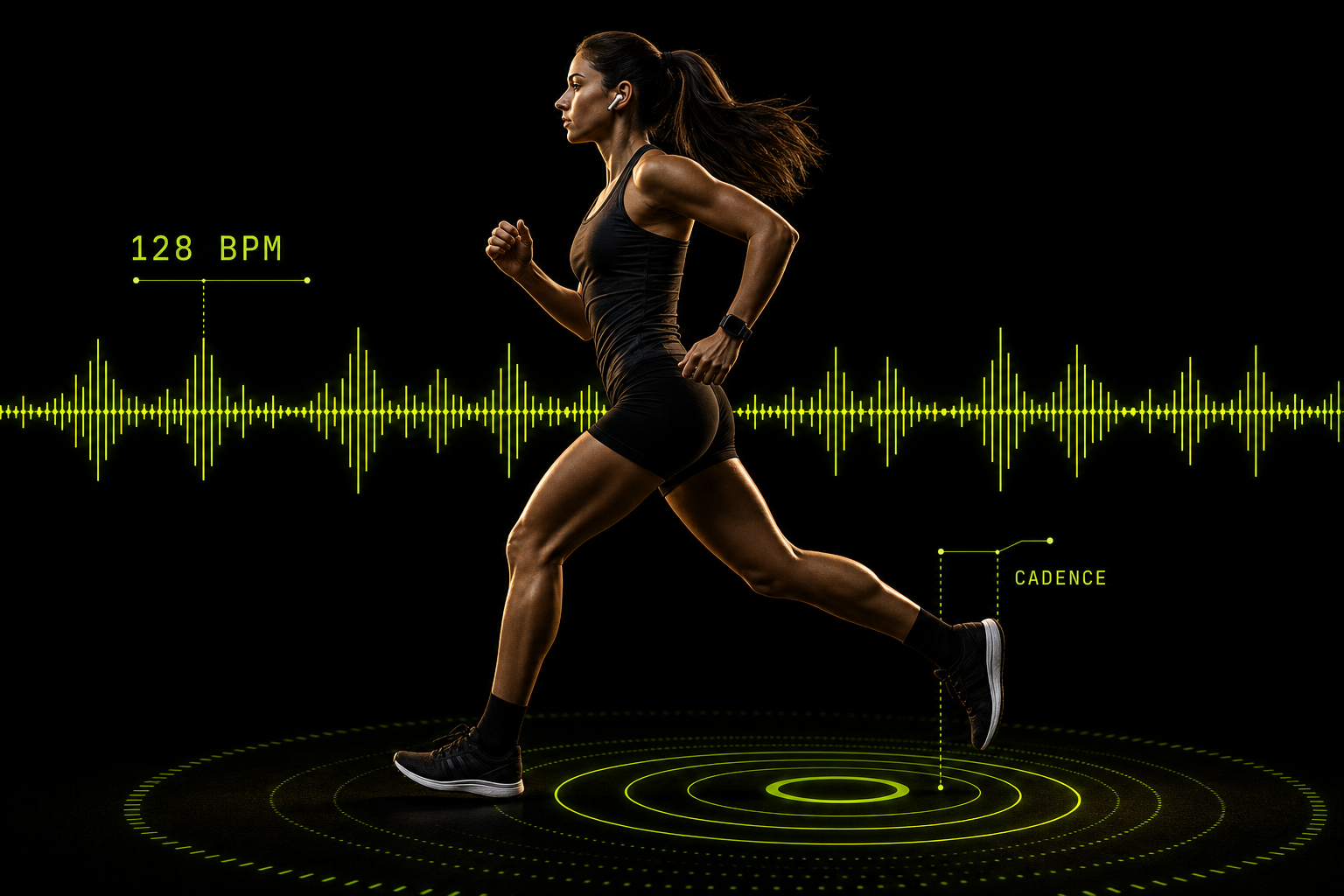
Cadence and pacing benefits. Research on auditory-motor synchronization shows that when music tempo closely matches your stride rate, your running economy improves. Your body naturally locks onto a rhythmic beat, which smooths out stride variability and reduces wasted energy. A runner targeting 170 steps per minute benefits from a playlist hovering around 170 BPM. The effect is real but tempo-dependent: a mismatch can actually impair economy rather than help it.
Performance gains in shorter efforts. A controlled trial published in MDPI had young male runners complete a self-paced 6-minute run with and without preferred music. The music condition produced roughly 10% more distance covered and lower blood lactate, with no change in RPE or heart rate. The runners went faster without feeling like they were working harder.
- Music increases training adherence, especially on long easy runs and treadmill sessions.
- Preferred tracks reduce perceived exertion more than non-preferred or background music.
- BPM-matched playlists improve cadence consistency and running economy.
- Short-effort performance (speed, distance) can improve without added perceived strain.
- Mood elevation before and during a run supports positive affect and enjoyment.
Pro Tip: Build a playlist anchored to your target cadence BPM rather than just “upbeat songs.” If your easy-run cadence is 160 steps per minute, anchor your playlist at 160 BPM. Tools like Spotify’s tempo filter or a BPM-tagging app make this straightforward.
What are the real drawbacks of running with music?
Safety is the most serious concern, and it is worth stating plainly: two earbuds at high volume in an urban environment is a genuine risk. You cannot hear approaching vehicles, cyclists passing on a shared path, or a marshal’s warning at a race. Most running-related accidents involving audio happen in exactly these conditions.
Running with headphones in traffic or on technical trails reduces your ability to react to hazards in time. The problem is not music itself — it is full audio isolation at the wrong moment. One earbud, bone-conduction headphones, or transparency mode changes the risk profile substantially.
Masked body signals. Music’s ability to suppress fatigue perception is a benefit during easy miles and a liability during hard ones. When you are pushing into threshold territory or running on tired legs, your breathing pattern, footstrike, and muscle tension are all communicating useful information. A loud playlist drowns that signal. Runners who train exclusively with audio often miss the early warning signs of overuse injuries: a subtle change in gait, a tightness that builds across a run, a breathing pattern that shifts before the legs do.
Psychological dependency. Coaches at Runner’s World flag this consistently: runners who always train with music often struggle on race day when headphones are banned or the battery dies at mile 4. If your pacing and motivation are entirely audio-dependent, you have no internal fallback. That is a fragile position for any race longer than a 5K.
Playlist-driven pacing errors. A high-energy track at the wrong moment can push you out of your target zone. If a 180 BPM anthem drops during the first mile of a marathon, your body will want to match it. That kind of early surge is one of the most reliable ways to blow up a long race.
A summary from TrainingPlan.dev notes that tempo ranges for running typically fall between 120 and 180 BPM, and that mismatches at either end of that range can disrupt rather than support performance.
What does the science actually say about music and running?
The evidence is consistent on psychological outcomes and more variable on physical ones. Here is where the research lands:
| Outcome | Typical effect | Evidence quality |
|---|---|---|
| Motivation | Significant increase with preferred music | Strong (meta-analysis) |
| Perceived exertion (RPE) | Reduced with preferred music | Strong (meta-analysis, controlled trials) |
| Running speed / distance | Modest gains in short efforts | Moderate (controlled trials, small samples) |
| Cadence consistency | Improved when BPM matches stride rate | Moderate (lab studies) |
| Blood lactate | Reduced in some short-effort trials | Limited (single studies) |
| Effect at high intensity | Diminishes as effort approaches maximum | Consistent across studies |
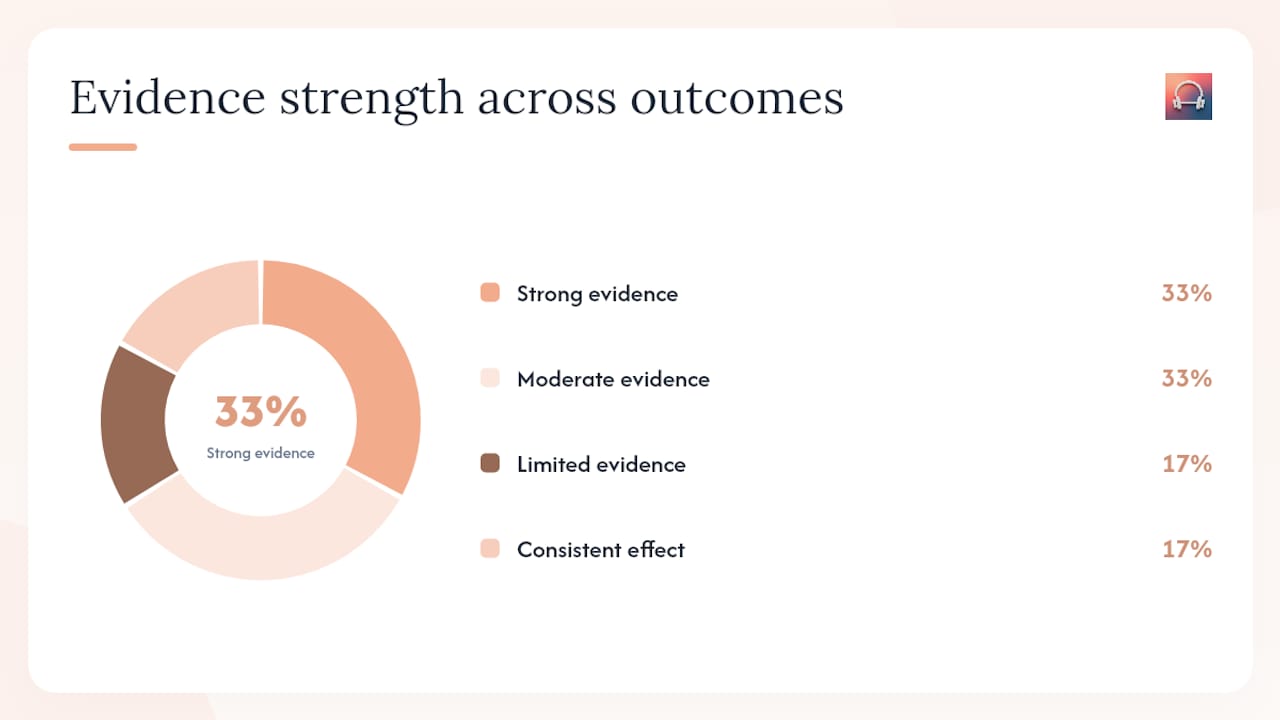
The PLOS One auditory-motor synchronization research explains the cadence row mechanistically: the brain’s motor system entrains to rhythmic auditory input, which is why tempo-matched music produces measurable economy gains while mismatched music can do the opposite.
The Springer meta-analysis found that preference is the strongest moderator of benefit. Music you love outperforms music you are neutral about, which outperforms silence for most psychological metrics. Physical outcomes are more context-dependent: intensity level, training status, and whether the tempo matches your cadence all shift the result.
Limitations worth knowing. Most studies use small samples, lab treadmills, and short durations. Field results in real training conditions are harder to isolate. Elite runners at high intensities tend to show smaller benefits, possibly because their internal focus is already highly trained. The effects are most reliable for recreational runners at moderate intensities.
How to use music strategically in your training
The most effective approach treats music as a variable, not a constant. Different run types call for different audio decisions.
Which runs get music, which stay silent:
Easy runs and long slow-distance sessions are the best candidates for audio. The effort is low enough that body-signal masking is not a concern, and the duration is long enough that motivational support pays off. Treadmill runs are another strong use case: the monotony is real, and music makes a meaningful difference in how long runners stay engaged.
Interval sessions, threshold workouts, and any run focused on form or technique are better done without audio. These sessions require you to listen to your body. Threshold work especially demands that you feel the effort accurately, not buffer it.
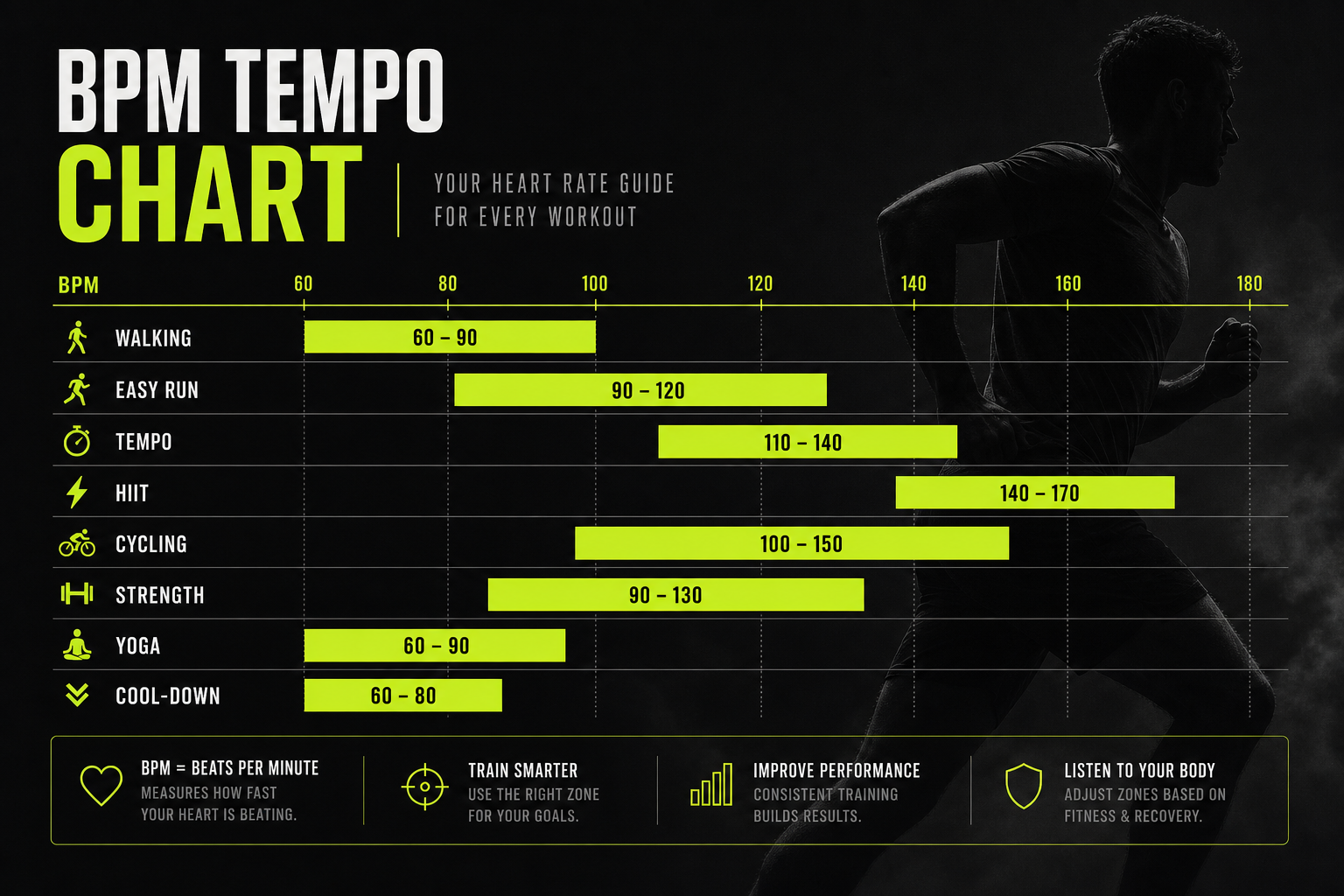
Matching BPM to cadence: Most recreational runners land between 150 and 180 steps per minute. A simple approach: count your steps for 30 seconds and double it. That number is your target BPM range. Build playlists within 5 BPM of that figure. For runners whose cadence shifts across a session, static playlists will drift out of sync. That is where adaptive tempo technology, which updates BPM in real time as your cadence changes, outperforms any fixed playlist. Wearable data like live cadence and heart rate makes this kind of real-time sync possible.
A simple weekly music plan:
- Decide the purpose of each run (easy, long, tempo, intervals, race-pace).
- Assign audio only to easy and long runs by default.
- Choose tracks from your preferred library at your target cadence BPM.
- Select your hardware mode based on the route (bone-conduction for roads, single earbud for mixed paths, no audio for trails).
- Run and note how your pacing felt relative to the music.
- After the run, adjust the playlist tempo if you found yourself fighting the beat.
Pro Tip: Alternate one long run with music and one without each week. The silent run builds the internal pacing cues you will rely on when audio is not an option. Over a training cycle, this makes you a more resilient runner in both conditions.
When should you run with music and when should you go silent?
The short answer: use music on easy and long runs, skip it on hard efforts and technical routes.
The best runners treat music the way a surgeon treats a scalpel: a precise tool for specific situations, not something left running in the background by default. Use it when it serves the session. Put it away when it doesn’t.
Music on: easy runs, long runs, treadmill sessions, recovery jogs, motivation-dependent training blocks.
Music off: threshold and interval workouts, technical trail runs, busy road routes, race-pace rehearsals, any session where you are monitoring form or managing an injury.
This week’s action plan: pick one long run to do with a cadence-matched playlist, keep one workout completely silent, and test your volume against the “10-foot voice” rule on every run. That combination gives you data on both sides within seven days.
How music affects your mood and stress beyond motivation
The motivational effect gets most of the attention, but music’s psychological reach during a run goes further. Listening to preferred tracks actively reduces tension and anxiety before and during exercise, not just effort perception. Runners who use music report lower pre-run anxiety and a faster return to baseline stress levels after hard sessions.

This connects to how music interacts with the autonomic nervous system. Slow, rhythmic tracks can lower heart rate and cortisol during warm-ups and cool-downs. High-tempo preferred music during the run itself elevates positive affect, which is the technical term for feeling good, and suppresses negative affect like frustration or dread. For runners who struggle with motivation on gray winter mornings, that pre-run mood shift is often what gets them out the door.
Music also functions as a dissociation tool: it redirects attention outward, away from internal discomfort, which is why it works best at moderate intensities. At very high efforts, internal focus tends to dominate regardless of what is playing, and the mood-regulation effect shrinks.
How genre and tempo shape your running performance
Genre matters less than tempo and preference, but the two are not independent. High-tempo genres like hip-hop, electronic dance music, and uptempo pop tend to cluster in the 120–180 BPM range that overlaps with most running cadences. That is partly why they dominate running playlists: the tempo fit is built in.
What the research consistently shows is that preference overrides genre. A runner who loves classic rock at 155 BPM will outperform the same runner listening to a “scientifically optimized” EDM playlist they find irritating. The psychological engagement with the music is the mechanism, and that engagement is personal.
Tempo matching matters most at moderate intensities. For easy runs, a playlist in the 150–165 BPM range supports a comfortable cadence without pushing pace. For uptempo long runs or progression runs, 165–175 BPM tracks tend to support a natural stride increase. Going above 180 BPM risks pulling your cadence into a choppy, overstriding pattern that wastes energy.
One practical note: real-time heart rate data can drive tempo adjustments automatically, so the music stays matched to your actual effort rather than a fixed playlist that made sense at mile 1 but not mile 8.
The case for treating music as a training variable, not a comfort blanket
The conventional wisdom frames this as a binary: music helps you run better, so use it. What that framing misses is that the benefit is conditional. Preferred music at a matched tempo during an easy run is one of the most reliable performance aids in recreational running. The same music during a threshold session on a busy road is a safety and performance liability.
What I find most interesting in the research is the dependency problem. Runners who never train without audio are essentially building a skill set that only works under one condition. The internal pacing sense, the ability to read your own effort by breath and footstrike, the mental resilience to push through discomfort without distraction: these are trainable capacities, and they atrophy when you always outsource them to a playlist. Race day, when headphones are banned or the battery dies, exposes that gap fast.
The smarter approach is to use music as a deliberate variable. Reserve it for the sessions where it genuinely serves the goal. Keep the hard workouts and technique sessions silent. Build the internal toolkit alongside the external one. That way, music becomes an amplifier for runs where you are already capable, not a crutch holding up runs where you are not.
Repbeats adapts your music to how you actually run
Static playlists have a structural problem: your effort changes across a run, but the BPM does not. A playlist that matches your cadence at mile 2 is likely out of sync by mile 6, especially on hilly routes or progression runs.
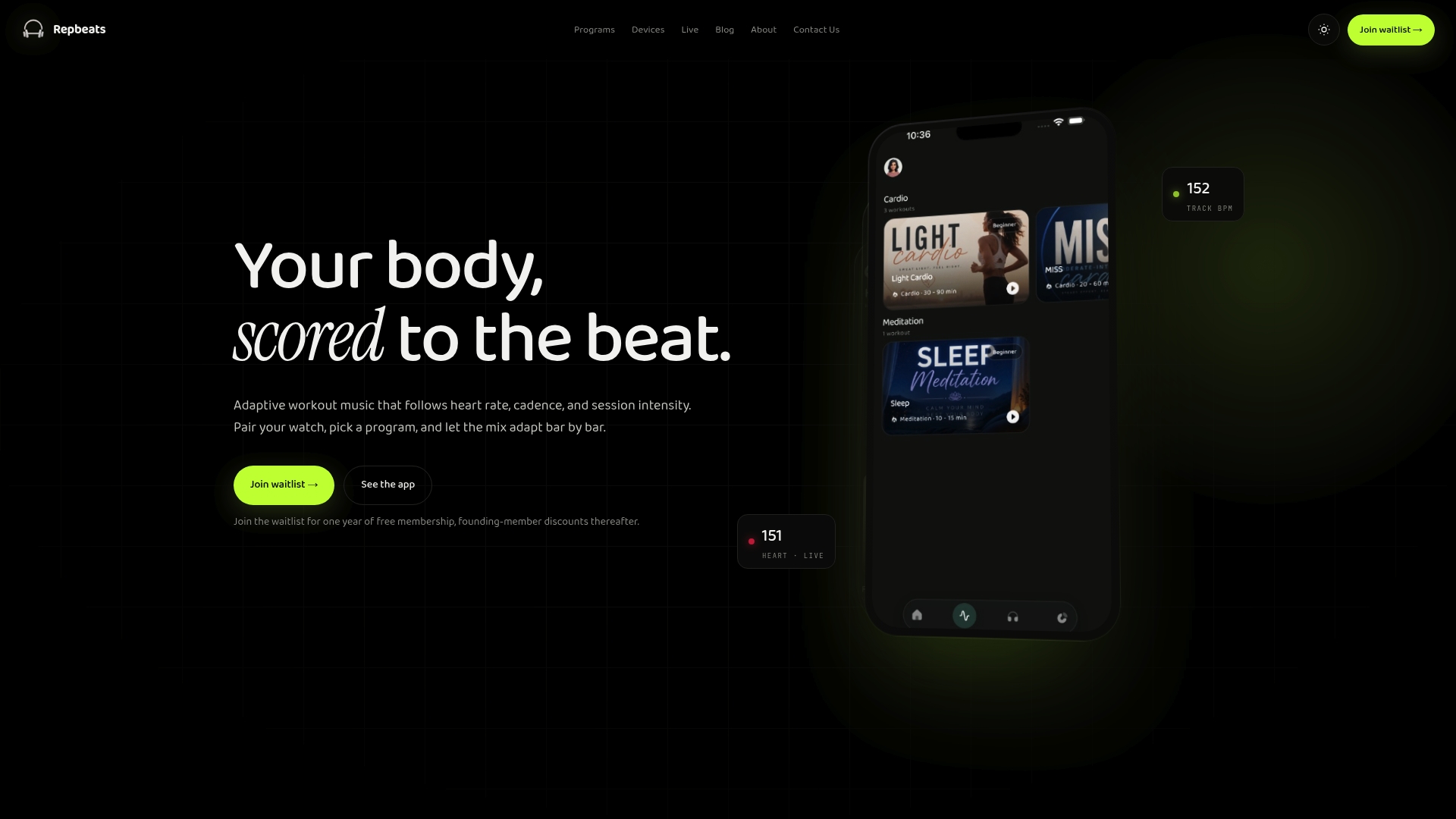
Repbeats solves this by syncing music tempo to your live cadence and heart rate, updating the BPM every bar using data from Apple Watch, Fitbit, and other popular wearables. The result is a soundtrack that stays matched to your actual effort rather than a fixed tempo you set before you left the house. For runners who want the adaptive music workout benefits the research points to, without manually rebuilding playlists for every session, Repbeats handles the matching automatically. It covers running, cycling, and meditation programs, and the free trial gives you a full year to test it against your current setup. Start your free trial at Repbeats and run your next long session with a soundtrack that actually keeps up with you.
Useful sources and further reading
The sources below back the claims in this article and are worth reading directly if you want to go deeper on any specific topic.
| Source | What it contributes |
|---|---|
| Springer Nature meta-analysis on preferred music | Systematic review and meta-analysis confirming preferred music improves motivation and reduces perceived exertion across sports. |
| MDPI controlled trial (6-minute run) | Randomized trial showing preferred music increased distance covered and reduced blood lactate without changing RPE. |
| PLOS One: auditory-motor synchronization | Mechanistic research explaining how cadence-BPM matching improves running economy. |
| Runner’s World: music ergogenics (Karageorghis) | Expert commentary from Dr. Costas Karageorghis on music as a psychological buffer and ergogenic aid. |
| Runner’s World: race-day music strategy | Coaching guidance on using music strategically and practicing without audio to avoid race-day dependency. |
| TrainingPlan.dev: practical tempo and safety guide | Applied guidance on BPM ranges (120–180), bone-conduction safety options, and run-type recommendations. |