Cycling Trainer Music: Match BPM to Cadence and Effort
Jordan MillsNovember 15, 2026 · 12 min read

Cycling Trainer Music: Match BPM to Cadence and Effort
The best cycling trainer music is music whose tempo fits what your legs are doing: roughly two beats per pedal revolution, with faster tracks for hard efforts and slower ones for warm-ups and recovery. You can build that by hand with a BPM-sorted playlist. Or you can let Repbeats do it live, since it adjusts music tempo to your heart rate, cadence and session intensity from your Apple Watch or Fitbit data.
TL;DR
- Double your target cadence to get your target BPM: 76 RPM pairs with 152 BPM, and 85 to 90 RPM pairs with about 170 to 180 BPM.
- Music in the 120 to 140 BPM range suits easier to moderate riding, and faster tracks suit harder efforts.
- In a controlled cycling study, speeding music up by 10% raised power and cadence, and slowing it down lowered both.
- Map your workout (warm-up, intervals, recoveries, cooldown) before you choose a single song.
- Repbeats changes the tempo every bar to follow your live data, so the playlist never falls out of step with the ride.
Table of Contents
- Why music changes how a trainer ride feels
- The BPM and cadence math
- Music by phase of the workout
- How to build a trainer playlist by hand
- Fueling the session
- Our perspective: tempo should follow you, not the other way around
- Let the music follow your ride
- Common mistakes with trainer music
- FAQ
- Sources
Why music changes how a trainer ride feels
A bike trainer ride is a long stretch in one spot with no scenery, no wind and no traffic. Music fills that gap, and it does real work.
A 2020 meta-analysis of 139 studies with 3,599 participants found that music improved mood, physical performance and perceived exertion (how hard the effort feels), and that the performance benefit was larger for fast music than for slow-to-medium music. It did not find a reliable drop in heart rate. So music will not make your body work less. It makes the same work feel better and, often, lets you do a little more of it.
Cycling-specific research points the same way. In a controlled cycling study, riders heard music sped up or slowed down by 10%. Faster music increased distance covered per unit of time by 2.1%, power by 3.5% and cadence by 0.7%. Slower music reduced those measures by 3.8%, 9.8% and 5.9%. Riders also rated faster music as more enjoyable and harder, and slower music as less of both.

The American Council on Exercise (ACE) summarizes the same pattern: in cycling studies, cadence and power output moved in parallel with the dominant beat of the background music, and faster music produced higher output.
The takeaway for a trainer session: tempo is a control knob. Used on purpose, it nudges your effort up when you want it up and down when you need to recover.
The BPM and cadence math
Cadence is how many times per minute your pedals go around (RPM). BPM is the beats per minute of a song. Because most people feel a pedal stroke as “every other beat,” the rule is simple:
Target BPM = target cadence × 2
Velo’s guide to cycling music gives matching pairs: 57 RPM with 114 BPM, 64 RPM with 128 BPM and 76 RPM with 152 BPM. At very high cadences, near or above 100 RPM, it suggests choosing a track whose BPM matches the cadence directly, because doubling would put the tempo too high to feel natural.
Bicycling reported in 2025 that 170 to 180 BPM tracks support roughly 85 to 90 RPM at that 2:1 ratio, a cadence it describes as generally efficient for most riders.
| Cadence you want | Song BPM (2:1) | Typical use |
|---|---|---|
| 60 RPM | 120 BPM | Seated climbing, low-cadence strength work |
| 70 RPM | 140 BPM | Warm-up, steady endurance |
| 80 RPM | 160 BPM | Tempo and sweet-spot riding |
| 85 to 90 RPM | 170 to 180 BPM | Threshold efforts and efficient everyday cadence |
| 100+ RPM | Match BPM to RPM | Sprints and spin-ups |
If you do not know your own comfortable cadence, our 20 to 30 minute indoor cycling cadence test walks you through finding it, and our guide to cycling cadence sync music shows how to turn it into a list of songs.
Do you have to sync exactly?
Not always. Velo, reporting sport psychologist Dr. Costas Karageorghis’s guidance, describes 120 to 140 BPM as a motivational sweet spot for cycling when the music is not synchronized to your pedaling. Around 120 to 125 BPM fits about 60% of maximum heart rate, and about 135 to 140 BPM fits roughly 80 to 85%.
A 2014 cycling study found that synchronous music lowered limb discomfort compared with no music, and that both synchronous and asynchronous music produced more positive mood than silence. Synchronization did not lower oxygen use. In plain terms, matching the beat is a pacing cue that helps the ride feel smoother, not a way to make it physiologically cheaper.
You also get a bigger lift from songs you like. In another cycling study, riders cycled farther at critical-power intensity with preferred music (9.8 ± 4.6 km) than with nonpreferred music (7.1 ± 3.5 km), while heart rate stayed the same. Nonpreferred music felt harder. So BPM gets you into the right range, and your taste decides which songs inside that range you choose.
Music by phase of the workout
A good trainer session has a shape, and the music should follow it. Here is a practical pattern built from the BPM figures above. Treat the ranges as starting points and adjust to your own cadence.
Warm-up
Start at the lower end, roughly 120 to 140 BPM, with an easy cadence. The aim is to let your legs and breathing settle. Songs with a clear, steady rhythm make it easy to find your pedaling.
Steady endurance and tempo
Move to 140 to 160 BPM for cadences of 70 to 80 RPM. Long, rhythmic tracks work well here because you do not have to think about the next change. ACE notes that cycling music commonly falls around 135 to 170 BPM and that a distinct, obvious rhythm makes synchronizing easier, so favor songs with a prominent kick or snare over those with a floaty, ambiguous beat.
Intervals and threshold work
For hard efforts, go to 160 to 180 BPM if your target cadence is 80 to 90 RPM. Keep the track length close to the interval length so a song does not end halfway through an effort. Our EDM cycling workouts show how 20, 30 and 40-minute rides can be laid out this way, and our guide to matching BPM to each training zone links tempo to effort level.
Recovery and cooldown
Drop back to 120 to 140 BPM. The tempo drop itself tells your body to ease off, and slower music is associated with lower perceived effort in the research above.
Climbing
Seated climbs use lower cadence, so the 2:1 rule gives you slower songs. Our piece on cadence-matched climb playlists covers that.
How to build a trainer playlist by hand
The American College of Sports Medicine’s playlist guidance says cycling and interval classes work best when you write a class map first: warm-up, intervals, active recoveries, cooldown, tempo changes and song length. Music then supports the plan, not the other way around.
- Write the workout as a timeline. For example: 10 minutes warm-up, five 4-minute intervals with 2-minute recoveries, 8 minutes cooldown.
- Set a cadence for each block. Use your own numbers. If you ride efforts at 90 RPM, you want about 180 BPM there.
- Convert cadence to BPM. Multiply by two, or match directly above about 100 RPM.
- Sort songs by duration and tempo. The Indoor Cycling Association recommends sorting songs by duration, then for each interval picking tracks with the right length and cadence, adding two or three options, listening, and finalizing.
- Check the transitions. Songs that end near a block boundary make a change feel natural. A jump from 140 to 175 BPM in the middle of a song does not.
- Save the list per workout. A threshold session and a recovery spin need different lists.
Where it goes wrong: BPM listings on streaming services are often off by a factor of two (a song listed at 85 BPM may feel like 170), tracks with tempo changes break your rhythm, and a list that fit last month’s cadence no longer fits after your fitness improves. That is a lot of upkeep for something you want to forget about while you ride.
Field tests and short efforts
For a 20-minute FTP (functional threshold power) test, the Indoor Cycling Association’s 2018 guidance is to mix lyrical and instrumental tracks, use shorter songs around longer rhythmic ones and finish with a familiar, hard-driving song. It suggests holding the mid-80s to mid-90s RPM, allowing for individual variation, and avoiding both very low cadence with heavy resistance and very high cadence.
For Tabata-style sessions, ACE’s cycle ergometer protocol is eight 20-second hard efforts separated by 10 seconds of easy recovery, with an eight-minute progressive warm-up and an eight-minute cooldown. Those 20-second blocks are too short for song-by-song planning, so pick a single high-tempo track with a strong beat and ride to its pulse.

Fueling the session
Longer trainer sessions burn a lot, and what you eat around them matters as much as the playlist. If you want to see how a hard ride fits your day, tracking your calories on iPhone takes a few minutes and pairs naturally with the numbers your trainer software already gives you.
Our perspective: tempo should follow you, not the other way around
A playlist is a guess about the future. You decide in advance how hard you will ride, at what cadence, for how long, and then hope the session goes to plan. Real sessions rarely do. Your heart rate drifts up, an interval feels harder than last week, you cut a recovery short.
That is why we built Repbeats around live data instead of fixed lists. The app takes heart rate, cadence and session intensity from wearables such as Apple Watch and Fitbit and updates the music’s BPM every bar, so the soundtrack follows what your body is actually doing. The research above shows why this matters: tempo shifts power, cadence and perceived effort, and a beat you can feel gives you an external pacing cue.
We think the best trainer music is the kind you never have to manage. You pick the session, you ride, and the music keeps its place in the effort. Our privacy policy limits the app’s device access to workout data only.
Jordan Mills
Let the music follow your ride
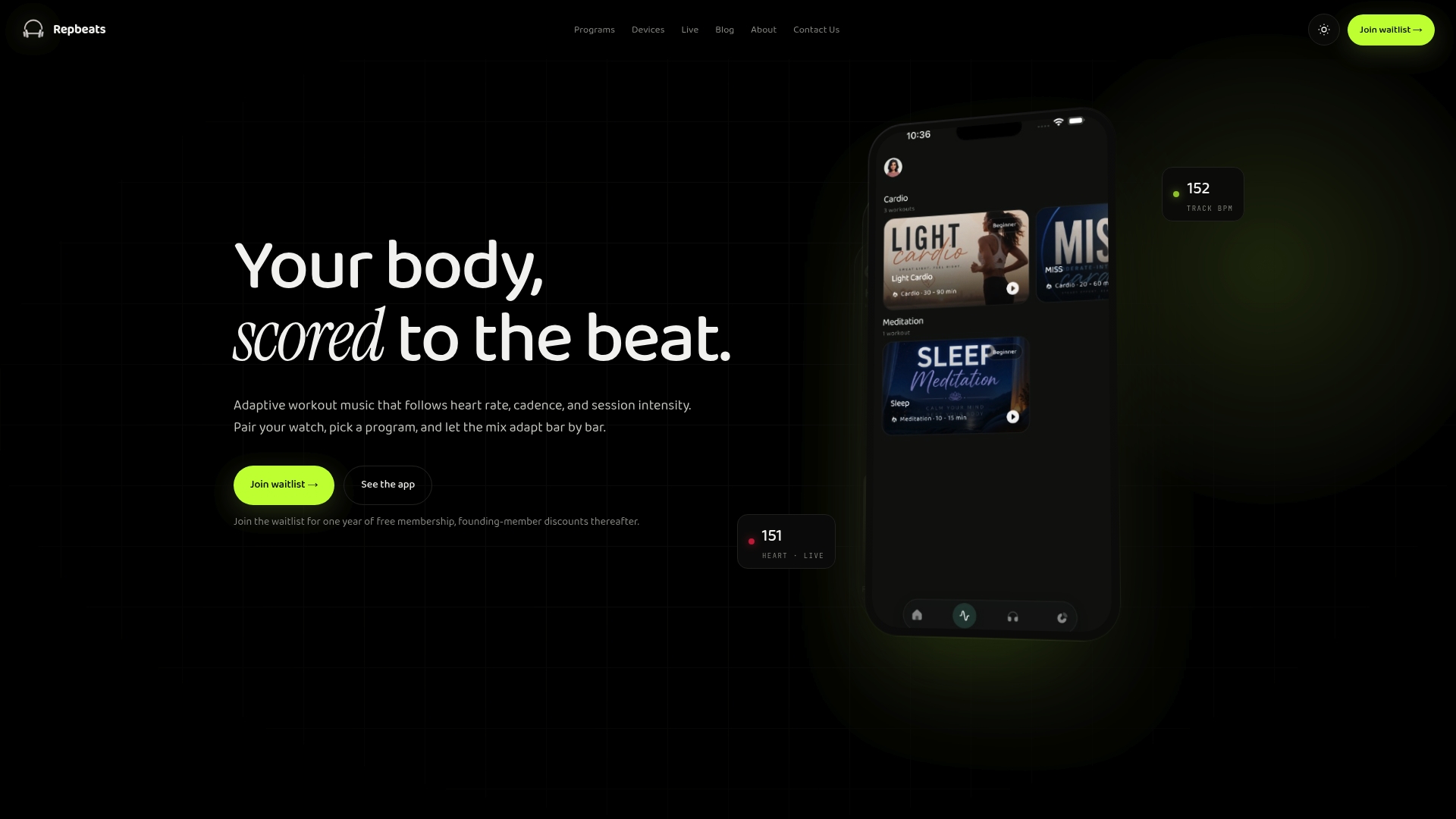
If you would rather ride than maintain spreadsheets of BPM, Repbeats is built for this. It is a fitness app that synchronizes music tempo to your heart rate, cadence and session intensity using data from wearables like Apple Watch and Fitbit. Its auto-DJ updates the BPM every bar, and you can control playback in real time, search the music library and schedule programs. It covers cardio sessions, cycling included, and meditation programs for the days you want to wind down.
To see how it fits your riding, start at repbeats.com and read our deeper guides on how music tempo affects your workout and cadence sensor music using BPM ÷ 2.
Common mistakes with trainer music
- Using one tempo for the whole ride. A constant 150 BPM suits a tempo block, but it flattens warm-up and recovery.
- Matching to the wrong cadence. Match to the cadence you intend to ride, not the one you ride when you are tired.
- Chasing a perfect sync at high cadence. Above about 100 RPM, match BPM to RPM directly rather than doubling.
- Ignoring taste. Preferred music improved distance in the study above, so keep songs you actually enjoy.
- Forgetting song length. A four-minute interval wants a track or two that line up with it, not an eight-minute song that outlasts it.
- Expecting a lower heart rate. Music improves mood, effort perception and performance, not heart rate on its own, so keep reading your zones from your own data.
If you also run, the same logic applies. Our guide to interval running music shows the tempo matching for foot strike, and our focus cycling music tips cover long, steady sessions where concentration is the goal.
FAQ
What BPM is best for cycling trainer music?
It depends on your cadence. Double your target RPM: 76 RPM pairs with 152 BPM, and 85 to 90 RPM pairs with about 170 to 180 BPM. If you are not syncing, 120 to 140 BPM is a widely cited motivational range for cycling.
Should the music match my pedaling exactly?
It helps, but it is not required. A 2014 study found that synchronized music lowered limb discomfort compared with no music, and that unsynchronized music still improved mood. Syncing gives you a clearer pacing cue, especially for steady efforts.
How do I make a playlist for interval workouts?
Write the workout map first, with each interval, recovery and cooldown. Then assign a cadence to each block, double it for BPM, and choose songs whose length fits the block. Add a couple of backup tracks per interval and listen through before you ride.
Can music really make me ride faster?
In a controlled cycling study, music sped up by 10% increased power by 3.5% and distance per unit of time by 2.1%, while slowed music reduced both. Music influences how hard effort feels and how much you do, though it does not reliably change heart rate.
Sources
- Effects of music in exercise and sport: A meta-analytic review (PubMed, 2020)
- Effects of music tempo upon submaximal cycling performance (PubMed, 2010)
- ACE-sponsored research: Exploring the effects of music on exercise intensity
- Tune up: How to use music to get the best out of your cycling (Velo)
- Indoor Cycling: 170-180 BPM Playlist (Bicycling, 2025)
- Psychophysiological effects of synchronous versus asynchronous music during cycling (PubMed, 2014)
- Effects of preferred and nonpreferred music on continuous cycling exercise (PubMed, 2010)
- Music that Moves: Building a Playlist that Hits (ACSM, 2022)
- Create Playlists Faster: Thousands of Songs Sorted by BPM (Indoor Cycling Association, 2025)
- FTP Field Testing Music Tips (Indoor Cycling Association, 2018)
- 20 Minute Tabata Workout Options (ACE, 2014)
- How to Track Calories on iPhone (VeriTrack)