Yoga Flow Music BPM: The Right Tempo for Every Phase
Jordan MillsOctober 22, 2026 · 11 min read

Yoga Flow Music BPM: The Right Tempo for Every Phase
For a vinyasa-style flow, aim for roughly 100 to 130 BPM at the peak of the class. Start lower, around 80 to 110 BPM, for the warm-up. Drop to 55 to 70 BPM, or go silent, for the cool-down. Those numbers are a starting arc, not a rule. Yoga covers everything from restorative holds to sweaty power flow, so the right tempo depends on the style, the sequence and your breath.
Below you’ll find the ranges, the reasoning behind them, and a practical way to build a playlist that moves the way you do.
TL;DR
- Think in an arc, not a single number: about 80 to 110 BPM to warm up, 100 to 130 BPM for active flow, 55 to 70 BPM (or silence) for Savasana.
- Slower styles such as yin, restorative and slow flow sit lower, roughly 45 to 70 BPM.
- Tempo matters less than steadiness: tracks that speed up or slow down abruptly can break a breath-linked sequence.
- Pick music you enjoy. Consistency of practice beats hitting an exact BPM.
- Heart rate, not a playlist label, tells you how hard a session really is, which is where adaptive music can help.
Table of Contents
- Why BPM matters in a yoga flow
- The BPM arc for a 60-minute class
- BPM by yoga style
- Match the beat to your breath, not just your feet
- Warm-up and peak: choosing tracks
- Cool-down and Savasana: slow, or silent?
- Does yoga flow count as cardio?
- Build your own yoga flow playlist in five steps
- Our perspective: static playlists have a ceiling
- Try tempo that follows you
- FAQ
- Sources
Why BPM matters in a yoga flow
BPM, or beats per minute, is how fast a song’s pulse runs. In a flow class, the pulse of the music gives your movement something to lean on. A steady 100 BPM track can feel like a metronome for transitions. A 60 BPM track feels spacious, almost like a slow breath.

There is some evidence that people respond to this without trying. One music-and-yoga blog points to a 2020 study reporting that students unconsciously adjusted their breath pacing and transition speed to the background music’s BPM. Treat that as a suggestive finding rather than settled science, but it matches what many teachers see in the room.
The flip side: music that fights your pace is distracting. Fast beats over a slow hold make you feel rushed. A sleepy 60 BPM drone under sun salutations makes the sequence drag.
The BPM arc for a 60-minute class

A one-hour flow has distinct phases, and each wants a different tempo. Industry guidance for a structured 60-minute class suggests a warm-up at 90 to 110 BPM, active flow sequences at 100 to 130 BPM, and a cool-down or Savasana at 55 to 70 BPM or in silence. Another teacher-focused guide describes an arc that starts at 80 to 95 BPM and peaks at 110 to 130 BPM during the vinyasa portion.
Here is how those ranges fit together:
| Phase | Typical length | BPM range | What the music should do |
|---|---|---|---|
| Centering and breath work | 5 minutes | 55 to 80 | Settle attention, stay out of the way |
| Warm-up (cat-cow, gentle sun salutations) | 10 minutes | 80 to 110 | Build gentle momentum |
| Active flow (standing series, vinyasas) | 25 to 30 minutes | 100 to 130 | Support breath-linked movement |
| Floor work and hip openers | 10 minutes | 70 to 95 | Ease the pace down |
| Cool-down and Savasana | 5 to 10 minutes | 55 to 70, or silence | Let your heart rate come back down |
The overlap between rows is deliberate. Nothing in a class should jump from 120 to 60 in one track. Step down over two or three songs.
BPM by yoga style
Because “yoga” spans such a wide range of effort, a single optimal tempo does not exist. A systematic review of yoga intensity covering styles from ashtanga and Bikram to gentle, hatha and Iyengar found a wide spread of heart rate and oxygen use. The title says it well: the range runs from Savasana to sweating.
A workable guide by style:
- Yin and restorative: about 45 to 65 BPM, or ambient music with no clear beat. One yoga teacher describes her slow flow playlist as running 45 to 60 BPM, suited to slow, mindful vinyasa.
- Hatha and gentle flow: about 60 to 90 BPM. Enough pulse to hold attention, slow enough to stay with long holds.
- Vinyasa and flow: about 90 to 120 BPM for most of the class, with peaks up to 130 BPM.
- Power and hot flow: about 100 to 130 BPM, with a stronger beat. Pick tracks with consistent drums so the pace doesn’t wobble.
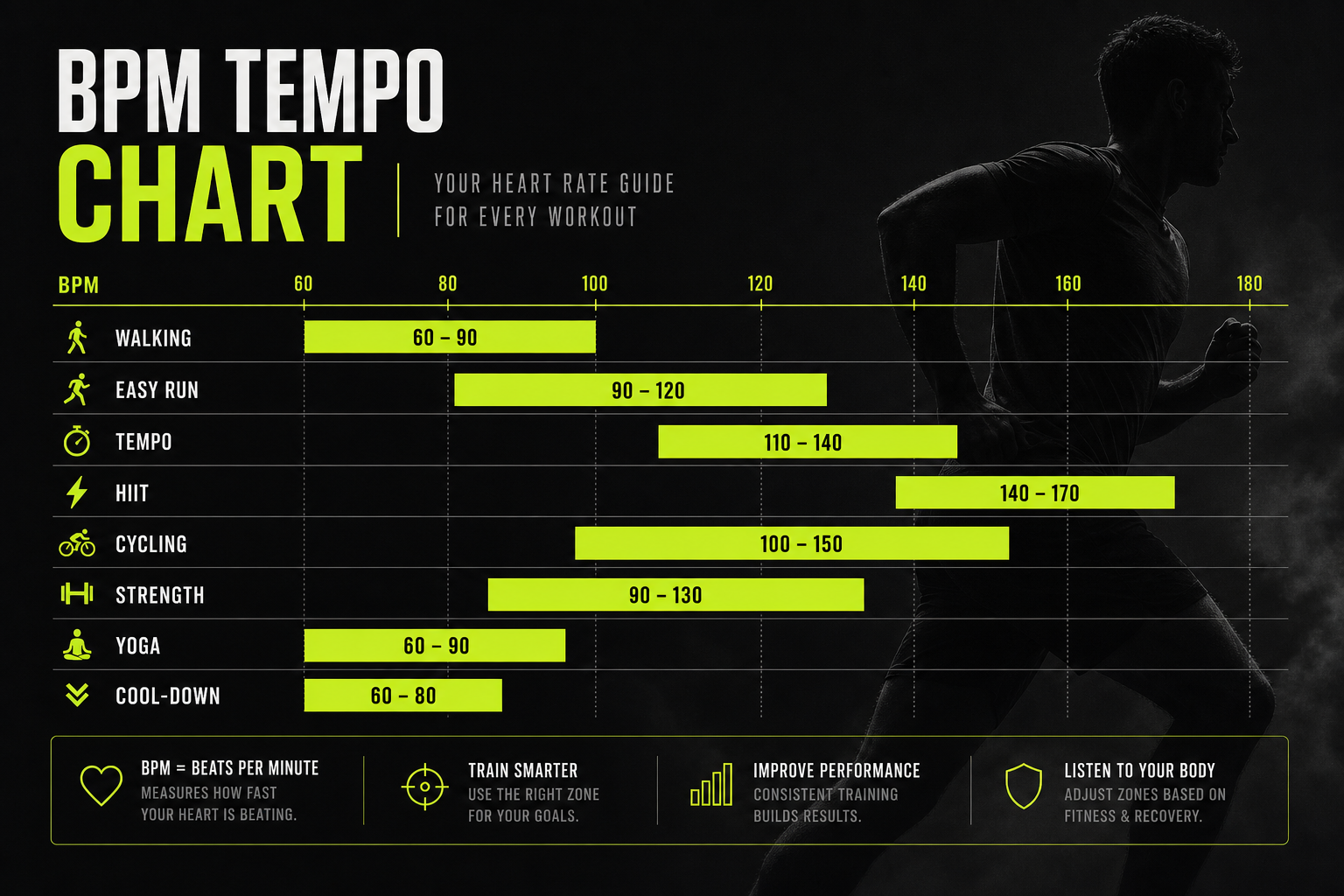
If you want a comparison with other workouts, our tempo chart for every workout type puts yoga next to running, lifting and cycling.
Match the beat to your breath, not just your feet
In running, tempo follows footfalls. In yoga, it follows breath. Experienced practitioners often aim for roughly one beat per breath cycle in the more demanding sequences, which means very slow songs, or songs with a half-time feel. A 120 BPM track can feel like a 60 BPM track if the drums land on every other beat.
Two practical consequences:
- Test for consistency. A song that starts at 90 and surges to 125 in the chorus will disrupt a challenging sequence. Play the whole track before it goes on a high-intensity playlist.
- Lean on half-time. If you want a lively feel but slow breathing, choose songs where the backbeat is sparse.
If you’re curious about how this works for pacing in other formats, our guide to tempo-matched workout templates shows the same idea applied to cadence.
Warm-up and peak: choosing tracks
For the first ten minutes, skip anything with a loud intro or heavy bass. Instrumental electronic, downtempo, acoustic or lo-fi tracks around 85 to 105 BPM work well. They give you enough rhythm to feel like you’ve started without telling your body to hurry.
At the peak, you can add energy. Look for:
- Steady drum patterns with little tempo drift
- Few abrupt stops or drops
- Vocals that are soft or sparse, so they don’t compete with a teacher’s cues
- Tracks of four to six minutes, so you aren’t changing songs mid-sequence
Slow R&B and neo-soul also fit this middle zone. A curated online station such as Hot Mic Radio’s soulful R&B show is a handy place to find smooth, mellow material for the downshift at the end of a flow, then pick the songs that land in the 60 to 80 BPM window.
Cool-down and Savasana: slow, or silent?
Sixty BPM is frequently cited as the tempo for deep relaxation, meditation and Savasana, because it sits near a typical resting heart rate. Royalty-free meditation libraries lean on 60 BPM for exactly that reason, often with ambient nature sounds or minimalist piano.
But slower is not always better. Some experienced teachers skip music in Savasana altogether, since even 60 BPM can feel over-stimulating when you’re trying to reach total stillness. If you practice at home, try both on different days and notice which one lets your mind quiet down.
Why does low-tempo music feel calming? We cover the mechanisms in why low BPM music calms the mind, and our cool-down BPM guide shows how to step the tempo down after harder workouts.
Does yoga flow count as cardio?
People often ask whether a vigorous flow class needs fast music because it “counts” as cardio. The honest answer is that it depends. The Physical Activity Guidelines for Americans recommend at least 150 to 300 minutes a week of moderate-intensity aerobic activity, or 75 to 150 minutes of vigorous activity. Yoga contributes to health, but many classes are light intensity, and a Johns Hopkins Medicine podcast cautions that it shouldn’t be counted toward your recommended weekly aerobic total.
That doesn’t make it less valuable. The American Heart Association describes yoga as a mind-body practice that supports heart health markers and well-being, though not as a replacement for traditional aerobic exercise. If you have a heart condition or high blood pressure, ask your doctor which kinds of yoga and what intensity are right for you before you push the pace.
For your playlist, the takeaway is simple: don’t pick faster music to turn a gentle class into cardio. Pick music that suits the practice you’re actually doing.
Build your own yoga flow playlist in five steps
- Decide the style and length. A 45-minute slow flow and a 75-minute power class need different arcs.
- Map the phases. Use the table above and write the BPM range next to each section.
- Gather more songs than you need. Collect 20 to 30 candidates per phase and check each tempo.
- Preview full tracks. Cut anything with sudden tempo shifts, loud intros or jarring drops.
- Sequence for gradual change. Move no more than about 10 to 15 BPM from one track to the next, and end with your slowest material.
Our walkthrough on how to find songs by BPM covers the tempo-lookup part in more detail. If you teach in public, check licensing before you play music. In the UK, for instance, playing recorded music in a commercial setting needs specific licenses, and teachers who rent space can be personally liable. In the US, ask your studio what performance licensing it holds before you assume a personal streaming account covers a class.
Our perspective: static playlists have a ceiling
A playlist is a guess made in advance. You pick 110 BPM for the flow, then you have a hard day, your heart rate is higher than you expected, and the music is out of step with your body. Or you feel strong, and it holds you back.
That gap is why we built Repbeats. The app reads live data from wearables such as Apple Watch and Fitbit and adjusts the music’s tempo to your heart rate, cadence and session intensity, updating the BPM every bar. We built it for running, cycling and meditation, where the right tempo changes minute by minute and a fixed list can’t keep up.
For yoga, our view is that the arc matters more than any single number, and that your body should set the arc. A soft, slow start, a lift in the middle and a long descent at the end is what a good teacher builds. Heart rate shows when you’re really descending, and music that follows it can help you get there rather than just telling you to. Our meditation programs follow that low-tempo logic, and we are careful not to promise more than the evidence supports: tempo is one tool, not a cure.
We also keep access narrow. Our privacy policy limits device access to workout data only.
— Jordan Mills
Try tempo that follows you
If you wear an Apple Watch or Fitbit and want music that adjusts to your effort instead of a fixed playlist, Repbeats is built for that. Join the waitlist and the launch includes a free year. You can read more on the Repbeats app page, and see how adaptive tempo works for athletes in our best practices guide.
FAQ
What BPM is best for yoga flow?
Most flow classes work well between 100 and 130 BPM at the peak, with 80 to 110 BPM for the warm-up. Slower styles such as yin or restorative sit around 45 to 70 BPM. Treat these as ranges, because tempo that feels right depends on your breath and the sequence.
What is some relaxing music at 60 BPM?
Ambient, minimalist piano, soft acoustic and nature-based tracks commonly sit near 60 BPM. That tempo is near a typical resting heart rate, so it’s a common choice for Savasana and meditation. Search a tempo-lookup tool for 58 to 66 BPM and preview full tracks before you commit.
Does yoga count as cardiovascular exercise?
Not reliably. Many classes are light intensity, and Johns Hopkins Medicine notes yoga shouldn’t count toward your weekly aerobic total. Some vigorous styles may raise your heart rate more, but yoga is best seen as a complement to aerobic activity. Ask your doctor if you have a heart condition.
What kind of music is played during yoga?
It varies by style: ambient and instrumental for restorative practice, downtempo electronic, lo-fi and acoustic for gentle flow, and steadier beats for vinyasa or power classes. Many teachers choose silence for Savasana. The best choice is music you enjoy enough to keep practicing.
Sources
- Choosing Music for Your Yoga Class: A BPM Guide, ClassComposer
- Yoga Music for UK Studios: Licensing, Playlists & Class Flow
- Range of Yoga Intensities From Savasana to Sweating: A Systematic Review, PubMed
- Slow Flow Yoga Class Playlist, Ami Norton Yoga
- Physical Activity Guidelines for Americans, 2nd edition
- Does yoga help heart health? Johns Hopkins Medicine Podcasts
- Is yoga heart healthy? American Heart Association
- What Makes Great Yoga Class Music, Melobleep
- Royalty-free meditation music, Terrasound