Cool-Down BPM: The Right Tempo for Post-Workout Music
Jordan MillsOctober 18, 2026 · 11 min read

Cool-Down BPM: The Right Tempo for Post-Workout Music
For most people, cool-down music works best at roughly 90 to 115 BPM, stepping down toward 60 to 80 BPM as your breathing settles. The exact number matters less than the direction: your music should get slower as your body does. A single “perfect” cool-down song does not exist, and the research explains why.
This guide gives you tempo ranges, what the studies do and do not show, a simple five-to-ten-minute routine, and a way to build a cool-down playlist that actually follows your recovery instead of ignoring it.
TL;DR
- Aim for about 90 to 115 BPM at the start of your cool-down, then drift toward 60 to 80 BPM for the last few minutes.
- Direction beats the absolute number: falling tempo signals a downshift, rising tempo activates the sympathetic nervous system.
- Plan on at least 5 to 10 minutes of easy movement, longer after hard efforts.
- Music helps mostly by lowering perceived effort and improving mood; pair it with slow breathing for the biggest recovery payoff.
Table of Contents
- Why the cool-down deserves its own soundtrack
- What BPM should cool-down music be?
- What music actually does for recovery
- A cool-down routine you can repeat
- How to build a cool-down playlist that works
- Our perspective: let your body set the tempo
- Let the music follow your recovery
- Common mistakes with cool-down music
- FAQ
- Sources
Why the cool-down deserves its own soundtrack
Most of us build playlists for the hard part of a workout and let whatever comes next play through the finish. That is the moment your body needs the most help. The American Heart Association says stopping suddenly can cause light-headedness because heart rate and blood pressure drop rapidly. When you stop hard exercise cold, the muscle pumping that returns blood from your legs disappears, and blood can pool in the leg veins. The result can be dizziness or, in rare cases, fainting.
The Mayo Clinic describes a cool-down as the same activity at a slower pace and lower intensity, letting heart rate and blood pressure return gradually toward pre-exercise levels. It adds that there is debate about whether cooling down prevents injury, but that doing it carries little risk.
Music is not a medical treatment here. It is a pacing tool. A slowing beat gives you something to follow when your instinct is to flop onto the couch or stand bent over with your hands on your knees.
What BPM should cool-down music be?
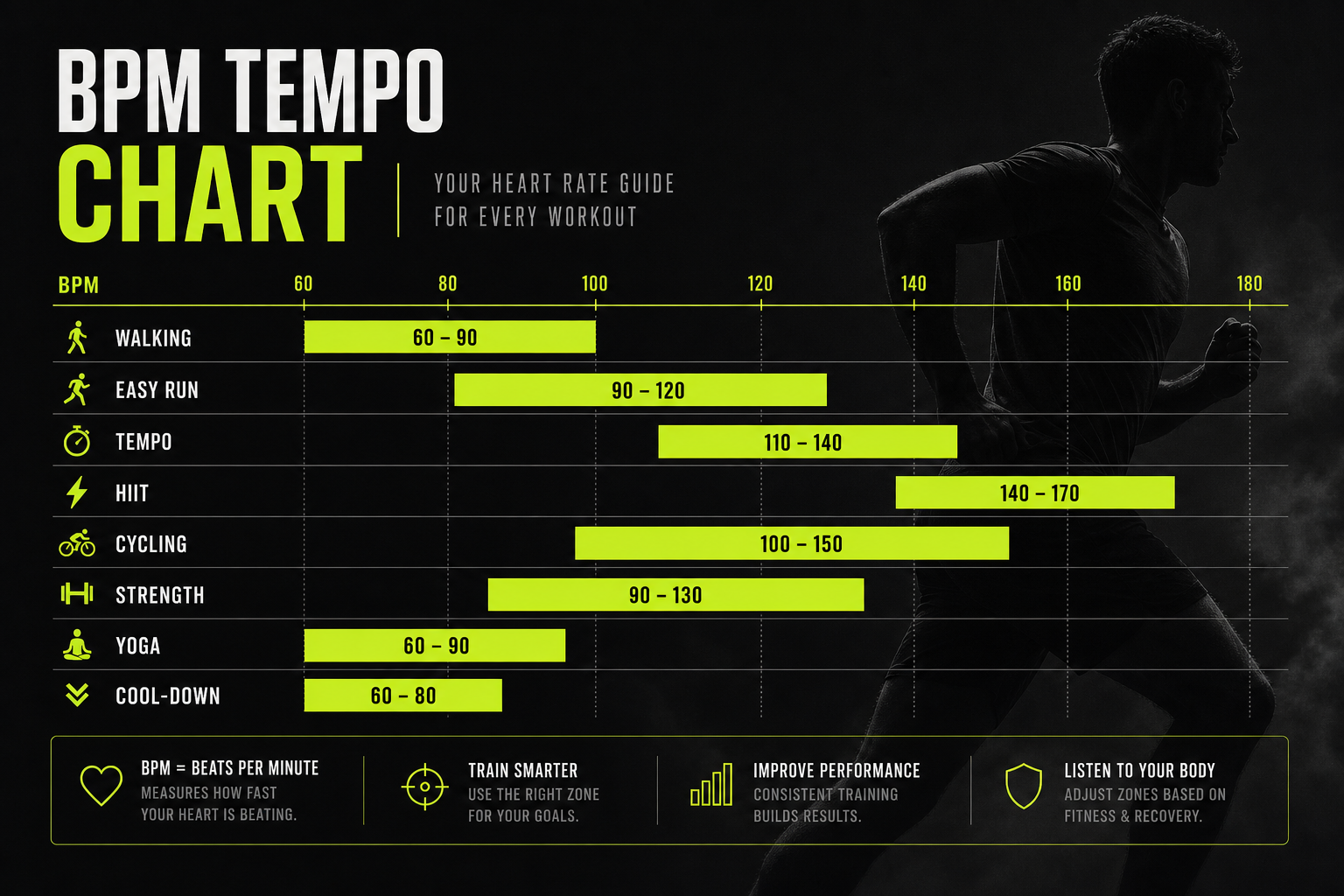
Beats per minute is the speed of a song. Warm-up and cool-down sit at the bottom of the workout tempo scale. One workout playlist guide puts cool-down at 90 to 115 BPM, noting that slower tempo supports the parasympathetic shift you are trying to trigger. For the final minutes, a stress-relief playlist guide lists 60 to 80 BPM for relaxation, meditation and yoga, and 40 to 60 BPM for sleep and deep relaxation.
Treat these as practical ranges from playlist guides, not clinical prescriptions. Here is how they translate into a cool-down:
| Cool-down phase | Typical length | Music tempo | What you are doing |
|---|---|---|---|
| Taper | 2 to 4 minutes | 100 to 115 BPM | Easy jog or brisk walk, breathing still audible |
| Settle | 3 to 5 minutes | 80 to 100 BPM | Slow walk, shoulders loose, breathing through the nose if you can |
| Stretch and breathe | 3 to 5 minutes | 60 to 80 BPM | Static stretches, paced breathing |
If your workout was a long run or a hard interval session, stretch each phase. If it was an easy 30-minute ride, you can compress them.
Why there is no single magic number
A 2026 study of male collegiate sprinters compared music tempos after exercise and measured heart rate variability, a marker of how the autonomic nervous system is recovering. Music at 120 BPM showed favorable recovery responses, and tempo-decreasing sequences ending at 60 BPM were associated with increased parasympathetic markers. That is a small group of young male athletes, so do not treat 120 BPM as a universal rule. It does support two practical ideas: you do not have to go ultra-slow immediately, and a descending sequence is worth trying.
Earlier work on controlled tempo manipulation and autonomic function points the same way. Increasing tempo goes with sympathetic activation, and decreasing tempo is the downshift signal. In other words, a 100 BPM song that follows a 160 BPM workout feels like a brake. The same 100 BPM song after a 70 BPM stretch feels like an acceleration.

What music actually does for recovery
It is tempting to believe your heart will lock onto the beat like a metronome. The evidence is more modest. A review of music’s effects on the cardiovascular system finds that tempo can entrain breathing and movement rhythms, but there is limited evidence that recorded music alone entrains heart rate. Music works mainly as a psychological tool: it lowers perceived exertion and improves how you feel during recovery.
That is still valuable. A cool-down people enjoy is a cool-down people actually do. And you can use the entrainment that does exist, breathing and stride, on purpose.
Pair the tempo with paced breathing
The American College of Sports Medicine discusses heart rate variability as a different measure from heart rate itself, and a common recommendation is paced breathing at about a 4-second inhale and a 6-second exhale. That pattern is associated with steadier blood pressure and higher HRV. You do not need a song at an exact BPM for this. Pick a slow track and let a few bars carry each breath: at 60 BPM, four beats in and six beats out is simple to follow.
If you have a heart condition, take blood pressure or heart medication, or get dizzy after exercise, ask your doctor what recovery heart rate and cool-down length are right for you. Breathing drills and long static holds are not a substitute for that advice.
A cool-down routine you can repeat
The American Heart Association says a cool-down typically lasts 5 to 10 minutes, and 15 or more after high-intensity training. UW Medicine’s guidance is similar: easy exercise for five to 10 minutes, such as walking or yoga, followed by static stretches. Here is a version that puts music to work.
- Drop the effort, not the movement. Keep moving at an easy pace. After a run, jog slowly then walk. After a ride, spin in a light gear. Music: 100 to 115 BPM.
- Walk it down. Keep walking until you can speak in full sentences without gasping. Music: 85 to 100 BPM.
- Check your heart rate. You should see it falling steadily. If your watch shows it staying high or climbing, slow down further and sit if needed.
- Stretch. Hold each major muscle group you used for 20 to 30 seconds, without bouncing. Music: 70 to 80 BPM.
- Breathe. Finish with two to three minutes of slow breathing, 4 seconds in and 6 seconds out. Music: 60 to 70 BPM, or ambient with no strong beat.
Cool-down stretches that suit most workouts: calves against a wall, standing quad stretch, hamstring reach, hip flexor lunge, and a chest opener. You do not need all of them. Pick the ones for the muscles you just worked.
Cool-down music by activity
- Running: Taper from your run cadence rather than leaping to a ballad. Our guide to recovery run music covers easy-pace playlists, and treadmill running music helps if you ramp down on a belt.
- Cycling: Spin at a light, comfortable cadence for the first few minutes and let the music slide down with it.
- Strength training: Rest between sets is a mini cool-down. Finish with a slow walk, then stretch to a 70 to 80 BPM track.
- Interval sessions: The jump from hard to easy is bigger, so give yourself the longer 10 to 15 minute version. See interval running music for the work side of that equation.
How to build a cool-down playlist that works
Songs vary, and streaming metadata is not always correct, so build your list with a few rules in mind.
- Sequence by tempo. Start near 110 BPM and end near 60 to 70 BPM, with each track a little slower than the last.
- Mind half-time feel. A 140 BPM track with a slow, spacious groove can feel like 70. Trust how it feels while you walk to it.
- Avoid surprises. A loud chorus or a sudden drop makes your effort level jump when you want it to fall.
- Mix genres. Downtempo, acoustic, ambient, slow R&B and soft instrumental all work. Pick what you like; enjoyment is part of the effect.
- Look up BPM before you commit. Our guide to finding songs by BPM shows how to check tempo, and what workout BPM means explains how it relates to your cadence.
The weakness of any static playlist is that you stop at a fixed time but recover at your own pace. A 4-minute song at 90 BPM might be too slow on a day your heart rate is already low, or too fast on a day it is still high. That is the gap adaptive music is designed to close.
Our perspective: let your body set the tempo
We build Repbeats around one belief: the music should respond to you, not the other way around. Most people choose a cool-down playlist at the start of a workout and hope it fits when they finish. In practice, a hard interval day and an easy recovery day end in very different places, yet the same playlist plays.

That is why we built our auto-DJ to update the music’s BPM every bar, using live data from wearables such as Apple Watch and Fitbit, along with cadence and session intensity. During a cool-down that means the beat can step down as your effort falls, instead of sitting at a number someone guessed in advance. We also think the research supports this approach: direction of tempo change matters, and recovery is individual.
We are also careful about what we claim. Music will not force your heart rate down, and no app replaces a proper easy-paced cool-down and good breathing. What a tempo-aware soundtrack can do is give you a cue to keep moving gently, then stretch, then breathe, and make that sequence feel natural. If you want to see how wearables read your effort in the first place, our explainer on how wearables measure exercise intensity goes through it, and our guide to syncing music to workout intensity shows the whole session, warm-up to cool-down.
— Jordan Mills
Let the music follow your recovery
If you wear an Apple Watch or Fitbit and want your cool-down to slow down when you do, Repbeats syncs music tempo to heart rate, cadence and session intensity, and it also includes meditation programs for the quiet end of the session. Our privacy policy limits device access to workout data only. You can see how it works on the Repbeats home page, and read more about the idea in our piece on AI workout music for wearables.
Common mistakes with cool-down music
- Jumping straight to silence or a slow ballad. If your heart is still pounding, an abrupt stop in movement is the problem, not the song.
- Chasing one exact BPM. The studies cover specific groups and conditions; your best tempo may differ by 10 to 20 BPM.
- Letting tempo creep up. Upbeat tracks mid-cool-down can pull you back into a faster pace.
- Skipping the breathing. Music alone does less for recovery than music plus slow, paced breaths.
- Ending too soon. If you are still sweating heavily and breathing hard at minute three, keep going. The numbers above are minimums.
FAQ
What is a good BPM for a cool-down song?
Start around 100 to 115 BPM and move toward 60 to 80 BPM by the end. A workout BPM guide suggests 90 to 115 BPM for the cool-down itself. The sequence matters more than any single number.
How long should a cool-down last?
Plan on at least 5 to 10 minutes. The American Heart Association notes it can stretch to 15 minutes or more after high-intensity training. Stop when your breathing is comfortable and your heart rate has dropped noticeably.
Does slow music lower my heart rate?
Not directly, as far as the evidence shows. Research suggests recorded music has limited ability to entrain heart rate, but it can lower perceived exertion and improve mood, and it can set the pace of your breathing and steps. Your heart rate falls mainly because you reduce effort.
Should I stretch before or after the cool-down music slows down?
Walk or move easily first, then stretch. UW Medicine recommends finishing with static stretches after five to 10 minutes of easy exercise. That fits the 70 to 80 BPM phase of your playlist.
Sources
- Warm Up, Cool Down, American Heart Association
- Aerobic exercise: How to warm up and cool down, Mayo Clinic
- How to Cool Down After Exercise, UW Medicine Right as Rain
- Effect of BPM music on post-exercise heart rate variability in male collegiate sprinters, Frontiers in Sports and Active Living
- The Effects of Controlled Tempo Manipulations on Cardiovascular Autonomic Function, Sage Journals
- Effects of music on the cardiovascular system, ScienceDirect
- Mental Health and Heart Rate Variability, ACSM
- Workout Playlist BPM Guide, Tzuka
- How to Create Playlists for Stress Relief and Relaxation, SearchSound.cloud