Elliptical Workout Music BPM: The Tempo to Pick for Each Stage
Jordan MillsNovember 7, 2026 · 13 min read

Elliptical Workout Music BPM: The Tempo to Pick for Each Stage
For a steady elliptical session, aim for music between 125 and 140 BPM. Go slower for the warm-up and cooldown, and push the tempo up only when you deliberately raise the effort. Below you will find the research behind that range, a stage-by-stage tempo table, ways to line the beat up with your stride, and tips for building a playlist you will want to finish.
TL;DR
- For most healthy exercisers doing steady aerobic work, 125 to 140 BPM is the sweet spot, according to a Brunel University expert statement.
- Build up to your target tempo during the warm-up and step back down for the cooldown.
- Faster, more obvious beats tend to push intensity up, so choose tempo on purpose instead of by accident.
- A song’s BPM and your heart rate are different numbers. Use BPM as a cue, and use your heart rate as the measure of effort.
- Pick songs with a strong, easy-to-follow beat that you know moderately well.
Table of Contents
- The short answer: 125 to 140 BPM for steady work
- Your BPM by stage: warm-up, steady state, intervals, cooldown
- Why tempo changes how hard you work
- How to match the beat to your stride
- Heart rate and BPM are different numbers
- What makes a good elliptical playlist
- Our perspective
- Let your music follow your workout
- FAQ
- Sources
The short answer: 125 to 140 BPM for steady work
The most useful single number comes from an expert statement written by sport psychologists at Brunel University. For most healthy people doing repetitive aerobic activity, 125 to 140 BPM works well. The same statement observes that preferred tempo stays inside that narrow band across a wide spread of exercise intensities, from 40 to 90 percent of heart rate reserve. In plain terms, you do not need a different tempo every time you nudge the resistance up a notch.
A second, independent line of evidence points to the same zone. A New York Times piece quoting sport psychologist Dr. Costas Karageorghis put the ideal tempo for a routine workout, such as 20 minutes on an elliptical trainer, at 120 to 140 BPM. That range roughly matches the average person’s heart rate during that kind of effort, which is part of why it feels natural.
Two caveats keep the number honest:
- Age matters. The Brunel statement notes the intensity and tempo relationship may differ for older exercisers, because maximal heart rate drops considerably with age.
- It is a range, not a rule. Within 125 to 140 BPM, pick what makes your stride feel smooth. A song at 128 that you enjoy beats a song at 135 that you tolerate.
Your BPM by stage: warm-up, steady state, intervals, cooldown
A workout is not one tempo. The American College of Sports Medicine’s guidance for group exercise says the BPM ranges apply to the work stages of a class: build up to that range during the warm-up and reverse the progression for the cooldown. That logic carries over directly to a solo elliptical session.
Here is a practical way to lay it out. The steady-state row comes straight from the research above. The other rows are working guidelines built on the same principle, so adjust them to how you feel.
| Stage | Suggested tempo | What to listen for |
|---|---|---|
| Warm-up (5 to 10 min) | Start below 125 BPM and climb toward your steady range | Relaxed rhythm, nothing that makes you rush |
| Steady cardio | 125 to 140 BPM | Prominent beat, familiar songs, a groove you can hold |
| Hard intervals | Top of the range or slightly above, for short bursts | Songs with a clear lift that match the effort rise |
| Recovery between intervals | Back toward the lower end of your range | Calmer songs that let your breathing settle |
| Cooldown (5 min) | Step down gradually below 125 BPM | Slower tracks that signal the session is winding down |
The professional guidelines from ACSM list 135 to 155 BPM for high-impact exercise and 60 to 110 BPM for indoor cycling. The elliptical sits between those worlds. It is low impact and rhythmic, so the steady-state range is the right home base, with the faster figures reserved for short hard efforts.
If your cooldown routine is a priority, our guide to cooldown BPM goes deeper on winding the tempo down.
Why tempo changes how hard you work
Music is not just background on a cardio machine. It acts as a timing cue, and your body tends to follow it.
Dr. Carl Foster of the University of Wisconsin-La Crosse, in ACE-sponsored research, describes the principle as entrainment: you get with the beat of the music, stepping or pedaling at the rate of the dominant beat. He adds that the stronger and more obvious the beat, the more likely you are to follow it. That is why a track with a muddy, buried rhythm can feel useless on an elliptical, while a clean four-on-the-floor beat practically drives your legs.
The same ACE-sponsored work summarizes a clear pattern: synchronous music tends to drive exercise intensity, so the faster the beat, the higher the intensity. It also notes that music-related arousal can make intense exercise seem less stressful. In one cardiac-rehab study described there, when the music tempo in a chair-aerobics class was sped up by 33 percent, patients followed the faster beat, and their heart rates rose by 10 to 15 beats per minute.
For your own training, that has two useful implications:
- Use tempo as a dial. If you want to ease off, choose slower songs. If you want to lift the effort, move to faster ones.
- Avoid drifting by accident. A playlist that jumps from 110 to 150 BPM without warning can pull your pace around when you wanted a steady effort.
Music can also make effort feel easier. A Brunel University study on high-intensity interval training found that medium-tempo music lowered ratings of perceived exertion, and both music conditions increased enjoyment and dissociation during recovery. If you do interval work on the elliptical, music is a real ally for getting through the hard parts.
How to match the beat to your stride
The elliptical has an advantage over many other cardio activities: your pace is steady and countable. Most machines show your cadence on the console, usually in strides or revolutions per minute. A basic approach:
- Read your current cadence after a few minutes of comfortable movement.
- Pick a song whose beat fits it. Often your stride lands on every beat or every second beat, so a 130 BPM song can suit a cadence of 65 or 130 depending on how you count. Experiment to find the pairing that feels effortless.
- Hold the pairing for a full song, then see whether you want to nudge the pace.
- Keep a few songs in reserve one step faster for when you decide to push.
Research on runners shows how powerful this cue can be. A 2022 study in IJERPH found that a six-week program with music set at a constant rhythm 10 percent higher than preferred stride frequency significantly increased stride frequency in recreational runners, with no significant change in the control group. The authors also caution that the increase should not exceed 10 percent, and that music works best as a performance aid in low and medium intensity activity rather than at the anaerobic threshold. For elliptical work, that is a good reminder to nudge your tempo gradually rather than leaping up.
Professor Kate Gfeller of the University of Iowa, quoted in the New York Times, explains that music provides a timing cue that helps you move more efficiently. She adds that the best workout songs combine a high BPM count with a rhythm you can coordinate your movements to. So a song that is fast but rhythmically vague is a worse pick than one that is a little slower with a clear, steady pulse.
For more on finding songs at a given tempo, see our guide to finding songs by BPM, and for the bigger picture on locking music to your movement, read about tempo matching music.
Heart rate and BPM are different numbers
It is easy to confuse three figures on an elliptical workout:
- Song BPM: how fast the music’s beat is.
- Cadence: how many strides you take per minute.
- Heart rate: how hard your body is working.
They are related, but they are not interchangeable. The ACE-sponsored research from the University of Wisconsin-La Crosse suggests a song’s BPM should correspond to the heart rate you hope to have during the workout, with figures of roughly 137 to 139 for power walking, 147 to 169 for running and 135 to 170 for cycling. The elliptical is not on that list, but its steady-state effort sits close to brisk walking and easy running, so those figures show why 125 to 140 BPM is a comfortable starting point.
The relationship is also not a straight line. The Brunel statement describes it as a series of inflection points rather than a smooth slope, with preferred tempo clustering in a narrow band even as intensity changes. A newer Brunel revisit from 2024 found that with unfamiliar, non-lyrical music, there was no discernible relationship between intensity and tempo preference, and that such music should be around 10 BPM faster than familiar, lyrical music to deliver the best psychological outcomes.
The takeaway: let heart rate, and how you feel, tell you how hard you are working. Use BPM to shape the experience around that effort. If you have a heart condition, take medication that affects your heart rate, or are unsure which heart rate zone is safe for you, ask your doctor before setting targets.
We cover the live-data side of this in syncing music to workout intensity.

What makes a good elliptical playlist
The Brunel expert statement gives a clear checklist. Music for repetitive aerobic exercise should be moderately familiar, suited to the activity, chosen for its motivational qualities, rhythmically prominent and played without compromising safety. Translate that into playlist habits:
- Choose songs you know a little, not songs you have heard to death. Moderate familiarity keeps you engaged without distracting you.
- Favor a strong beat over a clever one. Dense, off-beat tracks make it harder to settle into a stride.
- Keep the volume safe. You should still be able to hear your surroundings in a gym and protect your hearing.
- Avoid gaps. Sport-music producers have long worked with continuous mixes, and Power Music founder Richard Petty told the New York Times his remixes run with no pauses between songs so people can keep synchronizing their movement.
- Build the arc. Warm-up songs first, a steady middle, a short lift for any intervals, then a slow descent.
Song examples to start from
In that same New York Times piece, Dr. Karageorghis pointed to “Push It” by Salt-N-Pepa and “Drop It Like It’s Hot” by Snoop Dogg as songs in the 120 to 140 BPM range that suit elliptical workouts, and suggested “The Heat Is On” by Glenn Frey for high-intensity work. Treat them as seeds. Search for similar tempo songs in your own taste, whether that is pop, hip-hop, rock or electronic.
A simple 30-minute template:
- Minutes 0 to 5: two or three songs under 125 BPM, easy resistance.
- Minutes 5 to 25: songs between 125 and 140 BPM, with resistance at a level you can hold.
- Minutes 25 to 30: slow songs that let your breathing settle.
If you want ready-made structures, our BPM-matched workout music templates show how to lay out playlists like this for different efforts.
Our perspective
Static playlists ask you to guess your workout in advance. You pick a tempo, press play, and hope your legs, your heart and the song agree for 30 minutes. Real sessions are never that tidy. You warm up slowly, settle into a rhythm, surge, tire and recover.
That is why we built Repbeats around live data. Our app is designed to read signals from wearables such as Apple Watch and Fitbit, including heart rate, cadence and session intensity, and our auto-DJ updates the music’s BPM every bar so the soundtrack follows what you are actually doing instead of what you planned.
The research above is the reason we care. If a strong, obvious beat gives you a timing cue and tempo shapes how hard a session feels, then the tempo should be a tool in your hands, not a coincidence. We want the music to support each phase of a workout, from the first easy minutes to the last cooldown song.
We also keep access narrow. Our privacy policy limits device access to workout data only, because the point is better training, not collecting more about you.
Jordan Mills
Let your music follow your workout
If you would rather not build and rebuild BPM playlists by hand, Repbeats is a fitness app that synchronizes music tempo to your heart rate, cadence and session intensity using data from wearables like Apple Watch and Fitbit. Its auto-DJ adjusts the beat bar by bar, and the app also offers cardio and meditation programs, real-time music control, a music library search and program scheduling.
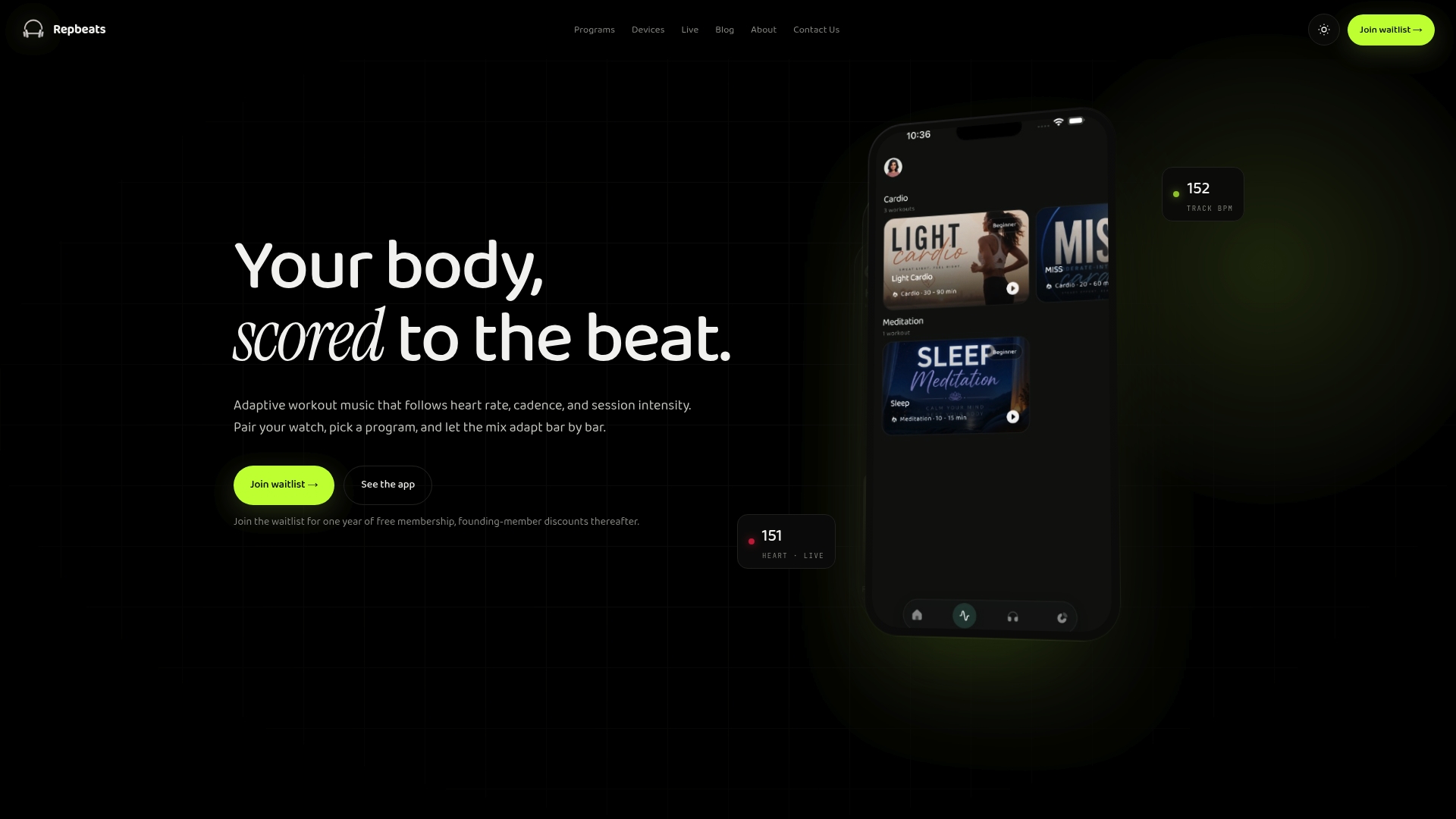
The waitlist launch includes a free year. You can join through the Repbeats homepage and check the app page for current details.
For a wider look at how wearable data and music work together, read about AI workout music that syncs to heart rate, or see adaptive music workout best practices.
FAQ
What BPM is best for elliptical workout music?
For most healthy exercisers, 125 to 140 BPM suits steady elliptical work. That range comes from an expert statement by Brunel University researchers and fits the 120 to 140 BPM figure cited for routine elliptical sessions. Start lower for the warm-up and finish lower for the cooldown.
Should my music match my elliptical cadence exactly?
It helps to have your stride land on the beat, or on every second beat, because the beat acts as a timing cue. You do not need a perfect match, though. Pick a song that feels natural against your cadence, and nudge the tempo up gradually if you want to speed up. Research on runners suggests keeping any increase to about 10 percent.
Does faster music make me work harder?
Usually, yes. ACE-sponsored research describes synchronous music as tending to drive intensity, so the faster the beat, the higher the effort. That is useful when you want an interval to hit harder. When you want a steady aerobic session, keep the tempo within your target range so the music does not pull you faster than you planned.
Should I use the same BPM for the whole workout?
No. Build up during the warm-up, hold your steady range for the main work and step down for the cooldown. ACSM guidance describes this same progression for group exercise. If you do intervals, move to faster songs for the hard efforts and calmer ones for recovery.
How do I find songs at a certain BPM?
You can search by tempo in a music library or use an app that reads tempo for you. Our guide to finding songs by BPM walks through the options. Repbeats also offers a music library search alongside its adaptive auto-DJ.
Sources
- Brunel University expert statement on music in exercise (Karageorghis et al.)
- ACSM music tempo guidelines for exercise
- ACSM: Music that Moves, building a workout playlist
- New York Times: They’re Playing My Song. Time to Work Out.
- ACE-sponsored research: exploring the effects of music on exercise intensity
- Brunel University HIIT and music study
- IJERPH: musical feedback and stride frequency in runners
- Brunel University 2024 revisit of the intensity and music-tempo preference relationship