Tempo Matching Music: How to Pick the Right BPM
Jordan MillsOctober 26, 2026 · 12 min read

Tempo Matching Music: How to Pick the Right BPM
Tempo matching music means choosing songs whose beats per minute (BPM) line up with what your body is doing: your running cadence, your pedaling rate, your walking pace or your target effort. Count your steps or pedal strokes per minute, find songs close to that number, and your movement tends to fall into step with the beat. Below you’ll find the BPM ranges coaches and researchers use, a worked running example, ways to find a song’s BPM, and what to do when a fixed playlist stops fitting your workout.
TL;DR
- Tempo is the speed of a song’s pulse, measured in BPM. One beat per second is 60 BPM, and two per second is 120 BPM.
- For running, measure your baseline cadence, then pick music 7.5% to 10% above it to nudge your steps faster.
- Published ranges differ by activity: roughly 60 to 110 BPM for indoor cycling and 135 to 155 BPM for high-impact exercise (ACSM), with wide windows for running and cycling outdoors.
- Music helps mood, performance and perceived effort, but a static playlist can’t follow you as your pace changes. Adaptive tools can.
Table of Contents
- What tempo means and how BPM works
- Why matching music to movement works
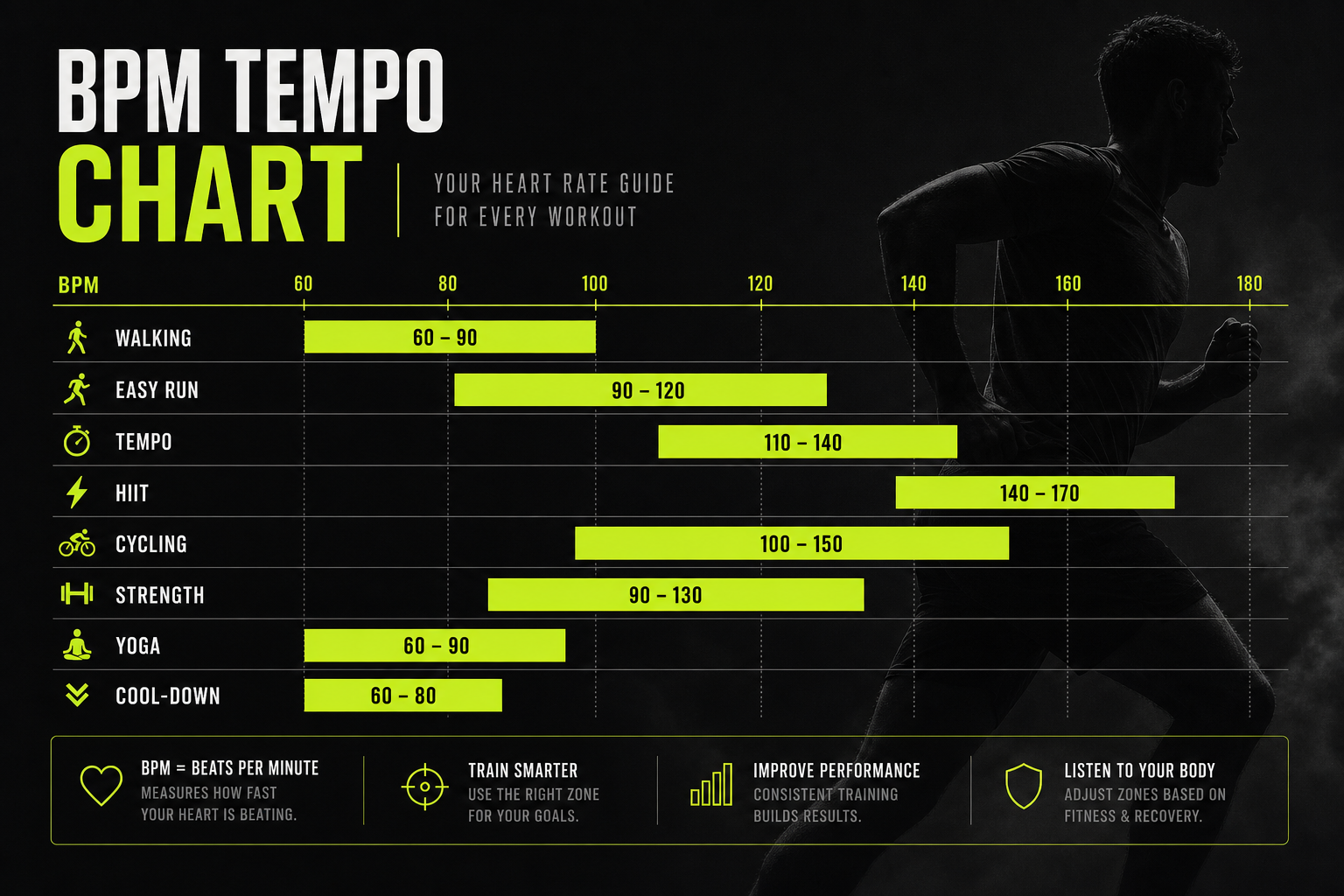
- BPM ranges by activity
- A worked example: tempo matching for a run
- How to find a song’s BPM
- Where a fixed playlist breaks down
- Our perspective: tempo should follow you, not the other way around
- Let the music adjust for you
- Tips for better results
- FAQ
- Sources
What tempo means and how BPM works
Tempo is the speed of the underlying pulse of a piece of music. It is measured in beats per minute, so 60 BPM equals one beat per second and 120 BPM equals two beats per second. A higher BPM means a faster tempo.
That is all a BPM number tells you. It says nothing about how energetic a song feels, because a song can have a fast pulse and a lazy groove, or the reverse. For workouts, though, the pulse is the useful part, because your feet and legs move in a repeating rhythm too. Matching the two is the whole idea.
Is 90 BPM a fast tempo?
Not in music generally. Classical tempo markings give a rough scale: Allegro, the fast and bright category, sits at 109 to 132 BPM, while Andante, the “walking pace” marking, is commonly listed at about 76 to 108 BPM. So 90 BPM is a moderate, unhurried tempo.
In a workout, 90 BPM is slow for running but fits a warm-up, a recovery stretch or a steady spin on an indoor bike, since the ACSM range for indoor cycling starts at 60 BPM. Whether a tempo is “fast” depends on the movement you pair it with.

Why matching music to movement works
People tend to fall into step with a strong beat. The term for it is entrainment: a person naturally tries to match the rate of their stepping or pedaling to the dominant beat of the music. Researchers at the University of Wisconsin, in work sponsored by the American Council on Exercise, pointed out that the stronger and more obvious the beat, the more readily exercisers sync their effort to it. Songs with a clear, steady kick or snare are easier to move to than songs with a floating, ambient pulse.

There is also a payoff beyond rhythm. A 2020 meta-analysis of 139 studies found that listening to music during exercise brings significant benefits to mood (affective valence), physical performance and perceived exertion. It did not find a significant effect on heart rate. The authors also note that moving in sync with music may lower the metabolic cost of the activity.
The effect on how hard the work feels is not equal everywhere. Research from 2020 found that music’s benefit on perceived exertion was more pronounced in endurance exercise than in high-intensity training. That fits experience: when you are grinding through a long, steady run, the music is your main distraction. When you are at maximum effort for 30 seconds, you are not thinking about the song.
Runners tell the same story from the practical side. Runner’s World describes tempo-matched playlists as a way to lock into a steady pace without constantly checking your watch.
BPM ranges by activity
There is no single correct number. Different organizations publish different windows, and those windows overlap. Use them as starting points, then adjust to your own body.
| Activity | Typical BPM range | Source |
|---|---|---|
| Indoor cycling | 60 to 110 | ACSM, 2022 |
| Low-impact exercise | 126 to 136 | ACSM, 2022 |
| High-impact exercise | 135 to 155 | ACSM, 2022 |
| Power walking | About 137 to 139 | ACE-sponsored research |
| Running | About 147 to 169 | ACE-sponsored research |
| Cycling | About 135 to 170 | ACE-sponsored research |
The cycling rows disagree, and that is worth understanding rather than smoothing over. The ACSM range for indoor cycling is low because it reflects a studio ride with its own pacing, where the beat is often half-time against your pedal strokes. The ACE-sponsored range reflects music that tracks pedaling rate directly. If you want the beat to equal your cadence, work from your actual revolutions per minute, not from a table.
Walking and warm-ups
Verywell Fit places music for moderate walking at 120 to 140 BPM, with a 120 to 130 BPM mix suited to about 3.2 to 3.5 miles per hour. It also suggests lower tempos for warm-ups. That is a sensible pattern for any workout: begin slower than your target, then climb.
Running
Runner’s World frames 120 BPM as a practical tempo for holding a consistent running pace, and notes that the broader range it considers ideal for runners is 120 to 180 BPM. Notice that 120 BPM is slower than most runners’ step rate. Runners often take 150 to 180 steps a minute, and a 120 BPM song can still work if you land one foot on every beat and let the other foot fall between them, or if your pace is easy. For a cleaner match, pick music near your actual step rate.
A worked example: tempo matching for a run
Research gives a concrete recipe. In a 2022 study, the approach was to identify the runner’s average baseline cadence, choose music with a beat 7.5% to 10% higher, and synchronize cadence to it. In that study, five runners raised their cadence by 8.5% during music training. Five runners is a very small sample, so treat it as a promising technique, not a guarantee.
Here is how you would apply it.
- Measure your baseline. Run at an easy to moderate pace for a few minutes and count your steps for 60 seconds, or read average cadence from your watch. Say it is 160 steps per minute.
- Compute your target window. 7.5% above 160 is 172, and 10% above is 176. Songs between 172 and 176 BPM are your target.
- Build the playlist. Pick tracks in that window, or use the half-time trick and pick songs at 86 to 88 BPM if you prefer a slower feel and step on every beat.
- Run to it, and let your feet follow. Do not force it. Within a couple of minutes, most runners find their stride drifting toward the beat.
- Re-measure after a few weeks. As your cadence rises, the baseline moves, and so should the music.
A higher cadence is not automatically better for everyone, and pushing it sharply can feel awkward or tire you in new places. If you have a recurring injury, ask a physical therapist or running coach before changing your stride on purpose.
How to find a song’s BPM
You have three practical options.
- Count it yourself. The ACSM method: determine the time signature, count the measures in the first minute, and multiply by the beats per measure. Most pop and dance songs are in 4/4, so 40 measures in a minute means 160 BPM.
- Tap it out. Tap along to the song for 15 seconds, count the taps, and multiply by four.
- Use a published list. Curated lists group songs by BPM, which saves the counting.
Songs at 120 BPM
If you want a starting point for walks, easy runs or warm-ups, these are listed at or in mixes of 120 BPM by Runner’s World or Verywell Fit: “Best Song Ever” by One Direction, “We R Who We R” by Kesha, “New Rules” by Dua Lipa, “Bad Romance” by Lady Gaga, “Dynamite” by Taio Cruz, “Raise Your Glass” by P!nk, “Sugar” by Maroon 5, “Call Me Maybe” by Carly Rae Jepsen, “Teenage Dream” by Katy Perry, “Flowers” by Miley Cyrus, “Hot Stuff” by Donna Summer and “Gimme! Gimme! Gimme!” by ABBA. Their Runner’s World list and the Verywell Fit walking guide carry more.
A caveat: streaming services and DJ software sometimes disagree on a song’s BPM, especially when they read a double-time or half-time feel differently. If a song feels wrong at its listed tempo, trust your feet.
Where a fixed playlist breaks down
A static playlist matches one tempo, and workouts rarely stay at one tempo. You warm up slowly, settle into a steady pace, hit intervals, and cool down. A group fitness studio solves this with an instructor who reads the room and cues the music; this overview of music’s role in fitness class energy covers how that works in class settings. When you train alone, you are your own instructor, and fiddling with your phone mid-interval is a poor way to do it.
There are three common failure points:
- Pace drift. Your cadence changes with fatigue, hills and wind, and a playlist locked at 170 BPM stops matching.
- Interval work. Sprint and recovery phases need different tempos, and manual switching interrupts the effort.
- Heart rate zones. Some workouts are governed by effort, not pace. Music that follows your zone supports the plan, while music that follows only your legs can push you out of it.
If you want to go deeper on building templates by hand, our guides on BPM-matched workout music templates and syncing music to workout intensity walk through the steps. For treadmill sessions specifically, see interval music built around a 130 BPM baseline.
Our perspective: tempo should follow you, not the other way around
We build Repbeats around one belief: the song list should respond to the workout, because the workout will not respond to the song list. Tempo matching on paper is a useful skill, and everything above is worth knowing. But the number you computed at the start of the run is a snapshot. Your body keeps changing it.
That is why our auto-DJ updates the music’s BPM every bar, using live data from wearables such as Apple Watch and Fitbit. It reads heart rate, cadence and session intensity, and moves the music with you, so the soundtrack supports each phase instead of fighting it. The same logic applies when the goal is the opposite of speed: in meditation programs, the music is there to help you settle.
We also think data access should be narrow. Our privacy policy limits device access to workout data only, because a music app has no business with the rest of your health information.
If you take one idea from us, make it this: choose tempo by what the session is for. Easy day, let the music stay low and steady. Interval day, let it rise and fall with the work. Recovery, let it drop.
— Jordan Mills
Let the music adjust for you
If you would rather not count steps and build playlists by hand, Repbeats does the matching live. It syncs music tempo to your heart rate, cadence and session intensity for running, cycling and meditation, lets you control playback in real time, search the music library and schedule programs. The waitlist launch includes a free year. See how it works on the Repbeats app page, or read how wearables measure exercise intensity for adaptive music first.
Tips for better results
- Start below your target. Use music around 110 BPM for a warm-up, then climb. Our piece on dynamic workout music from 110 BPM warm-ups shows one way to stage it.
- Choose a clear beat. Strong, obvious drums are easier to sync to than dense or atmospheric tracks.
- Keep a 4 to 10 BPM window in mind for pacing work. For time trials and tempo runs, a narrow window above your cadence keeps the beat useful without dragging you off your plan.
- Match the goal, not just the pace. Endurance sessions gain the most from music, so save your best tracks for long efforts.
- Review monthly. Fitness changes your cadence and heart rate at a given pace. Re-measure and rebuild.
For more on this approach, see our best practices for adaptive music workouts.
FAQ
What does tempo mean in music?
Tempo is the speed of the music’s underlying pulse. It is measured in beats per minute, so 60 BPM is one beat per second and 120 BPM is two. Higher BPM means faster music.
What songs can I listen to at 120 BPM?
Popular choices include “Dynamite” by Taio Cruz, “New Rules” by Dua Lipa, “Teenage Dream” by Katy Perry and “Hot Stuff” by Donna Summer. Runner’s World and Verywell Fit both publish 120 BPM lists. Because services sometimes disagree on BPM, check that a song feels right against your pace.
Is 90 BPM a fast tempo?
No. By classical tempo markings 90 BPM falls in the moderate Andante to Andante Moderato zone, well below Allegro. It suits warm-ups, recovery and easy indoor cycling more than running.
What BPM is best for running?
There is no single best number. Published ranges run from about 120 to 180 BPM, with ACE-sponsored research pointing to 147 to 169 BPM. A more personal method is to take your baseline cadence and choose music 7.5% to 10% above it.
Sources
- Explore dynamics and tempo in music, BBC Bitesize
- How do musicians know how fast to play a piece?, Symphony Nova Scotia
- Italian Tempo Markings: BPM Chart
- ACE-sponsored Research: Exploring the Effects of Music on Exercise Intensity
- Effects of Music in Exercise and Sport: A Meta-Analytic Review
- The Psychophysiological Effects of Different Tempo Music
- Music Tempo Guidelines for Exercise, ACSM (PDF)
- Music Tempo Guidelines for Exercise, ACSM
- Using beat frequency in music to adjust running cadence
- Best 120 BPM Pop Songs for Runners, Runner’s World
- Walking Music Mix Playlist and Workout Songs, Verywell Fit
- Music’s Role in Fitness Class Energy and Performance