Lactate Threshold Music: Match Tempo to Your Effort
Jordan MillsNovember 16, 2026 · 12 min read

Lactate Threshold Music: Match Tempo to Your Effort
There is no single song or BPM that puts you at your lactate threshold. Threshold is a physiological line, and music cannot measure it. What music can do is help you hold the effort once you have found it. The best threshold soundtrack follows your heart rate and cadence, so the tempo rises as you settle into the hard, steady zone and eases off during recovery. That is the idea behind Repbeats, an app that syncs music tempo to heart rate, cadence and session intensity using data from wearables such as Apple Watch and Fitbit.
TL;DR
- Lactate threshold is the fastest steady effort you can hold before fatigue builds quickly. For many runners it sits around 85–90% of max heart rate, and your own number can differ.
- Find threshold with heart rate, perceived effort (a 7 or 8 out of 10) and the talk test. Music does not tell you where it is.
- Music tempo works best as support: research links faster music to longer high-intensity work and a lower perception of effort.
- Running songs usually fall in the 147–169 BPM range and cycling songs in the 135–170 BPM range, but your heart rate and cadence should set the target.
- A tempo that adapts to your live data keeps a threshold session steady from warm-up to cool-down.
Table of Contents
- What lactate threshold actually is
- What threshold feels like
- What heart rate should you aim for?
- Does music really help at threshold?
- Picking BPM for a threshold session
- A threshold session, step by step
- Our perspective
- Try threshold training with music that follows you
- FAQ
- Sources
What lactate threshold actually is
When you exercise, your muscles produce lactate, and your body clears it at the same time. At easy effort, production and clearance stay balanced. Push harder and there is a point where lactate builds faster than you can clear it. That point is your lactate threshold.
The American Council on Exercise (ACE) defines it as the fastest you can continuously run, cycle, swim or exercise aerobically in a steady-state bout without fatiguing. A clinical guide in PMC adds that the work rate beyond which blood lactate rises exponentially is a better predictor of performance than VO2max and a better indicator of exercise intensity than heart rate.
You may see two thresholds mentioned. A coach quoted in Runner’s World explains that LT1 is the aerobic threshold and LT2 the anaerobic threshold: LT1 is where lactate rises above resting levels, and LT2 is where lactate outpaces what your body can clear. When coaches say “threshold workout,” they mean LT2. A review of exercise intensity notes that at that upper boundary, exercise duration is typically limited to 30–50 minutes.
Why it matters for your music
Threshold effort is a narrow band. Go a little under and the session feels comfortable but does less. Go a little over and you fade before the interval ends. A soundtrack for this kind of work has a specific job: keep your rhythm steady and your mind off the discomfort while you stay in the band.
What threshold feels like
You can test for threshold in a lab, but most people judge it by feel. Three signals work well together.
Perceived effort. A coach quoted by Outside suggests that a 7 or 8 on a 1–10 scale means you are probably around threshold. The Indoor Cycling Association’s field-test guide gives the same 7–8 range, with breathing deep and forceful but not ragged and some leg burning that does not make you slow down.
The talk test. At threshold, speaking in complete sentences becomes difficult. You can manage a few words, not a conversation.
The one-hour idea. Outside describes threshold pace as the pace you could hold for about an hour, which one coach calls “comfortably uncomfortable”. Bicycling puts it differently for cyclists: roughly a flat-out 30-minute time trial.
If you are above that line, breathing turns ragged, the burn spreads and your pace drifts. That is your cue to back off a notch, not to turn the music up.
What heart rate should you aim for?
A widely quoted guideline for runners is that threshold arrives at about 85–90% of maximum heart rate. The same guide says threshold pace is often a little faster than half-marathon pace: if your half-marathon mile is 10:00, threshold is around 9:45.
Treat that as a starting range, not a verdict. Bicycling points out that threshold is a better baseline than max heart rate for setting training zones, because sedentary people can have thresholds as low as 50% of max heart rate, while elite athletes can hold 90–95% for an hour. A review of exercise prescription makes the same point: percentages of max heart rate fail to acknowledge individual variability, and your boundaries shift as you train.
A precise number comes from an incremental test in an exercise physiology lab, where blood lactate is measured. ACE notes that a validated field test can estimate it if you cannot get to a lab. Effort ratings also line up reasonably with heart rate: a review in PMC reports that RPE correlates well with heart rate during steady-state exercise, and that submaximal heart rate can vary day to day by up to 6.5%. So check your estimate against how the effort feels on the day.
If you have a heart condition, take medication that affects heart rate, or are new to hard training, talk with your doctor before doing sustained threshold work.

Does music really help at threshold?
Yes, in specific ways. Music does not move your lactate threshold, but it changes how hard the same effort feels and how long you can stay with it.
A 2019 study of repeated high-intensity cycling bouts at 80% of peak power found that 130 BPM music let participants exercise 10.7% longer, about one extra minute, with only trivial differences in perceived exertion. Heart rate recovery five minutes after exercise was also 13.0% faster. The authors conclude that high-tempo music can alter the link between central motor drive, cardiovascular command and perceived exertion.
ACE’s research summary quotes sport psychologist Costas Karageorghis of Brunel University, who says music can reduce the perception of effort significantly and increase endurance by as much as 15 percent. He names three mechanisms: synchrony with the beat, increased arousal and distraction from discomfort. Threshold intervals lean on all three, since they are long enough to get boring and hard enough to hurt.
The evidence is not one-sided about tempo. A 2024 study found no clear link between exercise intensity and preferred tempo for unfamiliar, non-lyrical music, and fast tempos were tied to the most positive psychological outcomes. In practical terms: choose a tempo that suits the effort you plan to hold, then let your body data confirm it.
Picking BPM for a threshold session
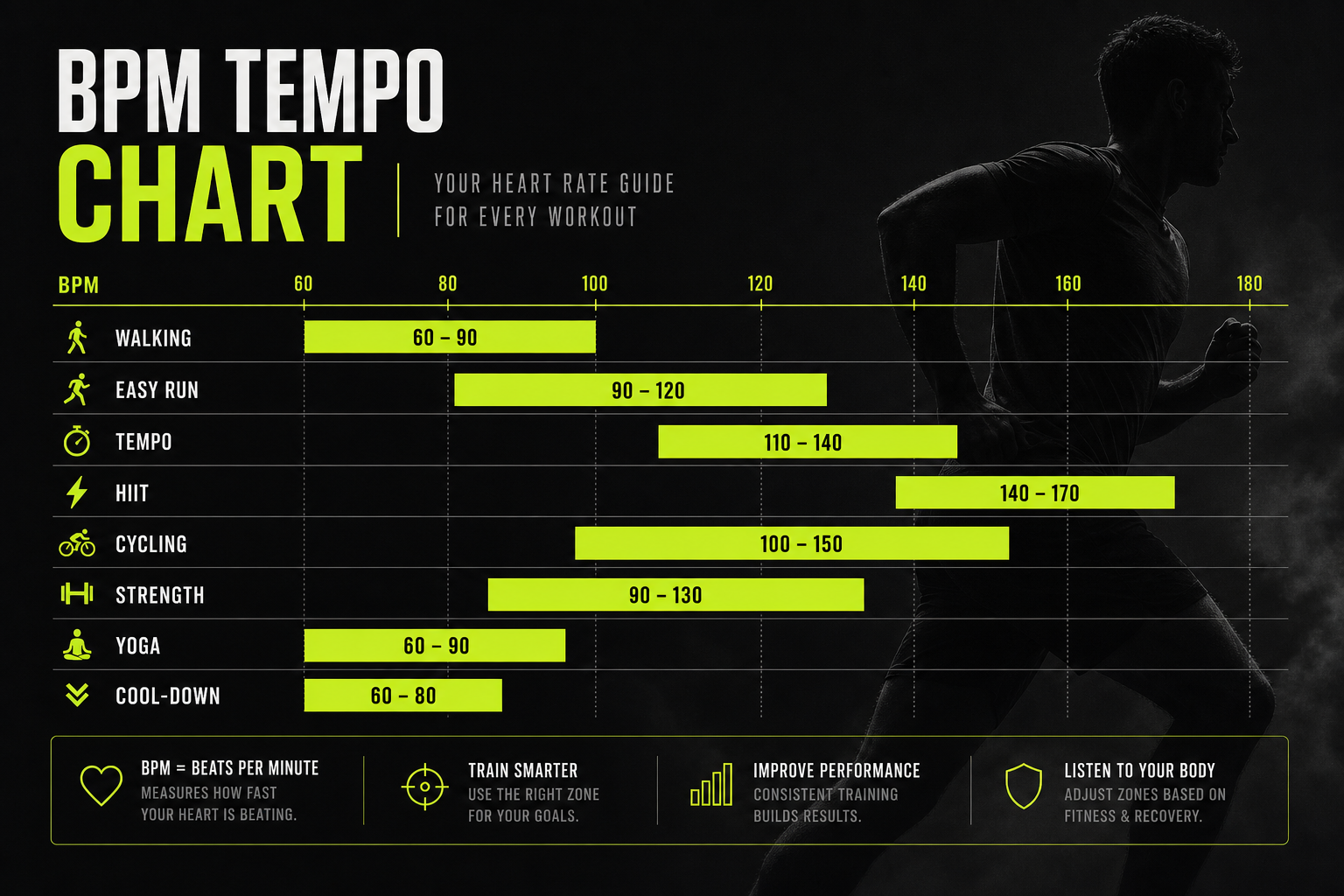
The tempo ranges most often cited for exercise come from ACE’s summary of research: about 147–169 BPM for running and 135–170 BPM for cycling. The same summary advises that a song’s BPM should correspond to the heart rate you hope to have during the workout.

That last point is the useful one. Your target is a heart rate and an effort, and the music follows it. For runners, cadence gives a second anchor: if your steps per minute sit in a certain range at threshold pace, tracks near that tempo (or at a clean half or double of it) feel natural to run with.
Here is how the pieces fit in a typical threshold workout.
| Segment | What you want | Music approach |
|---|---|---|
| Warm-up (10–15 min) | Raise heart rate gradually | Start low and climb. The Sport Journal suggests 80–130 BPM for a warm-up aiming at 120 bpm heart rate, each track a little faster |
| Threshold block (10–30 min) | Steady, “comfortably uncomfortable” effort | A steady, driving tempo that matches your target heart rate and cadence, with no big jumps |
| Recovery jog or spin | Heart rate drops, breathing settles | Slower, softer music |
| Cool-down | Return to easy effort | Gradually slowing tempo |
The same Sport Journal review describes the pattern of fast, loud music for work segments and slow, soft music for recovery, and a “segmentation” effect in which athletes time bursts of effort to especially motivating parts of music they know well. In circuit and interval training, tailoring music this way was linked to a 20% improvement in attendance among collegiate athletes.
Keep the tempo tied to the effort you intend
Tempo pulls on your body. In one cardiac-rehab study summarized by ACE, when the music for a chair-aerobics class was sped up 33%, participants followed it and their heart rate rose 10–15 beats per minute. That is useful information for a threshold session: the beat will nudge your pace, so the beat should be set to the effort you planned. A playlist chosen once and played at random can drift away from your target zone. A tempo tied to your live heart rate and cadence does not.
Familiar versus new music
The 2024 study above found that unfamiliar, non-lyrical music should be about 10 BPM faster than familiar, lyrical music to give the same effect. If you run to songs you know well, you may not need the top of the range.
A threshold session, step by step
Here is a simple running example. Adjust the numbers to your own fitness and cycling cadence if you ride.
- Estimate your zone. Start with 85–90% of max heart rate, then adjust by feel. You want an effort of 7–8 out of 10 and short, broken sentences when you speak.
- Warm up for 10–15 minutes. Begin with a low tempo and let it climb track by track as your heart rate rises.
- Run the block. ACE’s program progresses steady-state threshold work from 10 to 30 minutes, with 30 minutes considered sufficient. Beginners can start with two 10-minute blocks.
- Recover. Jog easily between blocks while the music slows and your heart rate drops.
- Cool down. Finish with easy running and a gentle tempo.
For progression, ACE recommends a three-part plan: base-building aerobic work, steady-state threshold sessions and high-intensity intervals, with training volume increased by about 10–20% per week and RPE used to judge steady-state effort. Threshold work is one part of an endurance plan, not all of it.
For ready-made tempo guidance, our tempo run BPM guide and threshold run music playlist guide walk through specific ranges. If you want to turn your pace into a target tempo, the pace-to-BPM math shows how. And for the science behind why tempo pulls on your body, see why music tempo affects exercise.
Our perspective
Threshold training asks you to do something hard to do by feel: hold one narrow effort for a long time. A static playlist cannot help with that, because it has no idea what your heart is doing.
We built Repbeats around a different idea. Your wearable already reports heart rate and cadence, so the music should respond to them. Our auto-DJ updates the BPM every bar, which means the tempo can follow your session intensity as it changes from warm-up to work to recovery, rather than staying fixed on whatever song happens to be playing.
That is why we think of music as part of how you pace the session, not just a backdrop. You still find your threshold the way coaches have always done it, with heart rate, effort and the talk test. Then the soundtrack supports the zone you chose and eases off when you do.
Jordan Mills
Try threshold training with music that follows you
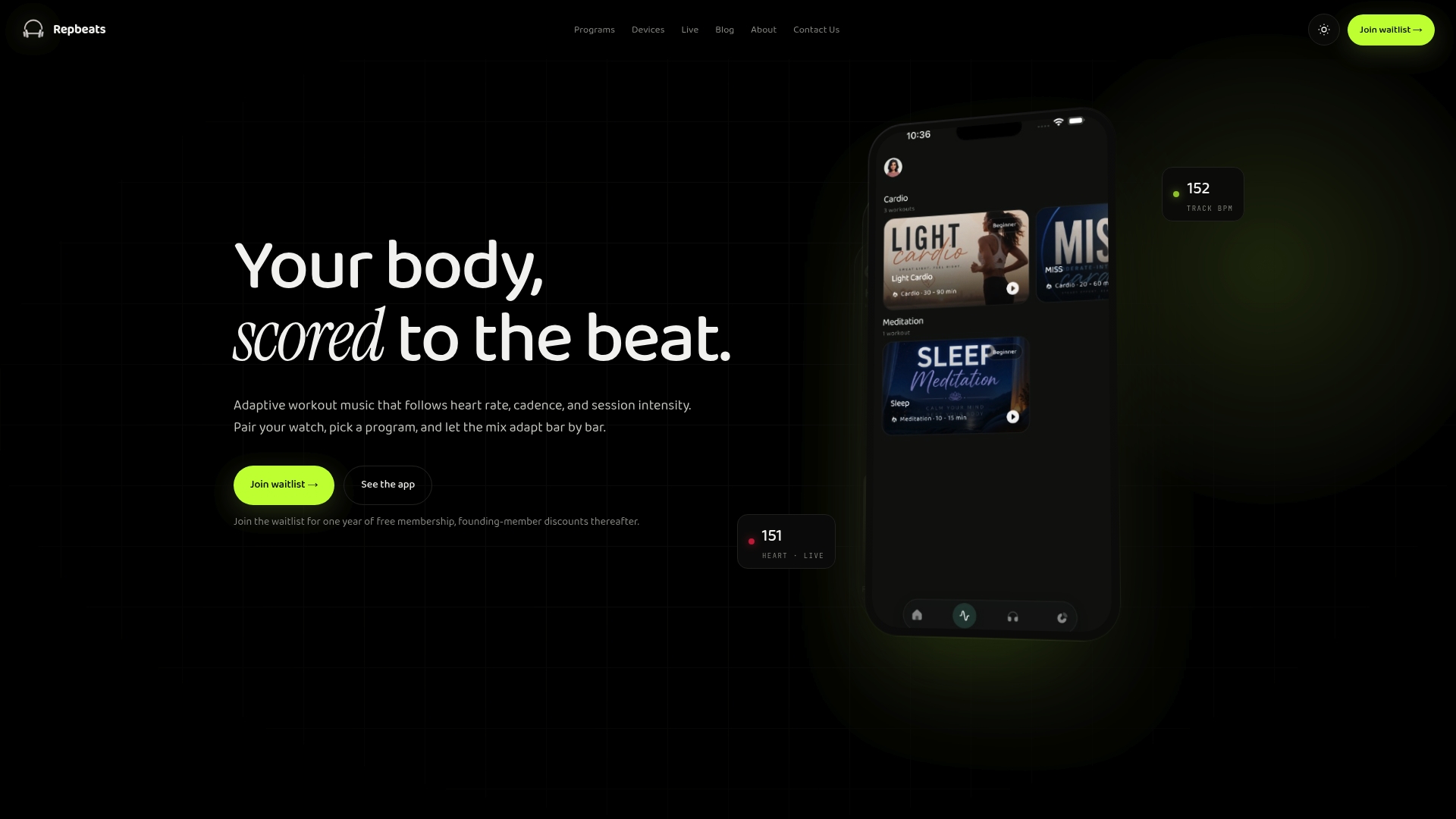
Repbeats syncs music tempo to your heart rate, cadence and session intensity using live data from wearables such as Apple Watch and Fitbit, and updates the BPM every bar. It supports cardio programs for running and cycling, plus meditation programs, with real-time music control, music library search and program scheduling. Its privacy policy limits device access to workout data only. The waitlist launch includes a free year. Learn more on the Repbeats app page.
If you want a place to start, see our guides to adaptive music workout practices and raising cadence with pace-matched music.
FAQ
What is a good lactate threshold heart rate?
For runners, threshold usually falls at about 85–90% of max heart rate. Individual values vary widely with fitness, so use that range as a starting point and check it against effort and the talk test.
What does it feel like to hit your lactate threshold?
Breathing becomes deep and forceful, your legs start to burn and speaking in full sentences gets hard. Most coaches describe the effort as a 7 or 8 out of 10, or “comfortably uncomfortable.” If you can chat easily, you are below it.
What is the fastest way to increase lactate threshold?
There is no shortcut. ACE recommends building an aerobic base, adding steady-state threshold workouts that grow from 10 to 30 minutes, and then including high-intensity intervals, while raising volume by about 10–20% per week. Consistent, gradual progression matters more than any one session.
Can music raise my lactate threshold?
Music does not change your physiology. It can change how hard the effort feels and how long you hold it. In a 2019 cycling study, 130 BPM music let participants exercise 10.7% longer at 80% of peak power.
What BPM should I use for threshold runs?
Start from the commonly cited running range of about 147–169 BPM, then tie the tempo to your target heart rate and cadence. Tempos that match your cadence feel natural to run with, and the best number is the one that keeps you in your threshold effort.
Sources
- Blood Lactate Measurements and Analysis during Exercise (PMC, 2007)
- What Is Moderate to Vigorous Exercise Intensity? (PMC, 2021)
- Lactate Threshold Training Program (ACE ProSource, 2015)
- How to Find Threshold Pace at Home (Runner’s World, 2026)
- Start Caring About Lactate Threshold (Outside Run, 2025)
- Field Testing (Indoor Cycling Association)
- Lactate Threshold: What It Is (Bicycling, 2026)
- Everything You Need to Know About Threshold Runs (ASICS, 2017)
- Monitoring Training Load to Understand Fatigue in Athletes (PMC, 2014)
- High tempo music prolongs high intensity exercise (PMC, 2019)
- Exploring the Effects of Music on Exercise Intensity (ACE, 2010)
- Music in Sport and Exercise: An Update on Research and Application (The Sport Journal, 2008)
- The exercise intensity–music-tempo preference relationship (ScienceDirect, 2024)