Heart Rate Training Music: Match BPM to Your Zones
Jordan MillsOctober 25, 2026 · 12 min read

Heart Rate Training Music: Match BPM to Your Zones
Heart rate training music is music whose tempo fits the zone you are trying to train in. Slow, steady tracks suit easy zones and warm-ups. Mid-tempo tracks of roughly 120 to 140 BPM suit steady cardio. Faster tracks suit hard intervals. The catch is that your heart rate moves around while a song’s BPM does not, so the best setup lets one follow the other. This guide covers the numbers, what the research does and doesn’t support, and how to build a system you won’t have to babysit mid-workout.
TL;DR
- For steady cardio, aim for roughly 120 to 140 BPM. For intervals, the useful range stretches to about 140 to 180 BPM, according to The Beachside Reader’s review of tempo research.
- Music mostly helps through mood and distraction. A meta-analysis found no statistically significant change in heart rate from music itself, so don’t expect a playlist to move your pulse for you.
- Songs you like beat songs that merely hit the right BPM. Use tempo as a tiebreaker, not a rule.
- Slow tracks help you come down after a hard effort. Fast ones are best saved for the work itself.
- A tempo that follows live heart rate data from your watch removes the guesswork. That is what we built Repbeats to do.
Table of Contents
- What heart rate training music actually means
- Know your zones before you pick a tempo
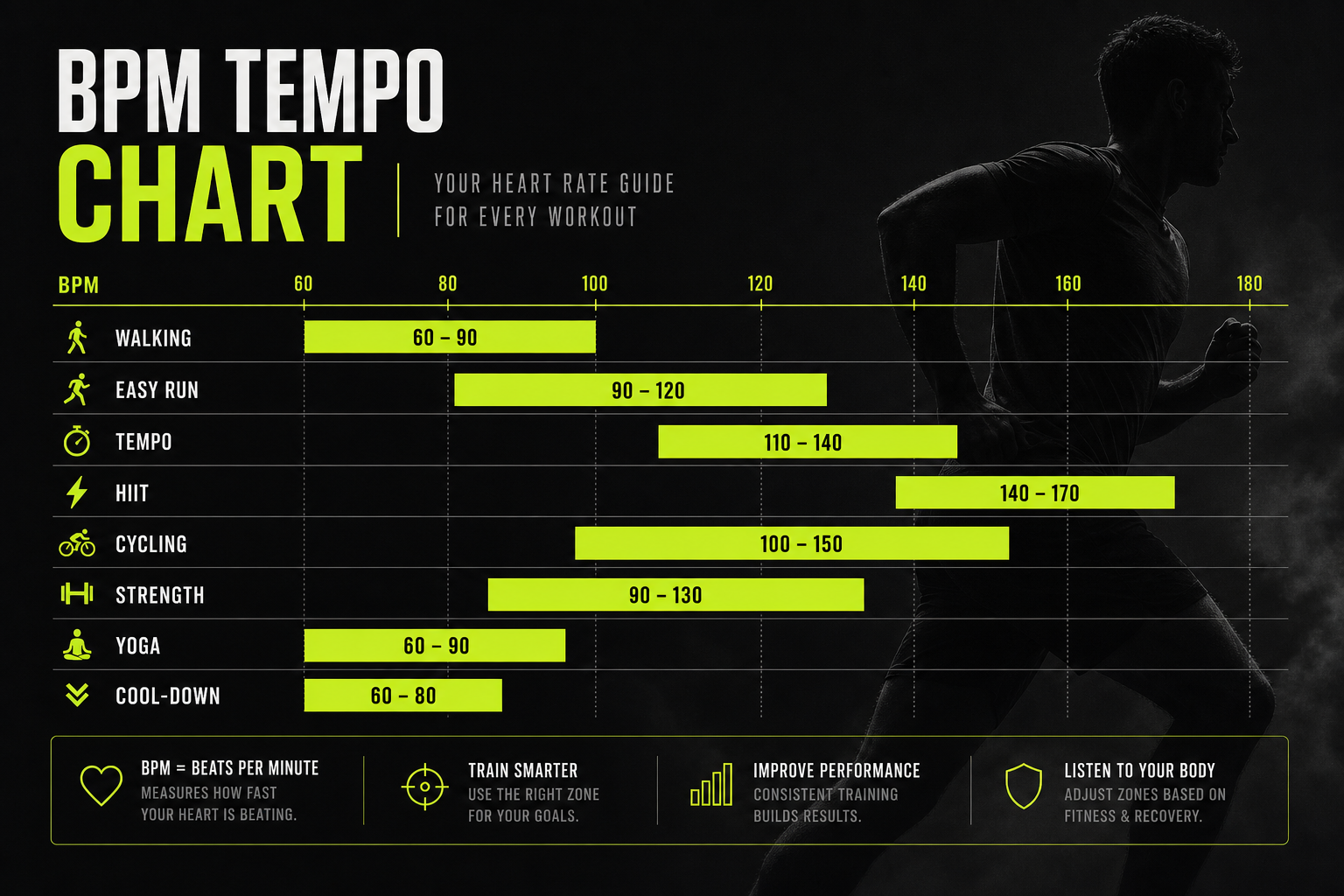
- BPM ranges that fit each effort
- What the research says (and what it doesn’t)
- Music for coming down: cooldowns and recovery
- Why static playlists fall short
- How to build a heart rate training playlist yourself
- Our perspective: let the body lead the beat
- Try it with your own watch
- Common mistakes with heart rate training music
- FAQ
- Sources
What heart rate training music actually means
Two ideas get mixed up under this keyword.
The first is tempo-matched playlists: you pick songs whose beats per minute suit your workout and run them in a sensible order. This is what most search results offer, with titles like “Run at 126 BPM” or “Cardio 163 BPM.” It works, but it is static. A 40-minute playlist cannot know that you hit a hill, that it’s 85 degrees out, or that you slept badly.
The second is heart-rate-responsive music: the soundtrack changes because your body did. Your watch reports a number, and the tempo of what you hear moves with it.
Both start from the same question: which BPM belongs with which effort? Let’s answer that first.
Know your zones before you pick a tempo
Heart rate zones are ranges of beats per minute that reflect different intensities, usually calculated as a share of your maximum heart rate. A common five-zone breakdown, as laid out by the National Council on Aging, looks like this:
| Zone | % of max heart rate | How it feels |
|---|---|---|
| 1 | 50 to 60% | You can talk easily |
| 2 | 60 to 70% | A little harder breathing, still comfortable conversation |
| 3 | 70 to 80% | Shorter sentences |
| 4 | 80 to 90% | A few words at a time |
| 5 | 90 to 100% | Very hard, brief efforts only |
The same page notes that the American Heart Association uses broader bands, with moderate exercise at roughly 50 to 70% of maximum and vigorous exercise at roughly 70 to 85%. Any zone formula is an estimate. If you have a heart condition, take medication that affects heart rate, or are returning after a long break, ask your doctor which zones are safe for you before you chase any number.
If you want a step-by-step way to set these up around music, we walk through it in how to create heart rate music zones.
BPM ranges that fit each effort
No single figure is “the best BPM,” but the ranges below are well supported and give you a starting point.
| Effort | Typical BPM | Source |
|---|---|---|
| Light jogging, easy aerobic work | 100 to 120 | KURU running guide |
| Steady cardio, endurance running | 120 to 150 | KURU running guide |
| General cardio motivation | 120 to 140 | Psychology Today |
| HIIT and intervals | 140 to 180 | The Beachside Reader |
| Sprinting | 150+ | KURU running guide |
Two details are worth remembering. Motivational benefit tends to plateau above about 145 BPM for general cardio, per the Beachside review, so a faster song is not automatically a better one. And above roughly 180 BPM, music can feel chaotic and returns diminish.
Zone 1 and 2: warm-ups, easy runs, long rides
This is the territory of 100 to 125 BPM. The music should feel like company, not a drill sergeant. If you are training to build your aerobic base, the whole point is staying easy, and a loud 160 BPM track will talk you into running too fast. Our piece on fat burn zone music explains how we pair a roughly 101 BPM feel with heart rate sync for this kind of session.
Zone 3: tempo work and steady cardio
Here 120 to 140 BPM is the sweet spot for most people. Tracks with a clear, driving beat help you hold effort without drifting. Treadmill runners can see this in practice in our guide to tempo-matched treadmill running music.
Zone 4 and 5: intervals and sprints
Hard efforts tolerate and often want faster music, typically 140 to 180 BPM. The trick is the recovery between reps. If the music stays at 170 while your heart rate falls, it can nudge you to cut rest short. For interval specifics, see our pages on HIIT running music, interval running playlists and sprint workout music.
What the research says (and what it doesn’t)
This is where most playlist articles oversell.
Music helps performance, mainly through your head. A 2026 systematic review and meta-analysis in Frontiers covering 15 studies and 339 physically active adults associated music with better fixed-duration aerobic performance (SMD 0.39). That is a modest but real effect.

It does not directly change your heart rate. The Beachside Reader summary of a meta-analysis reports a small effect on oxygen consumption and no statistically significant change in heart rate. The largest effect was on affective state, how good the effort feels. Researchers such as Costas Karageorghis describe music as a legal performance aid that works mainly through distraction from fatigue and through rhythm entrainment. If your heart rate rises with fast music, it’s usually because you chose to work harder.
Your preference beats precision. Self-selected, liked music tends to produce bigger gains than tempo-matched music you don’t enjoy. Psychology Today adds a practical tip: if a track is unfamiliar or has no lyrics, aim for about 10 BPM faster than your usual preferred range.
Benefits vary by athlete. Recreational exercisers and novices often see larger gains in endurance and perceived exertion, while highly trained athletes may see limited gains because of ceiling effects.
Don’t force your stride to the beat. Tempo matching is not a strict rule, and the Beachside review warns that pushing your stride frequency far from your natural cadence to match a song can lead to injury. If a track fights your natural rhythm, skip it.
The takeaway: choose music you like, then use BPM to sort it by effort. Tempo is the tiebreaker.
Music for coming down: cooldowns and recovery
Slow music does more than set a mood. Research on relaxing, slow-tempo music has found lower salivary cortisol and higher oxytocin, and a randomized trial found that “healing beat” music synced to an individual’s resting heart rate helped adults recover after stressful stimuli. Those studies were not about workouts specifically, so treat them as a reason to try it rather than a guarantee.
A practical cooldown: after your last hard effort, step to music near 100 BPM and let it fall toward 60 to 80 over five to ten minutes while you walk. KURU’s guide makes a similar point, noting that slower, calmer songs at the end of a run can help bring pace and breathing down. This also suits meditation and stretching, where the aim is a lower heart rate rather than a higher one.
How you recover also shapes the next session. Training apps in other sports use this idea too, as in this look at reading a recovery score to decide how hard to train.

Why static playlists fall short
A fixed playlist assumes your effort is predictable. In real training it isn’t:
- Heart rate drifts upward over a long steady session even when pace doesn’t change.
- Heat, caffeine, sleep and stress shift your zones from day to day.
- Hills and headwinds raise effort without changing your speed.
- Intervals make the mismatch worse: a song ends mid-rep, and the next one has the wrong tempo.
You can skip tracks by hand, but that means touching your phone at the exact moment you least want to. There is also a safety angle. ACE-sponsored research discussed by the American Council on Exercise points out that rapidly increasing music tempo can push people into intensities too high for their health status, and that this needs careful monitoring in clinical or rehab settings. Music that reads your actual heart rate, rather than just getting louder and faster, is the safer way to get the motivation.
How to build a heart rate training playlist yourself
If you want to do it by hand, here is a workable process.
- Find your zones. Use a recent max heart rate estimate or a field test, and have a doctor confirm them if you have any health concerns.
- Start from songs you love. Pull 40 to 60 tracks you already enjoy for training.
- Look up each BPM. Sort them into three bins: under 120, 120 to 140, and 140 plus.
- Map bins to zones. Under 120 for zones 1 to 2 and cooldowns, 120 to 140 for zone 3, 140 plus for zones 4 to 5.
- Shape the arc. Warm-up, build, work, then a slow descent. Place your strongest tracks where the effort is hardest.
- Test with real sessions. If a song makes you run faster than the plan says, move it up a bin.
- Adjust for the task. For heavy, technique-heavy lifting, lyrics can compete for your attention, so favor instrumental tracks and save lyric-heavy music for cardio or accessory work.
It works, and it is a decent weekend project. But it needs rebuilding whenever your fitness changes, and it still can’t react in the moment.
Our perspective: let the body lead the beat
We built Repbeats on a simple belief: the playlist should follow you, not the reverse. Most workout music is chosen before the workout, when you know the least about how it will go. We would rather read your effort live.
That is why the app takes data from wearables such as Apple Watch and Fitbit, including heart rate, cadence and session intensity, and adjusts the music’s tempo to match. Our auto-DJ updates the BPM every bar, so changes arrive on the beat instead of as a jarring song switch. If you are climbing out of zone 2, the music lifts with you. When you ease off, it settles. For how this data is gathered, see how wearables measure exercise intensity.
We are also honest about the limits. The evidence says music works largely by changing how effort feels, not by rewriting your physiology, and it says personal taste matters. So we treat tempo as a way to support the effort you chose, not a magic lever. We limit the app’s device access to workout data only, because a tool that listens to your body should ask for as little as possible.
The same logic covers more than running. Cyclists can sync to cadence, and meditators can have a soundtrack that slows as they settle. If you want the broader picture, how music tempo affects your workout goes deeper, and AI workout music for wearables explains the real-time side.
— Jordan Mills
Try it with your own watch
If you would rather not build and rebuild playlists, Repbeats does the matching for you. Connect your wearable, choose a cardio or meditation program, and the music tempo follows your heart rate, cadence and intensity. Our waitlist launch includes a free year. You can learn more on the Repbeats app page.
Common mistakes with heart rate training music
- Chasing the highest BPM. Motivation plateaus above roughly 145 BPM for general cardio, so faster is not better.
- Using music to override your plan. Easy days should stay easy. If a song pulls you out of your zone, change the song.
- Ignoring taste. A track you hate at the perfect tempo loses to one you love at an imperfect one.
- Matching stride to beat at all costs. If the tempo is far from your natural cadence, let it go.
- Skipping the cooldown track list. Recovery music is the half most people forget.
- Using it as a safety measure. Music is not a medical monitor. If you feel dizzy, have chest pain or an irregular heartbeat, stop and see a doctor.
FAQ
What’s the best BPM for working out?
It depends on the effort. Roughly 120 to 140 BPM works well for steady cardio, and 140 to 180 BPM suits intervals. Treat these as starting points and adjust for the songs you actually enjoy.
What type of music lowers your heart rate?
Slow-tempo music, especially in the 60 to 100 BPM range, has been linked to lower heart rate and cortisol in studies of relaxation. It is most useful for cooldowns, stretching and meditation. During hard exercise, music is not shown to change heart rate directly.
Does music change my heart rate during exercise?
Not directly. A meta-analysis summarized by The Beachside Reader found no significant heart rate effect, though music improved how exercise felt. Any rise in heart rate usually comes from you working harder.
What BPM is good for running?
Light jogging fits about 100 to 120 BPM, endurance running 120 to 150, and sprinting 150 and above. Many runners also like songs near their natural cadence, but never force your stride to match a beat.
Sources
- Heart Rate Zones by Age (National Council on Aging)
- Music BPM and Workout Pace (The Beachside Reader)
- What’s the Best Tempo for a Workout Song? (Psychology Today)
- 100 Best Running Songs (KURU)
- Music and aerobic exercise meta-analysis (Frontiers, 2026)
- Karageorghis et al., Psychological Bulletin
- Music and exercise performance (MDPI)
- Slow-tempo and fast-tempo music and salivary oxytocin and cortisol (PubMed)
- Healing beat music randomized controlled trial (PMC)
- ACE-sponsored research on music and exercise intensity