Music for Hill Repeats: BPM, Playlists and Recovery Tracks
Jordan MillsNovember 14, 2026 · 14 min read

Music for Hill Repeats: BPM, Playlists and Recovery Tracks
The best music for hill repeats is tempo-matched: driving tracks around 140 BPM or higher for the climbs, and brighter mid-tempo tracks of 125 to 135 BPM for the jog down. The closer the beat sits to your actual cadence on the hill, the more the music helps you. Because your cadence and heart rate change on every rep, a static playlist drifts out of step. Music that adjusts its tempo to your live data keeps up. Repbeats does this by syncing tempo to heart rate, cadence and session intensity from wearables like Apple Watch and Fitbit.
This guide gives you the numbers, the research behind them, a worked session plan and the song types that fit each phase.
TL;DR
- Use music above 140 BPM for hard efforts at 75 percent of max heart rate or higher, and below 120 BPM for warm-up, easy running and cooldown, per Nike’s summary of the research.
- For the jog-down recovery, fast motivational tracks at 125 to 135 BPM keep arousal up so you are ready for the next climb, according to Runner’s World.
- Music with a prominent, steady beat matched to your cadence is likely to give the best effect, according to a PLOS One study.
- Build the playlist around the session: one tempo band per phase, tracks that match rep length, and no long intros.
Table of Contents
- Why hill repeats are a special case for music
- What the research says music does for hard efforts
- The BPM to aim for on the climb
- The BPM for the jog down
- A worked hill-repeat playlist
- What songs work for hill repeats
- Syncing the beat to your hill automatically
- Mistakes that make hill-repeat music backfire
- Not only for runners: cyclists and meditators
- FAQ
- Sources
Why hill repeats are a special case for music
Hill repeats are short, hard climbs separated by easy jogs or walks back down. A typical session might be six to ten climbs of about 60 to 90 seconds. That pattern creates two very different jobs for music.
On the climb, you need drive and a steady beat to hold your rhythm while the slope pulls your cadence down. On the way down, you need your heart rate to come down and your mood to stay up, so the next climb does not feel like a chore.
Most playlists are built for a flat, steady run. They have one energy level for 45 minutes. Hill repeats alternate between maximum effort and recovery every minute or two, so the same playlist will be wrong for half of the session.
What the research says music does for hard efforts
Music does not make hills easier in a magical way, but the evidence shows it changes how hard efforts feel and how long you can keep going.
- In a PLOS One study on auditory-motor synchronization, time to exhaustion was significantly longer with acoustic stimuli than without. Motivational music slightly reduced perceived exertion at sub-maximal intensity and lowered heart rate at near-maximal intensity.
- In a 2021 Journal of Strength and Conditioning Research study, self-selected motivational music lowered runners’ perceived exertion by 0.5 points during a 1.5-mile time trial. Runners were on average 11 seconds faster with music, though that difference was not statistically significant.
- In a study of high-intensity running in warm conditions, a combined music and video intervention let participants run significantly further (3,524 m versus 3,110 m and 3,273 m) without a higher peak perceived exertion.
- A 2022 narrative review found that music could soften the drop in pleasure that usually comes with high-intensity interval training.
The PLOS One authors describe two mechanisms. Runners work harder because of the motivational side of music, which is strongest with motivational songs. They also work more efficiently because of auditory-motor synchronization, which means your steps fall into time with a steady beat. Hill repeats can use both: motivating songs for drive, and a beat that sits on your cadence for efficiency.
The BPM to aim for on the climb
BPM means beats per minute: how fast the music’s pulse is. Your cadence is how many steps you take per minute. When the two line up, you get the synchronization benefit.
Start with the general ranges
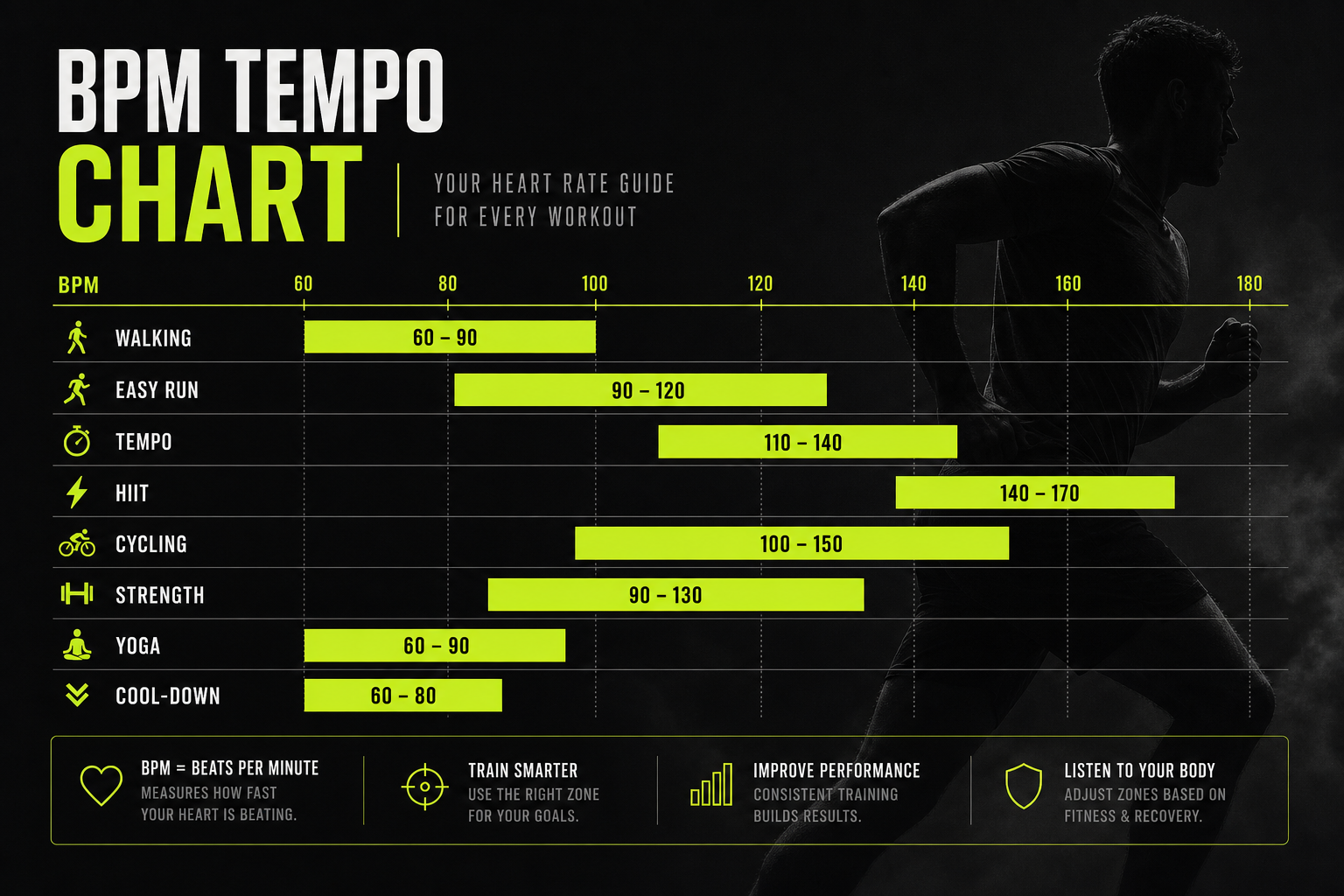
Nike’s guidance, which cites research in the Journal of Strength and Conditioning Research, is that music above 140 BPM suits harder sessions at 75 percent of max heart rate and above, speed workouts and race day. Below 120 BPM suits warm-ups, easy or recovery runs and cooling down. Sport psychologist Costas Karageorghis of Brunel University London puts the sweet spot for runs at around 60 percent of max heart rate between 120 and 140 BPM, as quoted on Nike’s site.
A retail running guide from Runners Need gives a similar ladder: 120 to 125 BPM for an easy jog, 130 to 145 BPM for moderate effort and 140 to 145 BPM for all-out effort, with 150 to 180 BPM for high-cadence stride work.

Hill climbs are hard efforts, so the upper end of these ranges is where you work. If you are not sure what 75 percent of max heart rate feels like, a heart rate reading from your watch takes the guesswork out. Our explainer on how wearables measure exercise intensity covers how that number is produced.
Then match your own cadence
General ranges are a starting point. The research points to cadence as the better target: the PLOS One authors concluded that a prominent, consistent beat matched to the runner’s cadence will likely produce the best effect, because it raises physiological effort while the steady cadence improves running economy.
Here is how to find your number:
- Run a normal climb at hill-repeat effort.
- Count your steps for 30 seconds in the middle of the climb and double it.
- Look for songs at that BPM, or at exactly half of it. A 170 BPM song can be felt as 85 BPM, one stride per beat, and that half-time feel works too.
Expect your climbing cadence to be lower than on the flat, because the slope shortens your stride and slows your turnover. A flat-road number will be too fast for the hill. If your song tempo is far above your climbing cadence, the beat will fight your legs instead of helping them.
For related plans, see our guides to interval running music and sprint workout music, which use the same cadence logic for flat intervals.
The BPM for the jog down
The recovery is where many runners make a mistake. They drop to a slow, sleepy playlist because they are tired. The evidence points the other way.
Runner’s World, citing sport psychologist Costas Karageorghis’s colleague Jones, recommends fast-tempo tracks of 125 to 135 BPM during the respite periods of high-intensity work. The reasoning is that they maintain arousal, help you feel good and make sure you are ready to go again. After the session, a series of tracks descending from 110 BPM to 60 BPM is recommended to wind you down.
Marathon Handbook, in its roundup of running songs, reports that several trials show fast, motivational music during recovery between high-intensity efforts brings heart rate down faster and leads to higher work output afterwards than silence or slow music. The 2022 PMC review mentioned above adds that fast-tempo recovery music, at 125 to 135 BPM, made the recovery experience more pleasant.
In practice: your jog-down tracks should be upbeat and easy to run to, not intense. Think steady groove at 125 to 135 BPM, a melody you like and a beat that lets your breathing settle.
A worked hill-repeat playlist
Here is a sample structure for a session of 8 climbs of 75 seconds each, with a jog-down of about 2 minutes. Adjust the BPM numbers to your own cadence.
| Phase | Duration | Tempo | What to look for |
|---|---|---|---|
| Warm-up jog | 10 to 15 min | Below 120 BPM | Easy, relaxed, a gradual build |
| Climb | 75 sec | 140 BPM or higher, or your climbing cadence | Strong, steady beat, little vocal complexity |
| Jog down | about 2 min | 125 to 135 BPM | Upbeat, motivational, a song you want to sing along to |
| Cooldown | 10 min | Descending from 110 to 60 BPM | Calm, slowing steadily |
To make this work in practice:
- Match song length to the phase. A 75-second climb and a 2-minute jog do not fit a four-minute song. Use tracks with the right structure, or plan to switch tracks at the top of each climb.
- Cut long intros. Slow builds waste the first 30 seconds of a climb. Start on the drop or the first chorus.
- Save the strongest tracks for the back half. The last three climbs are the hardest, and the best songs should be waiting for them.
- Make one list per tempo band. Keep a climbing list and a recovery list, and run them in alternation rather than shuffling one long mix.
This is a lot of manual work for one session, and it breaks down fast if your pace shifts. That is where tempo-matched music earns its place, and the next section shows how.
What songs work for hill repeats
A song that suits hills combines a driving rhythm, a clear beat and a sense of climbing. Marathon Handbook’s list of hill-work tracks includes The Phoenix by Fall Out Boy, Sabotage by Beastie Boys, Bulls on Parade by Rage Against the Machine, Eye of the Tiger by Survivor and Lose Yourself by Eminem. For recovery runs it suggests tracks such as Drops of Jupiter by Train, Lucky by Jason Mraz and Sunday Morning by Maroon 5.
Use those as flavor, not a rule. The research gives one more useful pointer: self-selected music works. In the 2021 study, runners chose their own motivational songs and perceived effort dropped. If a song makes you want to attack the hill, it belongs on your list. Nike’s advice to pick high-energy songs with positive, pump-you-up lyrics, based on research in Psychology of Sport and Exercise, backs the same idea.
The themed titles that top the search results, like songs about running up that hill, are fun for the first climb, but their tempo may not match your cadence. Check the BPM before they earn a slot.
Syncing the beat to your hill automatically
The weakness of any fixed playlist is that you have to guess the right BPM before you start. Real hill repeats do not cooperate. Your cadence slows on the steep part, your heart rate climbs rep after rep, and by the sixth climb the tempo that felt right on the first one is off.
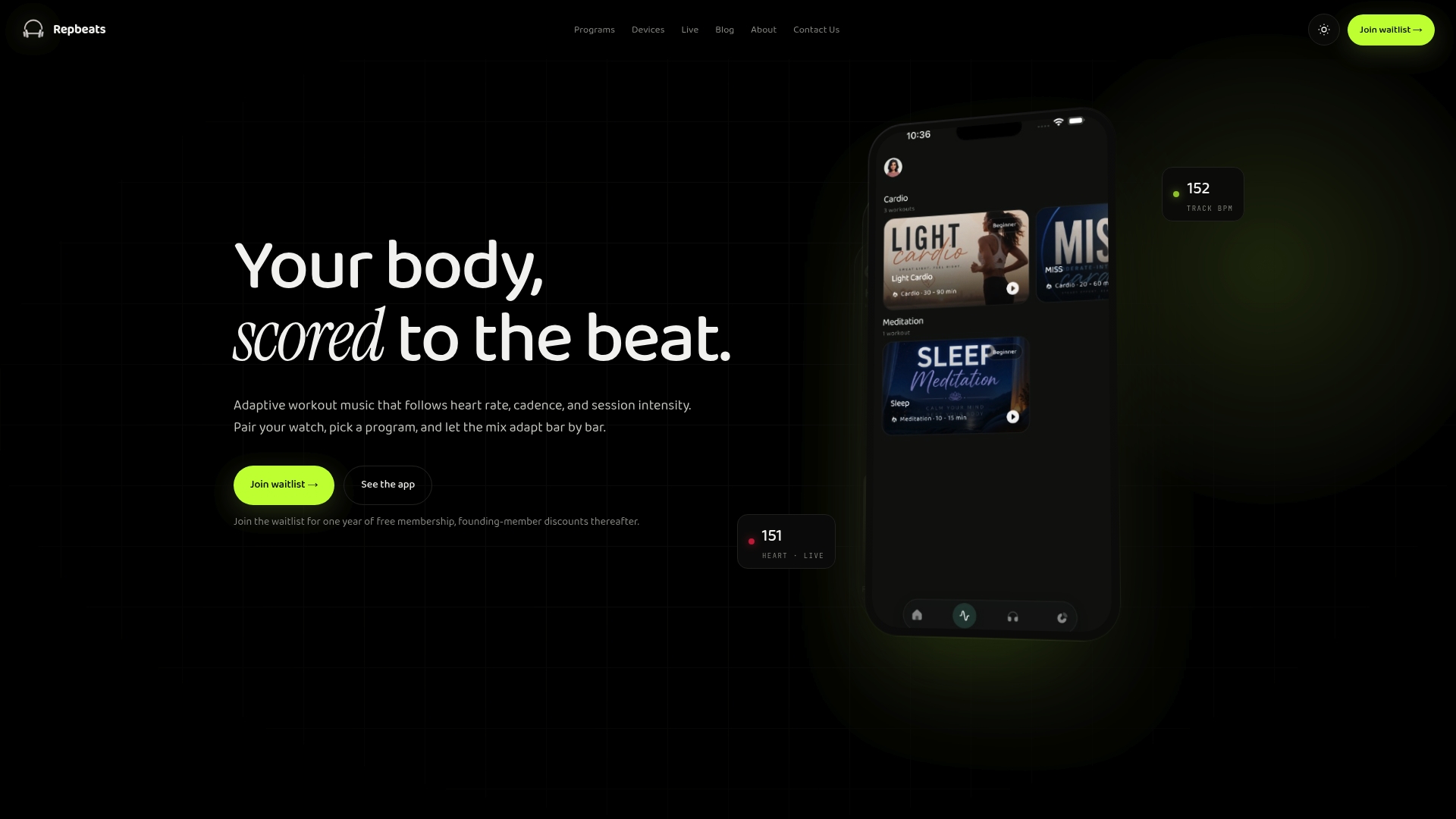
Repbeats is built for this problem. It is a fitness app that synchronizes music tempo to your heart rate, cadence and session intensity, using live data from wearables such as Apple Watch and Fitbit. Its auto-DJ technology updates the music’s BPM every bar, so the beat follows your effort as it changes through the session. Its privacy policy limits device access to workout data only. You can also control playback in real time, search the music library and schedule programs.
For hill repeats, that means the climb, the jog down and the cooldown each get music that matches what your body is doing, without building three playlists by hand. Repbeats has a waitlist launch that includes a free year, and you can see the app on the Repbeats app page.
If you want the hill-specific walkthrough, our guide on hill repeat music that syncs to cadence and heart rate goes deeper into the setup. Runners who want to nudge their turnover up gradually can read about raising cadence with small tempo shifts.
Mistakes that make hill-repeat music backfire
Using one tempo for everything. A 160 BPM playlist for the whole session leaves you with no contrast between work and rest. Give every phase its own band.
Picking the song before the cadence. If a song is a favorite but sits 20 BPM above your climbing cadence, it will pull you into short, choppy steps. Measure first, then choose.
Slow, sad recovery songs. The recovery evidence favors fast, motivational tracks at 125 to 135 BPM, so you are ready to go again.
Complicated tracks on the climb. Fast, driving tracks with minimal vocal complexity are easiest to lock onto when you are breathing hard. Save the intricate songs for easy runs.
Tuning out your body. Music narrows your attention, which is a feature in most training runs. Marathon Handbook points out two cases where it can hurt: when your form is breaking down from fatigue, and when you are pushing through early injury signals. On hill repeats, keep one ear on your own form and stop the session if something hurts. Sharp or lasting pain is a reason to see a doctor or physical therapist, not to turn the volume up.
Volume too high outdoors. Keep the level low enough to hear traffic, cyclists and other runners, especially on road hills.

Not only for runners: cyclists and meditators
The same logic applies on a bike. Cadence on a climb is measured in pedal revolutions per minute, and a beat that matches it can steady your rhythm just as it does for a runner. Repbeats supports cycling cadence and also offers meditation programs, where the music’s tempo follows a calmer target. If your hill repeats are on a treadmill, our guide to tempo-matched treadmill running music covers the indoor version.
What we think about music on hills
Hills expose a problem with ordinary playlists: effort on a hill is not constant, but a playlist is. One minute you are at the edge of your heart rate zone, the next you are walking down with your heart rate falling, and a song that was perfect for the first can be wrong for the second.
We built Repbeats on the idea that the music should follow the athlete, not the other way around. By reading heart rate, cadence and intensity from your wearable and adjusting the beat every bar, the soundtrack stays in step with each phase of the workout. That is why we think adaptive, tempo-matched music is the most natural way to run hill repeats: you get the drive on the climb and the lift on the recovery without stopping to touch your phone.
It is also why we care about the data being used only for the workout itself. Our privacy policy limits device access to workout data only.
Jordan Mills
FAQ
What BPM should I use for hill repeats?
For the climb, use music above 140 BPM, or better, a tempo that matches your own climbing cadence or exactly half of it. For the jog down, 125 to 135 BPM works well. Warm-ups and cooldowns should sit below 120 BPM and descend toward 60 BPM at the end.
Should I listen to fast or slow music between hill repeats?
Fast. Runner’s World recommends fast-tempo tracks of 125 to 135 BPM during recovery periods to maintain arousal and prepare you for the next effort. Research reported by Marathon Handbook also links fast, motivational music in recovery with a faster heart-rate decrease than silence or slow music.
Does music actually improve hill-repeat performance?
The studies point in a helpful direction. Motivational music lowered perceived exertion in a 2021 time-trial study and let runners cover more distance at high intensity in another trial. Music also makes hard intervals more enjoyable, according to a 2022 review. Results vary by runner and by song, so choose tracks you personally find motivating.
Should the beat match my running cadence?
Yes, that is the strongest approach. Researchers concluded that a motivational track with a prominent, consistent beat matched to your cadence is likely to give the best effects. Count your steps on a real climb, double the 30-second count, and look for songs at that BPM or exactly half of it.
How do I change the music tempo for each rep without touching my phone?
Use tempo-matched music that reads your wearable data. Repbeats takes heart rate, cadence and intensity from devices like Apple Watch and Fitbit and updates the BPM every bar, so the music follows the climb and the jog down automatically.
Sources
- Choose the Right Music to Power Your Run, Nike
- These running playlists will make your speedwork feel easier, Runner’s World
- Best Running Songs, Marathon Handbook
- The Power of Auditory-Motor Synchronization in Sports, PLOS One
- Self-Selected Motivational Music on the Performance and Perceived Exertion of Runners, Journal of Strength and Conditioning Research
- A Motivational Music and Video Intervention Improves High-Intensity Exercise Performance, PMC
- The effects of music on cardiorespiratory endurance, PMC
- Running BPM, Runners Need