Music vs. Podcasts for Workouts: Which Should You Press Play On?
Jordan MillsNovember 12, 2026 · 14 min read

Music vs. Podcasts for Workouts: Which Should You Press Play On?
For most workouts where you want to push harder or feel better doing it, choose music, ideally music you like with a fast tempo. Podcasts earn their place on easy, long, low-pressure sessions when your goal is to pass time or learn something. The research is fairly consistent on this split, and the details below show how to apply it to running, cycling, lifting, intervals and cooldowns.
TL;DR
- In controlled studies, fast-tempo music beat both podcasts and silence on enjoyment and intensity during interval workouts.
- Large meta-analyses link music to better mood, better performance and lower perceived effort. They do not show the same pattern for spoken audio.
- Podcasts fit easy, steady sessions. Music fits intervals, hills, lifting and anything where rhythm matters.
- Tempo matters: match it to your cadence or effort, and keep volume in a safe range.
- You do not have to choose one forever. Use a podcast for the warm-up or easy miles and switch to music for the hard part.
Table of Contents
- What the research says about music vs. podcasts
- Why music tends to win when effort is high
- When a podcast is the better pick
- Matching the audio to the workout
- A smart way to use both
- What we think about adaptive music
- Try workout music that follows your effort
- Keep your hearing safe while you train
- How to choose for your next workout
- FAQ
- Sources
What the research says about music vs. podcasts
The most direct evidence comes from studies that put the same people through the same workout with music, a podcast and no audio.
In a 2019 study by Stork, Karageorghis and Martin Ginis, 24 insufficiently active adults completed three 20-second all-out sprints under each condition. Post-exercise enjoyment was higher with music than with a podcast or no audio, and peak power output was higher with music. Motivation scores were far higher during music than during the podcast. Perceived exertion did not differ between conditions, so music did not make the sprints feel easier. It made people want to do them more.
A second small study, summarized by Harvard Health, tested 24 young adults across three 10-minute interval workouts. They enjoyed the session more and exercised more intensely, with slightly faster heart rates, when listening to up-tempo music (135 to 142 BPM) than when listening to a podcast or silence.
Both studies are small and short, so treat them as a clear signal rather than a final verdict. The larger reviews point the same way.
What the big meta-analyses add
A 2020 meta-analysis in Psychological Bulletin pooled 139 studies and 3,599 participants. Music was linked to better affective valence (how good you feel), better physical performance, lower perceived exertion and slightly better oxygen efficiency, but not to a meaningful change in heart rate. The effects were larger in exercise than in competitive sport, and larger with fast music than with slow-to-medium music.
Two newer reviews point in the same direction:
- A 2026 review of 15 aerobic exercise studies with 339 participants found that music was associated with better fixed-duration performance, longer time to exhaustion, lower perceived exertion and lower blood lactate.
- A 2025 review found that preferred music was associated with higher motivation, a more positive affective response, lower perceived exertion and better strength endurance, maximal strength and power output than non-preferred music or no music.
The word to notice is “preferred.” The benefit depends on the music being something you actually like, which is why a generic playlist often underdelivers.
Why music tends to win when effort is high
Music does three jobs at once during a workout. It lifts mood, it pulls attention away from discomfort, and it gives your body a beat to move with. A podcast can do the second job well, but it asks your brain to follow words and ideas, and it has no rhythm to lean on.

That third job is where tempo comes in. For rhythmic activities, Dr. Christopher Ballmann of UAB Medicine says changing the tempo can lead people to synchronize their movements with the beat, and he has found around 120 BPM to be ideal in his studies. Running, cycling, rowing and rep-based lifting all have a natural rhythm for music to support.
Spoken audio has no such rhythm, and it can work against you when you need to concentrate on hard effort. That is why the same research that favors music for intervals leaves podcasts in the “pleasant company” category for easy work.
When a podcast is the better pick
Podcasts are not a lesser choice. They are the right tool for a different job.
- Long, easy sessions. A 90-minute easy run or a steady bike ride on a trainer has little intensity to support, and a good story or interview makes the time pass.
- Warm-ups and cooldowns. When effort is low, you have attention to spare for words.
- Motivation to start. If the thing that gets you out the door is a new episode, that is a legitimate win. Showing up beats any audio optimization.
- Personal preference. Dr. Ballmann notes that some people prefer podcasts as a source of distraction, and his lab is still investigating it.
A simple rule: the harder the effort, the less spoken audio helps, and the more a steady beat does.
Matching the audio to the workout
| Workout | Best default | Why |
|---|---|---|
| Interval or sprint session | Fast-tempo music you like | Studies show higher enjoyment, motivation and power with music than with a podcast |
| Steady run or ride | Music matched to your cadence | Rhythm gives your stride or pedal stroke something to follow |
| Easy long run | Podcast or music | Low effort leaves attention free, so pick what keeps you going |
| Strength training | Music you love | Preferred music is linked to better strength endurance, maximal strength and power |
| Warm-up or cooldown | Mellow music or a podcast | Effort is low, so either works |
| Meditation or stretching | Calm, steady sound | Sound can serve as the focus of attention |
Running
Runners have the most to gain from tempo-aware music, but it pays to be realistic about BPM. It is a nudge, not a command. A study of 33 recreational runners by Van Dyck and colleagues found that runners entrained less to the music tempo when nobody told them to match it, and ran at lower speeds with shorter steps when they were instructed to match the tempo. In other words, forcing your stride to a beat can backfire. The better approach is to pick music in a range close to your natural cadence and let your body drift toward it.
If you want to know what that cadence is, this running cadence guide explains how to measure it and what typical ranges look like.
There is also evidence that the source of the rhythm matters. In a randomized trial of 54 trail runners, cadence-synchronous music improved performance and lowered perceived effort in men, while heart-rate-synchronous music significantly reduced perceived effort in women and let them run the longest of any group. Different people respond to different signals, which is a good argument for music that adapts to you rather than a fixed playlist. For a walk-through of how this works on the road, see our guide to running music without a phone, or our notes on aligning music with running heart rate.
Cycling
Cycling is one of the cleaner tests of tempo, because pedal strokes are so regular. In a 2010 study of 12 healthy male students riding at self-chosen work rates, speeding the music up by 10% raised distance per unit time by 2.1%, power by 3.5% and pedal cadence by 0.7%, while slowing it by 10% cut those figures by 3.8%, 9.8% and 5.9%. That was submaximal riding in a small group, so it shows direction rather than a promise. Still, it suggests that slow music can pull you down more than fast music pushes you up, so avoid sleepy tracks on your hard rides.
Lifting and gym work
Weight training has its own rhythm: lift, pause, lower, rest. Music you enjoy supports it well. The 2025 review above tied preferred music to better strength endurance, maximal strength and power output. If your gym playlist feels flat, our guide to personalizing music for gym sessions covers how to build one that fits your sets.
All-out efforts
There is one caveat worth knowing. Dr. Ballmann notes that during maximal sprinting, varied tempos may not help and could even hinder performance as focus shifts from synchronizing to reaching top speed. The 2026 review similarly found that benefits may shrink in tightly closed time-trial formats and very high-intensity tasks. The practical takeaway is to use music to get you fired up and through the build-up, and to let your effort take over in the final seconds. If sprints are your focus, our sprint workout music guide has BPM ranges to start from.
Meditation, stretching and cooldowns
For calm sessions, sound can be the point of focus itself. Some artists use binaural beats to try to induce states like deep rest, but some of those claims may be overly enthusiastic, and more recent studies suggest the effect may be a placebo. Choose sound you find settling rather than something that promises a specific brain state.

A smart way to use both
You do not need to pick a side for the whole session. A few hybrids work well:
- Podcast for the easy start, music for the work. Listen to an episode during your warm-up, then switch when the effort climbs.
- Save music for the hardest third. The Terry meta-analysis suggests using music for the last half or even last third of a session, when mood tends to drop.
- Save your best playlist for hard days. If you always use your favorite tracks, they lose their kick. Keep them for key sessions.
- Switch by workout type. Podcasts for recovery days, music for intervals, hills and lifting.
That peak-end idea is useful because people tend to remember how a workout finished. A strong ending makes the whole session feel better and makes you more likely to come back.
What we think about adaptive music
Most of the music-versus-podcast debate assumes a playlist is fixed. You press play, and the tempo is whatever the songs happen to be. But your effort is not fixed. Your heart rate climbs through a warm-up, holds in a tempo block, spikes in an interval and falls in recovery.
That mismatch is why we built Repbeats. The app is designed to match music tempo to your heart rate, cadence and session intensity, using live data from wearables such as Apple Watch and Fitbit. Our auto-DJ updates the BPM every bar, so the music follows what your body is doing instead of ignoring it.
The research points to the same ingredients: music you like, a tempo that suits the activity, and a beat your body can use. We designed Repbeats to bring those together, for running, cycling and meditation, so you spend less time skipping tracks and more time in your target zone.
And because we respect how personal this is, our privacy policy limits device access to workout data only.
Jordan Mills
Try workout music that follows your effort
If you want the benefits of tempo-matched music without building and rebuilding playlists, Repbeats is built for that. It syncs music tempo to your heart rate, cadence and session intensity using data from your Apple Watch or Fitbit, and it offers both cardio and meditation programs, real-time music control, library search and program scheduling. The waitlist launch includes a free year.
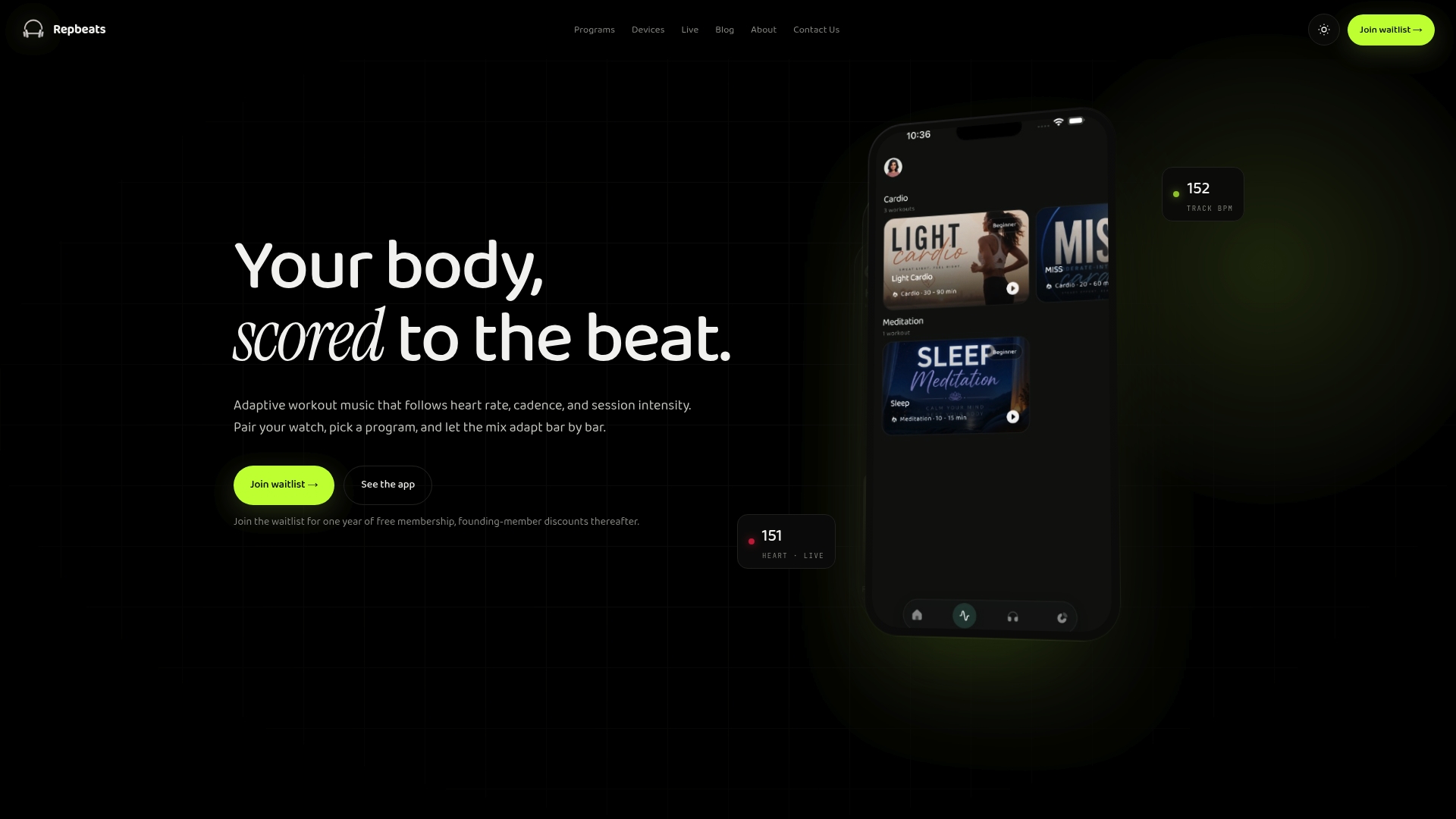
You can see how it works on the Repbeats homepage, or read our comparison of workout music apps for runners and gym-goers if you are weighing options.
Keep your hearing safe while you train
Whatever you choose, volume deserves attention, especially with earbuds and in loud gyms. According to the American Family Physician, personal listening devices at maximum volume can reach roughly 100 to 110 dB, and the only evidence-based safe noise dose is a daily average of 70 dB, while the WHO recommends limiting exposure to one hour a day at 85 dB.
Some practical habits:
- Follow the 60/60 rule. Listen for no more than 60 minutes at a time and keep volume at or below 60% of maximum.
- Use noise-canceling headphones in loud gyms. They let you hear your music at a lower volume instead of cranking it over background noise.
- Check your levels. Many smartphones and some fitness watches can monitor sound exposure.
- Stay aware outdoors. If you run or ride on roads, keep volume low enough to hear traffic, or use one earbud or open-ear headphones.
Podcasts are spoken at a steady level, which can tempt you to turn them up over wind or treadmill noise. The same limits apply.
How to choose for your next workout
Ask yourself three questions:
- How hard is this session? Hard and short, choose music. Easy and long, choose whatever keeps you moving.
- Does the activity have a rhythm? Running, cycling, rowing and lifting do. Pick music near your natural cadence or rep pace.
- What do I actually like? Preferred music is what the strongest reviews link to benefits. A track you dislike can make things worse, as Dr. Ballmann points out.
If you want to go further on tempo, our guides on syncing music to workout intensity and adaptive music best practices cover the practical steps, and our treadmill running music piece helps if most of your miles are indoors.
FAQ
Is it better to listen to music or podcasts while working out?
For most workouts where effort matters, music is the better pick. Controlled studies found higher enjoyment, motivation and intensity with fast-tempo music than with a podcast. Podcasts are a fine choice for easy, long sessions where you simply want company.
Does music actually improve performance?
On average, yes. A 2020 meta-analysis of 139 studies linked music to better physical performance, better mood and lower perceived exertion. The effect is modest and depends on choosing music you like with a suitable tempo.
What BPM should I choose for running or cycling?
Start near your natural cadence and see how it feels. UAB Medicine researcher Dr. Ballmann has found 120 BPM to be ideal in his studies, but individual cadence varies. Treat BPM as a nudge rather than a target, since forcing your stride to a beat can reduce speed.
Can I listen to a podcast during strength training?
Yes, especially during longer rest periods or lighter sessions. For heavy sets, music you enjoy has stronger support, since a 2025 review linked preferred music to better strength endurance, maximal strength and power.
How loud is too loud when working out?
The 60/60 rule is a simple guide: no more than 60 minutes at a time, at or below 60% volume. The WHO recommends limiting exposure to one hour a day at 85 dB, so keep volume lower when you can.
Sources
- Can music make workouts more fun and effective? (Harvard Health)
- Effects of Music in Exercise and Sport: A Meta-Analytic Review (Psychological Bulletin)
- Effects of listening to music during aerobic exercise (2026 review)
- Effects of preferred music listening on physical and psychological outcomes (2025 review)
- Let’s Go: Psychological, Psychophysical, and Physiological responses to music, podcast and no audio
- Pump up the jam: how music impacts exercise performance (UAB Medicine)
- Instructed versus spontaneous entrainment of running cadence to music tempo
- On Performance and Perceived Effort in Trail Runners Using Sensor Control to Generate Biosynchronous Music
- Effects of music tempo upon submaximal cycling performance
- Sound Contemplations playlist (University of Virginia)
- Making Recommendations to Reduce Noise Exposure (American Family Physician)
- Does Your Gym Routine Put You at Risk of Hearing Loss? (Audibel)
- What Is Running Cadence? A Practical Guide for Runners