Rowing Music BPM: Match Your Playlist to Stroke Rate
Jordan MillsOctober 20, 2026 · 14 min read

Rowing Music BPM: Match Your Playlist to Stroke Rate
For most rowing workouts, aim for roughly 120 to 130 BPM on steady-state pieces and 140 to 160 BPM on hard intervals. Then do one piece of math: multiply your stroke rate by a whole number of beats per stroke, so the music and your catch land together. At 24 strokes per minute (SPM), four beats per stroke gives you 96 BPM. At 20 SPM, six beats per stroke gives you 120 BPM.
The rest of this guide shows how to pick that number, what the research says about fast and slow music on the erg, and how to keep the tempo right as your effort changes.
TL;DR
- Steady-state rowing usually sits at 18 to 22 SPM. Pick a BPM that is a clean multiple of your rate, such as 20 SPM x 6 = 120 BPM.
- In a 2024 crossover study, fast music (about 134 BPM) produced shorter rowing times than slow music (about 97 BPM) during high-intensity intervals.
- Slow music is the better choice for recovery. Use fast music for work and slow music for cool-down.
- Songs you like beat songs with a theoretically perfect tempo that you dislike, so treat BPM as a filter, not a rule.
- Your stroke rate changes during a session. A fixed playlist drifts out of sync, so choose tempo-adaptive music or build playlists in blocks.
Table of Contents
- The quick answer: BPM by type of rowing session
- Why a stroke is not one beat
- What research says about fast and slow music on the rower
- When music helps less than you expect
- Heart rate and rowing music: what is a good rowing heart rate?
- How to build a rowing playlist at a target tempo
- Why a fixed playlist drifts
- Our perspective: tempo should follow the effort, not the clock
- Cross-training days and rowing
- Try tempo-adaptive music with Repbeats
- A sample 40-minute rowing session with music
- FAQ
- Sources
The quick answer: BPM by type of rowing session
There is no single correct tempo. It depends on the session. This table combines common erg stroke-rate ranges with the tempo bands the research and exercise guidelines point to.
| Session | Typical stroke rate | Music BPM to try | Beats per stroke |
|---|---|---|---|
| Warm-up, easy technique rowing | 16 to 20 SPM | 96 to 120 | 6 |
| Steady state (UT2, conversational) | 18 to 22 SPM | 108 to 132 | 6 |
| Moderate pieces, tempo work | 22 to 26 SPM | 88 to 104 or 132 to 156 | 4 or 6 |
| Hard intervals, sprints | 26 to 32+ SPM | 104 to 128 or 140 to 160 | 4 or 5 |
| Cool-down and recovery | Paddle, easy | Below 100, slower is fine | Free |
The steady-state band of 18 to 22 SPM is the standard range for low-intensity aerobic rowing, as described in this UT2 training guide. Your own rate may sit a little lower or higher, and that is fine. What matters is that you know your number before you pick songs.
Why a stroke is not one beat
If you tried to row one stroke per beat, 20 SPM would need 20 BPM music. That is a funeral march, not a workout track. Almost all workout music sits between 100 and 160 BPM, so each stroke has to span several beats.
A rowing stroke has two halves: a fast drive, then a slower recovery back up the slide. The recovery takes longer, often about twice as long as the drive. Beats give you a natural way to count both halves.

The formula is simple:
Music BPM = stroke rate x beats per stroke
Here is how it plays out:
- Two beats per stroke: one beat on the drive, one on the recovery. At 24 SPM that is 48 BPM, which only works with half-time tracks (a 96 BPM song felt at half speed).
- Three beats per stroke: drive on one, recovery on two and three. At 24 SPM that is 72 BPM. Good for slow, heavy tracks.
- Four beats per stroke: drive on one, recovery on two, three and four. At 24 SPM that is 96 BPM, and at 30 SPM it is 120 BPM. This is the most useful ratio for most rowers.
- Six beats per stroke: at 20 SPM that is 120 BPM, and at 22 SPM it is 132 BPM. Best for steady state, where you want faster music but a relaxed rate.
This is the same logic behind a playlist you will see circulating in rowing communities: a 24 stroke rate set to roughly 100 BPM songs. Four beats per stroke at 24 SPM lands on 96 BPM, so the pairing works out.
A worked example
Say you plan a 30-minute steady-state row at 20 SPM.
- Choose six beats per stroke: 20 x 6 = 120 BPM.
- Search for tracks between 118 and 122 BPM. A little drift is fine, because you will not hold exactly 20.0 SPM anyway.
- Put a 124 BPM song at the end of the set for the last few minutes, when your rate tends to creep up to 21 or 22.
For a 4 x 8-minute interval session at 28 SPM, four beats per stroke gives 112 BPM, while five beats per stroke gives 140 BPM. Pick whichever feels more energetic to you.
What research says about fast and slow music on the rower
The most useful recent study for rowers is a 2024 crossover study in Frontiers in Psychology. It compared slow-beat music (mean around 97 BPM) with fast-beat music (mean around 134 BPM) during high-intensity rowing intervals. Fast music led to significantly shorter rowing times. Rowers did not report that the effort felt harder, which is why the authors describe the music as a psyching-up stimulus.
The same work points to a split in roles. Fast music (generally above 120 BPM) suits the active phases. Slower music is the better fit for recovery, because it was linked to a faster drop in heart rate after the effort.

An older study of 500-m rowing sprints tested rowing with no music, slow music and fast music. It is a useful reminder that sprint rowing is where tempo has been studied most directly.
The ACSM tempo bands
The American College of Sports Medicine publishes a music tempo chart for exercise. It lists 135 to 155 BPM for high-impact work such as kickboxing, 120 to 140 BPM for low-impact aerobic routines, and lower ranges for yoga and Pilates. Rowing is not a listed category, so treat the chart as a guide to how intensity and tempo line up, not a rowing prescription. Rowing is low-impact but can be intensely hard, which is why we suggest the two bands in the table above rather than one number.
When music helps less than you expect
Honest answer: music does not work equally for everyone.
Very hard efforts. Researchers who tested self-selected, varying-tempo music note that highly trained athletes working near their limit may be less influenced by music, because their attention is already taken up by pacing and managing fatigue. If you have ever noticed that you cannot recall a single lyric from the last 500 meters of a 2K test, that is the effect. Music still helps with the warm-up, the long aerobic base and the grind of a 60-minute row. It matters least in the final minute of a race-pace piece.
Songs you do not like. A small study on preferred and non-preferred warm-up music found that listening to music you prefer matters. A track at the textbook BPM that you find irritating can give you no benefit at all. So use BPM to narrow your options, then choose what you actually enjoy.
Low-effort rowing with the wrong tempo. If the music is much faster than your natural rhythm, you may find yourself speeding up your stroke rate without raising your power. A high rate at low watts is a common technique problem, and a driving 150 BPM track will tempt you to do exactly that on a day meant for steady aerobic work. Anchor your rate first, then choose the music.
Heart rate and rowing music: what is a good rowing heart rate?
Music tempo and heart rate are separate things, and it helps to keep them that way. A song at 130 BPM does not make your heart beat at 130. It only gives your movement a rhythm.
As for a good rowing heart rate, there is no universal figure. It depends on your age, fitness and resting heart rate. Exercise scientists often use heart rate reserve (your maximum heart rate minus your resting heart rate) rather than the crude 220-minus-age formula, which has a standard deviation of roughly 10 to 12 beats either way. An ACSM article on the talk test explains why speaking ability is a practical field check on intensity.
In practice:
- If you can speak in full sentences while rowing, you are in a steady aerobic zone. Pair this with the 120 to 130 BPM band.
- If you can only manage a few words, you are working hard. Move to faster music for the work intervals.
- If you have a heart condition, are returning from illness or take medication that affects your heart rate, ask your physician before setting heart rate targets for hard rowing. A chest strap or watch can show the numbers, but a doctor can tell you which numbers are safe for you.
How to build a rowing playlist at a target tempo
A good playlist is built in blocks that mirror your session, not as one long shuffle.
- Know your rate. Row two minutes at your usual steady pace and read the SPM from the monitor. Round to the nearest even number.
- Pick your beats per stroke. Use six for steady state and four or five for intervals.
- Calculate the BPM. Multiply, then set a window of plus or minus 3 BPM.
- Filter by BPM. Streaming services and BPM databases let you search tempo. Our guide on finding songs by BPM walks through the process for wearable-synced workouts.
- Build blocks. Warm-up (8 to 10 minutes at 96 to 110 BPM), work block (your target BPM), recovery block (below 100 BPM), cool-down.
- Test and prune. Row the playlist once. Delete any song that pulls you off your rhythm or that you dislike, even if its BPM is perfect.
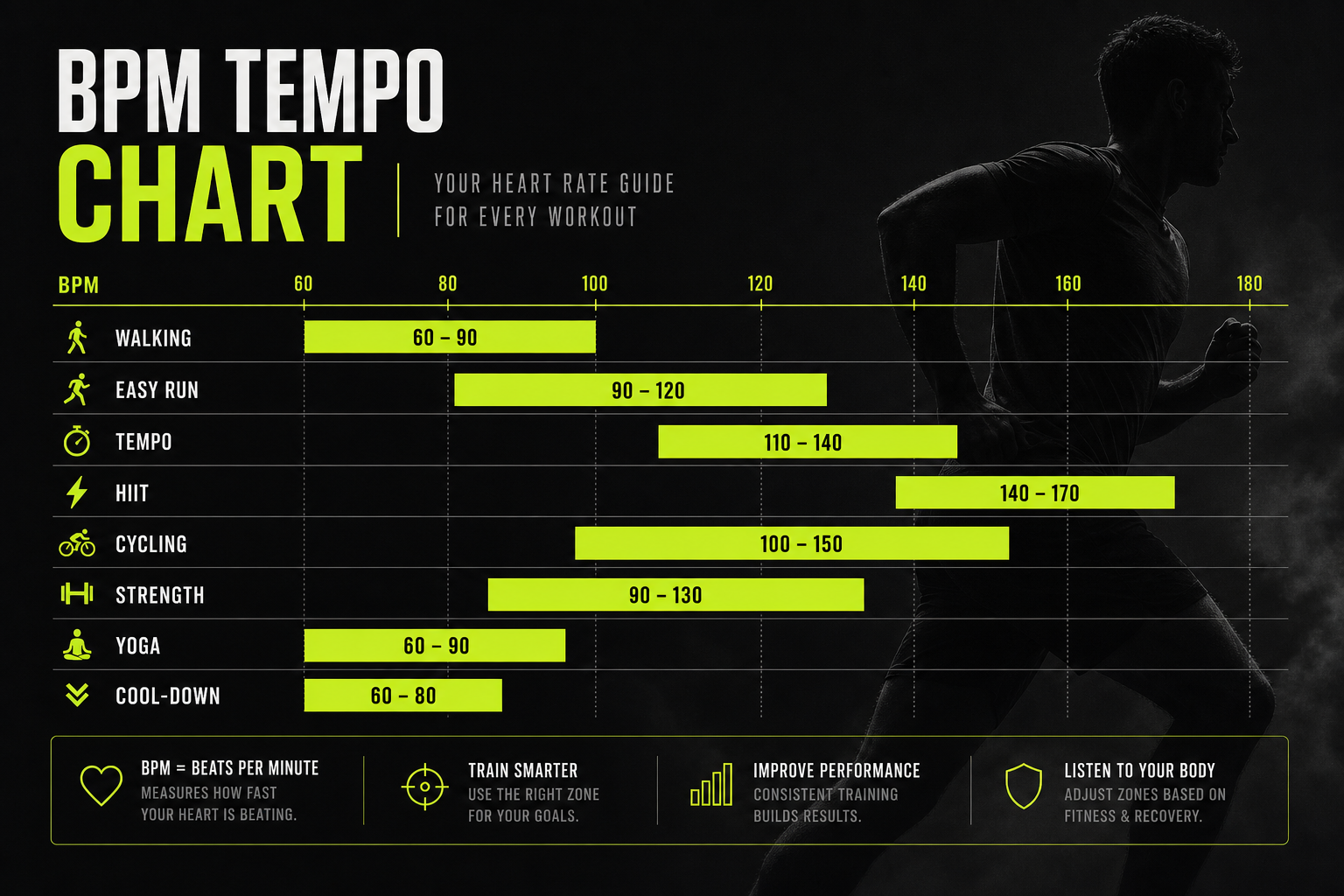
If you want more tempo ranges for other sports, the tempo chart for every workout type is a useful companion. For a plain-language explanation of what the numbers mean, see what workout BPM means.
Half-time and double-time tracks
A 70 BPM song can feel like a 140 BPM song if the drums play twice as fast. Many rowers use this trick. A 140 BPM drum and bass track can serve as 70 BPM for three-beat strokes. Use whichever feel matches your stroke.
Why a fixed playlist drifts
Most rowers find that a perfectly built playlist works for about ten minutes. Then the rate rises as fatigue builds. You push the last interval harder than the first. You drop to 16 SPM for a technique drill. The music stays the same, and the match falls apart.
There are three ways to handle it:
- Accept it. For steady state, small drift does not matter. The music is a backdrop.
- Build for the plan. Write a playlist where each song is matched to a planned segment: 20 SPM at 120 BPM, 24 SPM at 96 BPM, and so on.
- Let the music follow you. Adaptive music changes its tempo as your data changes.
Our article on why music tempo affects exercise covers the science behind the third approach, and how tempo affects your workout looks at the body’s response.
Our perspective: tempo should follow the effort, not the clock
We built Repbeats because we kept seeing the same problem. People spend an hour building the perfect playlist, and ten minutes into the session their effort has moved and the playlist has not. The music that was meant to help is now fighting the rhythm.
So we start from the body. Heart rate, cadence and session intensity are live signals, and the music should respond to them. That is why our auto-DJ updates the tempo bar by bar, using data from wearables such as Apple Watch and Fitbit, rather than asking you to pre-plan every minute.
We also take the research seriously, including the parts that cut against us. Preference matters as much as tempo. Highly trained athletes at the limit may not notice music at all. Slow music has a real role in recovery. A good tool should respect all three: it should keep the tempo in the right zone, let you choose music you like, and bring the intensity down when you stop pushing.
One more point: we limit device access to workout data only. Your watch should share what the session needs and nothing else.
— Jordan Mills
Cross-training days and rowing
Many rowers add swimming or cycling to build aerobic base without more erg hours. If you swim, an adaptive swim training plan app (the page is in Italian) can help you structure those sessions around recovery. On bike days, the same tempo logic applies with pedal cadence in place of stroke rate. Our guide to BPM-matched workout music templates shows how to set that up, and the tempo run guide does the same for threshold running.
Try tempo-adaptive music with Repbeats
If you are tired of rebuilding playlists, Repbeats syncs music tempo to your heart rate, cadence and session intensity, using live data from your wearable. It handles cardio and meditation programs, lets you control playback in real time, search the music library and schedule your programs. Rowers can use it to keep a steady-state or interval session in the right tempo zone without managing a queue by hand. Right now, joining the waitlist includes a free year. You can read more at repbeats.com, and our best practices for adaptive music workouts is a good place to start.
A sample 40-minute rowing session with music
Here is how the pieces fit together. Adjust the numbers to your own rates.
| Block | Time | Rate | Music BPM | Notes |
|---|---|---|---|---|
| Warm-up | 8 min | 16 to 20 SPM | 96 to 110 | Easy pressure, focus on legs first |
| Work 1 | 6 min | 24 SPM | 96 (4 beats) or 144 (6 beats) | Moderate-hard, still able to speak a few words |
| Recovery | 3 min | 18 SPM | Under 100 | Easy paddling |
| Work 2 | 6 min | 24 SPM | 96 or 144 | Match Work 1 |
| Recovery | 3 min | 18 SPM | Under 100 | Let breathing settle |
| Work 3 | 6 min | 26 SPM | 104 or 130 | Hold form |
| Cool-down | 8 min | 16 to 18 SPM | 80 to 100 | Slow tracks you enjoy |
Notice that the work blocks use faster tempos and the recovery blocks drop below 100 BPM, in line with the fast-for-work, slow-for-recovery pattern described in the 2024 rowing study.
FAQ
What BPM is best for rowing music?
For steady-state rowing, 120 to 130 BPM works well for most people, especially at six beats per stroke and 20 to 22 SPM. For hard intervals, 140 to 160 BPM is a common choice. The best match is a multiple of your own stroke rate, so calculate it before you pick songs.
What is a good rowing tempo?
Steady-state rowing is usually done at about 18 to 22 strokes per minute, while harder pieces run higher. Technique matters more than rate. Many rowers get faster by rowing with a lower rate and more power per stroke, so avoid pushing your rate up just because the music is fast.
What is a good heart rate for rowing?
It depends on your age, fitness and resting heart rate, so no single number fits everyone. Heart rate reserve is a more reliable basis than 220 minus age, and the talk test is a simple check: full sentences means steady aerobic effort. If you have a heart condition or take heart-affecting medication, ask your doctor before setting targets.
Is 130 BPM high for a song?
Not for exercise. It sits inside the 120 to 140 BPM band used for aerobic work and is a good steady-state tempo for rowing at around 22 SPM with six beats per stroke. For a relaxed listen it feels upbeat, and for a hard interval it is on the low side.
Sources
- Frontiers in Psychology (2024): music and high-intensity rowing intervals
- ACSM: Music Tempo Guidelines for Exercise
- ACSM Health & Fitness Journal: Intensity of Physical Activity and the Talk Test
- Performance Enhancement with Music in Rowing Sprint
- Effects of Self-Selected, Varying Tempo Music on Performance and Perceived Exertion
- Effects of Preferred and Nonpreferred Warm-Up Music on Exercise Performance
- UT2 Training for Rowing: Splits, Heart Rate and Volume