Steady-State Cardio Music: The Right BPM and Songs
Jordan MillsOctober 28, 2026 · 14 min read

Steady-State Cardio Music: The Right BPM and Songs
The best music for steady-state cardio is rhythmic, predictable and mostly in the 120 to 140 BPM range, with songs you actually like. That tempo suits an effort around 60% of your maximum heart rate, and it is easy to nudge up or down as the effort changes. Below, you get the numbers by activity, what the research says about why tempo matters, and a simple way to build a playlist that stays steady for 30, 45 or 60 minutes.
TL;DR
- Aim for roughly 120 to 140 BPM for steady-state work at about 60% of max heart rate. Go above 140 BPM only when the effort climbs to around 75% or more.
- Pick predictable rhythms. Songs with big tempo swings make it harder to lock your stride or pedal stroke to the beat.
- Use slower music, under about 120 BPM, for the warm-up and cool-down.
- Personal preference matters as much as tempo. A song you love beats a “perfect” BPM you tolerate.
- Keep enough awareness of your surroundings when you train outdoors.
Table of Contents
- What steady-state cardio asks of your music
- The BPM ranges that work for steady-state cardio
- Running: tempo and step rate
- Cycling and other machines: cadence is not the same as BPM
- Warm-ups and cool-downs: slow it down on purpose
- What kinds of songs work
- How to build a steady-state playlist in five steps
- Let your heart rate steer the music
- Perspective: why we think steady-state needs a living soundtrack
- Try it with your own steady-state sessions
- Staying safe while you train to music
- FAQ
- Sources
What steady-state cardio asks of your music
Steady-state cardio means holding one moderate effort for a long stretch: a 40-minute jog, a flat bike ride, a brisk incline walk, a rowing piece at conversational pace. Nothing spikes. That is exactly why the music matters. In interval training the sound can ride the surges. In steady work, the soundtrack is the thing that keeps the effort from feeling like a long, flat hallway.
Two jobs fall to the music. First, it should give your body a reliable beat to move with. Researcher Costas Karageorghis explains that predictable, not-too-complex rhythms work best for synchronizing movement to the beat, while shifts such as slowing down and speeding up mid-song, common in classical and some rock, get in the way. Second, it should lift your mood and make the time pass. Research cited in the Medicine LibreTexts sport psychology text points out that rhythm helps athletes stay focused on the task and keep their movement regular, which can make endurance work more energy-efficient when the music is used in sync with movement.
There is a third consideration that is easy to miss: speed has a cost. A 2021 review by Christopher Ballmann notes that fast music can raise cardiac output and oxygen consumption during steady-state exercise, but may also reduce cardiovascular efficiency, which is not what you want if the goal is a controlled aerobic session. In plain terms: if your plan says “easy to moderate,” a 170 BPM banger may quietly push you out of the zone you meant to train in.

The BPM ranges that work for steady-state cardio
BPM is beats per minute, the tempo of a song. Several expert bodies publish ranges, and they agree more than they disagree.
- The British Association of Sport and Exercise Sciences (BASES) expert statement says preferred tempo for good exercise performance typically sits around 125 to 140 BPM, regardless of intensity.
- Karageorghis puts the sweet spot for steady-state cardio at about 60% of max heart rate between 120 and 140 BPM, and recommends music above 140 BPM for harder sessions at 75% or more of max heart rate.
- American Council on Exercise (ACE) sponsored research suggests matching song tempo to the heart rate you want to hold, and lists roughly 137 to 139 BPM for power walking, 147 to 169 BPM for running and 135 to 170 BPM for cycling.
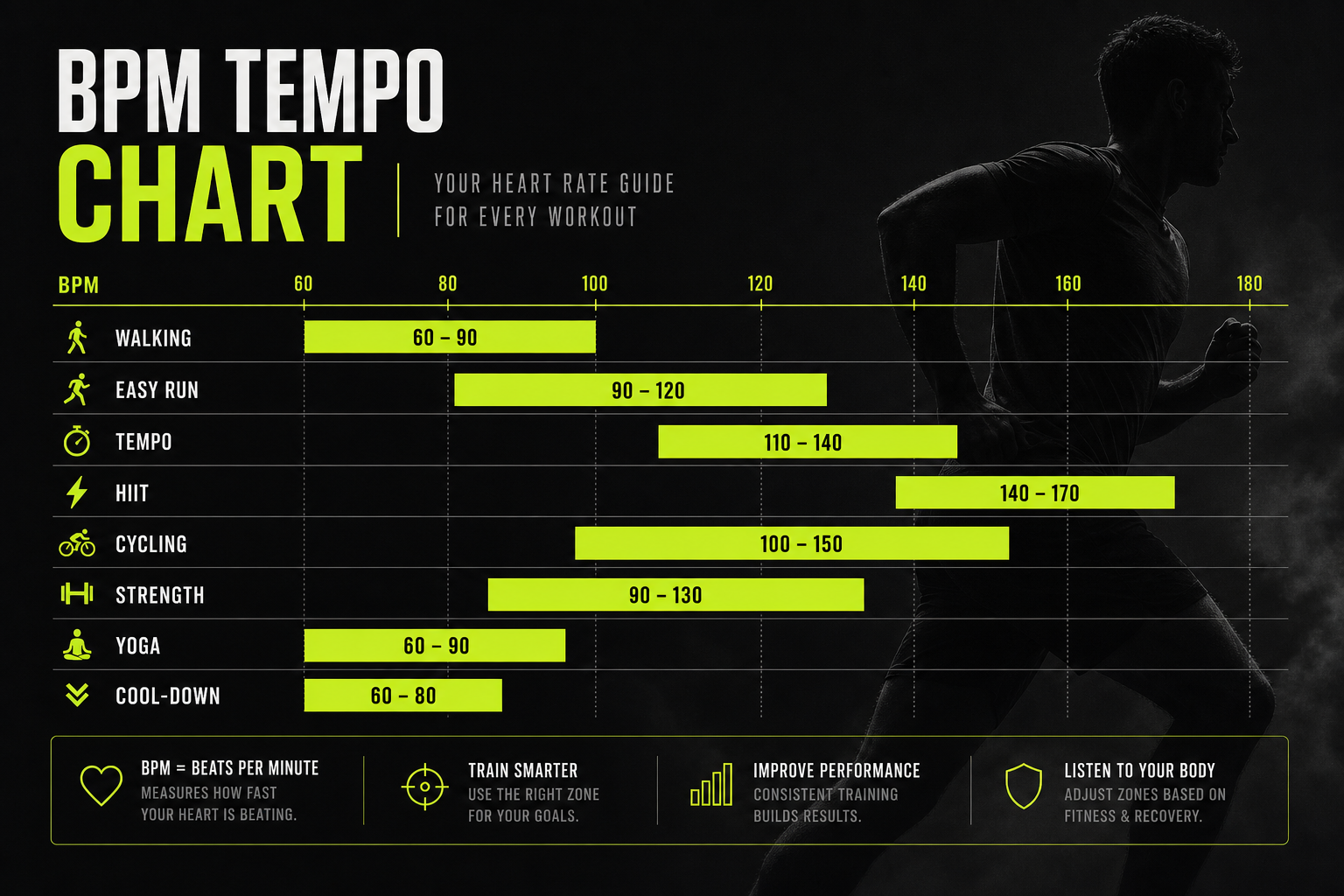
Here is how that translates into a working cheat sheet. Treat it as a starting point, then adjust to how you feel.
| Effort | Approx. share of max heart rate | Music tempo to try | Notes |
|---|---|---|---|
| Warm-up / cool-down | Below steady pace | Under 120 BPM | Lets heart rate and breathing settle |
| Steady-state cardio | About 60% | 120 to 140 BPM | The core range for this article |
| Brisk steady, upper end | 65 to 74% | Around 135 to 145 BPM | Our reading of the gap between the two published ranges |
| Hard sessions | 75% or more | Above 140 BPM | Tempo runs, hard efforts |
The third row is our own interpolation, not a published figure: the sources give a range for about 60% and another for 75% or more, and the in-between zone is where many people spend their long runs. If you find yourself there, the top of the steady range and the bottom of the harder range overlap sensibly.
To find the BPM of any song, search by tempo or use a tool that shows it. Our guide on how to find songs by BPM for wearable-synced workouts walks through the practical side.

Running: tempo and step rate
Runners have an extra lever: cadence, the number of times your feet hit the ground per minute. Matching the beat to your steps can help you shift up, hold a pace or slow down for recovery, according to research in PLOS One as summarized by Karageorghis. For steady running, 120 to 140 BPM is a workable band for holding a consistent pace, and you can match the song directly to your step rate.
A quick way to use this:
- Run at your usual easy pace for a minute and count your steps for 30 seconds, then double it. That is your cadence.
- Choose songs close to that number, or at exactly half or double it, since a beat can land on every step or every second step.
- Build the playlist from songs inside a narrow window, say within 5 BPM of each other, so the feel does not jolt as tracks change.
For runners who want to nudge cadence up, small steps beat big jumps. Our piece on raising cadence with 1 to 3% tempo shifts explains the idea. If your steady runs happen indoors, the same logic applies to the belt: see our notes on tempo-matched treadmill running music.
The ACE running range of 147 to 169 BPM looks higher than the 120 to 140 range. The two are not in conflict. Running at a given heart rate often means a step rate in the 150s or 160s, and the ACE figures are tied to the heart rate being targeted. If your steady pace puts you well above 140 steps per minute, a higher-tempo song, or a half-time feel, is perfectly reasonable.
Cycling and other machines: cadence is not the same as BPM
Cyclists should be careful here, because published guidance looks contradictory. The American College of Sports Medicine (ACSM) tempo guidelines list 60 to 110 BPM for indoor cycling, while the ACE-sponsored research cited above gives 135 to 170 BPM for cycling tied to heart rate. They are answering different questions. One is about the beat that accompanies a class format and pedal strokes, the other about the tempo that matches a target heart rate.
For a steady ride, a practical approach is:
- Know your comfortable cadence in revolutions per minute (many bike computers and trainers display it).
- Choose songs where the beat falls on every pedal stroke, every second stroke, or in a clean 2:3 pattern with it. A 90 rpm cadence pairs naturally with a 90 BPM song, or a 135 BPM song if you like a triplet feel.
- Keep the genre steady, so the pulse does not change character mid-ride.
The ACSM guideline sheet also gives ranges for other formats: 135 to 155 BPM for high-impact classes, about 120 to 140 BPM for low-impact, 118 to 128 BPM for step training, and under roughly 110 to 120 BPM for yoga and Pilates. For steady rowing, our rowing music BPM guide applies the same thinking to stroke rate.
Warm-ups and cool-downs: slow it down on purpose
Steady-state sessions have a shape: a ramp in, a long middle, a ramp out. Slower music, below about 120 BPM, is recommended for warm-ups and cool-downs to help regulate heart rate, blood pressure and recovery. That fits the ACSM sheet, which puts yoga and Pilates music below roughly 110 to 120 BPM.
There is also a payoff for the warm-up playlist itself. Ballmann’s review reports that preferred music keeps its performance-boosting potential even when played only before exercise or during a warm-up. So if you ride or run outdoors with one earbud out for the main set, the warm-up is a good place to put your favorites.
For the last five minutes, our cool-down BPM guide shows how to step the tempo down gradually instead of dropping off a cliff.
What kinds of songs work
Tempo gets you into the right zone. Taste keeps you there. The BASES statement is clear that music should be chosen with the listener’s personal preference and cultural background in mind to get benefits such as lower perceived exertion and a better mood. Ballmann’s review makes the same case: music is a practical, low-cost and easily personalized tool.
Here is what tends to work for steady effort:
- Songs you already love. Familiarity cuts the mental work of the session.
- Positive, high-energy lyrics. Karageorghis suggests upbeat, motivational tracks and genres such as hip-hop or high-energy EDM.
- Steady drum patterns. Four-on-the-floor dance, pop, house and a lot of hip-hop keep a metronomic pulse. Sprawling prog or classical pieces usually do not.
- Songs with strong cues. Karageorghis notes that a recognizable hook, like the guitar riff in “Eye of the Tiger,” can conjure imagery and encourage you to match the intensity.
What about the long mixes you see ranking in search, the hour-long EDM or pop compilations? They can work, but check their BPM. Many are built for gym energy at 130 to 180 BPM, which is above the steady-state range for most people. A mix that sits at 130 to 136 BPM is a better fit for a moderate session than one at 160.
How to build a steady-state playlist in five steps
- Decide your target zone. Use a heart-rate zone you already train in, or roughly 60% of max heart rate for classic steady-state work.
- Pick a tempo window. Start with 120 to 140 BPM. If you are running, narrow it around your cadence.
- Choose by feel first. Fill the list with songs you like, then filter by BPM. The reverse leaves you with a list you skip through.
- Add bookends. Put three or four songs under 120 BPM at the start and the end.
- Test and trim. Do one session, note when your mind drifted or your pace crept, and swap those tracks.
A longer session needs variety inside the range. Rotating among 125, 130 and 136 BPM tracks keeps the pulse steady without monotony.
Let your heart rate steer the music
Static playlists have one weakness: your effort drifts over a long session, but the music does not. Heat, fatigue and hills push heart rate up. A small study presented at ICAD 2010 found that guiding people toward target heart rate zones with music tempo worked as well as visual feedback, and was more enjoyable. The same paper reported that participants found it more intuitive when tempo indicated what they should be doing than when it merely mirrored their current state, since people naturally tend to move in time with the music they hear.
That is the logic behind adaptive music. If you want to see how a watch actually measures effort, our explainer on how wearables measure exercise intensity covers the sensors, and how real-time heart rate guides your soundscapes shows the music side.
If you coach groups, the same idea works in the studio. Live heart-rate displays are a growing part of class design, as covered in this piece on displaying heart rate on gym TVs, and tempo choice is part of music’s role in fitness class energy and performance.
Perspective: why we think steady-state needs a living soundtrack
We built Repbeats around one observation: the hard part of steady-state cardio is not the first ten minutes, it is minutes 25 to 50, when your effort wanders and a fixed playlist cannot respond. A track that was right at minute five can be wrong at minute thirty.
Our approach is to treat heart rate, cadence and session intensity as inputs to the music, and our auto-DJ updates tempo every bar using live data from wearables such as Apple Watch and Fitbit. The aim is not to make your workout louder or faster. It is to keep the soundtrack supporting the zone you chose, whether that is a calm aerobic run or a meditation session at the end of the week.
We also think the access question matters. Our privacy policy limits device access to workout data only, because a tool that sits on your wrist data should ask for as little as it needs.
— Jordan Mills
Try it with your own steady-state sessions
If you would rather not hand-sort songs by BPM, Repbeats pairs your Apple Watch or Fitbit with music that follows your heart rate, cadence and intensity, in cardio and meditation programs you can schedule. Details on the app are on the Repbeats app page. The waitlist launch includes a free year, and for current pricing after the trial, check the app page or your app store listing.
Staying safe while you train to music
Music helps performance, but not at the expense of awareness. Ballmann’s review frames music as an evidence-based performance aid, which means the practical advice is about use: outdoors, keep the volume low enough that you can hear traffic, bikes and people approaching, or use one earbud or open-ear headphones. On roads and shared paths, your ears are part of your safety system.
If you wear a watch or chest strap to guide your tempo, check compatibility with your phone and your music app before race day or a long ride, not during it. If you have a heart condition or you are new to exercise, talk with your doctor before you set heart-rate targets of any kind, since the percentages above are general reference points, not personal prescriptions.
FAQ
What BPM is best for steady-state cardio?
For most people, 120 to 140 BPM works well at about 60% of max heart rate. BASES describes a preferred range of about 125 to 140 BPM regardless of intensity. If the effort rises to 75% or more, music above 140 BPM fits better.
Is it okay to work out with music?
Yes. Studies show music can improve enjoyment and reduce perceived effort, and a 2017 study found it increased total exercise duration in young untrained adults. Just keep your volume and headphone choice compatible with hearing traffic and other people when you are outside.
Is faster music always better for cardio?
No. Faster tempo can raise oxygen consumption and cardiac output, but Ballmann’s review notes it may also reduce cardiovascular efficiency, which is not ideal for steady-state training. Match the tempo to the effort you planned, not the highest energy you can find.
What are some encouraging songs for a steady workout?
Choose songs you love with positive lyrics and a steady beat, often in hip-hop, pop or high-energy EDM. Pick tracks with a recognizable hook, since a strong cue helps you lock into the intensity. Then check each one’s BPM against your target range.
Should my warm-up music be slower?
Yes, under about 120 BPM is the usual recommendation for warm-ups and cool-downs. It helps your heart rate, blood pressure and recovery move smoothly instead of jumping.
Sources
- The BASES Expert Statement on use of music in exercise
- ACE-sponsored research: exploring the effects of music on exercise intensity
- Choosing the right music to power your run (Costas Karageorghis)
- Music helps you get fit, but the right mix will keep you coming back (The Guardian)
- The Influence of Music Preference on Exercise Responses (Ballmann, 2021)
- Effect of music tempo on exercise performance and heart rate (2017)
- ACSM music tempo guidelines for exercise
- How to apply music in sport (Medicine LibreTexts)
- ICAD 2010 paper on music tempo and heart rate guidance
- Displaying heart rate on gym TVs
- Music’s role in fitness class energy and performance