Running Form Rhythm: How to Find and Keep Your Stride
Jordan MillsNovember 13, 2026 · 14 min read

Running Form Rhythm: How to Find and Keep Your Stride
Running rhythm is your form repeating evenly: the same cadence, the same breathing pattern, the same arm swing, mile after mile. You build it by choosing one cue at a time, practicing it on easy runs, and giving your body a steady beat to lock onto. A beat that matches your cadence is the most direct way to do that, and the research below shows what it does for consistency. We built Repbeats around that idea: music whose tempo follows your cadence and heart rate through your wearable.
TL;DR
- Rhythm is the combination of cadence (steps per minute), breathing pattern and relaxed arm swing. Fix them one at a time.
- Speed comes from stride frequency and stride length. Consciously reaching for a longer stride is generally counterproductive, so work on turnover instead.
- Match breathing to steps, for example inhale for three steps and exhale for two, and move to a faster pattern as effort rises.
- In a 2013 treadmill study, runners who ran to a beat matched to their cadence held a steadier cadence and lasted longer before exhaustion.
- Practice changes on easy runs, in short blocks, and let them become automatic before adding another.
Table of Contents
- What running rhythm actually means
- Cadence: the number behind your rhythm
- Breathing in rhythm with your stride
- Posture, arms and landing: the cues that keep the beat
- Drills and practice that build a steadier rhythm
- Can music keep you in rhythm?
- Match the rhythm to your run type
- Where Repbeats fits
- Our perspective
- FAQ
- Sources
What running rhythm actually means
No one measures “rhythm” with a single number. It is what you feel when your legs, lungs and arms stop fighting each other. Your feet strike the ground at an even interval, your breath falls into a repeating pattern, and your arms swing back and forth without effort.
The University of Minnesota’s running guide treats running form as a motor skill. That is useful framing. A skill can be practiced, it improves through repetition, and it is more effective when the practice is deliberate and self-aware. Form covers footstrike, leg and hip mechanics, upper-body movement and breathing, and rhythm is how those parts line up in time.
Why it matters: the Hospital for Special Surgery notes that good form can help you run faster, more efficiently and more enjoyably, while less-than-ideal mechanics repeated under load could lead to injury. A steady rhythm is not a cure-all, but an uneven one is often the first sign that form is breaking down. If your pace surges and fades, or your breathing turns ragged, something in the pattern has slipped.
One caution keeps this honest. A peer-reviewed review of running economy found that some factors look favorable, including a preferred stride-length range, lower vertical oscillation, maintaining arm swing and lower muscle activation during propulsion. It also found that the evidence is inconsistent for several other variables and that a universal economical technique should be recommended cautiously. So your rhythm should be yours. The goal is a repeatable pattern that feels smooth for your body, not a copy of an elite runner.

Cadence: the number behind your rhythm
Cadence, or stride frequency, is the number of steps you take per minute. According to the Minnesota guide, running speed is determined by stride frequency and stride length, and roughly 180 steps per minute is typical of elite runners, though rates vary from runner to runner. The same guide says consciously lengthening your stride is generally counterproductive.
That last point is the practical one. Most runners who want to go faster try to reach farther with each step. That tends to push the foot out in front of the body. The better lever is turnover: quicker, lighter steps that land closer beneath you.
How to find your current cadence
You do not need a lab. Run at your normal easy pace, count how many times one foot touches the ground in one minute, and double it. That is your steps per minute. Do it a few times across different runs, because cadence drifts with pace, terrain and fatigue.
A wearable makes this easier, since most running watches report cadence live and after the run. If you use an Apple Watch, our guide to Apple Watch cadence targets walks through reading the number and making modest changes. If you want a longer view of how stride frequency and length change over weeks, you can log them alongside everything else you track, and the same habit applies if you also track calories on iPhone to fuel long runs.
Do not chase 180
The running-economy review argues against prescribing one stride or cadence to everyone. Treat 180 as a reference point, not a verdict. If you currently run at 160, jumping to 180 overnight will feel awkward and may spoil your rhythm rather than build it. A gradual shift of a few steps per minute, held comfortably, is a sounder approach. Our article on the 3 to 10% cadence window covers how to size that change.
Breathing in rhythm with your stride
Breathing is the part of rhythm that most runners can change today, with no equipment. The American Lung Association recommends diaphragmatic, or belly, breathing and describes rhythmic breathing as synchronizing your breath with your foot strikes.
The common patterns count steps per inhale and exhale:
| Pattern | Steps in | Steps out | When it fits |
|---|---|---|---|
| 2:2 | 2 | 2 | Beginner example, easy effort |
| 3:2 | 3 | 2 | Steady running, five-step cycle |
| 2:1 | 2 | 1 | Faster pace, higher oxygen demand |
The Lung Association recommends the five-step pattern, inhaling for three steps and exhaling for two, and says runners can shift to a three-step pattern of two steps in and one out as pace and oxygen demand rise. The Minnesota guide lists useful ratios of 2:1, 3:1, 4:1 and 5:2, with its beginner example of two steps in and two out within a four-step cycle.
There is a side benefit. A coach quoted in Runner’s World recommends the 3:2 pattern to regulate effort and prevent unintended speed surges. When your breath has a fixed count, you notice sooner when you are pushing too hard.
A simple check for pace is the talk test from the same guide: you should be able to converse without gasping, and if you cannot speak in full sentences, slow down. If you have a heart or lung condition, or breathing feels difficult at easy effort, talk to your doctor before building running volume.
Posture, arms and landing: the cues that keep the beat
Rhythm falls apart when the body is tense. These cues, drawn from the Minnesota guide, are the ones worth holding in mind:
- Head and eyes: look ahead, keep the head neutral.
- Shoulders: relaxed, not hiked toward your ears.
- Arms: swing comfortably forward and back without crossing the midline of the body.
- Landing: land close to beneath your hips rather than overstriding.
All four are in the Minnesota running basics. Your arms act like a pendulum that sets the tempo for your legs. If your arms swing tight and short, your steps tend to match. If they flail across your chest, your rhythm leaks energy sideways.
A quick scan helps, and it takes ten seconds. Every few minutes, check in from the top down: eyes up, shoulders loose, hands unclenched, arms swinging straight, feet landing under you. Pick a landmark, like a lamp post or a mile marker, as your trigger so you do not have to remember.
Drills and practice that build a steadier rhythm
The HSS coach Kate Baird makes a point worth remembering: runners improve form by training differently rather than just trying to run differently. Trunk placement, core engagement, hip and knee rotation and arm swing can become more natural through strength and neuromuscular training. The Minnesota guide adds that running-form drills can help activate muscles and improve form.
A practical weekly plan looks like this:
- Pick one cue. Cadence, breathing count or arm swing. Not all three.
- Practice it for 5 to 10 minutes inside an easy run, then go back to running normally.
- Warm up with drills such as skips and butt kicks before runs to wake up the muscles.
- Add strength work for the hips, core and legs. Two short sessions a week is a sensible target for most recreational runners, though you should scale it to your own fitness and any medical advice.
- Film yourself from the side or behind once in a while, so you see what the feel does not tell you.
- Repeat for several weeks before changing the cue. The aim is for the change to hold when you are tired.
Do not chase a perfect stride. Efficient form is individual, and overcorrecting can create new problems. Small adjustments made during comfortable running are the ones that stick.
A simple cadence drill
Find a flat, traffic-free stretch. After an easy warm-up, run at a comfortable effort and count one foot’s contacts for 30 seconds. Rest, then repeat, trying to add one or two counts each time without working noticeably harder. Do four to six repetitions. If you feel yourself straining, you have gone too far; go back to the previous count. This is the same count-and-double method described above, in a shorter format.
Can music keep you in rhythm?
Yes, and the evidence is specific. A peer-reviewed 2013 PLOS ONE study by Bood and colleagues tested 19 treadmill runners under three conditions: no stimulus, a metronome matched to their cadence, and motivational music matched to their cadence. Time to exhaustion was longer with acoustic stimuli than without.
The cadence numbers are just as interesting. Cadence variability was 2.90 steps per minute with the metronome versus 4.33 without acoustic stimulus. In plain terms, a steady beat made runners’ steps more consistent. The authors suggest that a prominent, consistent beat matched to the runner’s cadence may yield optimal effects.
The same idea is used by coaches. Runner’s World reports that coach Jason Fitzgerald recommends a metronome set to 180 beats per minute, with foot strikes in time, to promote efficient turnover, smoother pacing and a more even cadence.
The catch with a plain metronome
A fixed click is useful, but your ideal cadence changes. It rises on a tempo effort, falls on a hill and drifts when you tire. A single number set before the run cannot follow that. This is the gap that tempo-matched music fills: the beat follows what your body is doing, so it keeps supporting your rhythm through the whole session. For a deeper comparison, see our write-up on a metronome versus music, and our seven-step cadence lock setup for wearable runners.
Setting up the beat
Start with your measured easy-run cadence, not a target. Match the beat to that for a few minutes. Once it feels natural, nudge it up by a few percent, hold, and see whether your breathing pattern still fits. If you run with a watch, you can feed live cadence into your playlist; our guide on using wearable cadence data for playlists explains the approach.
Match the rhythm to your run type
Different runs call for different rhythms, and your beat should change with them.
- Easy runs: the place to practice form. Keep a conversational effort, use the longer breathing pattern, and work on one cue.
- Steady and tempo runs: your cadence will rise slightly. Breathing may shift to a faster count. Hold arm swing compact.
- Intervals: expect your rhythm to break at the end of each hard rep. Aim to recover it during the jog.
- Long runs: rhythm is your pacing tool. Settle early, resist surges, and keep your breathing count steady.
Runner’s World notes that pacing requires conscious practice to sustain a steady tempo, and that track splits, treadmill speed and GPS watches can give pace feedback. A rhythm cue, whether a breath count or a beat, works alongside those tools, because it keeps your effort even between feedback points.
Where Repbeats fits
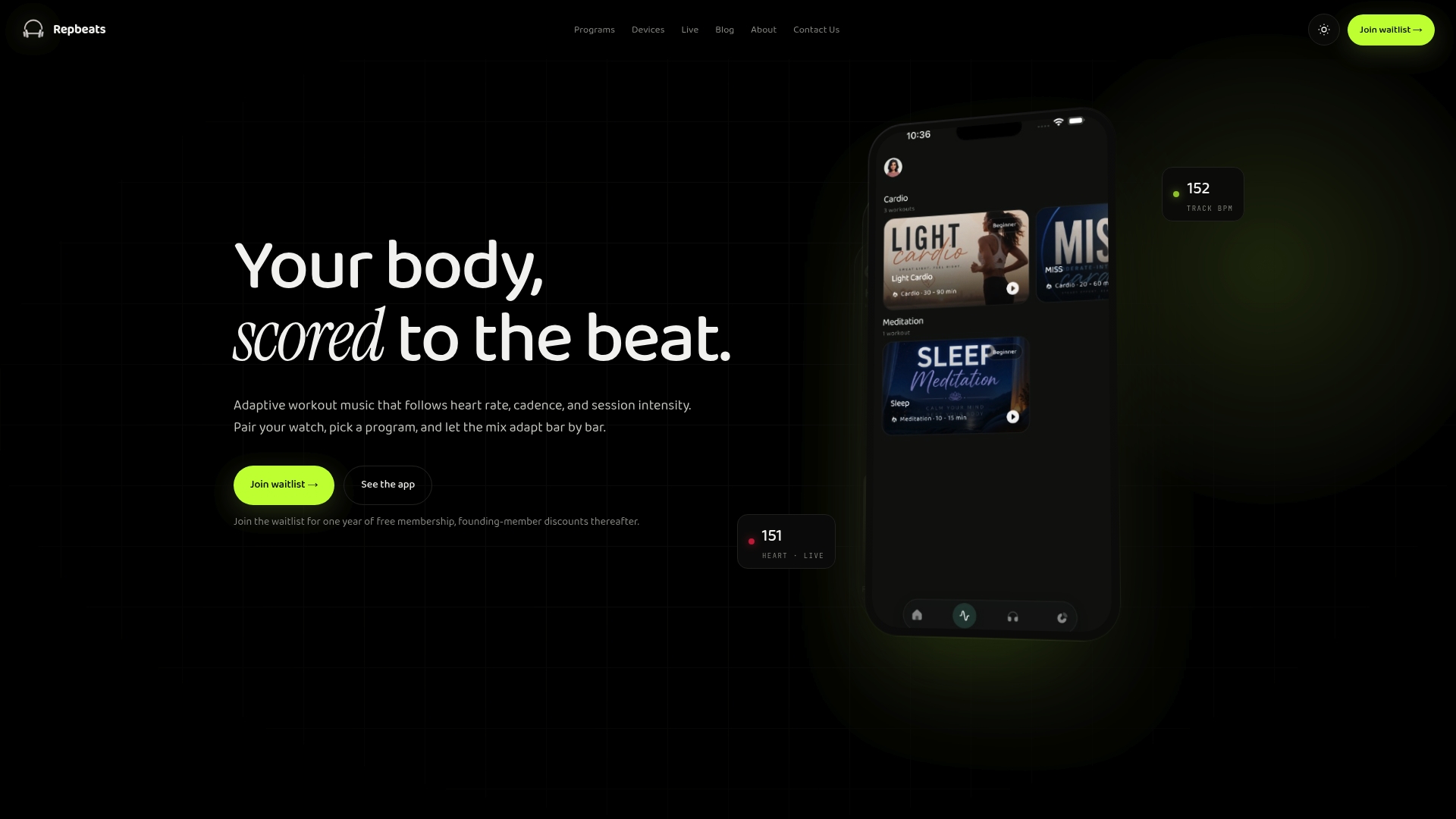
Repbeats is a fitness app that synchronizes music tempo to your heart rate, cadence and session intensity, using live data from wearables such as Apple Watch and Fitbit. Its auto-DJ technology updates the music’s beats per minute every bar, so the tempo keeps following you as your effort changes. You can control playback in real time, search the music library and schedule programs. It also offers meditation programs, which suits cool-down and recovery work. We are running a waitlist launch that includes a free year; see the Repbeats app page for details.
If you run without your phone, our guide to running music without a phone covers syncing cadence or heart rate on a watch. For a structured way to start, the four-week cadence plan shows how to make workout music follow your heart rate.
Our perspective
Most advice on running rhythm stops at “relax and count your steps.” That is good advice, but it leaves you alone with a number in your head for an hour. We think the better answer is to let the music carry the count.
A fixed metronome gives you a click. Your body, though, is not fixed. Your heart rate climbs, your cadence shifts, and the effort of mile six is not the effort of mile one. Repbeats is designed to update the tempo every bar from your live heart rate and cadence, so the beat you are running to stays tied to what you are actually doing.
That is why we pair form work with sound. Small cues, practiced on easy runs, become automatic. A beat that follows you gives those cues something to lean on while they are still new, and it keeps the run enjoyable while you learn.
Use the research as a guide and your own body as the judge. Start with the cadence you have today, add a gentle beat, and let your rhythm settle.
Jordan Mills
FAQ
What is a good running rhythm?
A good rhythm is one you can repeat: even steps, a steady breathing count and relaxed arms at an effort you could hold in conversation. There is no single ideal. The research on running economy warns against prescribing one stride or cadence to every runner, so judge it by how smooth and sustainable it feels.
How do I get into a rhythm quickly when I run?
Start slower than you think you need to. Settle into a comfortable pace, pick a breathing pattern such as three steps in and two out, and keep your shoulders loose. Most runners find the pattern clicks after the first few minutes, and a steady beat can help you lock in sooner.
What cadence should I aim for?
Around 180 steps per minute is typical of elite runners, but rates vary. Measure your own easy-run cadence first, then move up gradually by a few steps per minute if it feels natural. Lengthening your stride on purpose is generally counterproductive.
Should I breathe in time with my steps?
Many runners find it helpful. The American Lung Association describes rhythmic breathing as synchronizing breath with foot strikes and recommends belly breathing. A beginner can try two steps in and two out, then shift patterns as pace rises. If you feel dizzy or short of breath at easy effort, stop and see your doctor.
Does running to music actually help?
In a 2013 study of 19 treadmill runners, cadence-matched acoustic stimuli extended time to exhaustion compared with none, and a metronome produced more consistent cadence. The key was matching the beat to the runner’s cadence.
Sources
- Running Basics – One Foot in Front of the Other, University of Minnesota
- Proper Running Form for Every Part of the Body, Hospital for Special Surgery
- Is There an Economical Running Technique? A Review of Modifiable Biomechanical Factors
- Breathing Basics for Runners, American Lung Association
- Beginner Running Pace Guide: Tips from Run Coaches, Runner’s World
- The Power of Auditory-Motor Synchronization in Sports, PLOS ONE
- The Power of Auditory-Motor Synchronization in Sports, PubMed Central