Cadence Drills Music: Military Cadences and BPM Playlists
Jordan MillsNovember 11, 2026 · 13 min read

Cadence Drills Music: Military Cadences and BPM Playlists
Cadence drills music means one of two things: military call-and-response songs you march or run to, or tempo-matched tracks that set the rhythm for a running or cycling cadence drill. Use cadence songs when you want a group, a walk or a steady shuffle. Use BPM-matched music when you want your steps or pedal strokes to land on the beat. This guide covers both, with numbers you can start from today.
TL;DR
- Military cadences are call-and-response work songs sung while running or marching. Their tempo is slow and fixed, so they suit group work and easy miles more than precision drills.
- For running drills, pick music that feels natural. An exact match is optional, but a tempo near your target cadence gives your steps something to lock onto.
- For indoor cycling, set the target RPM first, then choose music at about twice that RPM, one half-revolution per beat. Above roughly 100 RPM, match the BPM to the cadence directly.
- Outdoors on a bike, keep your ears open. Federal safety guidance says not to listen to music while riding.
- Wearable data can adjust the tempo for you as your heart rate or cadence changes, so the drill does not depend on a static playlist.
Table of Contents
- What “cadence drills music” actually means
- Military cadences for walking, running and group workouts
- Cadence drills with BPM-matched music
- Riding outdoors: keep your ears open
- Making the music follow you
- Slow cadence for meditation and cool-downs
- A sample cadence drill session
- Our perspective
- Try it with Repbeats
- FAQ
- Sources
What “cadence drills music” actually means
The phrase covers two different habits, and the playlists for each look nothing alike.
Military cadences. Runner’s World describes military cadences as call-and-response work songs sung while running or marching, partly used to motivate. A leader calls a line, the group answers, and the rhythm keeps everyone in step. Studio recordings and field recordings of drill sergeants fill the top search results for this keyword for exactly this reason: people want a ready-made soundtrack for a group run, a ruck, a boot-camp-style workout or a mall walk.
Tempo-matched drill music. Here the song is a metronome with a melody. You choose a target cadence, in steps per minute or revolutions per minute, and play music whose beats per minute (BPM) supports it. The goal is entrainment, which is matching musical tempo to movement tempo. A 2020 study of running entrainment describes entrainment as something that can reduce the metabolic cost of exercise by improving neuromuscular or metabolic efficiency.
Both work. They solve different problems. Cadence songs bring people together and add a bit of theater. Tempo-matched music gives a drill a precise, repeatable pulse.

Military cadences for walking, running and group workouts
If you want the classic sound, a few places to start:
- Named tracks. We Are The Mighty suggests “The Ballad of the Green Berets,” “Here We Go,” and “1 2 3 4 Hey” for a running playlist.
- Streaming playlists. Spotify’s “The Sound of Military Cadence” playlist includes “C-130 Rolling Down the Strip.”
- Long-form videos and albums. The top results are hour-long compilations, which is handy when you do not want to touch your phone mid-workout.
Two practical notes. Cadence tracks tend to be short, so We Are The Mighty suggests repeating them to cover longer distances. And because the songs are built around call and response, they work best when you answer out loud, which is easy on a group run and awkward on a quiet trail.
The tempo behind the tradition
Military cadences are not set to a runner’s preferred cadence. According to a U.S. Army history document on jody calls, standard running (double time) cadences are set at 120 beats per minute, and marching cadences at 80.
That 120 BPM figure is worth understanding. When a song is sung at 120 and each foot strike lands on a beat, you take 120 steps per minute. If instead each pair of steps lands on a beat, one left and one right per beat, you take 240 steps per minute, which is far above a typical distance runner’s stride rate. In practice, recreational runners treat a slow cadence track as a loose, steady pulse and let their own stride settle where it wants. That is fine for easy miles and group runs. It is not a precision drill.

Cadence drills with BPM-matched music
When the point is the drill itself, you want the beat to do the counting.
Running
Here is the honest picture of how much matching you need. Runner’s World’s 2026 playlist guide says there is no single ideal BPM for running, and that an exact match is not required: music that feels natural and inspiring is the priority, and faster tracks can help you pick up pace or hold a steady cadence in zone 2.
Your body also does some of the work. In a 2020 study, 33.33% of recreational runners spontaneously entrained to music when they had not been told to match its tempo, and the same study found that instructing runners to match their cadence to the tempo affected their performance. An earlier study from 2015 notes that humans have a natural predisposition to synchronize with rhythm, which is why you can drift into step with a song without trying.
A simple way to turn that into a drill:
- Find your baseline. Run an easy mile on a watch that records cadence and note your average steps per minute.
- Pick a target. Choose a number a few steps above your baseline rather than a leap to a textbook figure.
- Choose music at that BPM. Many playlists are labeled by BPM, such as 150 for easy long runs or 160 to 170 and 170 to 180 for quicker work.
- Run short blocks on the beat. Try three to five minutes locked to the track, then three minutes free, and repeat.
- Hold form first. If you are overstriding or tensing up to hit the beat, drop to a slower track.
Our guides go deeper on each piece: a 7-step cadence lock setup for runners with wearables, a look at the best running metronome app options for wearable runners, and a page on treadmill cadence music for 150 to 185+ BPM.
Walking
Walking has its own sweet spot, and the slower marching tempo of military cadences fits it naturally. If you want BPM-labeled options instead of drill-sergeant recordings, see our walking cadence music playlists.
Indoor cycling
Cycling is where tempo matching is most precise. In a Velo interview, sports psychologist Dr. Costas Karageorghis describes two approaches: synchronous, where you consciously match your pedal rate to the beat, and asynchronous, where music is background motivation. He says indoor cycling is especially suited to synchronous music because the movement is technically simple and easy to control.
His starting point: set the training cadence first, then pick music at roughly twice the target RPM, with one half-revolution per beat. Here is how the examples from that interview line up:
| Target cadence | Music tempo | Rule |
|---|---|---|
| 57 RPM | 114 BPM | about 2x RPM |
| 64 RPM | 128 BPM | about 2x RPM |
| 76 RPM | 152 BPM | about 2x RPM |
| 100 RPM or more | match cadence directly | BPM equals RPM |
At very high cadences, near or above 100 RPM, doubling would push the music to an unusable tempo, so the BPM can match the cadence directly.
For structure, REI’s endurance ride uses 70 RPM for a 5-minute warm-up, 90 to 100 RPM for a 45-minute continuous block, and 70 RPM for a 5-minute cool-down. Continuous pedaling helps riders focus on form and technique. Pair each block with a track range that supports it, and you have a music-led drill.
Tailwind Coaching describes a musical cadence workout in which you match pedal strokes to the tempo, which also gives you practice with gear shifting and revving. Because tempos keep changing, you have to adjust power and gears to stay in sync. For ready-made sessions, try our guide to cycling cadence drills that build a faster pedal stroke and the walkthrough on syncing songs to your RPM.
One caution from LA Cycle + Yoga: if matching the beat leaves you bouncing in the saddle, prioritize controlled movement, keep enough resistance and adjust your pace. In a class, follow the instructor’s spoken cue rather than guessing from the song alone.
Group fitness and choreographed drills
Instructors build routines around musical phrasing. Fitmotivation notes that group fitness instructors typically work in phrases of 32 counts to design safe and effective routines, and says movement should be taught to the music’s cadence. If you lead drills for a class or a running club, counting in 32s gives you a built-in template: change the movement at each phrase boundary and the group stays together.
Riding outdoors: keep your ears open
Everything above about tight cycling sync is for the trainer. Dr. Karageorghis advises against listening to music while cycling outdoors, per the same Velo interview. In the United States, NHTSA says cyclists should not listen to music or use anything that takes their eyes, ears or mind off the road.
If you do ride with audio, Bicycling’s advice is one earbud with the other ear free, low volume, or a handlebar speaker at a considerate level. Also check your local rules: Active.com points out that motor-vehicle ordinances may also apply to cyclists, and headphones or distracting devices may be prohibited. The simplest plan is to do your music-led cadence work indoors and ride outdoors with your senses on the road.
Making the music follow you
A static playlist has one flaw for drills: your effort changes, and the playlist does not. Warm up at 70 RPM and a 114 BPM track fits. Ten minutes later you are at 95 RPM and the same playlist is dragging you backward.
Wearables close that gap. The UC Berkeley RunSync project describes using wearable data such as heart rate and heart-rate variability to inform music recommendations. Its model calculates heart-rate zones and adjusts playlist recommendations, including tempo, based on those zones.
That is the idea behind Repbeats. If you want to see how a watch turns signals into a number the music can use, read how wearables measure exercise intensity for adaptive music and how to use wearable cadence data for playlists. If you leave the phone at home, phone-free running music on a watch covers that setup, and the 4-week cadence plan lays out a progression that lets your music follow your heart rate.
Slow cadence for meditation and cool-downs
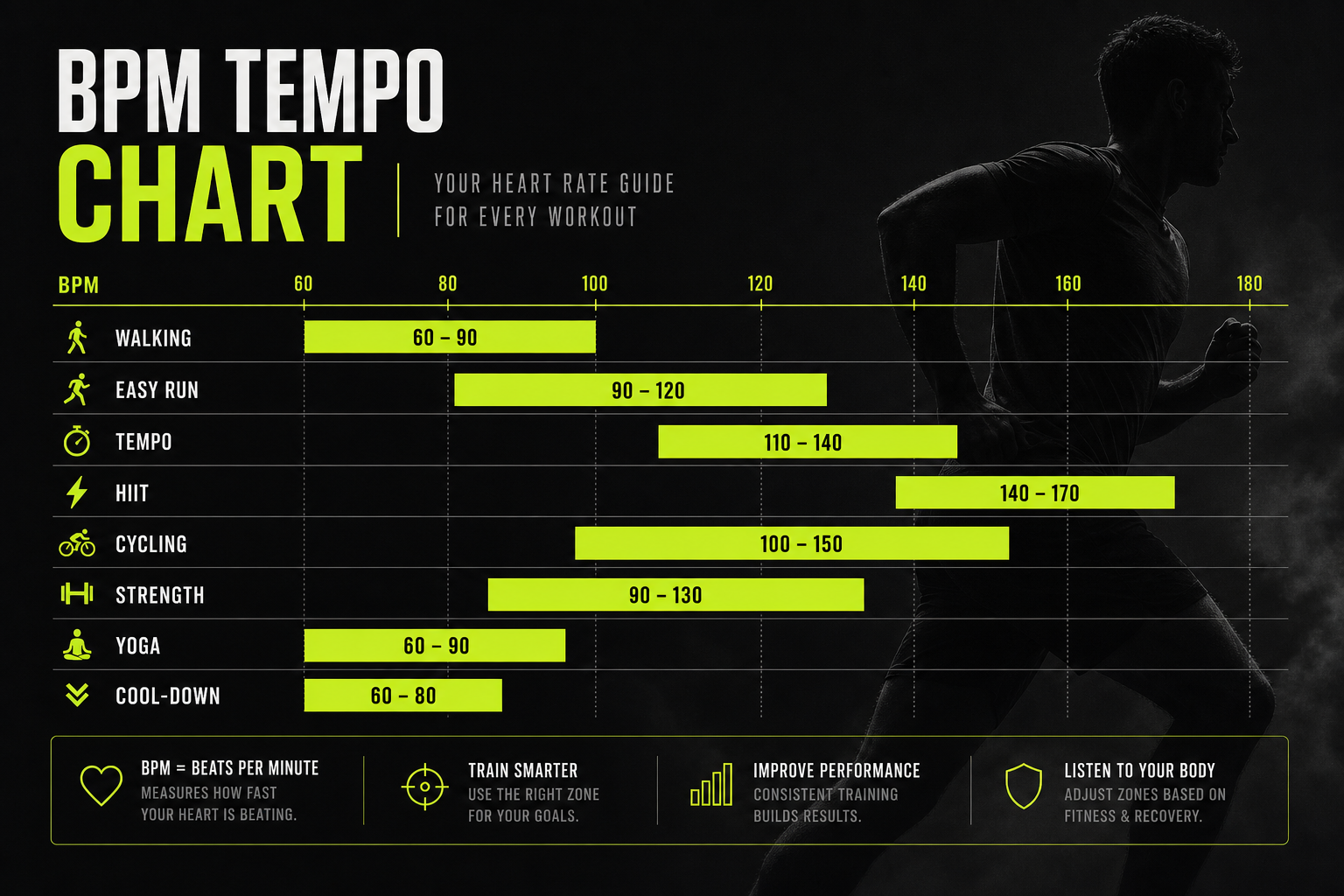
Cadence thinking is not only for hard efforts. Slow, steady rhythm belongs at the end of a session and in meditation. One clinical trial of relaxing music used slow-tempo music at 60 to 80 beats per minute, a range that sits near a typical resting heart rate. That makes it a reasonable place to start when you build a cool-down or a meditation soundtrack: soft instrumental sound, no abrupt changes, and a tempo you barely notice.
If you are cooling down after a run or ride, ease the tempo down in steps as your heart rate falls, rather than switching straight from a 170 BPM track to silence.
A sample cadence drill session
Here is a 40-minute run or indoor ride that uses both ideas. Adjust the numbers to your own baseline.
| Block | Time | Music approach |
|---|---|---|
| Warm-up | 8 min | Slow, steady cadence track, loosely followed |
| Lock-in | 4 x 4 min | BPM-matched to your target cadence, 2 min easy between |
| Free block | 8 min | Music you love, no matching |
| Cool-down | 8 min | Tempo stepping down toward 60 to 80 BPM |
On the bike, convert your target RPM using the half-revolution rule for the lock-in blocks. On foot, set the BPM to your target steps per minute. Either way, keep the form cues ahead of the beat.
Our perspective
Most cadence playlists are written once and used forever. They assume your effort is a flat line. It never is. You start slow, build, surge, recover and cool down, and the best tempo moves with each of those phases.
That is why we built Repbeats around live data. Our app is designed to sync music tempo to heart rate, cadence and session intensity using data from wearables like Apple Watch and Fitbit, and our auto-DJ technology updates the BPM every bar. The aim is a soundtrack that supports each phase of your session instead of one you have to babysit.
We also keep access narrow: our privacy policy limits device access to workout data only. For runners, cyclists and anyone building a cadence habit, we think music should do the counting so you can focus on form.
Jordan Mills
Try it with Repbeats
If you would rather not hunt for tracks at the right BPM, Repbeats is built for this. It adapts music to your heart rate, cadence and intensity from your wearable, for running, cycling and meditation programs, with real-time music control, library search and program scheduling. Our waitlist launch includes a free year, and you can join from the Repbeats homepage.
FAQ
What BPM is best for cadence drills?
It depends on the activity and your target. Runner’s World notes there is no single ideal BPM for running, so start from your own cadence. For indoor cycling, use about twice your target RPM, or match BPM to RPM at around 100 RPM and above.
What are military cadences, and can I use them for workouts?
They are call-and-response work songs sung while running or marching. They suit group runs, walks and boot-camp-style sessions. Their tempo is fixed and slow, so use them for steady pacing rather than precision drills.
Do I have to match my steps exactly to the music?
No. Runner’s World says an exact match is not necessary, and that music which feels natural is the priority. Many runners drift into step on their own, and a short locked block inside an otherwise free run is enough to practice.
Can I use cadence music while cycling outdoors?
The safest answer is no. NHTSA says cyclists should not listen to music or use anything that distracts their eyes, ears or mind. Save beat-matched cadence work for the indoor trainer, and check your local ordinances.
What music works for meditation?
Slow, soft instrumental music is a common choice. A clinical trial of relaxing music used 60 to 80 BPM, near a typical resting heart rate. Choose a tempo you barely notice and avoid sudden changes.
Sources
- Instructed versus spontaneous entrainment of running cadence to music tempo (2020)
- Spontaneous entrainment of running cadence to music tempo (2015)
- Tune up: How to use music to get the best out of your cycling, Velo
- The Best Running Playlists for Every Workout, Runner’s World
- Here are the military cadences you need to get in shape, We Are The Mighty
- The Sound of Military Cadence, Spotify playlist
- U.S. Army history: contemporary jody calls
- Music: when to be on the beat, Fitmotivation
- Bicycle Safety, NHTSA
- 5 Rules for Listening to Music on a Ride, Bicycling
- Debating the Pros and Cons of Music While Riding, Active.com
- Musical Cadence Workout, Tailwind Coaching
- Music and Rhythm in Cycling Class, LA Cycle + Yoga
- Indoor Cycling Workouts, REI Expert Advice
- RunSync: Music Meets Running Training, UC Berkeley School of Information
- Decreasing Delirium Through Music in Critically Ill Older Adults, ClinicalTrials.gov