How to Calibrate Music to Your Heart Rate
Jordan MillsOctober 30, 2026 · 14 min read

How to Calibrate Music to Your Heart Rate
To calibrate music to your heart rate, find your target heart-rate zone, pick a tempo range that fits the activity, then test and adjust over a few sessions based on how hard the effort feels. Music does not set your pulse, but tempo nudges effort, and a soundtrack that follows your zone instead of fighting it makes steady training easier. This guide shows how to do it by hand and where automation helps.
TL;DR
- Music tempo influences effort, not your heart directly. Faster music tends to raise heart rate and perceived intensity, while slow music tends to lower them.
- Start with your zone: your maximum heart rate is roughly 220 minus your age, and moderate effort sits around 50-70% of it.
- Use tempo ranges as starting points: 60-110 BPM for indoor cycling, 126-136 BPM for low-impact work, 135-155 BPM for high-impact work, per ACSM.
- Calibrate over several sessions, noting effort and heart rate, and change the music rather than chasing numbers.
- If you have a heart condition, ask your clinician before using fast music to push intensity.
Table of Contents
- What “calibrating” music to heart rate really means
- What the research says about tempo and heart rate
- Step 1: find your zone before you pick a tempo
- Step 2: choose a starting tempo for your activity
- Step 3: find the BPM of your songs
- Calibrating for specific goals
- A simple four-week calibration routine
- Know the limits and the safety angle
- Where automation helps
- Try adaptive music with your wearable
- FAQ
- Sources
What “calibrating” music to heart rate really means
People use the phrase in two ways. Some want music that lowers a racing pulse, such as binaural-beat or ambient tracks around 60 BPM. Others want a workout soundtrack whose tempo tracks their effort. Both rest on the same idea: tempo is a lever you can set on purpose.
Calibration is a loop with three parts:
- Measure: know your current heart rate and your target zone.
- Match: choose a music tempo that suits the target.
- Check: see whether your heart rate and your sense of effort land where you wanted, then adjust.
The third step is the one most people skip. A playlist labeled “150 BPM” is a guess about you. Your own data is the calibration.
What the research says about tempo and heart rate
The evidence is real but more modest than the marketing around it.
Faster music raises physiological arousal. A study in Heart measured cardiovascular and respiratory responses to different music and found that faster tempos increased heart rate, blood pressure and ventilation, while slow or meditative music, and especially pauses between pieces, produced relaxation.
It works during exercise too. In a study of cardiac rehabilitation patients, stimulating music increased heart rate during exercise, while sedative music lowered heart rate and perceived exertion compared with no music.
Effort shifts more than the pulse does. A 2020 meta-analysis of 139 studies found that music benefits mood, physical performance and perceived exertion, but showed no significant overall effect on heart rate itself. That matters for calibration: the clearest payoff of well-chosen music is that hard work feels easier and more enjoyable, not that your pulse lands on a number.
Your heart does not lock to the beat. A 2021 review notes that tempo may correlate with heart rate changes, yet earlier work found no evidence that heart rate entrains to recorded music without a visual performance. Do not expect a 140 BPM track to pull your pulse to 140. Expect it to change how much you want to move.
Matching to your own signals can help. In a trail-running trial, cadence-synchronous music improved performance, and heart-rate-synchronous music reduced perceived effort in female runners and allowed the longest runs. It is one trial, so treat it as promising, not settled.
Step 1: find your zone before you pick a tempo
Music is only useful if you know what you are aiming at. The American Heart Association says your maximum heart rate is about 220 minus your age, with moderate-intensity effort around 50-70% of that maximum. Vigorous effort sits above that band.
A worked example for a 40-year-old:
- Estimated maximum: 220 − 40 = 180 beats per minute.
- Moderate zone at 50-70%: about 90 to 126 beats per minute.
The formula is an estimate, and individuals vary. If you use a smartwatch, its zones may be based on your own data and are usually better than the formula. Our guide on how wearables measure exercise intensity explains what the sensors actually read and where they drift.
Also use the talk test as a cross-check. If you can speak in full sentences, you are likely in an easy to moderate zone. If you can only manage a few words, you are working hard. Wrist sensors lag at the start of intervals, so your breathing is sometimes the faster signal.
Step 2: choose a starting tempo for your activity
Tempo ranges are starting points, not rules. The American College of Sports Medicine publishes music tempo guidelines for exercise that give a useful map:
| Activity | Suggested tempo (BPM) |
|---|---|
| High-impact exercise | 135-155 |
| Low-impact exercise | 126-136 |
| Step training | 118-128 |
| Latin-style movement | 110-140 |
| Yoga or Pilates | Below 110-120 |
| Hip-hop | 90-120 |
| Indoor cycling | 60-110 |
ACE lists somewhat higher approximate tempos for steady-state work in a summary of its sponsored research: 137-139 BPM for power walking, 147-169 BPM for running and 135-170 BPM for cycling. The two sources differ because “cycling” covers everything from a spin class to a road ride. Treat the overlap as a sensible zone to test, and use your own cadence to settle it.
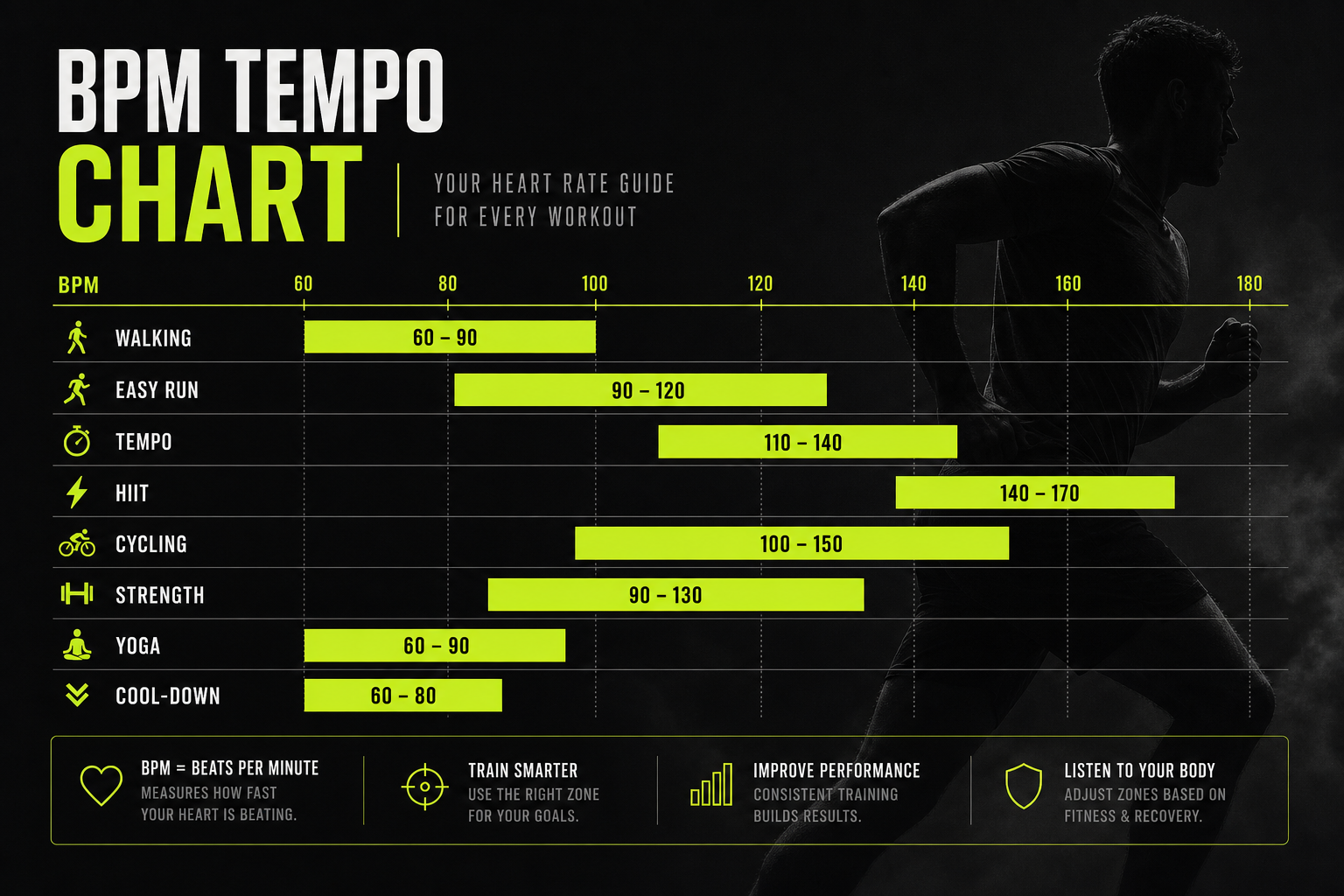
For a deeper chart by workout type, see our BPM tempo chart for every workout. If you are unsure what the number on a track means, what workout BPM means covers it in plain terms.

Two ways to link tempo to your body
Tempo to cadence. Steps per minute or pedal revolutions per minute are things you control directly. If you run at 165 steps per minute, music near 165 BPM, or a half-time feel at about 82, gives your feet a beat to land on. This is the most reliable form of matching because cadence is under your control.
Tempo to effort. Here the music follows heart rate or intensity. Lower zone, lower tempo. Higher zone, higher tempo. The research on biosynchronous music suggests real-time changes based on heart rate or cadence hold potential for portable music systems and coaching.
Step 3: find the BPM of your songs
You cannot calibrate without knowing each song’s tempo. ACSM explains that you can work out a song’s BPM by counting measures in the first minute and multiplying by the beats per measure. If a track has 35 measures in its first minute in 4/4 time, that is 140 BPM.
A faster shortcut is to tap along with a timer for 15 seconds and multiply by four. Do it twice and average. For library-wide searching, our walkthrough on how to find songs by BPM shows how to filter a collection by tempo, and tempo matching music shows how to pick the right number for your goal.

Watch for half-time and double-time. A slow ballad at 70 BPM can feel like 140 if the drums subdivide. Pick what your body feels, not only what the label says.
Calibrating for specific goals
Running
Runners usually want tempo to support cadence. Start by checking your natural cadence over a flat easy mile, then pick a playlist within about 5 BPM of it. For harder sessions, our guides on threshold run music at 130-140 BPM and tempo run BPM show how to align music to your threshold effort. On a treadmill, where pace is fixed and the beat has to do more work, see treadmill running music and treadmill cadence music at 150-185+ BPM.
One caution from a 2024 study: researchers using non-lyrical music found no clear link between exercise intensity and preferred tempo, though the most positive psychological outcomes came with fast tempos. Your preference may not rise neatly with effort, so let your own response guide you.
Cycling
Cycling cadence is typically 80-100 revolutions per minute for many riders, so a beat at that number or at a clean multiple of it can lock in. Because road and indoor riding have different demands, the ACSM range for indoor cycling (60-110 BPM) and ACE’s higher range (135-170 BPM) both show up in practice. Try both and keep what feels natural.
If you ride with others, your pace is partly set by the group. Learning to find pace-matched group rides helps you keep a steady effort, which makes it easier to settle on a tempo that suits that effort.
A 2026 University of Jyväskylä study found recreationally active adults cycled longer with self-selected music at 120-140 BPM than without music, with greater cumulative cardiovascular load. Self-selected music matters: songs you like make the work last.
Cooling down and relaxing
Here you want the opposite effect. A 2022 study on recovery after high-intensity exercise found that moderate-tempo (Moderato) piano music helped heart rate recovery and supported autonomic stability. For meditation and sleep, slow, steady tracks around 60 BPM are common, and the same Heart study showed that slow music and silence produced relaxation.
Slow music is a helper, not a treatment. If your resting pulse is consistently high or irregular, that is a question for a doctor, not a playlist.
A simple four-week calibration routine
Giving it a few weeks beats a single test. Timing studies of your own habits work the same way, and a piece on testing your gym timing for 3 to 4 weeks makes the case for comparing sessions rather than judging one. Apply that to music:
- Week 1, baseline. Do your usual workouts with your usual music. Record average heart rate, perceived effort on a 1-10 scale and how the session felt.
- Week 2, match cadence. Use a playlist within 5 BPM of your cadence. Keep everything else the same.
- Week 3, match zone. Raise or lower tempo by 10-15 BPM between easy and hard segments. Record the same numbers.
- Week 4, choose. Compare the three. Keep whichever setup gave the lowest perceived effort at the same pace, or the most consistent zone time.
Use the same route or workout for each test so the comparison is fair. Heat, sleep and caffeine all move your heart rate more than music does.
Reading your results
- Heart rate rose, effort felt the same. The faster tempo may have pushed you a little harder. Fine on a hard day, not on a recovery day.
- Heart rate flat, effort lower. This is the typical result, consistent with the meta-analytic finding that music mostly changes perceived exertion.
- Heart rate drifted above your zone. Lower the tempo or take a pause. In the Heart study, pauses reduced heart rate, blood pressure and ventilation.
Know the limits and the safety angle
Music can push intensity without you noticing. In the cardiac rehabilitation study cited by ACE, patients whose music tempo rose by a third followed the faster beat, with heart rate up 10 to 15 beats per minute and perceived exertion up significantly. Exercise scientist Carl Foster warned there that extra intensity can be dangerous for some people.
If you have heart disease, an arrhythmia, high blood pressure, or you take medication such as beta blockers that changes your heart rate response, ask your cardiologist or primary care doctor for a safe heart-rate ceiling before using fast tempos to drive intensity. In that case, use your prescribed ceiling as the cap and treat music as secondary.
There is a second limitation: wrist heart-rate readings can lag or spike, especially during intervals or with a loose strap. Use a chest strap if your decisions depend on accuracy.
Where automation helps
Doing this by hand works, but it is tedious. You build playlists, keep checking your watch and swap tracks as your effort changes. That is the problem we built Repbeats to handle.
Our perspective
We built Repbeats on a simple view: your body already tells you what the workout needs, and your music should listen. A static playlist is a guess made before you start. Your heart rate, cadence and session intensity change minute by minute, and a fixed tempo cannot follow them.
So we use live data from wearables such as Apple Watch and Fitbit and adjust the music’s BPM every bar, so the beat shifts as your effort shifts. The result is that you stay in your zone with a soundtrack that follows your intensity instead of pulling against it. We keep access to what we need, workout data only, and nothing more.
We also think honesty matters here. Music will not control your heart. It shapes how effort feels and how willing you are to stay in the work. Calibration is about making that effect consistent. The same logic applies to meditation, where a soundtrack that settles as you settle supports the practice.
— Jordan Mills
Try adaptive music with your wearable
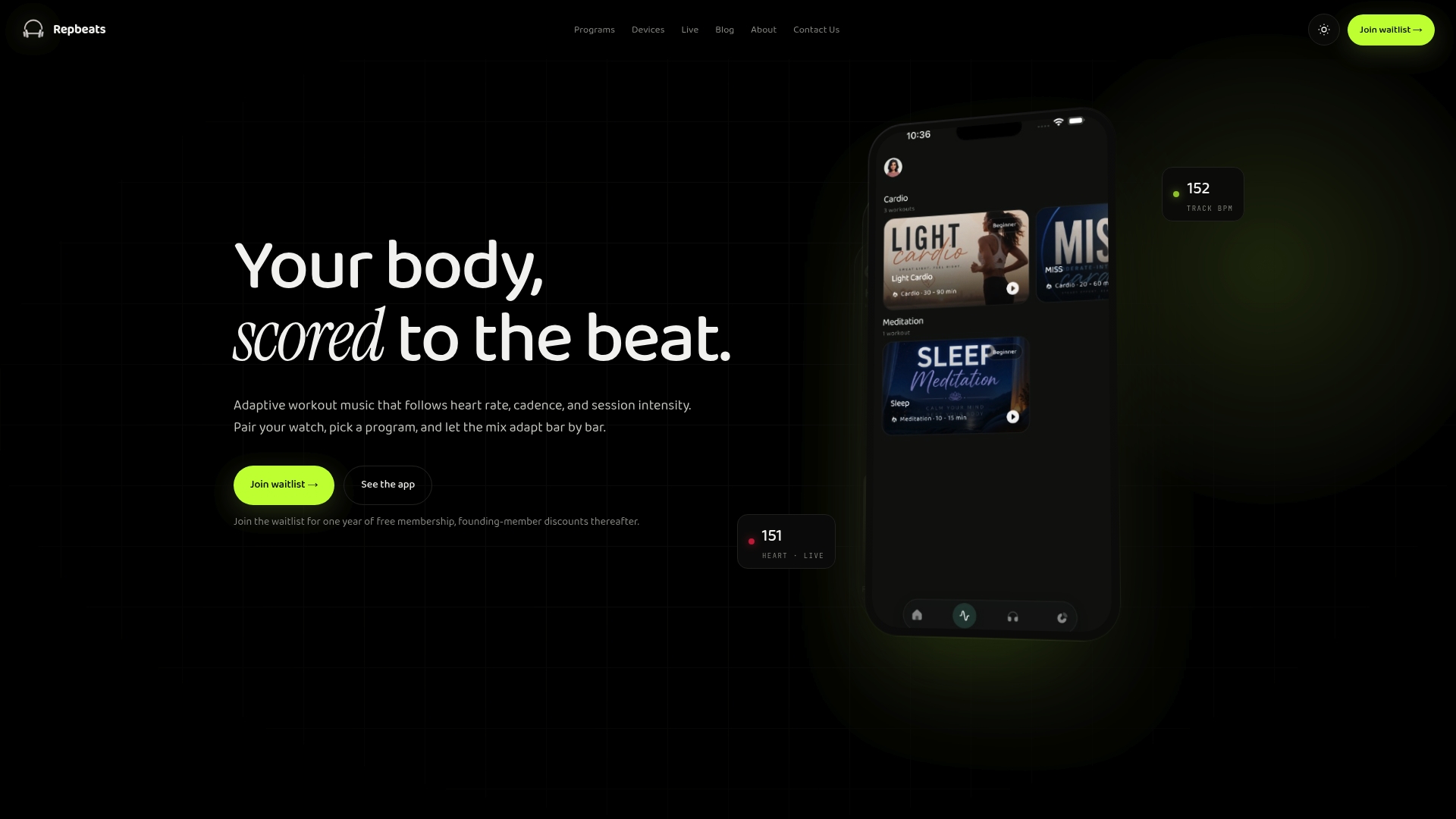
If you would rather skip the manual calibration, Repbeats syncs music tempo to heart rate, cadence and session intensity from your wearable, with cardio and meditation programs, real-time music control, library search and program scheduling. Our AI workout music for wearables guide shows how the real-time sync works, and you can see the app on the Repbeats page.
FAQ
Can music actually lower my heart rate?
Slow, calm music and silence can reduce heart rate, blood pressure and breathing rate in studies, so the effect is real but modest. During exercise, sedative music has lowered heart rate and perceived exertion compared with no music. Do not use it to manage a medical condition. See your doctor for a persistently high or irregular pulse.
What BPM should my music be for a target heart rate?
There is no direct conversion, because tempo changes effort, not pulse, in a one-to-one way. Start from the activity range: for example, 126-136 BPM for low-impact work or 135-155 BPM for high-impact work. Then adjust by 5-10 BPM based on your heart rate data and how hard the session feels.
Does my heart rate sync to the beat?
Not reliably. A 2021 review found no evidence that heart rate entrains to recorded music without a visual performance. What does follow the beat is your movement, such as steps or pedal strokes, which is why cadence matching is more dependable than trying to match your pulse.
Is faster music always better for workouts?
No. Fast tempos are linked with greater arousal and often better mood during exercise, but they can push intensity above what you planned. For recovery days, cooldowns and meditation, slower music fits better. Match the tempo to the purpose of the session.
How long does calibration take?
Plan on three to four weeks of comparing sessions. Change one variable at a time, such as cadence matching, and record average heart rate and perceived effort. After that, you will know which tempo ranges work for each type of workout.
Sources
- Cardiovascular, cerebrovascular, and respiratory changes induced by different types of music (Heart)
- Clinical outcomes of different tempos of music during exercise (PMC)
- Effects of music in exercise and sport: a meta-analytic review
- Effects of music on the cardiovascular system (PMC)
- Performance and perceived effort in trail runners using biosynchronous music
- Target heart rates chart, American Heart Association
- Music tempo guidelines for exercise (ACSM PDF)
- Music tempo guidelines for exercise (ACSM)
- ACE-sponsored research: exploring the effects of music on exercise intensity
- The exercise intensity and music-tempo preference relationship (ScienceDirect)
- Feel the beat, not the burn: effects of self-selected music (University of Jyväskylä)
- Effects of piano music of different tempos on heart rate recovery (PMC)
- Find pace-matched group rides
- Testing your gym timing for 3 to 4 weeks