How to Schedule Workout Music, Minute by Minute
Jordan MillsNovember 6, 2026 · 13 min read

How to Schedule Workout Music, Minute by Minute
Scheduling workout music means deciding, before you start, what tempo plays in each phase of your session: slower for the warm-up, a steady build into the work, the fastest music at your hardest effort, then a deliberate step down to recovery. The American College of Sports Medicine gives the core rule: build up to the tempo range of the main workout during the warm-up, and do the reverse for the cooldown. The rest of this guide turns that rule into a plan you can use for running, cycling, lifting, intervals and meditation.
TL;DR
- Schedule by phase, not by genre: warm-up, build, main work, peak, cooldown, each with its own beats-per-minute (BPM) range.
- For most steady aerobic work, a professional expert statement on music in exercise points to 125–140 BPM, with slower music for warm-up and cooldown.
- Runners and cyclists can aim for activity-specific ranges: roughly 147–169 BPM for running and 135–170 BPM for cycling.
- Wearable data (heart rate, cadence) lets the tempo follow your effort automatically instead of following a fixed playlist.
Table of Contents
- Why the order of your songs matters
- The four-phase template
- Scheduling music for running
- Scheduling music for cycling
- Scheduling music for strength training
- Scheduling music for meditation and recovery
- Choose songs you actually like
- Can your wearable do the scheduling?
- Scheduling with Repbeats
- Our perspective
- FAQ
- Sources
Why the order of your songs matters
A playlist on shuffle treats minute three and minute thirty the same. Your body does not. At minute three you are loosening up and your heart rate is climbing. At minute thirty you may be at your hardest effort. Music that ignores that arc can push you too early or let you drift when you need a lift.
The research on music and exercise is encouraging when music is used on purpose. A meta-analysis of 139 studies and 3,599 participants found beneficial associations with mood during exercise (g = 0.48), physical performance (g = 0.31), perceived exertion (g = 0.22) and oxygen consumption (g = 0.15). It found no significant benefit for heart rate itself (g = 0.07). In plain terms, music tends to make exercise feel better and easier, and helps people perform a bit more, without changing how fast the heart beats.
A more recent systematic review of 15 studies and 339 participants looked at aerobic exercise specifically. Music was associated with better performance over a fixed duration, longer time to exhaustion, lower rating of perceived exertion and lower blood lactate, while heart rate was not significantly affected.
Those are benefits worth planning around. Scheduling is how you collect them at the right moments.

The four-phase template
Every session, whatever the sport, can be split into four phases. Here is a working template built on the published ranges in this guide. Treat the numbers as a starting point and adjust to your own cadence and taste.
| Phase | What you are doing | Music direction | Typical BPM range |
|---|---|---|---|
| Warm-up | Easy movement, raising heart rate gradually | Start slow, climb steadily | Below the main range, rising into it |
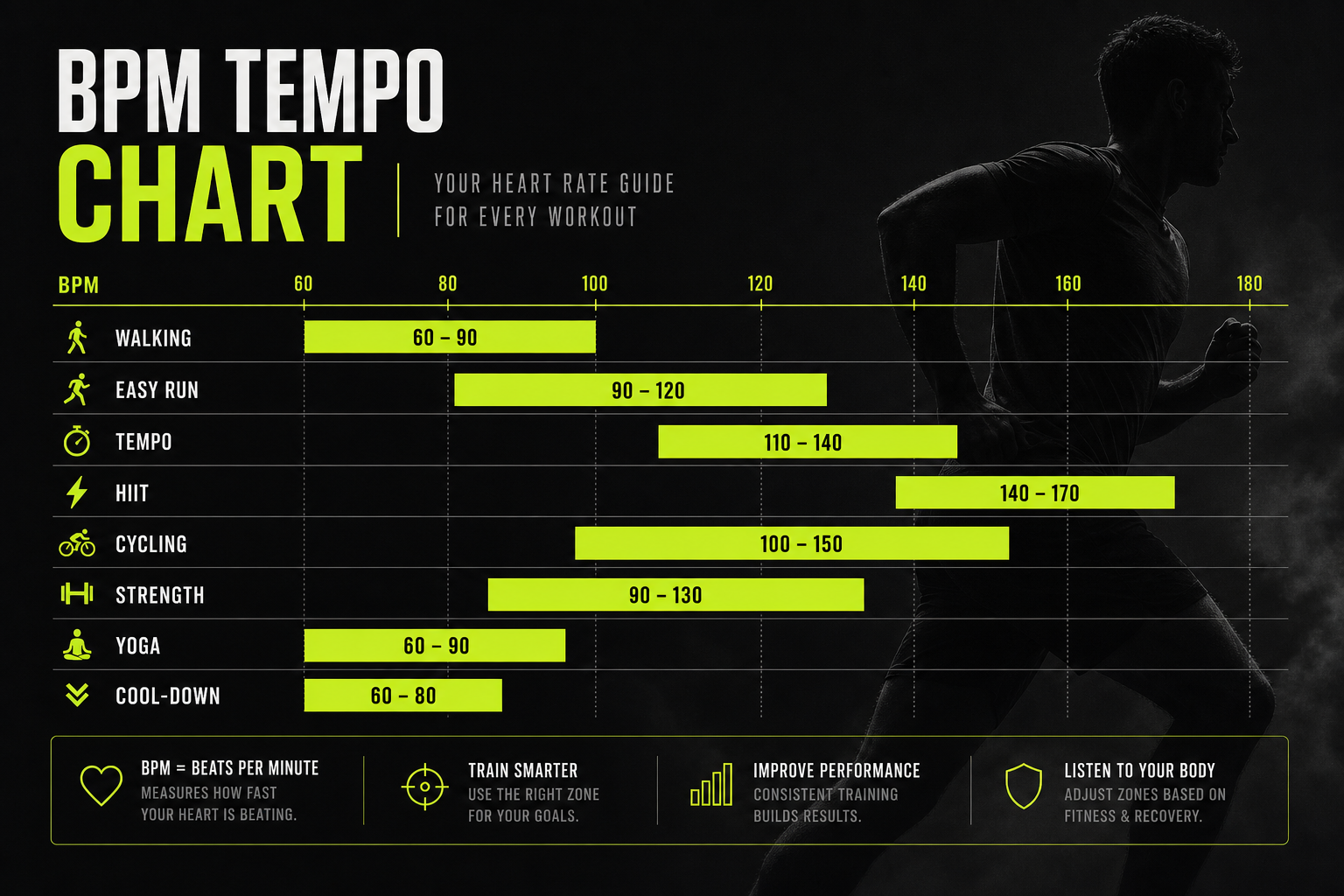
| Main work | Steady effort in your target zone | Hold a consistent tempo | 125–140 BPM for general aerobic work |
| Peak | Hardest intervals or final push | Fastest tempo of the session | Top of your activity range |
| Cooldown | Easing down, heart rate falling | Reverse the warm-up | Falling well below the main range |
The direction matters more than any single number. The ACSM advice is explicit about the mirror image: the warm-up builds toward the work tempo, and the cooldown retraces the steps back down. If you only remember one thing, remember the symmetry.
Warm-up: start below your working tempo
Pick songs a notch slower than your main set and step up every few minutes. A warm-up of five to ten minutes might use three or four tempo steps. The aim is that the last warm-up song sits at the bottom edge of your work range, so the first work song feels like a continuation rather than a jolt.

Main work: pick a band and stay in it
For repetitive aerobic activity such as jogging, rowing or steady cycling, the BASES expert statement recommends a band of 125–140 BPM for most healthy exercisers. It also advises choosing music that is functional for the activity, meaning its rhythm roughly approximates the movement pattern, with prominent rhythm and percussion. Lyrics that affirm movement or carry general motivating statements are suggested too.
Peak: save your fastest music
If your session has a hard finish, schedule the highest-tempo songs there. Starting your peak music at minute five spends your best motivational tool before you need it. Holding it back gives your hardest effort a soundtrack that has been building toward it.
Cooldown: step down on purpose
One study summarized in a narrative review in PMC found that fast music at 140 BPM improved running time on a treadmill test compared with no music and with slow music at 100 BPM. Slow music, though, produced lower lactate concentration during the 15-minute recovery phase. That is the logic of a two-direction schedule: fast music for the work, slow music for the recovery.
Scheduling music for running
Runners have the cleanest numbers to work with because cadence, steps per minute, is easy to read from a watch or phone. ACE-sponsored research identified approximate BPM targets of 137–139 BPM for power walking and 147–169 BPM for running.
A simple way to schedule a run:
- Note your easy-run cadence from a recent run.
- Warm up with songs 10 to 20 BPM below that number, climbing every song or two.
- Hold songs close to your easy cadence for the main block.
- For tempo or interval efforts, move to songs near your faster cadence.
- Cool down by stepping back down through the same ranges.
Half-time works too. A 170 steps-per-minute cadence can be paired with an 85 BPM song, because every other footfall lands on a beat. That gives you slow-feeling music with a fast-running pulse, which is handy for easy days.
If you want the math worked out for specific paces, our guides on pace-based playlists for runners and cyclists and tempo-matched treadmill running music show how pace converts to BPM. If your goal is to nudge cadence upward over weeks, pace-matched music with small 1–3% tempo shifts is the approach to read.
Interval and sprint sessions
Intervals are where scheduling pays off most, because the tempo has to change on a clock. A common structure is a steady baseline for recovery jogs and a higher tempo for each hard rep. Our write-ups on treadmill interval music built around a 130 BPM baseline, HIIT running music and sprint workout music lay out how to map each rep to a tempo. For a wider set of options there is also our guide to interval running music.
Scheduling music for cycling
Cycling differs from running because you spin the pedals at a different rate than your heart or legs would suggest. ACE research puts the activity range at 135–170 BPM for cycling. Indoor cycling instructors commonly use a roughly 2:1 ratio between music and pedal cadence, so pedaling at 85–90 RPM pairs with music at 170–180 BPM.
To schedule a ride:
- Warm up at a cadence you can sustain easily and use music at about twice that number.
- For climbs or seated efforts at lower cadence, drop the music tempo in proportion.
- For sprints, move to the top of your range for the length of the effort, then come back down.
If you would rather not do ratio math mid-ride, our piece on making music follow your cadence includes four ready-made templates.
Scheduling music for strength training
Lifting does not have a repetitive cadence the way running does, so the goal is different. You are not synchronizing steps to beats. You are using music to set arousal. The BASES statement describes loud, fast, percussive music with accentuated bass as an arousal-raising option, which suits heavy sets. Between sets and during mobility work, a slower track helps you settle.
A practical way to schedule a lifting session:
- Warm-up: moderate tempo, rising slowly as you add load.
- Heavy compound lifts: your most driving music, kept energetic without rushing the movement itself. Do not match bar speed to the beat.
- Accessory work: a slightly lower tempo that lets you focus on controlled reps.
- Finisher: the fastest music of the day, if you end with conditioning.
- Cooldown: slow and quiet.
We suggest treating tempo as a direction rather than an exact target: higher-intensity moments get faster music and lower-intensity moments get slower music. A window of several BPM either way is not going to change how a song feels.
Scheduling music for meditation and recovery
The end of a workout deserves the same attention as the beginning. Slow, simple music supports the transition into rest, and meditation sessions benefit from the same logic.
Research on post-exercise relaxation is still developing, but one study found that listening to theta-frequency binaural beats for 20 minutes after exercise was associated with greater self-reported relaxation and increased parasympathetic activation compared with a placebo. For yoga and similar practices, one studio-music guide suggests slow music at 60–80 BPM at the start and end of class, around 100–120 BPM for the dynamic part of a flow, and instrumental or wordless vocal pieces rather than pop songs.
A short recovery schedule might look like this:
- Five minutes of the slowest workout-appropriate songs while your breathing settles.
- Five to twenty minutes of instrumental or ambient audio for stretching or meditation.
- Silence, if you want it. Scheduling music includes scheduling none.
Choose songs you actually like
Tempo is only part of the equation. The BASES statement recommends selecting music in consultation with the people who will listen, ideally using some form of rating method, and favoring prominent rhythm alongside pleasing melody and harmony. In other words, a song at the perfect BPM that you dislike will not help. Build each phase from songs that fit the tempo and that you enjoy, and keep a few spares per phase so you can swap one out without breaking the schedule.
For finding songs by tempo, our guide to finding songs by BPM for wearable-synced workouts walks through the process, and tempo matching music: how to pick the right BPM covers the fundamentals.
Can your wearable do the scheduling?
A fixed playlist assumes your session will go exactly to plan. Real workouts rarely do. You start the run slower because it is hot, a hill pushes your heart rate up early, or you cut an interval short. A schedule written in advance cannot react.
That is where wearable data helps. A watch or band that reports heart rate and cadence gives a live read on how hard you are actually working. Music that responds to those signals can raise or lower tempo as you move between zones, rather than waiting for the next song on a list.
A few practical points make wearable-driven music work better:
- Treat the data as one input. Heart rate and cadence tell you what your body is doing, but not how you feel. Keep your own sense of effort in the loop.
- Set your zones first. Adaptive music can only follow the targets you give it, so decide your easy, moderate and hard ranges before you start.
- Keep the warm-up and cooldown rule. Even with live data, the principle stays: ramp up on the way in and down on the way out.
- Check your connection. Make sure your watch is paired and reporting before you head out, so the music has something to follow.
Scheduling with Repbeats
Planning tempo by hand works, but it takes effort every time. Repbeats is built to take that effort on. The app synchronizes music tempo to your heart rate, cadence and session intensity using live data from wearables such as Apple Watch and Fitbit, and its auto-DJ updates the music’s BPM every bar. It covers cardio and meditation programs, lets you search the music library, control playback in real time and schedule programs ahead of time.
That means the warm-up climb, the work block and the cooldown descent can follow your actual effort instead of a guess you made at home. Our privacy policy limits device access to workout data only.
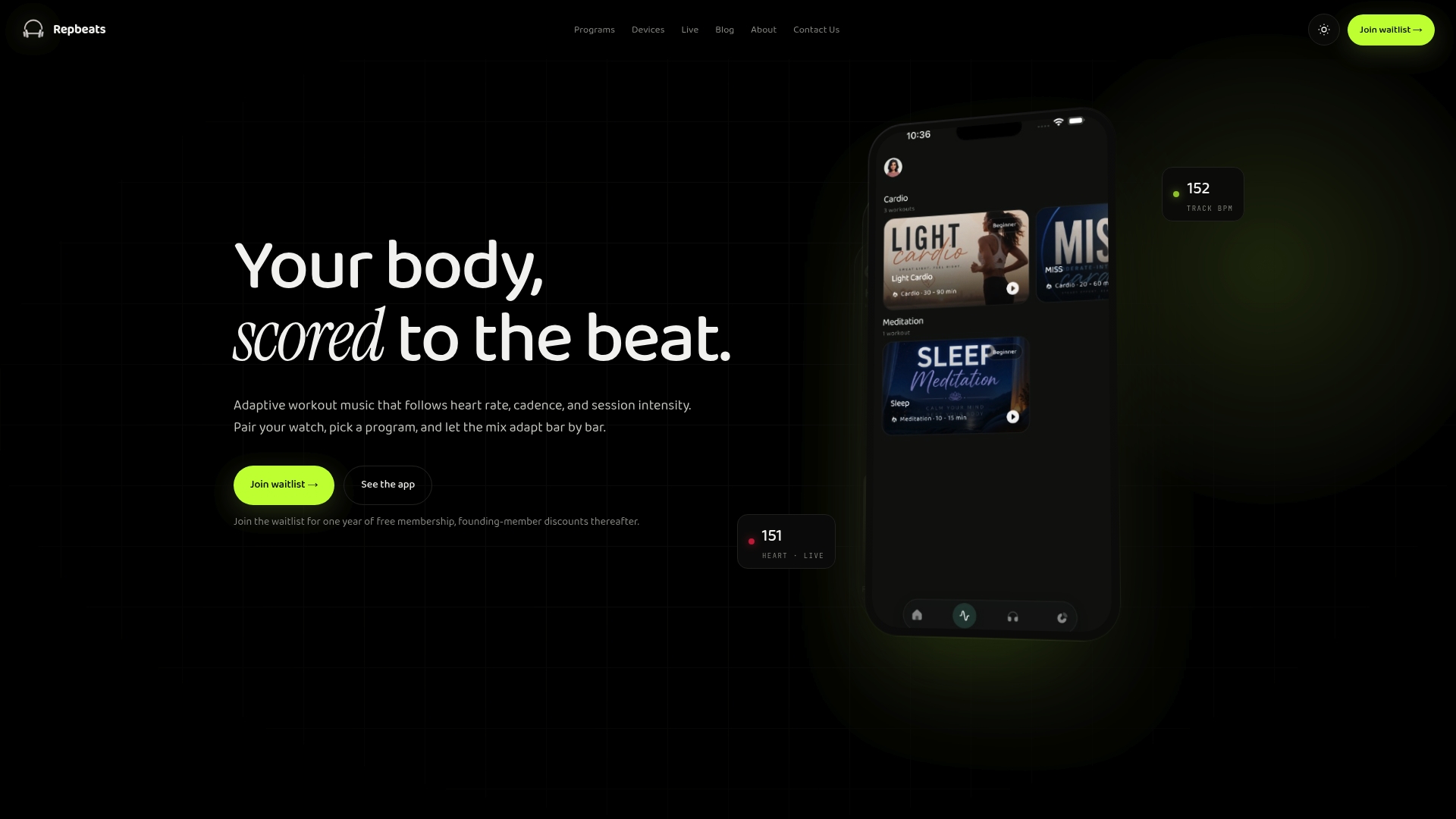
The waitlist launch includes a free year. You can see how the app works on the Repbeats app page or start from repbeats.com.
Our perspective
We built Repbeats around one idea: your music should work as hard as you do, and it should know when to ease off. A playlist is a static object. A workout is not. The moment you slow down on a hill, skip a rep or push past plan, a fixed list is out of step with you.
That is why we update tempo every bar rather than every song, and why we tie it to live heart rate, cadence and session intensity. We think the best schedule is one that starts from the proven structure, a gradual build, a held work phase and a mirrored cooldown, and then adapts to what your body is doing in real time.
Our approach is designed to keep you in your chosen zones with music that supports each phase, whether you are running, cycling or settling into meditation afterward. We would rather you spend your attention on the workout than on the playlist.
Jordan Mills
FAQ
What BPM should my workout music be?
For most steady aerobic exercise, a professional expert statement recommends about 125–140 BPM for healthy exercisers. Running tends to land higher, around 147–169 BPM, and cycling around 135–170 BPM, based on ACE-sponsored research. Warm-up and cooldown music should sit below your working range.
How long should a warm-up playlist be?
Match it to your warm-up, which is commonly five to ten minutes. Use three or four songs that climb in tempo so the last one sits at the bottom of your main work range. The cooldown can mirror that in reverse.
Should lifting music match the beat of my reps?
No. Lifting is not repetitive like running, so you use music to set energy rather than to time movement. Pick driving, percussive tracks for heavy sets and slower ones between sets and for cooldown. Let the movement stay controlled, not paced by the song.
Can I schedule music ahead of a workout in Repbeats?
Yes. Repbeats lets you schedule programs, search the music library and control playback in real time. Its auto-DJ then adapts tempo to your heart rate, cadence and intensity from a connected wearable such as an Apple Watch or Fitbit.
What should I play after a hard workout?
Step down to slower, simpler music. One study found 20 minutes of theta-frequency binaural beats after exercise was associated with greater self-reported relaxation. Instrumental or ambient audio at a slow tempo is a good starting point for stretching or meditation.
Sources
- ACSM: Music that Moves, Building a Playlist that Hits
- The BASES Expert Statement on the Use of Music in Exercise
- Effects of Music in Exercise and Sport: A Meta-Analytic Review
- Effects of listening to music during aerobic exercise (Frontiers in Sports and Active Living)
- The effects of music on cardiorespiratory endurance (PMC)
- ACE-sponsored Research: Exploring the Effects of Music on Exercise Intensity
- Indoor Cycling: 170-180 BPM Playlist
- Auditory driving of the autonomic nervous system (Frontiers in Psychology)
- Yoga music: The guide for the perfect atmosphere