Fixed Cadence Music: What It Is and Why Adaptive Beats It
Jordan MillsOctober 24, 2026 · 11 min read

Fixed Cadence Music: What It Is and Why Adaptive Beats It
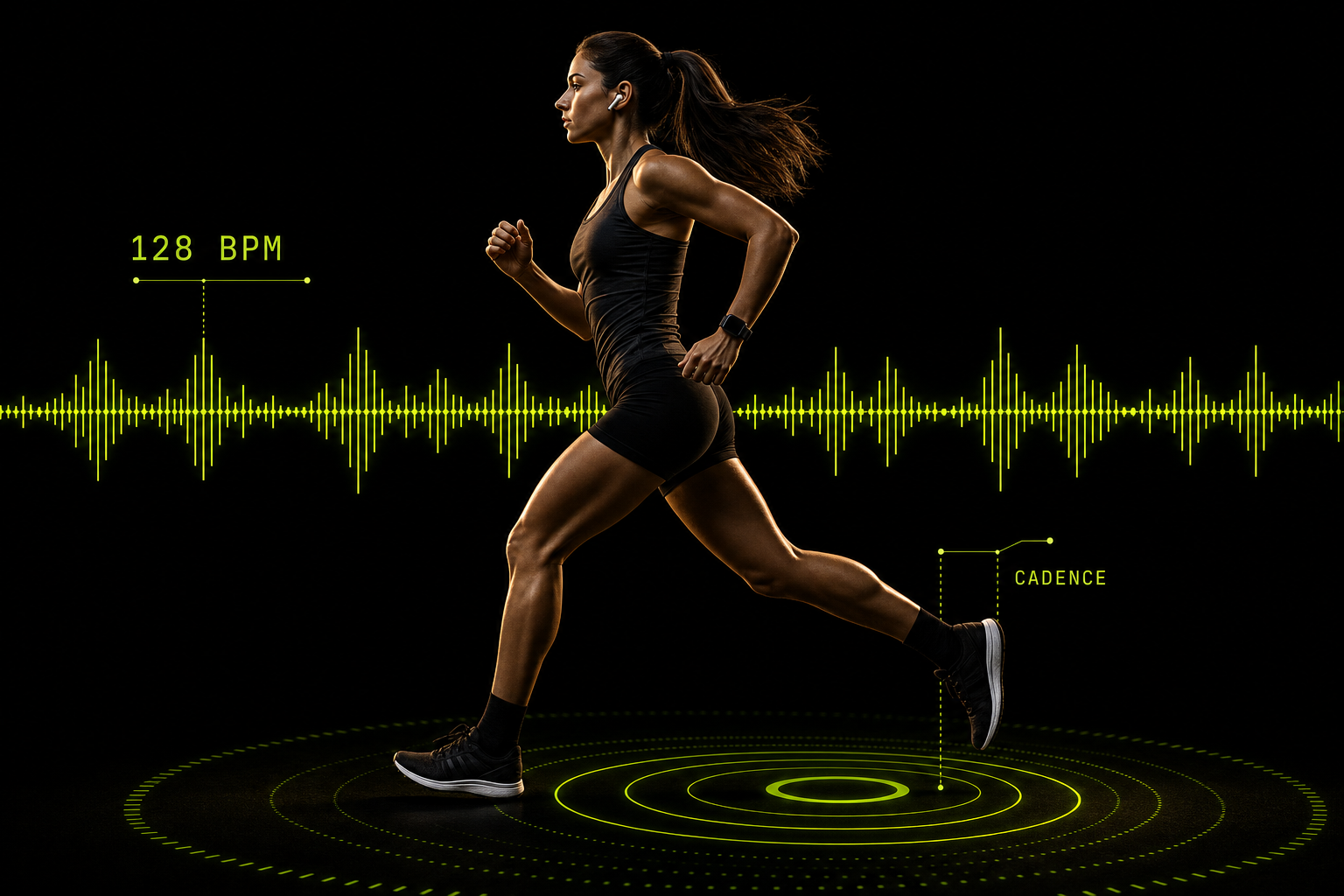
Fixed cadence music is music (or a click) set to one constant tempo, in beats per minute, that you match with your steps or pedal strokes. It works as a pacing cue, and the research says it can change how you move. But a rigid tempo has limits, because your body is not a metronome. This guide covers how fixed tempo works, how to pick a number, where it breaks down, and how adaptive music handles those problems.
A quick note on the word. If you searched “fixed cadence music” and found pages about V–I chord endings, that is the other meaning of cadence: the chords that close a musical phrase. We cover that briefly below, then get to the running and cycling meaning.
TL;DR
- Fixed cadence music is a constant BPM that you match to your steps or pedal strokes. It is a pacing tool, not a playlist trick.
- Research on recreational runners found that a beat 7.5% to 10% above preferred cadence raised cadence by about 8.5%, without raising heart rate or perceived effort.
- A single rigid tempo drifts out of step as you tire, change pace, or hit a hill. Adaptive tempo follows you instead.
- Start with small shifts, a few steps per minute at a time, and use music with a clear, prominent beat.
- Repbeats adjusts music BPM every bar from live heart rate and cadence data on your wearable.
Table of Contents
- Two meanings of cadence, one quick disambiguation
- How fixed cadence music works
- Choosing a fixed tempo you can actually use
- Why the beat has to be easy to hear
- Where a fixed tempo falls short
- Fixed versus adaptive: a side-by-side
- Our perspective: fixed is a starting point
- Setting it up with a wearable
- A four-week way to try it
- Try adaptive tempo with Repbeats
- FAQ
- Sources
Two meanings of cadence, one quick disambiguation
In music theory, a cadence is a chord progression that ends a phrase. Theory courses name four main types: authentic (V–I), plagal (IV–I), deceptive (V–vi) and half (ending on V). Authentic cadences give the strongest sense of closure, and half cadences sound unfinished.
In exercise, cadence means how often your foot strikes the ground or your pedals turn, counted in steps or revolutions per minute. “Fixed cadence music” in this sense means a tempo that stays constant while you move. The rest of this article uses that meaning.
How fixed cadence music works
The mechanism is called auditory-motor synchronization. Your brain tends to lock movement to a clear, repeating sound. Sports scientists describe two separate benefits of music in exercise: motivation, from music you enjoy, and entrainment, from coupling your movement tempo to the beat. Fixed cadence music is mostly about the second one.
If you run at 160 steps per minute and play a 168 BPM track, each beat gives your feet a target. Because the beat is steady, you do not have to count. You just nudge your stride toward it.
What the studies found
Three results are worth knowing:
- Cadence changes. In a 12-week study of recreational runners, a beat 7.5% to 10% above each runner’s preferred cadence led to a cadence increase of roughly 8.5% during the intervention, and about 7.9% of it was retained afterward when running without music.
- Efficiency may improve. In a lab comparison, people exercising in sync with music used less oxygen than when out of sync: 1.80 L/min versus 1.94 L/min.
- Music helps endurance in general. A 2026 systematic review and meta-analysis of 15 studies and 339 active adults linked music to better fixed-duration aerobic performance (SMD = 0.39).
These are controlled studies on specific groups. They show what is possible, not what any one runner will get.
Choosing a fixed tempo you can actually use
There is no universal best BPM. The right number depends on your current cadence, and the safe move is a small step up from it.
- Measure your baseline. Run at an easy, comfortable pace and record your average cadence from a watch or a phone sensor.
- Add a small margin. The studies above used 7.5% to 10% over preferred cadence. Many coaches advise gentler changes. One running retailer’s expert guide warns that raising cadence more than 5% at once can cause fatigue and hurt running economy, and suggests two to six steps per minute at a time.
- Pick the conservative end if you are unsure. A small shift you can hold beats a big one that breaks your form.
- Repeat gradually. Once the new tempo feels automatic, move up another small step.
If you want a worked version of this for runners, our guide on raising cadence with 1–3% tempo shifts goes through the numbers, and the 7-step cadence lock setup shows how to configure it with a wearable.
Example
Say your easy-run cadence is 164 steps per minute. A 3% shift is about 169. A 5% shift is about 172. The 7.5% to 10% range used in the research would be roughly 176 to 180, which is a big jump to ask of your legs in one session. Starting around 166 to 169 and building over several weeks is a more cautious route.

Why the beat has to be easy to hear
Not every song works. Entrainment depends on a salient beat: a clear, percussive pulse. Songs with tempo changes, rubato or busy arrangements give your motor system a muddy signal. This is why gait rehabilitation research often uses music or metronome cues, and why one study found music supported entrainment better than a metronome in people with and without Parkinson’s disease.
Practically, that means:
- Favor tracks with a strong kick or snare on the beat.
- Avoid songs with long breakdowns or tempo drift.
- If a track has a weak pulse, a layered click or high-frequency accent can help anchor your stride.
Phase matters too. Matching BPM is not the whole job. The beat should land close to the moment your foot strikes, or the music feels like it is fighting you.
Where a fixed tempo falls short
Human movement is naturally variable. Your cadence changes with fatigue, terrain, pace and heart rate. A tempo that never moves means one of two things happens: you drift off the beat, or you force yourself to hold it.
Researchers working on biosignal-synchronous music for trail runners built a generative system, HEARTBEATS, that creates music in real time from sensor data. Their study on performance and perceived effort points toward interactive systems rather than static ones, because the world a runner moves through is not static.
Six common problems with a rigid tempo:
- Hills and wind. Cadence naturally drops uphill. A fixed 170 BPM becomes a fight.
- Fatigue. Late in a long run, your preferred cadence slips, and a fixed beat feels too fast.
- Intervals. One tempo cannot serve both a warm-up jog and a hard repeat.
- Cycling. Preferred pedaling rate varies with gear and gradient. In a study of submaximal cycling, participants listened to popular tracks at different tempi, which shows how much the tempo variable matters.
- Walking. Stride shifts with surface and pace, so a single BPM suits only part of a walk.
- Cool-downs and meditation. You want the beat to slow with your heart rate, not hold steady.
There is also an engineering problem. A delay between a wearable’s sensor reading and the sound reaching your earbuds can be enough to push you out of sync, so how a system processes data matters as much as the music.
Fixed versus adaptive: a side-by-side
| Fixed cadence music | Adaptive cadence music | |
|---|---|---|
| Tempo | One constant BPM | Changes continuously with your data |
| Input | Your own choice | Cadence, heart rate, intensity from a sensor |
| Best for | Steady, flat, easy runs and drills | Mixed terrain, intervals, long sessions |
| Risk | Drift or forced form on variable ground | Needs a sensor and a good connection |
| Setup | Pick a BPM, build a playlist | Pair a wearable once |
Fixed tempo is still a good tool. For a short, flat, steady run, a constant beat is simple and works. Adaptive music earns its place when your effort changes.
Our perspective: fixed is a starting point
We built Repbeats because we kept running into the same problem: a playlist at one tempo is right for about five minutes of a real workout. Your heart rate rises, your cadence drifts, and the song stays where it was.

Our view is that the useful idea inside “fixed cadence music” is the lock between beat and body, not the fixedness. So Repbeats uses auto-DJ technology that updates the music’s BPM every bar, using live data from wearables such as Apple Watch and Fitbit. The tempo follows your cadence, heart rate and session intensity, so the music keeps supporting you through each phase of a session, whether that is running, cycling or meditation.
We also think the shifts should be small. The research and the coaching advice agree that big jumps can backfire, so smooth, gradual movement of the beat is the goal. And on privacy: our policy limits device access to workout data only.
— Jordan Mills
Setting it up with a wearable
Whether you go fixed or adaptive, your data source decides how good the result is. A few practical points:
- Use a chest strap or a recent watch for heart rate. Wrist sensors are fine for steady efforts but can lag during sudden changes. Our explainer on how wearables measure exercise intensity covers what each signal tells you.
- Keep the connection tidy. If your cadence data comes from a Garmin, syncing Garmin Connect properly keeps your activity data flowing where you need it.
- Go phone-free if you like. Our guide to running music without a phone explains cadence and heart rate sync on a watch.
- Pair once, then test. Our walkthrough on connecting wearables to music shows the steps. Do a short test run before a key workout.
Other situations have their own pages: treadmill running music and walking cadence music. If a plain click is what you want, we compared options in our piece on running metronome apps.
A four-week way to try it
Here is a simple progression you can use with either a fixed playlist or adaptive music:
- Week 1: Run easy with your normal cadence. Record averages. No changes.
- Week 2: Use music about 2% to 3% above your baseline on easy runs only.
- Week 3: Hold that tempo on easy runs and add one slightly higher run if form feels relaxed.
- Week 4: Run one session without music and check whether your cadence held.
Stop increasing if you feel new pain, especially in the shins, knees or feet. If pain persists, see a physician or a physical therapist who works with runners. Our 4-week cadence plan lays out the same idea with heart rate in the mix, and the thinking behind it is in our post on AI workout music that syncs to heart rate.
Try adaptive tempo with Repbeats
If you want the benefits of a beat that locks to your stride without managing BPM by hand, Repbeats is built for it. It syncs music tempo to your heart rate, cadence and session intensity, offers cardio and meditation programs, lets you control playback and search the music library in real time, and supports scheduling programs. The waitlist launch includes a free year. You can see more on the Repbeats home page.
FAQ
What is fixed cadence music?
It is music or a click at one constant tempo that you match with your steps or pedal strokes. It acts as a pacing cue. It is different from adaptive music, which changes tempo as your cadence or heart rate changes.
What BPM should I use for running?
Start from your own easy-run cadence, not a generic number. Studies used beats 7.5% to 10% above preferred cadence, while coaching guidance advises small steps of two to six steps per minute. A small increase you can hold is the safer start.
Does music at your cadence make running easier?
Sometimes. Exercising in sync with music was linked to lower oxygen use in one lab study, and the cadence-rate study found no rise in heart rate or perceived exertion while cadence went up. Results vary by person and setting.
Can a fixed tempo hurt my form?
It can if you force yourself to hold a beat that does not suit your stride, for example uphill or when tired. Researchers studying interactive music systems point to tempo that responds to the runner as the better approach. If a tempo feels strained, lower it.
Is fixed cadence music the same as a metronome?
Not quite. A metronome gives a bare click, while music adds motivation and enjoyment on top of the beat. Music with a clear, prominent pulse can give you both effects.
Sources
- Using beat frequency in music to adjust running cadence in recreational runners
- Effect of music-movement synchrony on exercise oxygen consumption
- Effects of listening to music during aerobic exercise: systematic review and meta-analysis (Frontiers, 2026)
- Cadences, Music Theory for the 21st-Century Classroom
- The Power of Auditory-Motor Synchronization in Sports
- Music and Metronomes Differentially Impact Motor Timing
- Performance and Perceived Effort in Trail Runners Using Biosynchronous Music
- Effects of music tempo upon submaximal cycling performance
- Running and Music: Finding your BPM